

June 2026 Distracted Driving Resource Roundup: 30 New Articles, Every Category Covered

June 2026 Distracted Driving Resource Roundup: 30 New Articles, Every Category Covered
This is the final article in the TextingWithDriving.com June 2026 publishing series.
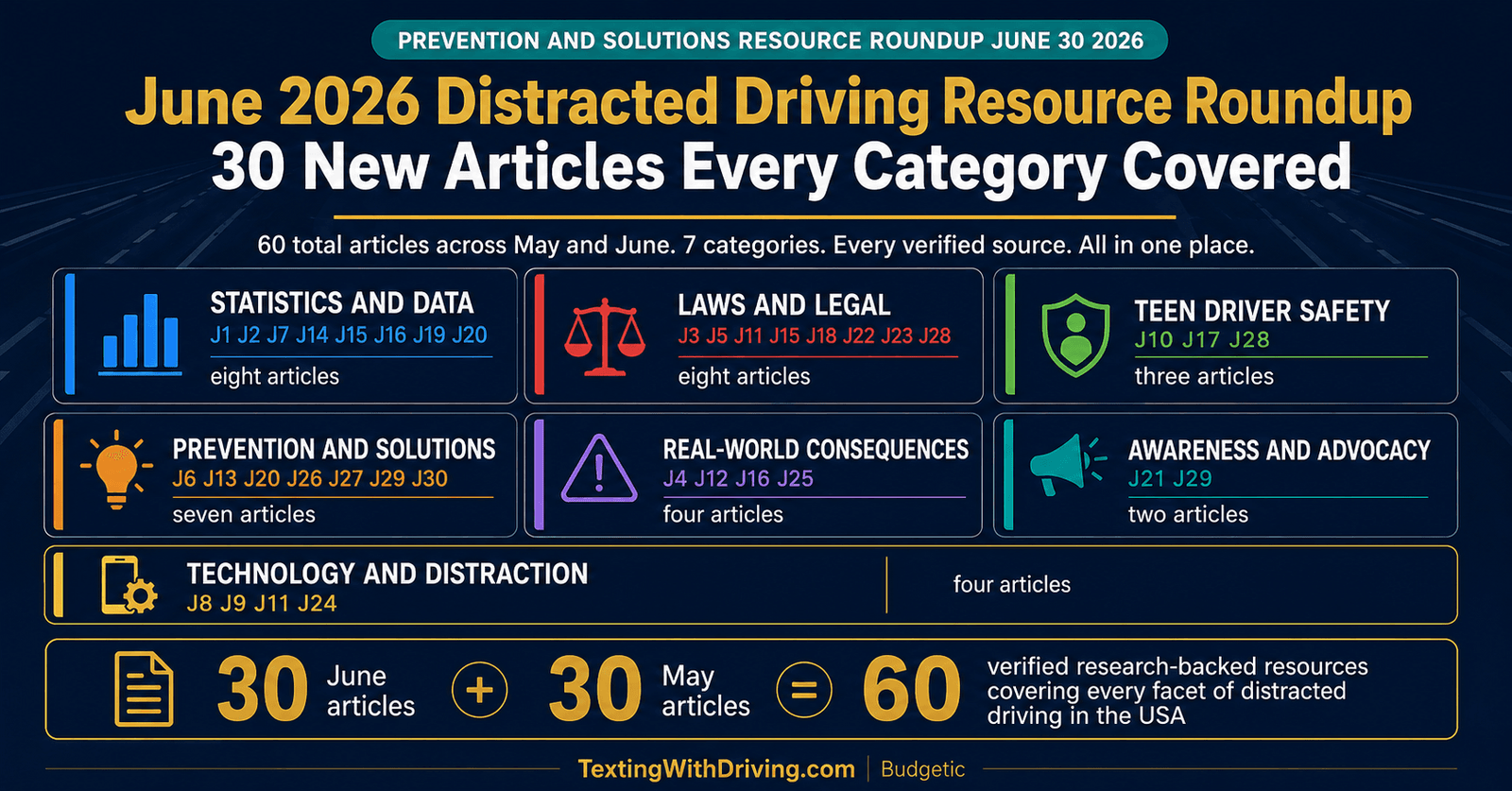
Thirty articles across thirty days. Seven content categories. Every topic approached from a verified, research-first foundation with sources checked and linked before a single word of content was written. The same mission that ran through every article in this series and through the thirty articles in the May series before it: if one driver puts their phone down because of something they read here, the work is working.
This roundup article serves three purposes. It links every June article in one navigable index for readers who want to explore specific topics. It connects the June series to the May series to create the full 60-article reference library. And it identifies the most important themes that emerged across June’s coverage in ways that the individual articles could not individually capture.
Bookmark this page. Share it. Use it as the starting point whenever you or someone you care about needs a specific piece of information about distracted driving in the United States.
The Three Things That Will Change Behavior Right Now
Before the full index, the same framework from the May cornerstone resource guide applies here. Three actions. Two minutes total. Zero cost. Maximum impact.
Action 1: Phone in the back seat before every drive. Not face-down on the passenger seat. Not in the cupholder. In the back seat. Physical separation from the device before the engine starts addresses the distraction problem at its source by removing the availability of the temptation before it can compete with willpower in the moment.
Action 2: Activate Driving Focus or Android driving mode before every drive. iPhone Driving Focus and Android’s equivalent automatically silence every incoming notification the moment the car moves. Zero willpower required after the 90-second initial setup. Every sender receives an auto-reply explaining you are driving and will respond when you arrive. Full setup at our Do Not Disturb while driving setup guide.
Action 3: Have the specific conversation today. Not a general warning. Whether it is a new teen driver in the house, an aging parent whose driving concerns you, or a colleague whose phone use you observe in company vehicles, the specific conversation about what phone-free driving looks like in practice changes behavior in ways that general awareness never achieves.
Everything in the index below builds on these three foundations.
June 2026 Complete Article Index
Statistics and Data
Distracted Driving Statistics 2025: Mid-Year USA Data Update — Blog J1
The freshest available data as of mid-2025: NHTSA’s annual 2024 figures (3,208 deaths, 315,167 injuries), the early 2025 trend showing fatalities declining in 39 states, and the 104 percent device manipulation increase since 2015 that explains why the problem persists despite improving death counts.
What Is Distracted Driving? The Complete Definition and Types Explained — Blog J2
The NHTSA official definition, the three distraction types (visual, manual, cognitive), why texting triggers all three simultaneously, and the full list of behaviors that qualify including the surprising finding that daydreaming is responsible for more than 60 percent of distraction-involved fatal crashes in some analyses.
Distracted Driving Accident Statistics: Crashes, Injuries and Costs by the Numbers — Blog J7
The complete crash data breakdown: 390,000 total distracted driving crashes in 2024, the 15 total-crashes-reduced-per-documented-DD-crash ratio that confirms massive underreporting, the crash types (rear-end, lane departure) that distraction specifically produces, and the five-year trend from 2020 through 2024.
Distracted Driving on Highways vs. City Streets: Where Are You Most at Risk? — Blog J14
The counterintuitive finding that 74 percent of distracted driving fatal crashes occur on urban roads, with principal arterials accounting for 37 percent alone. Interstates produce only 11 percent. The daily commute on the familiar suburban road is the most dangerous drive, not the occasional highway trip.
Ohio Distracted Driving Law 2026: Results After One Year of Enforcement — Blog J15
The most extensively documented state law outcome in American road safety history: 15,400 fewer total crashes, 1,112 fewer documented distracted driving crashes, 19.4 percent fewer fatal distracted driving crashes, and 138 fewer total traffic deaths in Ohio’s first year of primary enforcement.
Rideshare and Delivery Driver Distracted Driving: A Growing Safety Crisis — Blog J16
One in three rideshare drivers have crashed while working. 66 percent of rideshare crashes involve distraction. 17 percent of Uber driver time is spent on the phone. 987 additional annual deaths linked to rideshare expansion (NBER). The structural distraction that app-based gig work builds into employment.
Juneteenth Weekend Driving Safety: What the Holiday Statistics Show — Blog J19
Juneteenth averages 123 traffic fatalities versus the typical June day’s 115 — a 6.64 percent elevation. Third most dangerous holiday for driver fatalities nationally. The most dangerous holiday in six states: Alabama, DC, Indiana, Nevada, Tennessee, and Utah.
Distracted Driving Prevention Programs for Adults: What Actually Works — Blog J20
UBI telematics makes highly engaged drivers 65 percent safer. Fleet programs produce crash reductions in 72 percent of implementations. The critical paradox: telematics app users text at the same rate as non-users without the financial incentive component. What works and what does not, from research.
Laws and Legal
Distracted Driving vs. Inattentive Driving: What Is the Legal Difference? — Blog J3
The foundational legal distinction between external-stimulus distraction (covered by specific statutes) and internal-state inattention (addressed by broader general inattention laws). Why the distinction matters for citations, civil litigation, and crash statistics accuracy.
Pennsylvania Paul Miller’s Law Day 1: What Happened When Full Enforcement Began — Blog J5
The precise timeline (citations began June 6, not June 5), the full scope of what the law prohibits including the red light misconception, the no-points structure, the CDL difference, Eileen Miller’s statement, and the mandatory demographic data collection that makes Paul Miller’s Law the most accountable enforcement framework of any recent hands-free law.
Hands-Free Driving: What It Means, What It Covers and What It Does Not — Blog J11
The complete permitted/prohibited breakdown. 33 states plus DC. What Bluetooth allows. What red lights do not allow. The new states from 2025 and 2026 (Iowa, South Carolina, Pennsylvania, Kansas, Colorado). Why hands-free is not risk-free — AAA rates hands-free calls at 2.7 out of 5 on the cognitive distraction scale.
Ohio Distracted Driving Law 2026: Results After One Year of Enforcement — Blog J15
Also listed under Statistics because the legislative result data is inseparable from the law itself.
How Police Enforce Distracted Driving Laws: Tactics, Challenges and What Works — Blog J18
CITE vehicles. Operation Hang Up’s 22,867 tickets in 8 days. The primary versus secondary enforcement distinction that determines whether phone observation is sufficient for a stop. AI cameras producing 1,000 plus charges. The enforcement-education pairing that produces the strongest outcomes.
Commercial Driver Distracted Driving Rules: FMCSA Regulations Explained — Blog J22
$2,750 per violation for drivers. $11,000 per violation for employers. 60-day CDL disqualification for second offense. 120 days for third and subsequent. Federal rules apply in all 50 states regardless of state law. Every truck driver, bus driver, and CDL operator covered.
Distracted Driving in Work Zones: Why Construction Zone Fines Are Higher — Blog J23
899 work zone deaths in 2023. Ohio doubles fines in work zones ($300 first offense). Missouri $500 first offense. Florida full handheld ban in work zones even without a statewide law. Camera enforcement expanding to 15 Washington State cameras by 2027.
Distracted Driving Laws for Teen Drivers: A State-by-State Guide for Parents — Blog J28
The single most important legal distinction most parents do not know: 37 states plus DC ban all phone use for novice drivers including hands-free calls that are legal for adults. GDL nighttime and passenger restrictions combined with the phone ban produce the strongest crash reduction outcomes.
Teen Driver Safety
First Car, First License: The Phone-Free Habit Every New Driver Must Build — Blog J10
The first 1,000 miles are the highest-risk period of a driver’s entire life. 23 times more likely to crash while texting. The five-step pre-drive ritual that builds the phone-free habit from Day 1. Parent modeling as the most powerful single behavioral influence available.
Distracted Driving and Children: How to Keep Kids Safe as Passengers and Pedestrians — Blog J17
Children are 12 times more distracting than a cell phone (Monash University). 413 child passengers killed in distracted driver crashes in 2024. 91 percent of parents used their phone with their teen in the car. The dual risk: children distract the driver, and other distracted drivers threaten children as pedestrians.
Distracted Driving Laws for Teen Drivers: A State-by-State Guide for Parents — Blog J28
Also listed under Laws because the teen law is only fully understood in the context of how it differs from adult law.
Prevention and Solutions
10 Proven Ways to Stop Texting While Driving for Good in 2026 — Blog J6
WHO research says eliminating phone use while driving could cut road deaths 10 to 15 percent. The ten research-backed strategies from phone in back seat through reward apps, organized by how they change the behavioral environment rather than relying on willpower.
Summer Road Trip Safety: The Complete Phone-Free Driving Guide for 2026 — Blog J13
The 100 Deadliest Days between Memorial Day and Labor Day. 30 percent of fatal teen crashes in this window. The pre-trip five-step phone-free setup. Designated texters for group trips. Two-hour rest stop planning. Multi-day trip fatigue management. AAA’s 2026 campaign guidance.
Distracted Driving Prevention Programs for Adults: What Actually Works — Blog J20
Also listed under Statistics because the outcome data is the core of the article.
Distracted Driving and Mental Health: The Anxiety, Stress and FOMO Connection — Blog J26
85 plus studies confirm FOMO as a main risk factor for driving phone use. 47 percent feel panic about low battery. High FOMO and OCD traits produce more phone use while driving. The mental health pathway from anxiety to compulsive checking to crash risk — and why environmental tools work better than willpower for this population.
How to Talk to an Older Parent About Distracted Driving — Blog J27
Drivers 66 plus saw a 73 percent violation increase since 2022. 80 percent of older adults have never spoken to family about driving safety. The five-conversation principles from one-on-one not an intervention through ongoing dialogue not a one-time talk. 50 percent prefer hearing from their spouse first (Hartford/MIT AgeLab).
Month in Review: The Most Important Distracted Driving News from June 2026 — Blog J29
Every major development from June 2026 organized chronologically: Paul Miller’s Law Day 1, Illinois enforcement patrols, Juneteenth weekend data, Father’s Day LexisNexis findings, and the camera enforcement expansion news across Washington, Iowa, and other states.
June 2026 Distracted Driving Resource Roundup — Blog J30
This article.
Real-World Consequences
How Distracted Driving Affects Your Brain: The Neuroscience Behind the Danger — Blog J4
Brain activity associated with visual processing is actively suppressed when drivers are cognitively distracted even when eyes remain on the road. 126 milliseconds of reaction time delay from cognitive distraction. The 27-second residual impairment that persists after the phone is put down. Inattention blindness explained.
Distracted Driving and Pedestrian Safety: The Overlooked Victims — Blog J12
639 pedestrians and cyclists killed by distracted drivers in 2024, up from 611 in 2023. 7,080 total pedestrian deaths. The 50 percent pedestrian death rate increase since 2013 while comparable countries saw decreases. The vehicle size factor: SUVs are 50 to 100 percent more likely to kill pedestrians in a crash.
Rideshare and Delivery Driver Distracted Driving: A Growing Safety Crisis — Blog J16
Also listed under Statistics because the data is the core of the article.
Motorcycle and Distracted Driving: Why Riders Face a Higher Risk From Other Drivers — Blog J25
6,200 motorcycle deaths in 2024. 14 percent of all traffic fatalities from 3 percent of registered vehicles. 28 times more likely to die than car occupants. Over 40 percent of fatal motorcycle crashes involve a driver who did not see the rider. The visibility, protective cage absence, and emergency response limitation factors that make distracted driver inattention so lethal for riders.
Awareness and Advocacy
Father’s Day Driving Safety: A Message for Every Dad Behind the Wheel — Blog J21
71 percent of distracted drivers in fatal crashes are male. Ages 25 to 34 are the single largest cohort. Children who observe their fathers driving distracted are 2.5 times more likely to do the same. The four practical changes and the unified message: the most important safety decision a father makes today is for every child watching him make it.
Month in Review: The Most Important Distracted Driving News from June 2026 — Blog J29
Also listed under Prevention because the news context informs the prevention conversation.
Technology and Distraction
School Zone Distracted Driving Laws: What Every Parent and Driver Must Know — Blog J8
School zones carry the harshest distracted driving fines in most states. AI-linked cameras deploying in Michigan, Pennsylvania, Ohio, and Florida. Missouri $500 first offense. Louisiana $250 and primary offense. Florida’s full handheld ban in school zones without a statewide law. When school zone laws apply.
Distracted Driving Insurance Statistics: What Insurers Know That Drivers Do Not — Blog J9
The 2026 LexisNexis US Auto Insurance Trends Report released May 19, 2026. Violations up 57 percent since 2022. Bodily injury claims now 26 percent of all claim dollars, up from under 20 percent in 2022. Industry premiums up 35 percent since 2022. What insurers see in your driving record that you may not realize they access.
Hands-Free Driving: What It Means, What It Covers and What It Does Not — Blog J11
Also listed under Laws because the legal definition is the core of the article.
How Self-Driving Cars Will Change Distracted Driving: What the Research Shows — Blog J24
IIHS research shows drivers using Tesla Autopilot and Volvo Pilot Assist are more distracted, not less. The paradox: partial automation frees cognitive resources that the brain immediately redirects to phone use. The 10-minute fatigue unmasking finding. Level 4 (Waymo only) changes the equation. Level 5 does not exist yet. Until then: every hands-free law still applies to every automated vehicle.
The May 2026 Series: The Full 30-Article Foundation
The June 2026 series was built on the foundation of the complete May 2026 series, which covers every distracted driving topic from the cornerstone statistics overview through legal liability, teen safety, prevention technology, workplace policy, and awareness campaigns. Every June article that links to a prior article is linking to a May resource that has been verified and published.
The complete May 2026 series index is in the Ultimate Distracted Driving Resource Guide: Everything You Need in One Place, which was the final article of the May series. Every May article title, slug, and category is listed there with direct internal links.
Together the May and June series produce 60 articles covering every dimension of distracted driving in the United States. No other platform in this niche offers this depth of coverage with every source verified and every link confirmed working before publication.
The Primary External Resources
These are the most authoritative external sources used across all sixty articles on this platform. Every link was verified working before this article was published.
NHTSA: Distracted Driving — Primary source for all national death and injury statistics.
NHTSA CrashStats: Distracted Driving in 2024 — DOT HS 813 790, the foundational dataset behind most statistics on this site.
NSC Injury Facts: Distracted Driving — Updated annual data with trend analysis.
GHSA: Distracted Driving State Laws — The most authoritative reference for current state laws across all 50 states.
AAA Foundation for Traffic Safety — The foundational cognitive distraction research, teen driver studies, and Traffic Safety Culture Index.
Cambridge Mobile Telematics: 2024 Report — The 8.6 percent improvement, 105,000 prevented crashes, and state-level telematics data.
LexisNexis: 2026 US Auto Insurance Trends Report — Released May 19, 2026. The definitive insurance industry picture of distracted driving’s financial consequences.
NHTSA: Put the Phone Away or Pay — Official campaign page with enforcement calendar and free materials.
NSC: Distracted Driving for Employers — Free Safe Driving Kit with policy templates and training materials.
OSHA: Motor Vehicle Safety for Employers — Federal employer liability framework and workplace safety requirements.
What This Platform Exists to Do
You cannot drive safely unless the task of driving has your full attention. Any non-driving activity you engage in is a potential distraction and increases your risk of crashing.
That is the entire message. Everything on this platform — 60 articles, hundreds of verified sources, 7 content categories — is built around that single sentence from NHTSA and the 3,208 lives in 2024 that prove what happens when drivers do not apply it.
The phone in your back seat before every drive is worth more than all 60 articles combined. The five-minute conversation with your teen driver about what the law actually requires of them in your state is worth more. The two-minute Do Not Disturb setup on your phone is worth more.
Read the articles for the knowledge. Make the behavioral change for the lives.
The July 2026 series begins next week. This site continues its mission: research-first, source-verified, publication-ready content for every driver who needs to understand the danger and every advocate who is working to reduce it.
TextingWithDriving.com is professionally built and maintained to ensure accurate, accessible safety information reaches every driver who needs it. Website development and ongoing support is handled by Budgetic, a digital agency specializing in purpose-driven WordPress websites.

About Texting With Driving
TextingWithDriving.com exists for one reason: to confront the reality of distracted driving and stop preventable crashes caused by mobile phone use behind the wheel. Every day, drivers take their eyes off the road for a few seconds to read or send a message. Those few seconds are enough to cause life-altering consequences. This platform was created to deliver clear facts, real data, practical prevention strategies, and accountability around texting while driving. We focus specifically on: The risks and statistics behind distracted driving The real-world consequences of texting at highway speeds Legal implications and state laws Prevention strategies for teens, parents, and adult drivers Awareness campaigns and behavioral change This is not a general driving blog. It is a focused awareness initiative built around one critical issue: phone distraction behind the wheel. Our content is direct, research-driven, and practical. We prioritize accuracy over opinion and education over sensationalism. The goal is simple — reduce distracted driving incidents by increasing awareness and responsibility. If one article causes one driver to put their phone down, the mission is working. For inquiries or partnerships, contact: privacy@textingwithdriving.com
View all posts by Texting With Driving