

First Car, First License: The Phone-Free Habit Every New Driver Must Build

First Car, First License: The Phone-Free Habit Every New Driver Must Build
Every June, hundreds of thousands of American teenagers receive something that changes everything: a driver’s license and the keys to a car that is now, for the first time, entirely theirs to operate without a parent sitting next to them.
This is one of the most significant moments of adolescent development in American life. It represents freedom, independence, and a level of personal responsibility that few milestones before it have demanded. It is also one of the most dangerous transitions any person makes, statistically speaking, and the habits formed in the first weeks of independent driving shape how a driver will handle their phone behind the wheel for years or decades to come.
This article is for new drivers, for parents of new drivers, and for anyone who knows a teenager who just got their license this graduation season. It is specifically about one habit: phone-free driving. Not because it is the only safety consideration for new drivers, but because it is the one that is most urgently needed, most frequently skipped in driving education, and most consequential in the period when new drivers are at their absolute highest crash risk.
Why the First 1,000 Miles Are Different From Every Mile After That
The most dangerous period of a driver’s entire driving life is not their first attempt at parking or their first experience of rain. It is the first six months of independent licensed driving.
Motor vehicle crash rates are highest among novice teen drivers, especially during the first six months and 1,000 miles of independent licensed driving. WWBT
The mechanism behind this concentrated risk is the absence of automaticity. Experienced drivers handle the fundamental tasks of driving, maintaining lane position, monitoring mirrors, judging following distance, responding to intersections, largely through automated neural routines built by thousands of hours of practice. These routines run in the background, freeing up cognitive capacity for hazard response and decision-making.
New drivers do not have these routines. Every aspect of driving that an experienced driver handles automatically requires conscious attention from a new driver. Lane position. Speed management. Mirror checks. Turning radius. Gap selection at intersections. All of it competes for the same limited cognitive bandwidth.
Talking or texting on the phone takes your teen’s focus off the task of driving and significantly reduces their ability to react to a roadway hazard, incident, or inclement weather. Ridester
When a new driver’s limited cognitive bandwidth is already fully consumed by the mechanics of driving, the arrival of a phone notification does not simply add a small additional distraction on top of a well-managed system. It creates direct competition for the cognitive resources that are already stretched thin. The result is not a degraded version of safe driving. It is a complete breakdown of the attention management that keeps the vehicle safe.
This is why a new driver’s vulnerability to distraction is categorically higher than an experienced driver’s vulnerability to the same stimulus. The experienced driver draws from a reserve of automatic capacity. The new driver has no reserve.
The 23-Times More Likely to Crash Statistic
Research has found that dialing a phone number while driving increases a teen’s risk of crashing by six times, and texting while driving increases the risk by 23 times. Ridester
23 times more likely to crash while texting. Not 23 percent more likely. 23 times. For a new driver who is already operating in the highest-crash-risk period of their entire driving life, this multiplier lands on top of an already elevated baseline risk.
The 2024 NHTSA data confirms the stakes. In 2024, a total of 2,320 people were killed in traffic crashes that involved a teen aged 15 to 18 driver, and 752 of those killed were the teen driver themselves. Of the 2,320 people killed in crashes involving a teen driver, 478 were passengers of that teen driver, with 280 of those, or 59 percent, being other teens riding with a teen driver. In 2024 there were 85,947 teen drivers injured in traffic crashes.
752 teen drivers killed. 85,947 injured. These are the outcomes that distracted driving prevention in new drivers is working to prevent, one habitual phone placement decision at a time.
Why Habits Formed Now Last for Decades
Here is the most compelling behavioral science argument for focusing on phone-free driving from the very first drive rather than waiting until driving becomes more comfortable.
Habits are formed most easily when a behavior is new and its associated neural patterns have not yet been established. A new driver who places their phone in the back seat every time they get in the car is building that behavior into the neural routine that constitutes their driving habit from the ground up. The phone placement becomes part of the pre-drive sequence as naturally and automatically as putting on the seat belt.
A driver who begins driving with the phone in the cupholder and develops the habit of checking it at red lights is building a different neural routine from the ground up. That routine is significantly harder to change after months or years of reinforcement than it would have been to not establish in the first place.
The behavioral research on habit formation consistently shows that the formation window for new behaviors is widest when the context is novel. New drivers are forming driving habits from scratch. The habits that will govern their phone use at 25, 35, and 45 years old are being shaped right now, in the first months of independent driving.
This is not a metaphor or an approximation. Neural pathway formation is a physical process. The routes that become automatic are the ones that are traveled repeatedly. A new driver who travels the phone-in-back-seat route 500 times in their first year of driving is building a neural pathway that will make that behavior automatic for life. A new driver who travels the phone-in-cupholder route 500 times is building an equally durable but far more dangerous alternative.
What New Drivers Need to Know About the Law
The graduation season of 2026 produces new drivers who are beginning their independent driving lives in the most extensively regulated phone use environment in American history.
As of June 2026, 33 states plus DC have primary enforcement hands-free laws, meaning police can stop a driver solely for holding a phone. Distracted driving is a primary offense in Pennsylvania as of June 6, 2026, the exact day many new Pennsylvania drivers will be celebrating their first solo drives. Louisiana, Missouri, Iowa, and dozens of other states have enacted similar laws in the past two years.
And for new drivers specifically, most states apply even stricter rules. Thirty-six states and DC ban all cell phone use by novice drivers, not just texting or holding. In these states, a new driver cannot use their phone for any purpose while driving, including hands-free calls, for the duration of their graduated driver licensing period.
AAA recommends that during at least the first six months of provisional licensure, new drivers carry no more than one non-family passenger under age 20. GDL systems reduce the number of teen crashes according to multiple studies. Facebook
The GDL provisions in most states are designed specifically to protect new drivers during the first 1,000 miles of elevated risk by limiting the situations they encounter during that period. Passenger restrictions limit social distraction. Nighttime restrictions limit the combined risk of darkness and fatigue. And cell phone prohibitions, where they exist in state law, directly address the distraction risk this article is focused on.
For a complete picture of what the laws require for new drivers specifically in every state, our hands-free driving laws by state 2026 guide covers all 50 states including novice driver provisions.
The Pre-Drive Phone-Free Ritual: Build It From Day One
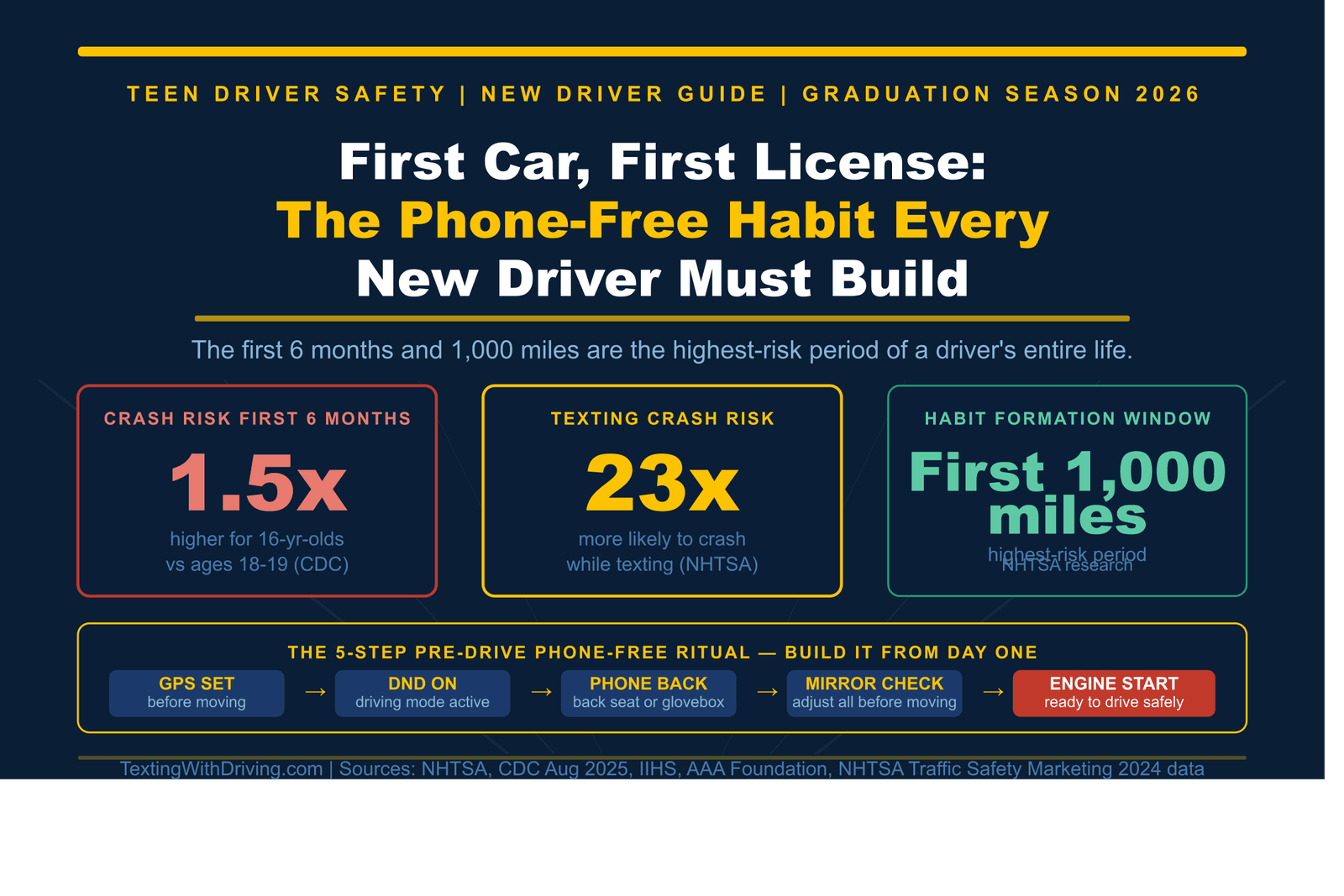
The five-step pre-drive ritual in the featured image of this article is not a checklist to be read before each drive. It is a behavioral sequence to be practiced until it is automatic, in the same way that checking mirrors before reversing becomes automatic through repetition.
Here is why each step matters and how to practice it.
Step 1: GPS set before moving. Enter your destination before the car starts moving. This removes the temptation and the law violation of touching a phone screen while operating a vehicle on a public road. On iPhone, use Siri to set navigation by voice while the car is still stationary: “Hey Siri, navigate to 123 Main Street.” On Android, use Google Assistant the same way. The navigation is active and providing audio directions before the car moves, requiring no further interaction.
Step 2: Do Not Disturb mode active. iPhone Driving Focus silences every notification automatically the moment the car starts moving. Android’s equivalent does the same. This is a two-minute one-time setup that makes every subsequent drive automatically notification-free. The full setup guide is in our Do Not Disturb while driving article. For new drivers, activate this on the day the license arrives, not eventually.
Step 3: Phone in back seat. Before the engine starts, the phone goes in the back seat or glove box. Not face-down on the passenger seat. Not in the cupholder. Out of reach. The physical separation means that when a notification arrives, which the driving mode will prevent anyway, the phone cannot be reached without a deliberate decision to stop the car and retrieve it. That deliberateness is what willpower alone cannot consistently provide.
Step 4: Mirror and seat position check. Adjust all mirrors and the seat before the car starts moving. This is standard driving education content, but it serves a specific function in the phone-free ritual: it completes the pre-drive setup sequence in a way that replaces the phone check as the last thing done before driving. The new driver who checks mirrors last has completed a safety-oriented sequence. The new driver who checks their phone last has created the exact habitual sequence that unsafe driving looks like.
Step 5: Start the engine. The drive begins. Everything is handled. Navigation is running. Notifications are silenced. Phone is out of reach. Mirrors are set. The new driver’s full attention is available for the only task that requires it.
Practice this sequence every time. Without exception. In the first hundred times it is a deliberate checklist. In the first thousand times it becomes a habit. After that it is automatic.
The Parent Conversation That Makes This Stick
Research from the University of Michigan Transportation Research Institute found that teens are 2.5 times more likely to engage in distracted driving behaviors if they frequently observe their parents doing it. And data from SADD and Liberty Mutual found that 14 percent more teens text while driving when they have observed their parents doing the same.
For parents who are handing over keys this graduation season, the most important thing is not the conversation about the rules. It is the behavior the teen has observed in the family vehicle for the past decade.
Before the first solo drive happens, two things should occur. First, the parent should establish the five-step ritual together with the new driver, practicing it in the driveway before the car moves. Not explaining it. Practicing it. Both putting phones in back seats, both setting GPS by voice, both activating driving modes. The shared ritual is the modeling event that makes the behavior natural rather than imposed.
Second, the parent should commit visibly to the same standard going forward. Not “I can do it because I have more experience.” The same standard. Phone in back seat. Driving mode on. Every time. In front of the teen driver who is forming their habits now.
The full research-backed framework for this conversation, including what to say when the teen pushes back and how to structure specific pre-drive commitments, is in our parent’s guide to talking to your teen about phone use while driving.
Technology Tools That Make This Automatic
For new drivers, the phone-free ritual above handles the pre-drive behavioral setup. Several technology tools reinforce the safety during the drive itself.
The built-in driving modes on iPhone and Android are free, require one setup, and run automatically. For new drivers who also want parental oversight during the high-risk first months, monitoring apps add an accountability layer.
Apps like LifeSaver and Canary allow parents to see whether their new driver’s phone was active during trips and receive real-time alerts if the app is disabled. This is not surveillance for its own sake. It is the accountability structure that research shows is particularly effective for new drivers during the first-year period when habits are forming and the social and neurological pressures to use the phone are highest.
The You-in-the-Driver-Seat app scores teen driving habits including phone use and rewards improvement with gift cards and badges, using the positive incentive model that behavioral research supports as particularly effective for young drivers. The gamified approach turns phone-free driving into something the teen does for their own benefit, not just as a rule imposed from outside.
We covered all of these tools and more in our complete guide to the best apps to block texting while driving.
What AAA Recommends for the First Year
The AAA PROMise program was developed to help teenage drivers and their passengers stay safe on roadways during prom and graduation season. The AAA PROMise encourages young drivers and their parents to talk about the dangers of impaired or distracted driving. AAA recommends conducting at least 50 hours of supervised practice driving, passenger limits of no more than one non-family passenger under age 20 for at least the first six months of provisional licensure, and making safe driving a priority from the first day behind the wheel. Facebook
AAA’s guidance on the first year of driving establishes the framework within which the phone-free habit operates. Fifty supervised practice hours before independent driving. Passenger restrictions. Nighttime restrictions. And explicit conversations about distracted driving that are grounded in what the behavioral research actually supports rather than fear-based shock messaging.
Crash risk is about 1.5 times higher for 16-year-old drivers than for drivers aged 18 to 19 according to the CDC. The two-year gap between 16 and 18 represents a significant reduction in crash risk as experience accumulates. The phone-free habit does not accelerate the accumulation of experience. But it does remove one of the largest risk multipliers from the equation during the period when experience is thinnest.
The Simple Framing That Works
Here is the framing that makes this whole conversation easier for both parents and new drivers.
The phone-free habit is not a restriction. It is a feature. It is the thing that the 32 percent of drivers who never text while driving have, and the 68 percent who admit to it do not. It is the decision that turns the keys to a car from a ticket to a statistic into a ticket to independence.
The new driver who puts their phone in the back seat before every drive is not missing out on anything. They are not making a sacrifice. They are building the automatic behavior that will make every drive they take for the next sixty years safer, cheaper, and legally cleaner.
Build it from day one. Make it automatic before it has a chance to compete with habit. And model it in front of every new driver who is watching.
For the statistical backdrop that explains why this matters, our distracted driving accident statistics article has the complete crash data. For the science of why phone distraction is so dangerous for new drivers specifically, our article on how distracted driving affects your brain covers the neuroscience. And for the national death toll context, the distracted driving statistics 2026 overview has everything in one place.
Sources Used in This Article
All links verified working before publication.
NHTSA Traffic Safety Marketing: Teen Driver Safety — 2024 data: 2,320 killed, 752 teen drivers, 85,947 injured
NHTSA: Teen Safe Driving — 23x texting crash risk, 6x dialing crash risk, GDL system research
CDC: Reducing Risk for Teen Drivers — August 2025, crash rate 1.5x for 16-year-olds vs 18-19
AAA: Safe Driving for Teenagers — PROMise program, 50 supervised hours, GDL passenger limits
Seattle’s Child: Teen Driver Safety Tips — You-in-the-Driver-Seat app review, August 2025
Mass.gov: RMV and AAA Promote Safe Driving for Teens Ahead of Summer — Graduation season safety resources, May 2025
ClinicalTrials.gov: Effect of Experience on Driving Performance in New Teenage Drivers — First 6 months and 1,000 miles highest-risk period
PMC: Driving Contradictions Behaviors and Attitudes Among Young Drivers — Young driver phone use behavior research
IIHS: Teenagers Research Page — Fatal crash rates and GDL effectiveness
GHSA: Distracted Driving State Laws — 36 states with novice driver cell phone bans
TextingWithDriving.com is professionally built and maintained to ensure accurate, accessible safety information reaches every driver who needs it. Website development and ongoing support is handled by Budgetic, a digital agency specializing in purpose-driven WordPress websites.

About Texting With Driving
TextingWithDriving.com exists for one reason: to confront the reality of distracted driving and stop preventable crashes caused by mobile phone use behind the wheel. Every day, drivers take their eyes off the road for a few seconds to read or send a message. Those few seconds are enough to cause life-altering consequences. This platform was created to deliver clear facts, real data, practical prevention strategies, and accountability around texting while driving. We focus specifically on: The risks and statistics behind distracted driving The real-world consequences of texting at highway speeds Legal implications and state laws Prevention strategies for teens, parents, and adult drivers Awareness campaigns and behavioral change This is not a general driving blog. It is a focused awareness initiative built around one critical issue: phone distraction behind the wheel. Our content is direct, research-driven, and practical. We prioritize accuracy over opinion and education over sensationalism. The goal is simple — reduce distracted driving incidents by increasing awareness and responsibility. If one article causes one driver to put their phone down, the mission is working. For inquiries or partnerships, contact: privacy@textingwithdriving.com
View all posts by Texting With Driving