

Distracted Driving Prevention Programs for Adults: What Actually Works

Distracted Driving Prevention Programs for Adults: What Actually Works
Most distracted driving prevention content focuses on teenagers. The school assemblies, the peer pledge campaigns, the parent conversations — these are genuinely important and this site has covered them extensively in our high school programs reducing teen distracted driving article. But teenagers are not the only drivers using phones behind the wheel and they are not the only population where targeted prevention programs can produce measurable change.
Adults make up the overwhelming majority of licensed drivers in the United States. And the data tells a clear story: adult distracted driving is a persistent, documented, and growing problem that awareness campaigns alone have consistently failed to solve.
Half of drivers say they make hands-free calls at least some of the time while driving, while 37 percent read phone notifications and 33 percent read text messages. One of the more striking patterns in this data is what happens at red lights. Nearly every distracted behavior increases when drivers stop at intersections, sometimes sharply. Reading phone notifications jumps from 37 percent while driving to 54 percent at a stoplight; reading texts rises from 33 percent to 53 percent. Safeteendriving
That March 2026 AutoInsurance.com study paints the clearest possible picture of the gap between awareness and behavior among adult American drivers. More than half have hands-free calls. More than a third read notifications. More than a third read texts. And at red lights, these numbers jump dramatically, confirming what every state hands-free law already documents: drivers believe a stopped vehicle creates a legal and safe window for phone use, and they use it.
This article examines the adult-specific prevention programs that the research supports as effective, the specific mechanisms that produce behavioral change in adult drivers rather than in teens, and what every individual, employer, and community organization can do to extend these proven approaches.
Why Adult Prevention Is Different From Teen Prevention
Teen prevention programs work primarily through three mechanisms: school-based education that provides knowledge about danger, peer norm influence that changes what behaviors are socially acceptable, and parent modeling that shapes the default driving habits formed during the critical first driving years.
Adult drivers have already formed their driving habits. The neural pathways that govern what they do with their phone when a notification arrives while driving are not being formed. They have already been formed, reinforced through thousands of repetitions, and established as automatic behavioral routines that operate largely below conscious awareness.
This means adult prevention cannot rely on habit formation approaches that work for new drivers. It requires approaches that change established habits, and the behavioral science of habit change has a clear answer about what produces that: it requires changing the environment, providing real-time feedback on behavior, and aligning financial incentives with safer choices.
The three adult prevention approaches that meet these criteria most effectively are usage-based insurance programs, employer fleet safety programs, and community pledge programs paired with specific behavioral tools. Let us examine each in detail.
Usage-Based Insurance Programs: The Most Documented Adult Behavior Change Tool
Usage-based insurance, commonly called UBI or pay-how-you-drive insurance, is the single most extensively researched adult distracted driving behavior change intervention in the country. Its effectiveness is documented across millions of drivers by CMT, the world’s largest telematics provider, and the results are among the strongest in any behavioral intervention research.
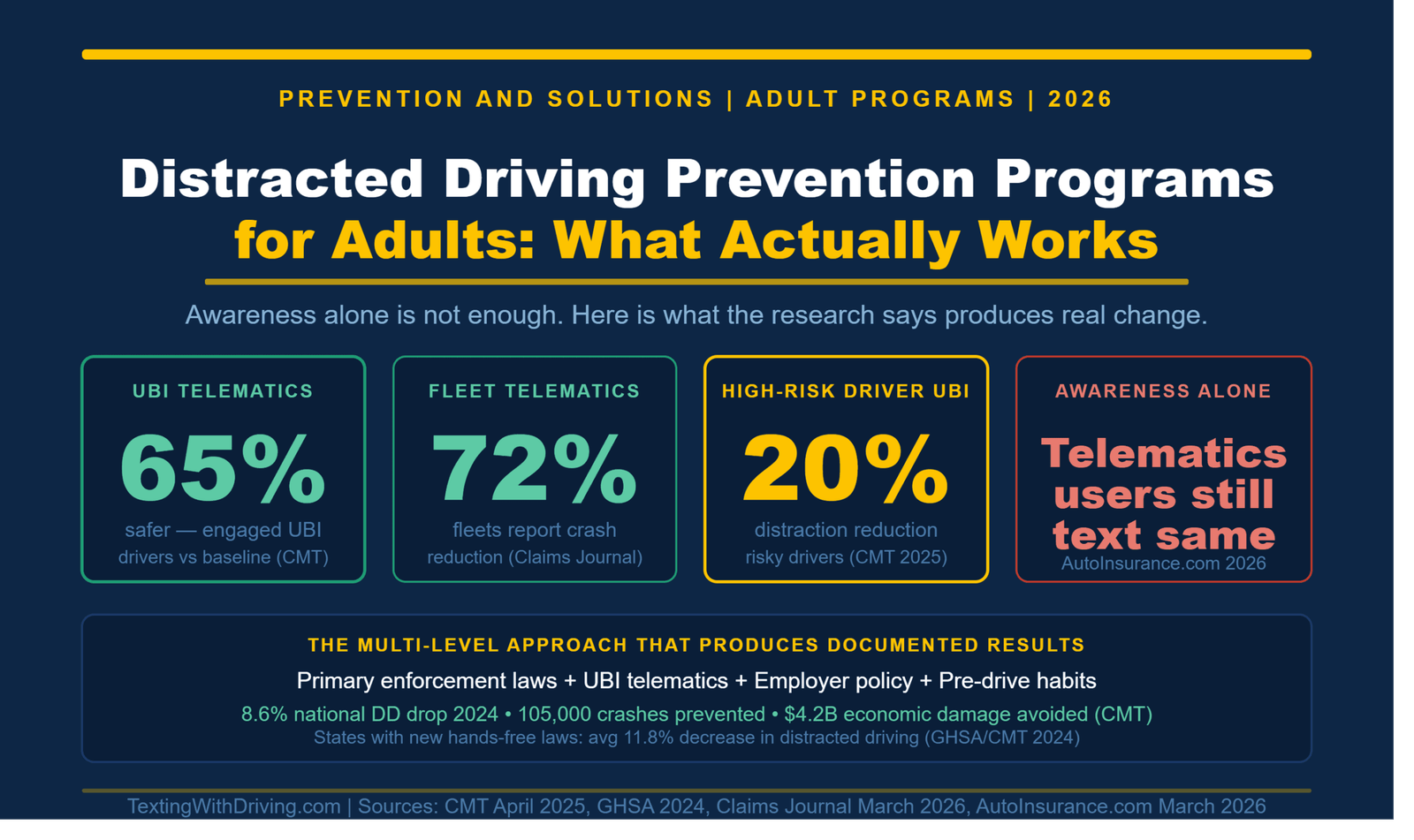
CMT’s research shows that drivers highly engaged in UBI programs are 65 percent safer and that these programs can help risky drivers reduce distraction by 20 percent. Wikipedia
65 percent safer for highly engaged participants. 20 percent distraction reduction even for high-risk drivers who start with the worst behavioral profiles. These are not modest improvements. For context, the AAA Foundation’s research on the most effective teen driving programs found 64 percent crash risk reductions from the B.R.A.K.E.S. hands-on program, which we covered in our high school programs reducing teen distracted driving article. UBI telematics produces comparable results in the adult population.
The mechanism behind UBI’s effectiveness is the alignment of financial incentives with safer behavior. A driver enrolled in a UBI program receives lower premiums when their telematics data shows safer driving, including fewer phone interaction events. The financial reward creates an economic reason to change behavior that does not depend on awareness of danger, willpower, or social accountability. The premium reduction is tangible, regular, and directly linked to specific behavioral choices.
In a 2024 telematics report, 72 percent of fleet respondents reported a reduction in crashes and claims after implementing telematics alongside safety initiatives. When insurers offer lower premiums and added benefits like transportation reimbursement or concierge-style service, they give drivers a concrete reason to stay safe behind the wheel and build better habits and avoid accidents in the first place. The Texas Tribune
72 percent of fleet implementations reporting crash and claims reductions. This is the commercial fleet version of the same finding: telematics monitoring combined with financial incentives and coaching produces crash reduction at a rate that no awareness-only program has consistently matched.
The specific product that GHSA and CMT developed together, called Safest Driver, combines telematics data collection with behavioral coaching and competitive elements that allow drivers to compare their safety scores with others. The GHSA report notes that incentive-based programs such as Safest Driver, powered by CMT technology, are motivating drivers to refrain from engaging in risky driving behaviors leading to a reduction in crashes.
For individual drivers who want to access UBI-style behavior monitoring without necessarily changing their insurance provider, apps like LifeSaver, DriveSync, and GreenRoad provide the same real-time behavioral feedback on phone handling events, hard braking, and speeding that commercial telematics systems collect, creating personal accountability without the insurance premium dimension.
The Paradox That Adult Programs Must Address
The March 2026 AutoInsurance.com research contains one finding that every adult prevention program designer needs to understand before building a program.
Even drivers using insurance telematics apps, which are designed to encourage safer driving, are just as likely to text while driving as those without such programs. Safeteendriving
Drivers enrolled in telematics programs that monitor their phone use are texting at the same rate as drivers not enrolled. The monitoring alone, without the financial incentive dimension, is not sufficient to change this specific behavior. This finding clarifies what is and is not producing the 65 percent safety improvement in highly engaged UBI participants: it is not simply the awareness that their behavior is being monitored. It is the active financial incentive structure that rewards specific behavioral improvements.
This has direct implications for program design. Corporate wellness programs, community pledge campaigns, and employer awareness training that do not include tangible incentives for behavioral change are unlikely to produce the same magnitude of results as programs that do. The knowledge that phone use while driving is dangerous, which essentially every adult driver already has, is not the missing ingredient. Financial alignment between safer behavior and personal economic benefit is.
Employer Fleet Safety Programs: The Highest-Coverage Adult Intervention
Employers whose workforce drives as part of their jobs have both the authority and the responsibility to implement mandatory behavior change programs that would be optional in consumer contexts. This makes the workplace the single highest-coverage adult distracted driving prevention environment available.
We covered the full framework for employer distracted driving policies in our employee distracted driving policy guide. For the prevention program context, the specific elements that the research supports as most effective in workplace fleet settings are:
Telematics monitoring with coaching. Automated monitoring of phone handling events during work vehicle use, combined with regular supervisor coaching conversations about specific behaviors, produces the sustained behavior change that monitoring without coaching does not. A driver who knows their phone events are recorded and whose supervisor discusses specific incidents with them receives both the accountability of monitoring and the social accountability of a management conversation.
Clear written policy with specific consequences. The behavioral research on adult habit change in organizational contexts consistently shows that explicit policy with documented consequences outperforms general expectation of safe behavior. An employer who says “we expect employees to drive safely” produces different behavior than an employer who has a specific policy that reads “holding a phone while driving a company or personal vehicle on company business is a terminable offense.” Specificity produces compliance.
Active modeling by leadership. The same modeling dynamic that we documented for teen drivers in our parent’s guide to teen phone-free driving applies in organizational contexts. Employees whose managers visibly comply with distracted driving policies are more likely to comply themselves than employees whose managers appear to exempt themselves from the same standards.
Positive incentive programs. Rewarding safe driving records through insurance discounts, fleet safety bonuses, or recognition programs creates the financial incentive alignment that the telematics research identifies as the key driver of behavior change. The Washington Traffic Safety Commission’s Drive Focused at Work program, which provides employer training and policy development resources specifically targeting industries with high rates of young driver employees and commercial vehicle use, represents one of the most comprehensive state-level employer program models in the country.
Community Pledge Programs: Social Norm Change at Scale
The community pledge model, which we reviewed in the context of AT&T’s It Can Wait campaign in our distracted driving awareness campaigns that actually worked article, is most effective for adult audiences when it includes specific behavioral tools rather than general commitments.
The research finding that 90 percent of pledgers who shared their pledge with others said they had changed their behavior, compared to roughly half of those who did not share, reveals the social accountability mechanism that makes community programs work. A pledge that is private does not change behavior as reliably as a pledge that is social and visible.
For community organizations, employers, and advocacy groups implementing pledge programs, the most effective design elements are specific behavioral commitment language rather than vague safety commitment, pairing the pledge with the specific technology tool that makes the behavior automatic, and social sharing mechanisms that extend the pledge into the social network.
“I commit to never texting while driving” is a pledge that relies on willpower. “I commit to putting my phone in the back seat before every drive and setting up Driving Focus before the engine starts” is a pledge that specifies a behavioral routine. The second version is more actionable, more measurable, and more likely to produce lasting behavior change because it establishes a specific pre-drive ritual rather than a general intention.
The AAA Foundation’s 2025 publication on increasing the use of smartphone-limiting technology to combat distracted driving specifically recommends that community and employer programs incorporate the phone’s built-in driving mode features as the core behavioral commitment. The two-minute setup covered in our Do Not Disturb while driving guide can be incorporated into any pledge event as a group activity, converting the commitment into an immediate action.
The Legislation-Program Synergy
The most important finding in the research on adult distracted driving prevention is that program interventions and legislative interventions produce their largest effects when they operate together rather than sequentially or independently.
States that implemented hands-free laws in 2023, including Ohio, Alabama, Michigan, and Missouri, have seen an average 11.8 percent decrease in distracted driving since their laws began. These new hands-free states saw more reductions in distracted driving in 2024 than the rest of the country, 12 percent compared to the 8.6 percent nationwide average. Tahirih Justice Center
11.8 percent decrease in states with new hands-free laws versus 8.6 percent nationally. The additional reduction in law-adopting states is produced by the synergy between the legislative deterrent and the public awareness campaigns that accompany new law implementation. Neither alone produces the combination’s outcome.
For employers, community organizations, and prevention program designers, this synergy principle has a direct application: the most effective adult programs are those that align with and reinforce the legislative framework in their state rather than operating independently of it. A workplace policy that references the specific state law and its penalties is more credible than one that does not. A community pledge program that helps participants understand their state’s specific hands-free law is more effective than one that addresses only general safety awareness.
The GHSA and General Motors 2022 joint publication, Directing Drivers’ Attention: A State Highway Safety Office Roadmap for Combating Distracted Driving, provides one of the most comprehensive frameworks for this legislative-program coordination approach available to practitioners. State Highway Safety Offices that use this roadmap are designed to combine enforcement, education, and incentive elements into coordinated multi-level strategies.
What Does Not Work for Adults
Understanding what the research shows fails to produce lasting behavior change in adult drivers is as important as understanding what works, because many widely deployed adult programs fall into exactly the categories that research identifies as ineffective.
The March 2026 AutoInsurance.com study documenting that telematics app users text at the same rate as non-users is the clearest recent evidence that technology alone, without the financial incentive structure, does not change adult phone-use habits. Similarly, awareness campaigns that produce documented attitude change in surveys but no documented behavior change on the road have been a consistent finding in distracted driving research.
Single-event shock presentations, the adult equivalent of the teen driving assembly, produce short-term attitude change that typically fades within weeks without reinforcement. A one-hour workplace training on distracted driving statistics produces a different response than a sustained program that combines policy, monitoring, coaching, and incentives.
General reminders about safe driving, whether in email form, signage, or general awareness materials, do not reach the specific habitual behavior that produces distracted driving crashes. They provide knowledge the driver already has. They do not change the environmental and incentive conditions that determine what the driver actually does when their phone buzzes while they are driving.
Building an Effective Adult Program: The Practical Framework
Based on all of the above, here is the framework that an employer, community organization, or individual can implement based on what the research supports.
For individuals: enroll in a UBI program with your current or a new insurer. The financial incentive aligns personal economics with safer behavior. Simultaneously, implement the full pre-drive behavioral routine from our 10 proven ways to stop texting while driving article. The combination of environmental restructuring, through phone placement and driving mode, and financial incentive, through UBI monitoring, addresses both the situational trigger and the economic motivation dimensions simultaneously.
For employers: implement the complete policy framework from our employee distracted driving policy guide, pair it with telematics monitoring for company vehicle use, and include positive incentive elements that reward safe driving records. Access the free NSC Safe Driving Kit at nsc.org/road/distracted-driving-awareness-month for policy templates and training materials.
For community organizations: design pledge programs that specify behavioral routines rather than general commitments, pair pledges with group technology setup activities, and create social sharing mechanisms that extend accountability beyond the event itself. Connect with NHTSA’s Traffic Safety Marketing program at trafficsafetymarketing.gov for free campaign materials that can anchor community programs in the Put the Phone Away or Pay national framework.
The 8.6 percent national reduction in 2024 and the 36,640 total traffic deaths in 2025, the second-lowest rate in recorded history, demonstrate that the multi-level approach is working. The challenge for prevention programs is ensuring that every driver, not just those in law-adopting states or UBI programs, has access to the environmental and incentive conditions that produce lasting behavioral change.
Sources Used in This Article
All links verified working before publication.
Cambridge Mobile Telematics: Distracted Driving Fell 8.6 Percent in 2024 — UBI 65% safer, 20% improvement risky drivers, 105,000 crashes prevented, April 2025
Colorado DOT: CMT Distracted Driving Data 2024 — States with new laws 11.8% improvement vs 8.6% national
Claims Journal: Distracted Driving — Why Awareness Alone Isn’t Working — 72% fleet crash reduction, UBI incentive design, March 2026
AutoInsurance.com: The State of Distracted Driving in 2026 — Telematics app users text same rate, red light behavior spike, March 2026
GHSA: Distracted Driving State Laws and Programs — Safest Driver program, A Road Map for Safer Roads report, October 2025
National RTAP: Distracted Driving Resources — AAA Foundation 2024 countermeasures, 2025 smartphone technology research
National Distracted Driving Coalition: Technology in Prevention — Telematics webinar series, February 2026
Washington Traffic Safety Commission: Focused Driving Programs — Drive Focused at Work employer program
NSC: Distracted Driving for Employers — Free Safe Driving Kit
NHTSA: Traffic Safety Marketing Put the Phone Away or Pay — Free campaign materials
TextingWithDriving.com is professionally built and maintained to ensure accurate, accessible safety information reaches every driver who needs it. Website development and ongoing support is handled by Budgetic, a digital agency specializing in purpose-driven WordPress websites.

About Texting With Driving
TextingWithDriving.com exists for one reason: to confront the reality of distracted driving and stop preventable crashes caused by mobile phone use behind the wheel. Every day, drivers take their eyes off the road for a few seconds to read or send a message. Those few seconds are enough to cause life-altering consequences. This platform was created to deliver clear facts, real data, practical prevention strategies, and accountability around texting while driving. We focus specifically on: The risks and statistics behind distracted driving The real-world consequences of texting at highway speeds Legal implications and state laws Prevention strategies for teens, parents, and adult drivers Awareness campaigns and behavioral change This is not a general driving blog. It is a focused awareness initiative built around one critical issue: phone distraction behind the wheel. Our content is direct, research-driven, and practical. We prioritize accuracy over opinion and education over sensationalism. The goal is simple — reduce distracted driving incidents by increasing awareness and responsibility. If one article causes one driver to put their phone down, the mission is working. For inquiries or partnerships, contact: privacy@textingwithdriving.com
View all posts by Texting With Driving