

Summer Road Trip Safety: The Complete Phone-Free Driving Guide for 2026

Summer Road Trip Safety: The Complete Phone-Free Driving Guide for 2026
Summer is the best time of year to be on the road in America. National parks, family reunions, beach drives, cross-country adventures. The freedom of a full tank, an open highway, and hundreds of miles ahead.
It is also the most dangerous time of year.
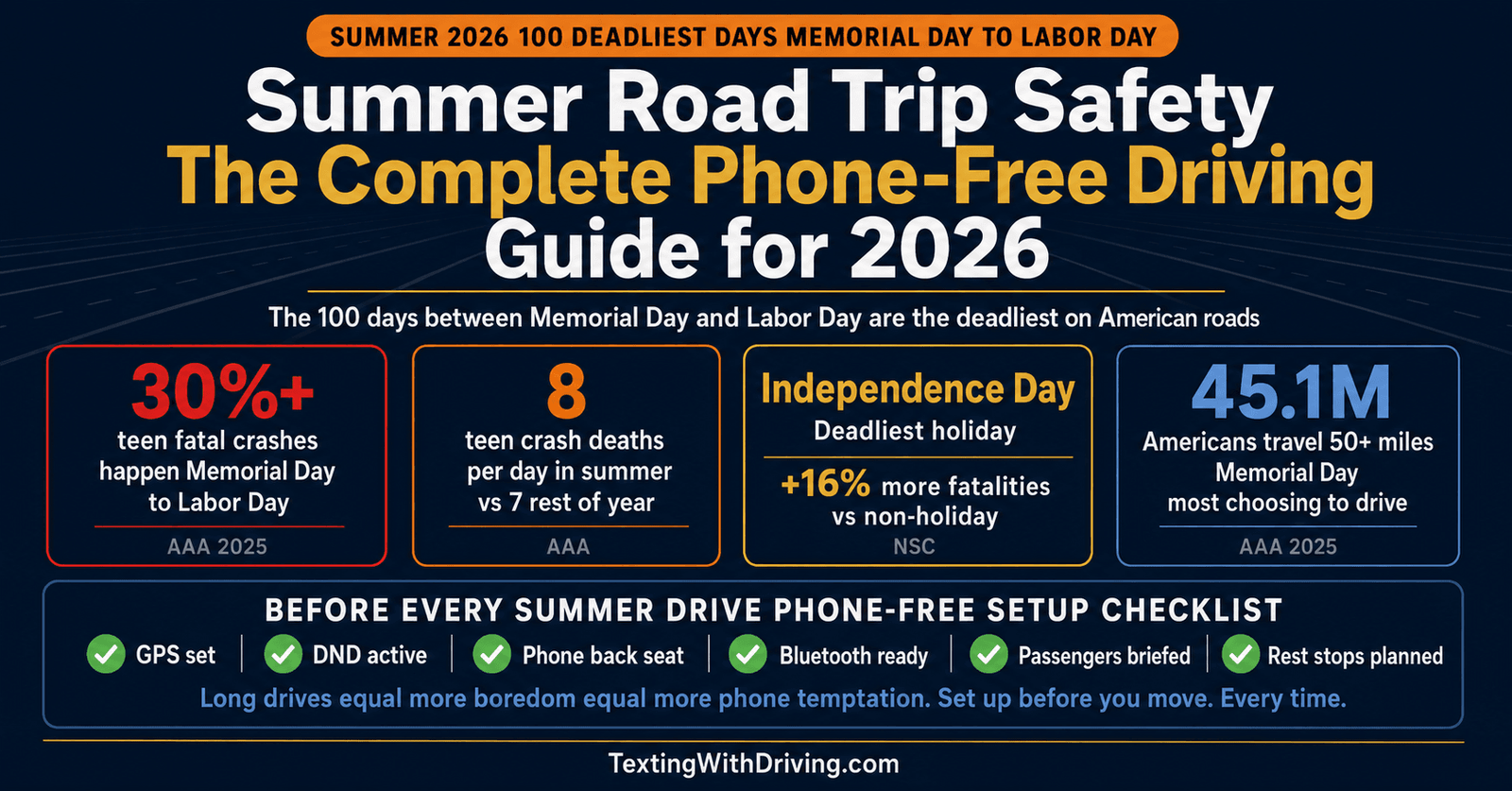
AAA’s review of national crash data found that more than 30 percent of fatal crashes involving teen drivers happen during the summer driving season between Memorial Day and Labor Day. Nearly one-third of all impaired-driving fatalities also happen during the same period. Insurify
The 100 days between Memorial Day and Labor Day have been called the 100 Deadliest Days by AAA for more than a decade. The name is not dramatic exaggeration. It reflects a consistent, documented, and annually recurring pattern of elevated crash rates that coincides precisely with the period of maximum road trip activity.
And distracted driving is one of the primary contributors to that pattern. Long drives create specific conditions that make phone use more tempting, not less: monotony on empty highways, impatience in traffic, boredom in the passenger seat, the accumulated pull of social media notifications during hours of driving, and the gradual erosion of the pre-drive habits that work well for a 20-minute commute but require more deliberate reinforcement for a 600-mile road trip.
This guide covers everything you need for a phone-free summer driving season: the data on why summer is more dangerous, the specific conditions that make long drives uniquely challenging for distraction prevention, and the complete pre-trip setup that makes every summer drive as safe as any drive you take all year.
The 100 Deadliest Days: Understanding the Summer Crash Pattern
AAA launched its 100 Days of Safe Driving campaign just days ago for 2026, continuing its multi-year effort to address the elevated crash risk of the summer driving period.
Across the country, 13,135 people were killed in crashes involving a teen driver between 2019 and 2023. Over 30 percent of those deaths occurred during the 100 deadliest days between Memorial Day and Labor Day. On average, 8 people are killed per day in teen-involved driving crashes in the summer, compared to 7 per day during the rest of the year. Albianews
Eight deaths per day involving a teen driver versus seven during the rest of the year. That one-death-per-day increase during the summer months, multiplied across 100 days, represents 100 additional deaths in teen-involved crashes that would not have occurred if summer driving patterns matched year-round patterns.
In 2024, the most recent year with complete crash data, 2,636 people were killed in crashes involving a teen driver nationwide, according to AAA. Of those deaths, 825 happened during the 100 days between Memorial Day and Labor Day.
Why does summer produce elevated crash rates? Multiple factors converge simultaneously. Teen drivers who recently received licenses in spring graduation season are in their highest-crash-risk first months of independent driving, as we documented in our first car first license phone-free habit article. School is out, producing more unsupervised driving time with fewer routine constraints on where and when teens drive. Social activities extend driving into late evenings when distraction and fatigue risks are highest. And road trip distances are longer than typical commutes, producing extended driving sessions in which all risk factors have more time to compound.
The Holiday Weekend Problem: When Traffic Volume Peaks
Within the summer season, holiday weekends produce the highest concentration of crash risk because they combine maximum traffic volume with maximum social activity and the specific behavioral patterns of holiday travel.
Independence Day ranked highest for average traffic fatalities per day in 2021 and had the highest estimated fatalities of any holiday, producing 16.1 percent more traffic fatalities than comparable non-holiday periods, according to NSC analysis.
The NSC estimates that an estimated 424 people may die in preventable traffic crashes during the 2025 Labor Day holiday period, reflecting the scale of holiday weekend crash exposure. Memorial Day 2025 data from Verra Mobility showed that speeding violations increased 28 percent from 2024 to 2025 over the holiday weekend, with extreme speeding violations of 20 miles per hour or more above the speed limit increasing 26 percent year over year.
More drivers on the road. More distance traveled. More late-night driving. More fatigue from holiday activity. And the same 186 daily phone check habit that produces distraction risk every day of the year, combined with the specific social pressures of holiday travel: coordinating arrival times, updating family members on progress, responding to group chats about the weekend plans.
Last year alone, 45.1 million Americans were expected to travel at least 50 miles from home over the Memorial Day holiday weekend, according to AAA, with most choosing to drive. More drivers mean more congestion and more risk. KPCNews
45.1 million people driving 50-plus mile trips in a single long weekend. Even a small percentage of those drivers engaging in phone distraction during any portion of their trip produces an enormous number of distracted-driving events on American roads simultaneously.
Why Long Drives Are Harder Than Short Commutes
A driver who successfully maintains phone-free habits during a 20-minute morning commute may find those same habits significantly harder to maintain during a 6-hour road trip. The difference is not a character failure. It is a behavioral science reality about how monotony, social pressure, and fatigue interact with phone temptation over extended time periods.
The first challenge is monotony. Empty highway driving with consistent speed and minimal lane changes is the driving condition most associated with mind wandering and the impulse to seek additional stimulation. As we covered in our article on the psychology of phone addiction and distracted driving, the understimulated brain seeks input. A long stretch of featureless interstate at 3 PM in the afternoon is the exact environment that creates the strongest pull toward picking up the phone.
The second challenge is accumulated notification pressure. During a 20-minute commute, perhaps 3 to 5 notifications arrive that the driver knows are waiting. During a 6-hour road trip, dozens of messages may accumulate, including from family members wondering about arrival time, friends with weekend plans, and colleagues with Monday questions. The awareness that notifications are building creates a background anxiety that is harder to manage than the daily notification pattern.
The third challenge is passenger dynamics. A solo driver has only their own discipline to rely on. A family vehicle with children creates specific distraction demands: managing backseat conflict, responding to questions, handling requests for music changes or snacks. A group road trip creates peer social pressure around group chat engagement and the shared phone use norms of the traveling group.
Crash risks for sleep-deprived drivers increase steadily compared to those who get seven or more hours of sleep. Avoid distractions. For parents, that can be children in the backseat. For any driver, it can be the temptation to use a cellphone behind the wheel. If you have to make a call or send a text, find a safe place to pull over. Aceable
The Complete Pre-Trip Phone-Free Setup
The solution to all three of these extended-drive challenges is the same solution that works for any drive: complete the setup before the car starts moving. The difference for a road trip is that the setup needs to be more comprehensive and more explicitly planned.
GPS navigation for the full route. Enter the complete destination and verify the route before leaving the driveway. For long trips, split the navigation into segments if needed, but set each segment before starting that leg of the drive. On iPhone, use Siri to set the next waypoint by voice when stopped at a rest area: “Hey Siri, navigate to the next rest stop on I-80.” On Android, Google Assistant works the same way. Never touch the navigation screen while moving.
Do Not Disturb for the full driving duration. iPhone Driving Focus silences all notifications automatically when the car moves. Android’s driving mode does the same. For road trips specifically, consider setting the auto-reply message to include your expected arrival time: “I’m driving and will arrive around 4 PM. I’ll respond then.” This preemptively manages the arrival-time coordination notifications that create the most pressure on long drives. Full setup instructions are in our Do Not Disturb while driving guide.
Designated texter for group trips. If you are traveling with passengers, designate one passenger as the communications manager for the trip before leaving. This person handles all incoming messages, responds on your behalf to the group chat, manages navigation adjustments, and controls the music. The driver’s only interaction with their phone during the drive is zero. For family trips with children, an older child or teen can take on this role, which also keeps them engaged and reduces backseat boredom.
For families with teen drivers participating in the summer road trip, safety advocates recommend that parents should encourage teens to use Do Not Disturb features on their phones to silence distractions while driving, according to AAA Foundation research on smartphone-blocking technology.
Planned rest stops every two hours. The two-hour rule for rest stops serves double duty: it addresses driver fatigue and provides a legitimate, scheduled phone-use window. When every driver in the vehicle knows that a rest stop is coming in 90 minutes where everyone will have time to check their phones, the urgency of checking during the drive decreases. The phone will be available soon. The notification can wait until the designated stop.
Planning rest stops before leaving also means knowing in advance where they will occur. Apps like GasBuddy, iExit, and Rest Area Finder identify upcoming stops along your specific route. Having the stops pre-planned means the driver does not need to look up options while driving, which is itself a distraction event.
Charging management before departure. A phone at 15 percent battery creates anxiety that increases the temptation to interact with it. Ensure all devices are fully charged before departure. Bring a car charger. Keep the charging cable plugged in and accessible to the designated texter passenger, not to the driver.
The Teen Driver Summer Road Trip: Additional Considerations
For families where a teen driver will be driving any portion of a summer road trip, the safety considerations require explicit pre-trip discussion rather than assumption.
AAA encourages teens to use the summer months to build safe driving habits by limiting distractions, following speed limits, buckling up and never driving impaired. Parents and other motorists are also encouraged to set expectations and model safe driving behavior. Insurify
The distraction risk for teen drivers on summer road trips is compounded by the same factors that make summer more dangerous generally, combined with the elevated baseline distraction vulnerability of new and young drivers. Distracted driving accounts for 60 percent of teen crashes according to NRSF research, higher than the adult driver distraction proportion.
For a teen who will be driving any portion of a road trip, the pre-drive conversation should be specific: phone goes in the back seat before they drive. Not the cupholder. Not the center console. The back seat. The designated texter role transfers to a different passenger when the teen is driving. The two-hour rest stop schedule applies with extra strictness during their driving segments.
The modeling element is also specifically relevant for summer road trips. When a parent drives the first leg of the trip with their phone in the back seat and clearly visible to the teen in the passenger seat, the behavior is modeled for the leg the teen will drive. When the same parent checks their phone at a red light during the first leg, the same behavior is modeled. The summer road trip is an extended, concentrated modeling opportunity that most parents do not deliberately deploy but should.
Music, Podcasts and Entertainment: Managing in-Car Audio Safely
One of the most common distractions during long road trips that is distinct from phone-related distraction is the ongoing management of in-car entertainment. Music selection, podcast navigation, audiobook playback, and radio scanning all create brief but real interaction demands that compound over a 6-hour drive.
Avoid eating behind the wheel. Enjoy snacks at rest areas or stop at restaurants for meals. When packing, distribute weight evenly in and atop your vehicle. Aceable
The AAA summer driving guidance addresses the nutrition dimension that most distraction discussions miss. Eating while driving is a consistent manual and visual distraction that is more prevalent on road trips than on any other driving occasion. The combination of hours of driving, limited food options, and the desire to maintain progress creates a strong incentive to eat in the vehicle. Planned meal stops at restaurants or designated rest areas where the driver is fully stopped and not operating remove this distraction entirely.
For entertainment management, the designated texter approach is equally useful. The passenger handles playlist management, podcast navigation, and volume adjustment through the car’s audio system. The driver’s only audio interaction is voice commands to confirm or reject suggestions: “Next track” or “Turn it up” at most.
For solo road trips, the most effective approach is to build your full playlist or podcast queue before leaving and set it to play continuously. No need to skip tracks, search for content, or manage anything while driving. The queue runs. You drive.
What Happens When the Trip Goes Wrong: The Breakdown and Emergency Protocol
Every road trip carries some probability of an unexpected event: a flat tire, a warning light, an unexpected traffic backup. Each of these scenarios creates a strong incentive to pick up the phone to call roadside assistance, check a traffic app, or text someone about the delay.
The protocol is simple and consistent with the general phone-free standard. Pull completely off the road to a safe shoulder, parking lot, or rest area before touching the phone. Call roadside assistance after the vehicle is fully stopped and off the travel lane. Check the traffic app after you are parked. Send the delay message after you are safely stopped.
The only exception, consistent with every state’s hands-free law, is an emergency call to 911 to report an accident, a road hazard, or a crime in progress. This can be made while still in the travel lane if the emergency does not allow for an immediate pull-off.
For drivers enrolled in AAA or other roadside assistance programs, the AAA app and most roadside assistance apps work through voice commands on iPhone Siri and Android Assistant, meaning a distress call can be initiated without touching the phone screen.
Multi-Day Trips: Fatigue and the Second-Day Distraction Problem
For road trips that extend across multiple days, a specific behavioral pattern deserves attention: distraction risk increases on the second and subsequent days of driving as accumulated fatigue reduces the prefrontal cortex’s ability to override phone impulses.
As we covered in our article on distracted driving at night, decision fatigue and physical fatigue both degrade impulse control, particularly in the evening hours. On the second day of a road trip, both factors are present from an earlier hour because sleep quality in unfamiliar accommodations is typically lower than at home and the physical fatigue of the first day’s driving and activity has not fully recovered.
The pre-drive setup that was maintained consistently on day one requires extra deliberate reinforcement on day two and beyond. Building the phone-in-back-seat and driving-mode-active rituals into the morning routine of each travel day, as consistently as putting on a seat belt, maintains the habit across multi-day journeys.
The Summer Mandate: What AAA Is Saying Right Now
AAA’s 100 Days of Safe Driving campaign launched in May 2026 with a direct message for every driver this summer.
By making smart choices behind the wheel, like putting cell phones out of reach, following posted speed limits, buckling up, and planning ahead for a sober ride, drivers can help make summer roads safer for everyone. The 100 Days of Safe Driving campaign is about encouraging drivers to make simple choices behind the wheel that can help save lives, said Gene Boehm, president and CEO of AAA. By staying focused, slowing down, buckling up, and planning ahead for a sober ride, every driver can help make our roads safer this summer. Insurify
Putting cell phones out of reach. Not off. Not face-down. Out of reach. AAA’s 2026 campaign language is the same recommendation we have made throughout this entire series: phone in the back seat, every time, before the drive starts.
The summer road trip is the highest-exposure driving event of the year for most American families. More miles. More hours. More conditions that test phone-free habits. And the same preventable consequence if those habits fail.
For the complete technology setup that makes phone-free road tripping automatic, our Do Not Disturb while driving setup guide covers both iPhone and Android from scratch. For the apps that add an additional protection layer including blocking and reward programs, our guide to the best apps to block texting while driving covers every option. And for the context of what the national death toll looks like when these habits fail at scale, our distracted driving statistics 2026 overview has the complete picture.
Drive this summer. Drive far. Drive with the phone in the back seat.
Sources Used in This Article
All links verified working before publication.
AAA Newsroom: AAA Urges Drivers to Practice 100 Days of Safe Driving This Summer — 2026 campaign launch, 2,636 teen deaths in 2024, 825 during 100 days, May 27, 2026
AAA Newsroom: The 100 Deadliest Days Teen Driver Deaths Jump in Summer Months — 13,135 deaths 2019-2023, 8 per day summer vs 7 rest of year, May 29, 2025
AAA Northeast: 100 Days of Safe Driving Summer Urges Teens — Massachusetts summer crash data, May 29, 2026
Upstate Today: AAA Urges Driver Safety During 100 Deadliest Days — AAA summer crash statistics, June 2026
AAA Your AAA Network: Summer Driving Safety Tips — Pre-trip preparation and food safety guidance
Verra Mobility: Memorial Day Driving Trends Speeding Rebounds Sharply — 28 percent speeding increase Memorial Day 2025, May 2026
ConsumerAffairs: Which US Holiday is the Deadliest Traffic Day 2026 — Independence Day 16.1 percent increase over non-holiday
The Healthy: Nearly 80 Percent of Drivers Confessed to Highly Hazardous Behavior — Labor Day 2025 NSC 424 estimated deaths, August 2025
NRSF: 100 Safest Days of Summer — Distraction accounts for 60 percent of teen crashes
NSC Injury Facts: Holiday Motor Vehicle Introduction — Holiday period fatality data
NHTSA: Distracted Driving — National distraction statistics context
TextingWithDriving.com is professionally built and maintained to ensure accurate, accessible safety information reaches every driver who needs it. Website development and ongoing support is handled by Budgetic, a digital agency specializing in purpose-driven WordPress websites.

About Texting With Driving
TextingWithDriving.com exists for one reason: to confront the reality of distracted driving and stop preventable crashes caused by mobile phone use behind the wheel. Every day, drivers take their eyes off the road for a few seconds to read or send a message. Those few seconds are enough to cause life-altering consequences. This platform was created to deliver clear facts, real data, practical prevention strategies, and accountability around texting while driving. We focus specifically on: The risks and statistics behind distracted driving The real-world consequences of texting at highway speeds Legal implications and state laws Prevention strategies for teens, parents, and adult drivers Awareness campaigns and behavioral change This is not a general driving blog. It is a focused awareness initiative built around one critical issue: phone distraction behind the wheel. Our content is direct, research-driven, and practical. We prioritize accuracy over opinion and education over sensationalism. The goal is simple — reduce distracted driving incidents by increasing awareness and responsibility. If one article causes one driver to put their phone down, the mission is working. For inquiries or partnerships, contact: privacy@textingwithdriving.com
View all posts by Texting With Driving