

Ohio Distracted Driving Law 2026: Results After One Year of Enforcement

Ohio Distracted Driving Law 2026: Results After One Year of Enforcement
There are states where distracted driving laws have been passed and their outcomes have been studied. And then there is Ohio, which produced one of the most extensively documented, most dramatic, and most unambiguous single-state results in the history of American road safety legislation.
The numbers from Ohio’s first year of enforcing Senate Bill 288, which was announced by Governor Mike DeWine and the Ohio State Highway Patrol in October 2024, are not incremental. They are transformative. And because they are documented from official state crash databases rather than from survey estimates or modeled projections, they represent some of the strongest real-world evidence available that well-designed distracted driving legislation, properly enforced, can save lives at scale.
This article covers the complete story of Ohio’s law: how it came to be, what it specifically requires, what the first-year enforcement data showed, and what the continuing 2025 and 2026 trend data confirms about whether the initial improvement has been sustained.
The Law: What Ohio Senate Bill 288 Requires
Ohio Governor Mike DeWine signed Senate Bill 288 into law in January 2023 following years of advocacy from road safety organizations, distracted driving victims’ families, and Ohio law enforcement who had pushed for stronger enforcement authority.
The law prohibits all drivers, in most circumstances, from using or holding a cell phone or electronic device while driving on Ohio roads. It is a primary offense, allowing law enforcement to stop a driver solely for a violation without any other traffic offense occurring.
The primary offense designation is the most important structural element of Ohio’s law. The previous Ohio distracted driving law was a secondary offense, meaning police needed another justification to initiate a stop before they could cite phone use. The behavioral research on distracted driving enforcement consistently shows that secondary enforcement produces significantly weaker behavior change than primary enforcement because the perceived risk of being caught is substantially lower.
Although Governor DeWine signed Senate Bill 288 into law in January 2023, a six-month grace period meant penalties for distracted driving were not doled out until October 2023 at the earliest. Get Gordon
The grace period from April through October 2023 followed the same model used by Pennsylvania, Louisiana, Missouri, and Iowa. Officers spent six months issuing written warnings and educating drivers about the new law before citations began. This approach builds public awareness before financial penalties take effect and allows law enforcement agencies to develop consistent enforcement protocols.
Ohio’s law includes escalating penalties designed to produce sustained behavior change rather than one-time compliance. A first offense is a minor misdemeanor with a $150 fine. Second offenses carry $250 fines. Third and subsequent offenses carry $500 fines and two points on the driver’s license. In school zones and construction zones, all fines double.
First-time offenders can have their fines and points waived if they complete an online distracted driving safety course, creating a rehabilitation pathway that recognizes the difference between a habitual offender and a driver who made a one-time mistake and is willing to be educated.
The First-Year Results: Unprecedented Improvement
The October 2024 data release from Governor DeWine’s office and the Ohio State Highway Patrol represents the most comprehensive official documentation of a hands-free law’s impact in American history.
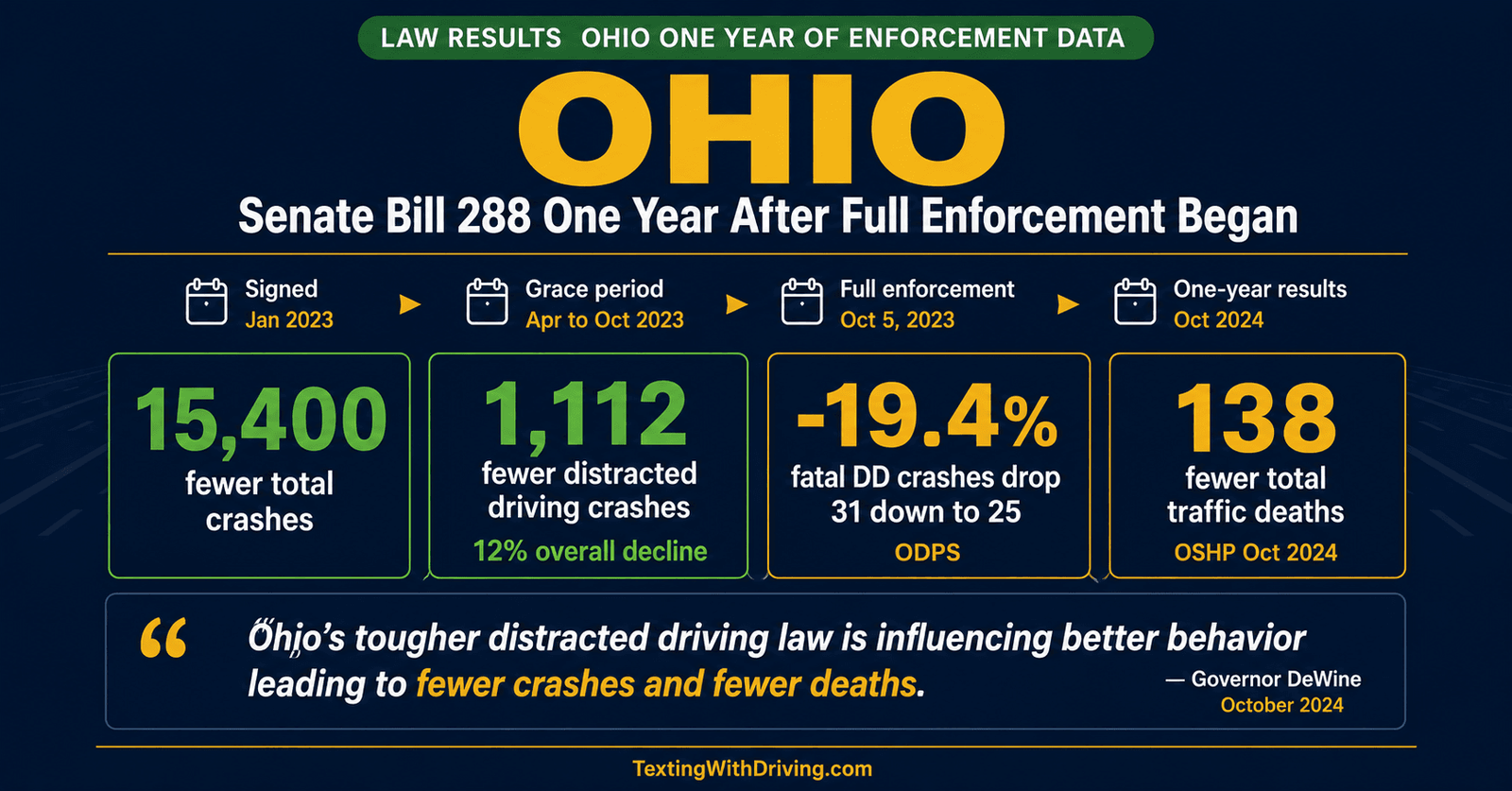
According to preliminary data from the Ohio State Highway Patrol, there were approximately 1,112 fewer distracted driving crashes in Ohio from October 5, 2023, to October 4, 2024, compared to the 12 months prior. Fatal crashes attributed to distracted driving dropped 19.4 percent. Preliminary OSHP data shows that from October 5, 2023, to October 4, 2024, there were nearly 15,400 fewer motor vehicle crashes compared to the 12 months prior. The total number of traffic fatalities also dropped with 138 fewer people killed. Lahighwaysafety
Breaking down these figures individually makes the scale of the improvement clearer.
15,400 fewer total crashes. Not 15,400 fewer distracted driving crashes. 15,400 fewer crashes of all types. The scale of the total crash reduction vastly exceeds the documented distracted driving crash reduction, which supports a conclusion that distracted driving was contributing to far more crashes than official statistics were capturing. This is precisely what the underreporting problem in distracted driving data predicts: the law changed behavior in ways that reduced crashes across categories because distraction was a hidden factor in many crashes that were never attributed to it.
1,112 fewer distracted driving crashes. The specifically documented distracted driving crash reduction reflects a 12 percent year-over-year decline. The Ohio Department of Public Safety reported a decrease from 9,529 to 8,417 distracted driving incidents from the year before the law took effect to the year following.
19.4 percent drop in fatal distracted driving crashes. Fatal crashes attributed to distracted driving fell from 31 incidents to 25. Nearly one in five fatal distracted driving crashes that would have occurred without the law did not occur.
138 fewer total traffic deaths. Across all crash types, 138 fewer people died on Ohio roads in the year after enforcement began compared to the year before. The drop in total traffic deaths that is roughly 100 times the documented drop in fatal distracted driving crashes again confirms the underreporting hypothesis: the law’s impact on behavior extended to crashes where distraction was a contributing but officially undocumented factor.
Governor DeWine said, “This is exactly what we expected would happen. Ohio’s tougher distracted driving law is influencing better behavior behind the wheel, leading to fewer crashes and fewer deaths.” KPLC 7 News
Ohio State Highway Patrol Lieutenant Ray Santiago said he believes the data is thanks to the law in action. Get Gordon
The Early 2023 Data: The Signal That Appeared Before Full Enforcement
One of the most interesting elements of Ohio’s law story is that measurable improvement appeared during the grace period before citations began, not just after.
New preliminary data from the Ohio State Highway Patrol shows that distracted driving crashes hit a record low in September 2023 when compared to each month dating back at least to January 2018. Distracted driving crashes peaked in May 2018 with 1,383 crashes as compared to September 2023’s low of 576 crashes. In just six months, this law is saving lives by changing the culture around distracted driving and changing the behavior of drivers behind the wheel, said Governor DeWine. When comparing the first nine months of 2022 and 2023, there were 1,255 fewer distracted driving crashes, a decrease of 16 percent. Over the same time period, distracted driving fatalities also declined by nearly 25 percent. The Current
A 25 percent decline in distracted driving fatalities during the grace period before a single citation was issued. September 2023 produced the lowest monthly distracted driving crash count in at least five years.
This pre-citation improvement reveals something important about how distracted driving legislation works. The behavioral change is not purely about the deterrent effect of fines. It is about the social norm signal that a law’s passage and announcement sends. When Ohio drivers learned that law enforcement now had primary authority to stop any driver holding a phone, many changed their behavior immediately, even before the financial consequence was real.
This norm-shift effect is consistent with the research we covered in our article on distracted driving awareness campaigns that actually worked. Campaigns that produce behavior change before enforcement reaches full intensity demonstrate that perceived legitimacy of the rule, not just the financial deterrent of the fine, drives compliance.
The Underreporting Revelation
The most analytically significant finding from Ohio’s law results is the relationship between the documented distracted driving crash reduction and the total crash reduction.
The law reduced official distracted driving crashes by approximately 1,112. But the total crash count fell by 15,400. The ratio is approximately 14 total crashes reduced for every one documented distracted driving crash reduced.
The impact of the new law is also reflected in the overall decrease in crashes in Ohio, supporting the theory that drivers do not always admit to driving distracted before a collision. Lahighwaysafety
This is the official Ohio state government’s own acknowledgment that the law’s impact confirms the underreporting hypothesis: official distracted driving statistics capture only a fraction of the true incidence of distraction-affected crashes. The crashes where distraction is officially documented are those where the driver admitted it, where a witness observed it, or where investigators established it from phone records. The vast majority of crashes where distraction was actually a factor are never documented as such.
The 15,400 total crash reduction in Ohio’s first year is therefore the best available estimate of the true behavioral impact of the law: far larger than the documented distracted driving crash reduction alone suggests, and consistent with research estimates that distraction contributes to 25 to 29 percent of all crashes rather than the 8 to 12 percent that police reports document.
The 2025 Continuation: Has the Improvement Been Sustained?
A single year of strong results could reflect novelty effects, where drivers comply with a new law initially and gradually return to previous habits. The Ohio data available for 2025 addresses this sustainability question.
Preliminary 2025 data shows traffic deaths fell 3 percent compared to 2024, marking a fourth straight year of decline. While our troopers continue to see the positive impact of this law through fewer crashes, our goal remains zero, said OSHP. Samphireneuro
A fourth consecutive year of declining traffic deaths. The improvement that appeared during the grace period in 2023, strengthened through the first enforcement year through October 2024, and has continued into 2025. There is no visible return-to-previous-habits pattern in the available data. The behavioral change appears to be sustained.
Ohio is now also below the national average for distracted driving. A new study from Cambridge Mobile Telematics and Nationwide Insurance found Ohio below the national average for distracted driving, confirming through telematics data collected from actual driver behavior what the crash statistics show through accident records. As we covered in our distracted driving statistics 2025 mid-year update, CMT’s data showing Ohio’s behavioral improvement is independent of the crash database analysis and provides convergent evidence from a completely different measurement methodology.
What Ohio’s Law Covers: The Specific Prohibitions
For Ohio drivers reading this in 2026, the specific requirements of Senate Bill 288 are worth stating precisely.
Ohio law prohibits holding or using a handheld electronic device while driving. This covers all phone use including voice calls, texting, GPS, social media, and any other interaction that requires holding the device. The phone must be mounted if used for navigation and must not be held for any other purpose.
The law includes the standard exceptions: emergency calls to 911, single-touch call answering or ending, hands-free systems that do not require holding the device, and use while parked off the roadway.
School zones and construction zones carry enhanced penalties. Novice drivers under a temporary instruction permit or probationary license are held to the same standard as all Ohio drivers under the law, and violating the law as a novice driver may have additional implications for license status.
What Ohio’s Results Mean for Every Other State
Ohio’s experience is the most important single-state case study in American distracted driving law history not because it is Ohio specifically but because of what it demonstrates about the achievability of rapid, large-scale behavioral change through well-designed primary enforcement legislation.
For the 16 states that still lack comprehensive hands-free laws, the Ohio data provides a specific, documented answer to the question of what passing this type of legislation would produce. Not a theoretical projection. An actual outcome measured in actual crashes, actual injuries, and actual lives.
15,400 fewer crashes. 1,347 fewer injuries. 138 fewer deaths. In one state, in one year.
As we documented in our article on how many people die from texting while driving, the national distracted driving death toll is 3,208 per year. Ohio accounts for approximately 3.5 percent of the US population. Scaling Ohio’s proportional first-year improvement to the remaining states without hands-free laws would project thousands of additional lives saved nationally if comparable legislation were enacted and enforced.
That projection is not a certainty. Every state has different demographics, road environments, baseline enforcement cultures, and starting distracted driving prevalence. But Ohio’s results are the strongest available evidence that this type of improvement is achievable in a state that had previously seen years of stagnation or worsening trends.
For the comparison of Ohio’s results with the national legislative landscape and which states still lack comparable protections, our hands-free driving laws by state 2026 guide covers all 50 states. For the Texas situation specifically, where a comprehensive law has repeatedly failed to pass despite evidence like Ohio’s, our Texas hands-free driving bill 2026 article covers the ongoing legislative battle.
What Ohio Drivers Need to Know in 2026
For Ohio drivers operating under Senate Bill 288 now entering its third year of full enforcement, the practical requirements are unchanged from what they were in October 2023.
Phone must not be in hand while driving on any Ohio road. Navigation must be mounted and preset. Calls must be through Bluetooth or the vehicle’s hands-free system. Any other phone interaction requires pulling off the road and parking completely.
The fines have not changed: $150 first offense, $250 second offense, $500 and two points for third and subsequent offenses, all doubled in school zones and construction zones. The first-offense course-completion option remains available.
Ohio State Highway Patrol troopers continue to enforce the law actively. Citations have been issued consistently since October 2023. There is no indication of reduced enforcement intensity as the law has matured. The behavior change that the data documents is the product of both the law’s existence and consistent, visible enforcement. Both continue in 2026.
For Ohio drivers who need the complete setup guide to make phone-free driving automatic rather than dependent on willpower, our Do Not Disturb while driving setup guide covers both iPhone and Android from scratch. For the apps that provide additional blocking and accountability, our guide to the best apps to block texting while driving covers every option.
Sources Used in This Article
All links verified working before publication.
Ohio Governor’s Office: New Distracted Driving Law Leads to Significant Decrease in Traffic Crashes — First six months data including 25 percent fatal crash decline during grace period
Ohio Governor’s Office: Press Release October 16, 2024 — One-year results official announcement
WKYC Cleveland: Ohio State Highway Patrol Data Shows Drop in Crashes — October 16, 2024
WOSU Public Media: Ohio State Agencies Say Data Shows Distracted Driving Law Is Working — ODPS 12 percent decline, 31 to 25 fatal crashes
Ohio Department of Transportation: New Study Finds Ohio Below National Average for Distracted Driving — CMT and Nationwide data, 2025 fourth year decline
Autobody News: Ohio New Distracted Driving Law Reduces Fatal Crashes by Nearly 20 Percent — Complete first-year results breakdown, November 2024
Call Attorney Mike: Ohio Distracted Driving Laws Accident Compensation Guide 2025 — First offense course completion option, September 2025
Hometown Stations: Ohio Sees Drop in Crashes After Implementation of Distracted Driving Law — October 17, 2024
GHSA: Distracted Driving State Laws — National comparison context
NHTSA: Distracted Driving — National statistics context
TextingWithDriving.com is professionally built and maintained to ensure accurate, accessible safety information reaches every driver who needs it. Website development and ongoing support is handled by Budgetic, a digital agency specializing in purpose-driven WordPress websites.

About Texting With Driving
TextingWithDriving.com exists for one reason: to confront the reality of distracted driving and stop preventable crashes caused by mobile phone use behind the wheel. Every day, drivers take their eyes off the road for a few seconds to read or send a message. Those few seconds are enough to cause life-altering consequences. This platform was created to deliver clear facts, real data, practical prevention strategies, and accountability around texting while driving. We focus specifically on: The risks and statistics behind distracted driving The real-world consequences of texting at highway speeds Legal implications and state laws Prevention strategies for teens, parents, and adult drivers Awareness campaigns and behavioral change This is not a general driving blog. It is a focused awareness initiative built around one critical issue: phone distraction behind the wheel. Our content is direct, research-driven, and practical. We prioritize accuracy over opinion and education over sensationalism. The goal is simple — reduce distracted driving incidents by increasing awareness and responsibility. If one article causes one driver to put their phone down, the mission is working. For inquiries or partnerships, contact: privacy@textingwithdriving.com
View all posts by Texting With Driving