

Distracted Driving and Pedestrian Safety: The Overlooked Victims

Distracted Driving and Pedestrian Safety: The Overlooked Victims
Every conversation about distracted driving eventually arrives at the same place: the driver and the vehicle. The phone in the driver’s hand. The crash the driver caused. The fine the driver will pay. The insurance rate the driver will face.
This article is about a different group entirely.
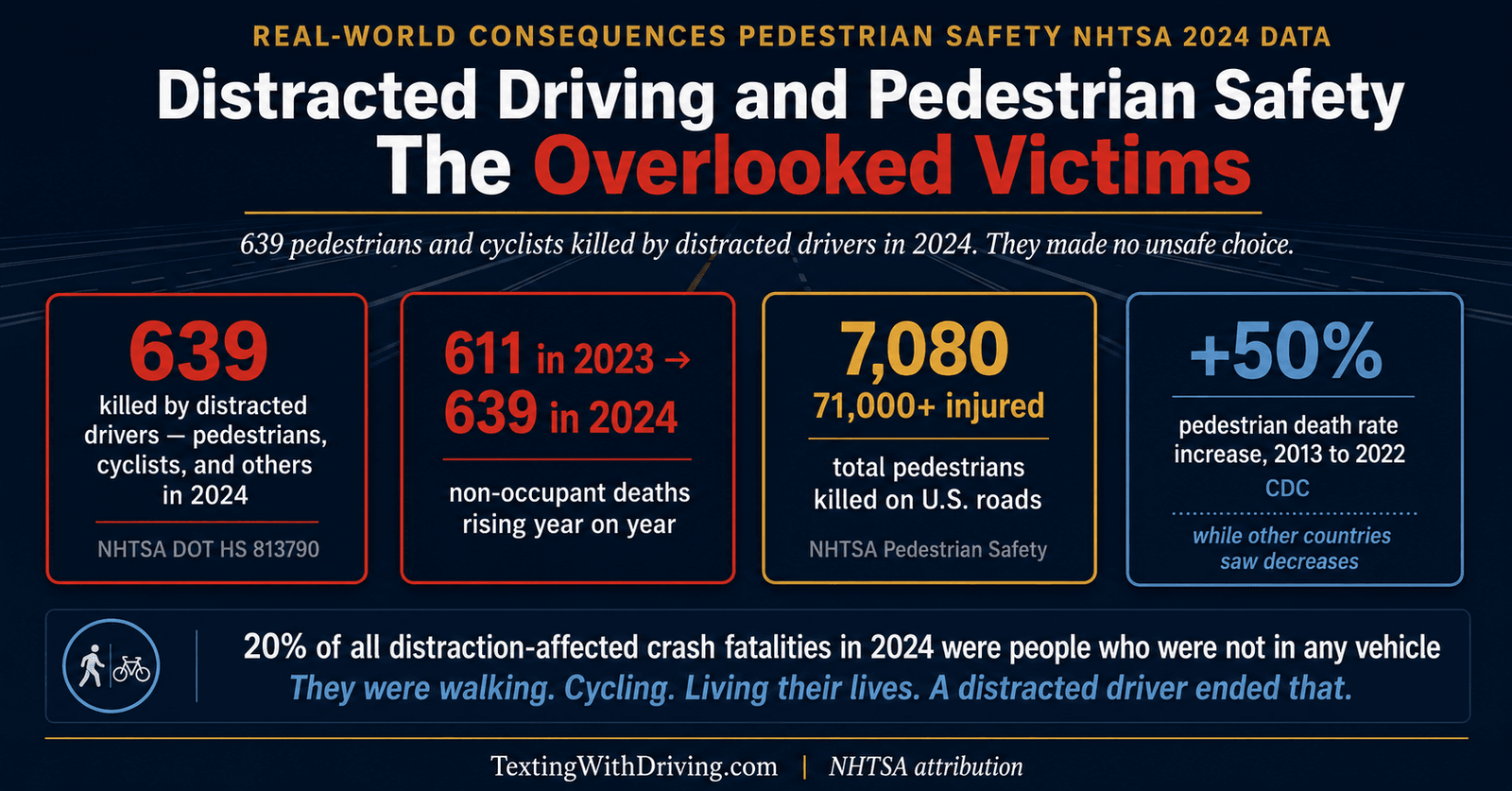
In 2024, 639 people were killed in distraction-affected crashes who were not in any vehicle at the time. They were pedestrians walking to work, to school, to a store. They were cyclists on their morning commute or afternoon ride. They were people living their ordinary lives on or near a public road.
Distracted drivers were involved in the deaths of 639 nonoccupants in 2024, including pedestrians, pedalcyclists, and others. This risky driving behavior poses a danger not only to vehicle occupants but pedestrians and pedalcyclists as well. Zutobi
639 people who made no unsafe choice. Who were not texting, not distracted, not engaged in any of the behaviors this site covers. They were simply present on or near a road when a driver chose to look at their phone.
That is 20 percent of all distraction-affected fatalities in 2024. One in five people killed by a distracted driver that year was not in a vehicle. And unlike the driver, unlike even the passenger, the pedestrian or cyclist had no ability to prevent it, no awareness it was coming, and no protection when it arrived.
The 2024 Data: The Full Non-Occupant Picture
NHTSA’s Distracted Driving in 2024 report, published as DOT HS 813 790, provides the most detailed breakdown of who dies in distraction-affected crashes. The non-occupant category, which covers pedestrians, pedalcyclists, and others including people on motorized scooters and mobility devices, shows a troubling year-over-year increase.
Most fatalities in distraction-affected traffic crashes were motor vehicle occupants including motorcyclists, representing 78 percent for all traffic fatalities and 80 percent for distraction-affected traffic fatalities. The other victims were nonoccupants, including pedestrians, pedalcyclists, and others. Distracted drivers were involved in the deaths of 639 nonoccupants in 2024. Zutobi
In 2023, the equivalent figure was 611 nonoccupant deaths in distraction-affected crashes. From 2023 to 2024, non-occupant deaths in distracted driving crashes increased by 28, a rise of approximately 4.6 percent, even as overall distracted driving deaths declined slightly from 3,275 to 3,208. The total death toll went down. The pedestrian and cyclist share went up.
This divergence matters because it suggests that whatever improvements in driving behavior and vehicle safety are slowly reducing distracted driving deaths overall, the benefits are not reaching pedestrians and cyclists proportionally. The people least protected are not benefiting from the same safety improvements that are gradually reducing fatalities among vehicle occupants.
The Broader Pedestrian Crisis: Where Distraction Fits
To fully understand the 639 figure, it needs to be placed in the context of America’s broader pedestrian safety crisis, which extends well beyond distracted driving.
In 2024, 7,080 pedestrians were killed and more than 71,000 pedestrians were injured nationwide, according to NHTSA’s pedestrian safety data. Traffic Safety Resource Center
7,080 total pedestrian deaths in 2024. 639 of those, approximately 9 percent, were specifically in crashes where the driver was identified as distracted. The remaining 91 percent involved other contributing factors including speeding, alcohol impairment, poor road design, inadequate lighting, and the growing proportion of large vehicles on American roads.
Between 2013 and 2022, US pedestrian death rates increased 50 percent from 1.55 to 2.33 per 100,000 population while other countries generally experienced decreases, according to the CDC. Mattiacci Law
The 50 percent increase in the US pedestrian death rate over that decade is one of the most striking statistics in American road safety data. Not because it directly implicates distracted driving as the sole cause, but because it tracks almost exactly with the period of smartphone adoption and the documented explosion in driver device manipulation that NSC data shows increased 104 percent between 2015 and 2024.
The correlation does not prove causation. Pedestrian death rates are driven by multiple factors simultaneously: vehicle type, road design, speed limits, lighting, and driver behavior all contribute. But the specific decade in which American pedestrian deaths diverged sharply from trends in comparable countries is also the decade in which smartphone ownership became universal and driver phone use became normalized. The overlap demands attention.
In 2022, pedestrian deaths reached their highest number, 7,522, in 41 years. The same year, the US had the highest pedestrian death rates overall and among ages 15 to 24 and 25 to 64 when compared internationally. The 2024 figure of 7,080 represents a modest improvement, with pedestrian deaths decreasing 3.9 percent in 2024 over the prior year according to NHTSA final data. But it remains far above what the comparable international trend would predict if the US had followed the same trajectory as peer nations.
The Vehicle Type Factor: Why SUVs and Pickups Amplify the Risk
Understanding who gets killed when a distracted driver strikes a pedestrian requires understanding how vehicle type affects crash outcomes.
Compared with passenger cars, SUVs and pickup trucks are more likely to strike pedestrians during certain maneuvers such as turning, and pedestrians are 50 to 100 percent more likely to be killed when they are in a crash involving an SUV or pickup truck, according to CDC research. Mattiacci Law
SUVs and pickup trucks are larger, taller, and heavier than passenger cars. When they strike a pedestrian, the impact typically occurs at a higher point on the body, affecting the torso or head rather than the legs, which produces more severe injuries. The hood height means the pedestrian is more likely to go under the vehicle rather than over it, which produces different and often more catastrophic injury patterns.
The relevance to distracted driving is direct. The United States has seen a sustained shift in vehicle mix toward larger vehicles over the past two decades. SUVs and pickup trucks now represent more than half of all new vehicle sales. A distracted driver in a large SUV who fails to perceive a pedestrian in a crosswalk creates a more lethal combination than the same driver-distraction event in a smaller passenger car.
This vehicle type factor helps explain why the US pedestrian death rate has diverged from international peers. Countries with more balanced vehicle mixes, where passenger cars remain more prevalent, experience lower pedestrian fatality rates from equivalent crash scenarios. America’s vehicle size trend is multiplying the consequences of driver inattention events that would be survivable in a smaller vehicle.
Where Pedestrians Are Most at Risk From Distracted Drivers
The geography of distracted-driver-pedestrian crashes is not random. The risk concentrates in specific road environments that share identifiable characteristics.
High-speed and complex multi-lane roadways are associated with increased US pedestrian deaths according to CDC analysis. These environments, typically arterial roads in suburban areas, concentrate pedestrian risk because they combine high vehicle speeds, infrequent pedestrian infrastructure, and driver behavior patterns associated with highway driving where phone use is particularly common.
The suburban arterial road, a four to six lane divided road with strip mall parking lots on both sides, represents one of the most dangerous environments for pedestrian-vehicle conflicts involving distracted drivers. These roads carry high volumes of traffic at speeds between 40 and 55 miles per hour. Pedestrians cross between signalized intersections. Drivers are traveling at speeds where a five-second glance at a phone covers hundreds of feet. And the road design itself, lacking separation between pedestrians and vehicles, provides no protection when a driver fails to perceive someone in or entering the travel lane.
Urban intersections present different but equally real risks. A driver who is looking at their phone while completing a left turn at an urban intersection may not perceive a pedestrian in the crosswalk who legally has the right of way. At the turning speeds involved, typically under 15 miles per hour, the SUV factor described above means that even a relatively low-speed impact can produce fatal injuries.
School zones and residential streets introduce the child pedestrian dimension that we covered in our article on school zone distracted driving laws. Children are unpredictable pedestrians with limited ability to assess vehicle approach speeds and less conspicuous physical profiles than adults. A distracted driver whose visual processing is suppressed, as documented in our article on how distracted driving affects your brain, may fail to perceive a child stepping off a curb even when they are looking in that direction.
The Cyclist Dimension: Smaller Profile, Faster Speed, Same Exposure
Cyclists occupy a particularly vulnerable position in the distracted driving landscape because their physical profile is smaller than a pedestrian and their speed relative to traffic creates different geometry in collision scenarios.
A pedestrian who steps into a roadway gives a distracted driver a relatively slow-moving target. A cyclist traveling at 15 to 20 miles per hour in a bike lane or on the road shoulder reduces the time a driver has to perceive and respond to their presence, even when the driver is fully attentive. Add a visual distraction event that takes the driver’s eyes off the road for five seconds and the available response time may drop to zero.
The 639 non-occupant figure from NHTSA includes pedalcyclists alongside pedestrians. NHTSA’s CrashStats does not publish a separate breakdown of distraction-affected cyclist deaths versus pedestrian deaths within the non-occupant category in the DOT HS 813 790 report, but the overall cyclist death count provides context. Cyclist deaths decreased 6 percent in 2024 over the prior year according to NHTSA final data, a more significant improvement than the 3.9 percent decline in pedestrian deaths. The direction is positive. The absolute numbers remain concerning.
For cyclists who ride on roads shared with motor vehicle traffic, the prevalence of distracted driving creates a specific risk that they have essentially no ability to manage through their own behavior. Wearing a helmet, following traffic laws, using lights, taking the lane, wearing visible clothing — all of these are reasonable safety practices. None of them protect against a distracted driver who does not perceive the cyclist’s presence until the collision is unavoidable.
The Vision Zero Connection: How Infrastructure Addresses What Individual Behavior Cannot
The pedestrian and cyclist deaths in distraction-affected crashes represent a policy failure as much as a behavioral failure. The behavioral failure is the driver’s choice to use a phone. The policy failure is a road environment that provides no protection when that behavioral failure occurs.
Vision Zero, the road safety framework adopted by many US cities and endorsed by NHTSA’s Safe System approach, operates on the premise that road fatalities are not inevitable and that the road system should be designed to be forgiving of human error rather than requiring perfect human performance. Under this framework, the solution to distracted-driver-pedestrian deaths is not exclusively about changing driver behavior. It is equally about designing roads, intersections, and pedestrian infrastructure so that a driver’s momentary lapse does not produce a fatal outcome.
Physical separation between pedestrians and moving vehicles, raised crosswalks that slow turning vehicles, reduced speed limits in high-pedestrian-density areas, protected bike lanes with physical barriers, and enhanced pedestrian signal phasing that gives people time to cross before vehicles begin moving are all infrastructure interventions that reduce the lethality of distracted driving events without requiring drivers to be perfect.
The accelerated adoption of a Safe System approach, focused on creating safer roadways and vehicles, establishing safer speeds, supporting safer road users, and improving post-crash care, can help reduce US pedestrian deaths, according to CDC analysis. This systems approach acknowledges that individual behavior change, while necessary, is insufficient as a sole strategy when the road environment amplifies the consequences of every behavioral failure.
Distracted Pedestrians: The Separate but Related Issue
Any honest discussion of pedestrian safety and distraction must acknowledge that pedestrians also engage in distracted behavior that increases their risk.
Pedestrians who walk while looking at phones, use earbuds that prevent them from hearing approaching vehicles, or cross streets without watching for traffic create a different but real distraction risk. A pedestrian who steps off a curb into moving traffic because they were reading a message is not the same as a pedestrian struck by a distracted driver, but both behaviors contribute to pedestrian fatality statistics.
NHTSA specifically addresses this on its pedestrian safety page, advising pedestrians to put your phone away and focus on the road, not your phone. If you need to make a call or send a text, stop and step away from the road first.
The policy implication is important: pedestrian distraction and driver distraction are separate problems requiring separate interventions. A pedestrian safety campaign that focuses only on drivers ignores one behavioral dimension. A campaign that focuses only on pedestrians ignores another. Both behaviors are preventable. Both contribute to the pedestrian death toll. And addressing both simultaneously produces better outcomes than addressing either in isolation.
That said, the power imbalance between a distracted driver in a two-ton SUV and a distracted pedestrian on foot means that the consequences of driver distraction are categorically more severe. The pedestrian who steps into traffic while looking at their phone may be injured by a vehicle. The driver who fails to perceive a pedestrian while looking at their phone may kill someone. The scale of consequence is not equivalent.
What This Means for Every Driver
The 639 non-occupant deaths in distraction-affected crashes in 2024 add a dimension to the distracted driving argument that is qualitatively different from the argument about protecting yourself.
The danger to yourself from texting while driving is real and the data is stark. But self-harm arguments have limited motivational power for drivers who are confident in their own ability, who have driven while distracted hundreds of times without incident, and who have normalized the behavior through repeated exposure without consequence.
The pedestrian dimension removes the self-harm framing entirely. A driver who texts while driving is not only risking their own life. They are operating a lethal instrument in an environment shared by people who cannot protect themselves, cannot anticipate the driver’s inattention, and have made no choice that contributed to their risk.
The 639 people killed by distracted drivers in 2024 who were not in any vehicle had no stake in the driver’s decision about their phone. They were simply present. Every one of their deaths was directly attributable to a decision made by someone else that was entirely within that person’s power to make differently.
A phone in the back seat. Driving mode activated. GPS set before moving. These are the decisions that keep 639 from becoming 700.
For the complete statistical context of all distracted driving deaths including non-occupants, see our distracted driving statistics 2026 overview. For the specific behavioral and technology tools that make the phone-free decision automatic rather than dependent on moment-by-moment willpower, our guides to the best apps to block texting while driving and Do Not Disturb while driving setup cover every available option. And for the full accident statistics that place these pedestrian deaths in the broader crash context, our distracted driving accident statistics article has the complete breakdown.
Sources Used in This Article
All links verified working before publication.
NHTSA CrashStats: Distracted Driving in 2024 — DOT HS 813 790, 639 non-occupant deaths, full person-type breakdown
NHTSA CrashStats: Distracted Driving in 2023 — DOT HS 813 703, 611 non-occupant deaths comparison year
NHTSA: Pedestrian Safety — 7,080 pedestrian deaths, 71,000 injuries in 2024
NHTSA: Distracted Driving Dangers and Statistics — 3,208 total deaths, non-occupant proportion
Smart Cities Dive: US Traffic Deaths in 2025 Lowest Since 2019 — Pedestrian deaths decreased 3.9 percent and cyclist deaths 6 percent in 2024, April 2026
Repairer Driven News: Preventable Traffic Deaths Remained at Crisis Level in 2024 — CDC 50 percent pedestrian death rate increase, SUV and pickup truck 50-100 percent more lethal, March 2025
NSC Injury Facts: Distracted Driving — Device manipulation 104 percent increase since 2015
NHTSA: Traffic Safety Marketing Distracted Driving — 639 non-occupant figure confirmed
SafeTREC Berkeley: 2025 Traffic Safety Facts Distracted Driving — Research note context
GHSA: Distracted Driving State Laws — Legislative context
TextingWithDriving.com is professionally built and maintained to ensure accurate, accessible safety information reaches every driver who needs it. Website development and ongoing support is handled by Budgetic, a digital agency specializing in purpose-driven WordPress websites.

About Texting With Driving
TextingWithDriving.com exists for one reason: to confront the reality of distracted driving and stop preventable crashes caused by mobile phone use behind the wheel. Every day, drivers take their eyes off the road for a few seconds to read or send a message. Those few seconds are enough to cause life-altering consequences. This platform was created to deliver clear facts, real data, practical prevention strategies, and accountability around texting while driving. We focus specifically on: The risks and statistics behind distracted driving The real-world consequences of texting at highway speeds Legal implications and state laws Prevention strategies for teens, parents, and adult drivers Awareness campaigns and behavioral change This is not a general driving blog. It is a focused awareness initiative built around one critical issue: phone distraction behind the wheel. Our content is direct, research-driven, and practical. We prioritize accuracy over opinion and education over sensationalism. The goal is simple — reduce distracted driving incidents by increasing awareness and responsibility. If one article causes one driver to put their phone down, the mission is working. For inquiries or partnerships, contact: privacy@textingwithdriving.com
View all posts by Texting With Driving