

Distracted Driving Laws for Teen Drivers: A State-by-State Guide for Parents

Distracted Driving Laws for Teen Drivers: A State-by-State Guide for Parents
If you have a teenager with a driver’s license or a learner’s permit, you may know that your state has a texting ban and possibly a hands-free law. What most parents do not know is that teen-specific driving laws are substantially stricter than the adult laws in almost every state, and that understanding the specific teen provisions is essential for having an informed conversation with your new driver about what the law actually requires of them.
This guide covers the complete picture: the national framework that applies to every teen driver in every state, the specific provisions that differ from adult laws, the Graduated Driver Licensing system that creates tiered restrictions as drivers gain experience, and what the research says about which of these legal provisions most effectively reduce teen crash risk.
The Most Important Thing Most Parents Do Not Know
Here is the single most consequential legal difference between what applies to adult drivers and what applies to teen novice drivers in most states.
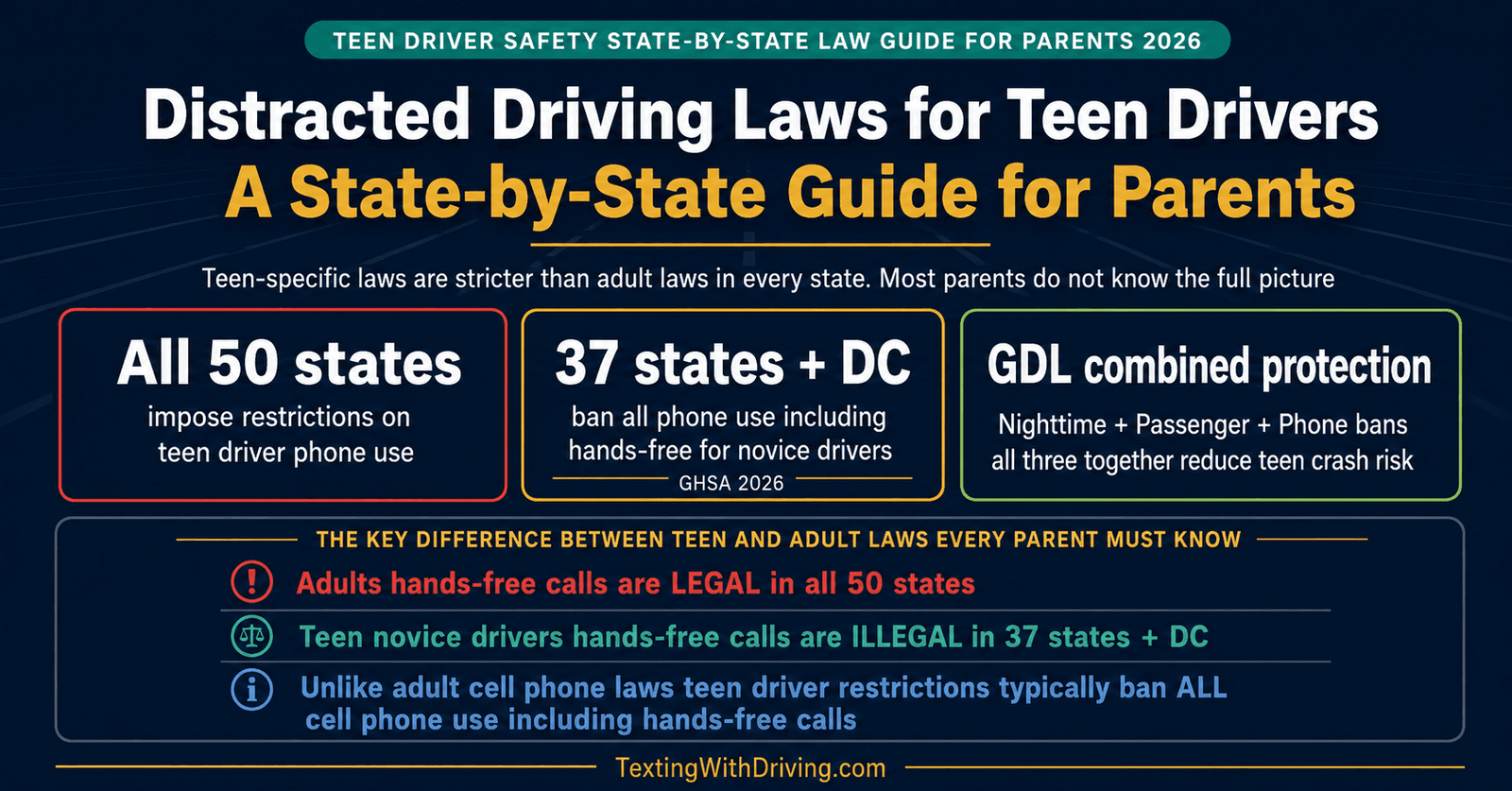
All 50 states and DC ban all cell phone use including handheld and hands-free for novice drivers, and 41 states plus DC impose additional cell phone restrictions for drivers under 18 as part of Graduated Driver Licensing programs. Unlike adult cell phone laws that may only ban handheld use or texting, teen driver restrictions under distracted driving laws typically ban all cell phone use entirely including hands-free calls. This stricter standard reflects the higher crash risk for inexperienced drivers and the goal of minimizing all potential distractions during the learning period. Fibichlaw
All 50 states. Hands-free included. For adult drivers in most states, a Bluetooth call is completely legal. The same call made by a teen novice driver in 37 states plus DC is a violation.
Cell Phones and Texting: 37 states and DC ban all cell phone use by novice drivers. Nighttime Driving Restriction: All states except Vermont restrict nighttime driving during the intermediate stage. Passenger Restriction: 47 states and DC restrict the number of passengers during the intermediate stage. Federal Register
This means that if your teenager has their intermediate license in one of the 37 states plus DC with complete novice driver bans, they cannot legally use their phone for any purpose while driving, including a hands-free call to you to say they are on their way home. The law is not about how they hold the phone. It is about any interaction with the phone at all.
Most parents are aware that texting while driving is illegal for their teen. Many are aware that holding the phone is illegal in states with hands-free laws. Very few are aware that even a Bluetooth call is illegal for their teen in most states.
This matters for the conversation you have with your teenager about driving and phones. If you tell them the adult standard, that hands-free is fine, you may be giving them incorrect legal information specific to their license status.
The Graduated Driver Licensing Framework
The teen driver phone restrictions exist within the broader framework of Graduated Driver Licensing, which is the system used in all 50 states to phase in full driving privileges as new drivers accumulate supervised experience.
GDL programs typically involve three stages. The learner’s permit stage requires supervised driving with a licensed adult, usually with a minimum hours requirement and often including night and highway driving specifically. The intermediate license stage, sometimes called the restricted or provisional license stage, allows unsupervised driving but with specific restrictions. The full license stage grants the complete driving privileges of an adult driver.
The restrictions that apply during the intermediate license stage are where the most important teen-specific distracted driving provisions are found. The phone ban, the nighttime driving restriction, and the passenger limit all operate during this stage.
Studies show that restrictions on nighttime driving and the number of teenage passengers help reduce fatal crashes for teenage drivers. Research indicates these combined GDL provisions produce measurable crash rate reductions for new drivers.
As we covered in our first car first license phone-free habit article, the first six months of independent driving and the first 1,000 miles are the highest-risk period of a driver’s entire lifetime. The GDL restrictions exist specifically to limit risk exposure during exactly this window.
The National Picture: What Every Teen Driver Faces
At the national level, the teen-specific legal framework in 2026 covers three categories of restriction that interact to create the most protective driving environment legally achievable for new drivers.
Phone restrictions. 37 states plus DC ban all cell phone use for novice drivers. In the remaining states, texting and handheld phone use are still prohibited under the general distracted driving and texting ban laws that apply to all drivers. No state allows teen novice drivers to text while driving. No state has no phone restriction at all for teen drivers. The difference between states is whether the restriction covers hands-free calls in addition to handheld and texting restrictions.
Nighttime restrictions. Every state except Vermont restricts nighttime driving during the intermediate license stage. The specific hours vary by state but typically begin between 9 PM and midnight and extend through early morning. The nighttime restriction addresses the documented crash risk that peaks in the late evening hours for teen drivers, which we covered in detail in our distracted driving at night article.
Passenger restrictions. 47 states plus DC restrict the number of passengers a novice driver can carry during the intermediate stage. Most commonly this means one non-family passenger under a certain age, typically under 21, for a defined period after licensing. The passenger restriction addresses the peer distraction dynamic documented in research: teen crash risk increases with each additional teenage passenger in the vehicle.
All three restrictions together create a driving environment for new drivers that is substantially more protective than the environment adult drivers operate in. The GDL combined effect reduces teen crash risk in ways that no single provision produces alone.
Key State Provisions: What Your State Specifically Requires
Because the specific novice driver provisions vary by state, parents need to know the specific requirements in their state rather than relying on the general national picture. The following overview covers the most important state-specific variations.
States with complete all-phone bans for novice drivers including hands-free. California, New York, Illinois, Pennsylvania, Texas, Florida, Ohio, Michigan, Washington, Colorado, and most other states with comprehensive hands-free laws or explicit novice driver provisions ban all phone use for drivers under a defined age or with a restricted license status. In these states, even Bluetooth is prohibited for your teen until they age out of the novice driver provision or obtain a full license.
The age threshold question. The definition of novice driver varies by state. Most states define novice drivers based on license stage rather than age alone. An 18-year-old who just obtained their first license may still be subject to novice driver restrictions during their GDL intermediate stage even though they are an adult. A 17-year-old who has held a license for two years may have completed the GDL program and be subject only to adult laws. The stage of licensure, not the driver’s age, determines which legal standard applies in most states.
Primary vs. secondary enforcement for teen provisions. 32 states have primary enforcement for their novice driver phone bans, meaning police can stop a teen driver solely for phone use. 6 states have secondary enforcement for the novice provision, meaning another violation must be present before the teen-specific restriction can be cited. For states that have primary enforcement for adult handheld bans, the adult primary enforcement covers teen drivers as well, and the teen-specific provision adds additional coverage for hands-free use.
Missouri’s unique situation. Missouri is the only state that has a statewide ban for drivers under the age of 21 rather than for novice drivers specifically. A 20-year-old fully licensed driver in Missouri is still subject to a stricter standard than a 21-year-old in the same state.
Montana’s outlier status. Montana remains the only state without a statewide texting ban for all drivers. It is also the only state with minimal novice driver phone restrictions. Montana teen drivers face the weakest legal protection from distracted driving law of any state in the country.
The Hands-Free Distinction: Why It Changes the Parent Conversation
The hands-free provision in novice driver laws deserves specific attention in the parent-teen conversation about driving because it creates a legal standard that directly contradicts what teens observe their parents doing legally.
For adult drivers, hands-free phone calls are legal in all states. However, distracted driving laws ban all cell phone use including hands-free for novice and teen drivers in most states. Research shows hands-free calls still cause cognitive distraction, but current laws generally permit them for adults. Fibichlaw
When a parent makes a Bluetooth call while driving and their teen is in the passenger seat, the teen is observing a legal adult behavior. When that teen then makes the same Bluetooth call while driving their own car, they may be committing a violation in their state.
This creates a specific conversation that parents need to have explicitly and that is separate from the general phone-free driving discussion. The parent should communicate: here is what I can legally do while driving because I have a full license, and here is what is different for your license specifically.
The research we covered in our father’s day driving safety article and our parent’s guide to teen phone-free driving both document that parent modeling is the single strongest predictor of teen driver behavior. A parent who models hands-free calling as an acceptable driving behavior, without specifically clarifying that this is legal for adults but not for their teen’s novice license, is potentially normalizing a behavior that is illegal for their teen.
The simplest resolution to this modeling complexity is the same approach this site recommends throughout: phone in the back seat before every drive, driving mode active, no phone interaction of any kind during the drive. This standard, which exceeds the legal requirement for both adults and teens, eliminates the distinction between adult and teen standards and produces the safest possible driving behavior for the entire family.
The Research on What Actually Reduces Teen Crash Risk
Understanding what the research says about which specific GDL provisions most effectively reduce teen crashes helps parents prioritize the conversations and the enforcement that matters most.
Night driving restrictions and passenger limits are consistently identified as the GDL provisions with the strongest evidence for crash reduction. Research on GDL systems found that teen fatal crash rates decline significantly when both nighttime and passenger restrictions are in place.
The phone-specific provisions are newer and have a somewhat less extensive research base than the nighttime and passenger provisions, which have been studied for decades. But the broader research on distracted driving and new driver vulnerability that we covered in our first car first license phone-free habit article is consistent with the legislative judgment that all phone use should be prohibited during the highest-risk period of new driver experience.
The AAA Foundation found that teens are 2.5 times more likely to engage in distracted driving behaviors if they frequently observe their parents doing it. This finding is not primarily about what laws say. It is about what behavior is normalized in the household and the vehicle before, during, and after the teen’s driving period.
How to Use This Information in the Licensing Conversation
The most effective use of the information in this article is not as a legal reference document to hand to your teen. It is as preparation for a specific, informed conversation about exactly what the law requires of them at their current license stage.
Before your teen’s first solo drive, sit down with them and go through the specific provisions that apply to their license in your state. What are the nighttime hours when they cannot drive? How many non-family passengers can they carry? Is a Bluetooth call legal for them or not? What happens if they violate one of these provisions?
Having this conversation with specific information rather than general warnings produces a different result. A teen who knows that a Bluetooth call is a primary violation in your state, citable without any other offense, and that the violation will appear on their driving record and affect insurance rates, has specific, concrete information. A teen who is told “be careful with your phone” has a general instruction that competes with hundreds of other general instructions they receive.
The technology setup is part of this conversation. Set up iPhone Driving Focus or Android driving mode with your teen present, during the conversation about their license. Our Do Not Disturb while driving setup guide covers both platforms from scratch in under two minutes. Making the setup a joint activity during the licensing conversation produces a behavioral tool that is active from the first drive.
The monitoring apps we covered in our best apps to block texting while driving guide, including LifeSaver’s parent monitoring version, allow parents to verify that Driving Focus or similar protection is active during drives and to receive alerts if the teen disables it. For the first months of independent driving, during the highest-crash-risk period, this monitoring adds an accountability layer that research consistently shows improves new driver compliance with safety standards.
What Violations Mean for Teen Drivers Specifically
Beyond the behavioral consequences, the legal and financial consequences of a distracted driving violation for a teen driver are worth understanding before any incident occurs.
A teen driver who receives a distracted driving citation faces the same financial fine structure as an adult in most states. In addition, the violation appears on their driving record and is accessible to insurance companies. At the age when insurance rates for teen drivers are already significantly higher than for adult drivers, a distracted driving citation during the novice period can increase premiums substantially.
In states with points systems, the violation adds points to the driver’s record. For a teen in the GDL intermediate stage, accumulating a specified number of points may result in license suspension or a return to a more restricted license stage, extending the period before they can obtain a full license.
Some states have provisions that allow teen drivers to complete a distracted driving safety course in lieu of the citation and points, similar to the Ohio provision we documented in our Ohio distracted driving law results 2026 article. Understanding whether your state offers this option is part of the complete legal picture.
The full fines by state, including the enhanced school and work zone provisions, are covered in our texting while driving fines by state 2026 guide. The complete adult hands-free law landscape is in our hands-free driving laws by state 2026 guide. The complete teen driving safety research context is in our why teen drivers are the most at-risk group article.
Sources Used in This Article
All links verified working before publication.
GHSA: Teens and Novice Drivers State Laws — 37 states plus DC ban all cell phone use for novice drivers, nighttime and passenger restriction data
Road Law Guide: Distracted Driving Laws by State 2026 — All 50 states impose restrictions, 41 states plus DC GDL additional restrictions, February 2026
CHOP Teen Driver Source: Distracted Driving Laws — 36 states plus DC ban all cell phone for novice, 235 teen deaths 2022 distracted crashes
Torgenson Law: Cell Phone Driving Laws by State — 38 states ban for all novice drivers, primary vs secondary breakdown, February 2026
World Population Review: Cell Phone Driving Laws by State 2026 — 36 states plus DC novice driver ban, updated June 2026
Price Benowitz: Laws on Distracted Driving State Prevention Regulations — Arkansas novice driver definition, primary vs secondary enforcement
NHTSA: Distracted Driving — 3,208 deaths 2024, national statistics
AAA Foundation: Smartphone Blocking Countermeasures 2025 — Teen phone use and DND adoption data, April 2025
TextingWithDriving.com is professionally built and maintained to ensure accurate, accessible safety information reaches every driver who needs it. Website development and ongoing support is handled by Budgetic, a digital agency specializing in purpose-driven WordPress websites.

About Texting With Driving
TextingWithDriving.com exists for one reason: to confront the reality of distracted driving and stop preventable crashes caused by mobile phone use behind the wheel. Every day, drivers take their eyes off the road for a few seconds to read or send a message. Those few seconds are enough to cause life-altering consequences. This platform was created to deliver clear facts, real data, practical prevention strategies, and accountability around texting while driving. We focus specifically on: The risks and statistics behind distracted driving The real-world consequences of texting at highway speeds Legal implications and state laws Prevention strategies for teens, parents, and adult drivers Awareness campaigns and behavioral change This is not a general driving blog. It is a focused awareness initiative built around one critical issue: phone distraction behind the wheel. Our content is direct, research-driven, and practical. We prioritize accuracy over opinion and education over sensationalism. The goal is simple — reduce distracted driving incidents by increasing awareness and responsibility. If one article causes one driver to put their phone down, the mission is working. For inquiries or partnerships, contact: privacy@textingwithdriving.com
View all posts by Texting With Driving