

Father’s Day Driving Safety: A Message for Every Dad Behind the Wheel

Father’s Day Driving Safety: A Message for Every Dad Behind the Wheel
This article is not about statistics. It is not primarily about laws or fines or insurance rates. It is about fathers specifically, and about a set of numbers that belong in every Father’s Day conversation that is serious about road safety.
Father’s Day falls on Sunday, June 21, 2026. Millions of families across the country will be in vehicles together: driving to celebrations, picking up dads from airports, heading to restaurants, making the trip to grandparents’ homes. And the driver in most of those vehicles will be a man.
Here is what the data says about male drivers and distracted driving. And here is why it matters not just for those drivers, but for every person riding with them and every child watching them.
The Numbers That Belong in This Conversation
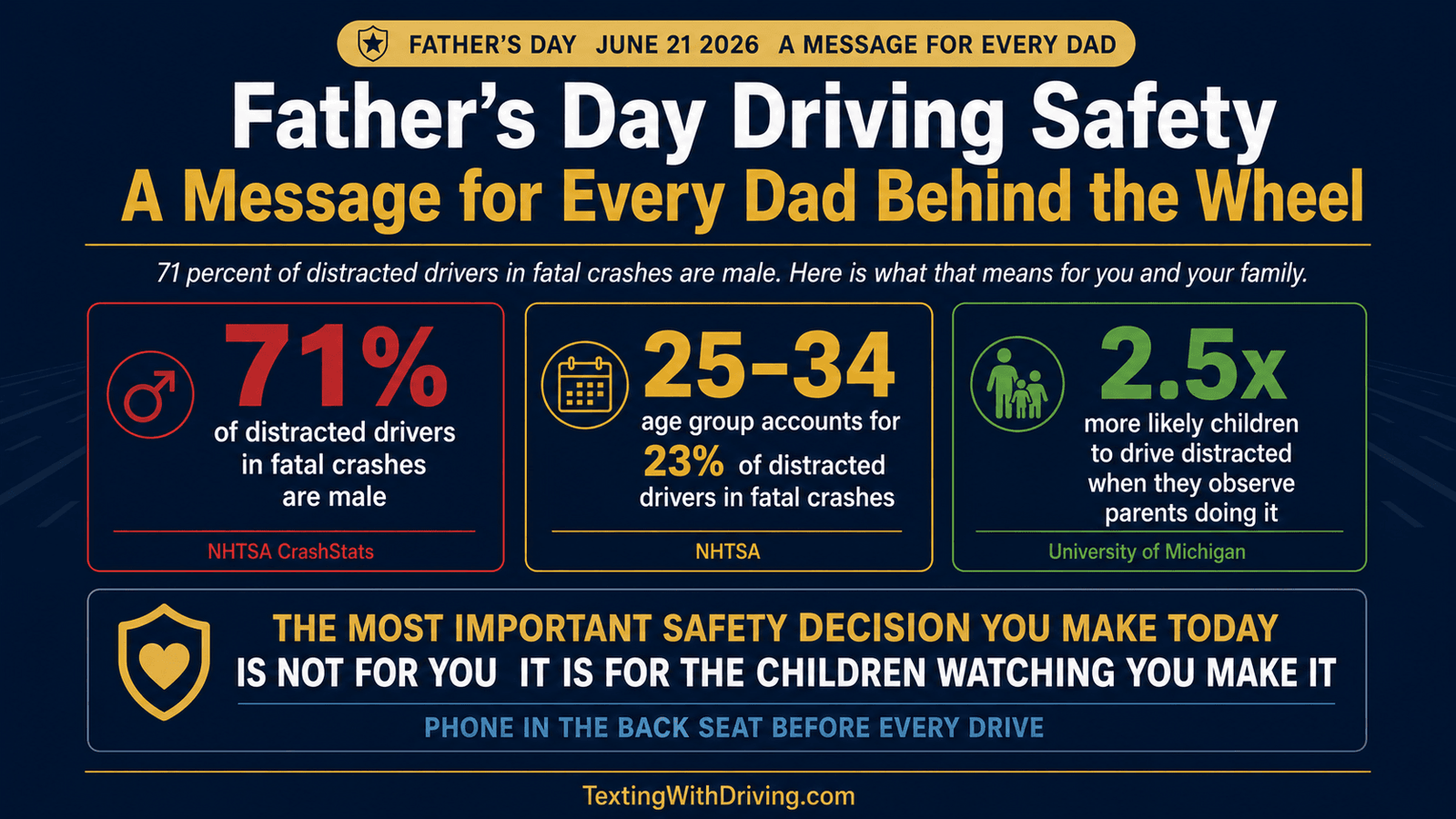
71 percent of distracted drivers involved in fatal crashes were male, according to NHTSA CrashStats data. Teletrac Navman
That is not a small margin. Nearly three out of every four people who were distracted at the time of a fatal crash were men. This is not a function of men driving more miles than women, though that is a factor. It reflects a specific behavioral pattern in how male drivers engage with their phones behind the wheel that is documented consistently across multiple years of NHTSA crash data.
Drivers ages 25 to 34 accounted for 23 percent of distracted drivers and 24 percent of cellphone-distracted drivers in fatal crashes. Teletrac Navman
The 25 to 34 age group, which includes a large proportion of fathers of young children, is the single largest age cohort in distracted driving fatal crash data. Not teenagers. Not older drivers. Men in their late twenties and early thirties, exactly the age when many fathers have young children in their back seats and demanding professional communication expectations on their phones simultaneously.
Male victims made up 62 percent of all fatally injured victims and seriously injured victims in distracted driving crashes in 2023, according to SafeTREC Berkeley analysis of NHTSA FARS data. Occupational Safety and Health Administration
62 percent of people killed or seriously injured in distracted driving crashes are male. Both as the distracted driver and as the victim of other distracted drivers, men are overrepresented in the most severe distracted driving outcomes.
These numbers are not presented to assign blame. They are presented because they belong in the Father’s Day conversation specifically because they describe the population most acutely at risk and most able to change the outcome through the decisions they make before every drive.
What Fatherhood Does to Driving Risk
There is a specific intersection between fatherhood and distracted driving risk that goes beyond the general male driver data.
As we covered in our article on distracted driving and children, children in the back seat create unique distraction demands that research documents as producing more than 20 percent of total drive time in distraction events. During an average 16-minute car trip, drivers are distracted by their children for an average of 3 minutes and 22 seconds. Children are documented as 12 times more distracting than a cell phone in research by Monash University.
For fathers of young children, this creates a specific compound risk profile that combines the general male driver distraction pattern documented in NHTSA data with the passenger distraction demands of an occupied back seat, and frequently with the professional communication pressures of being reachable during all waking hours.
The professional communication expectation dimension is particularly significant. Research consistently documents that male drivers are more likely than female drivers to report that work-related communication creates pressure to use their phones while driving. A father who is also a manager, a contractor, or a small business owner experiences a specific pull toward phone use during drives that combines professional obligation with the social pressure to be immediately responsive.
None of these factors excuse the behavior. All of them explain it in ways that allow targeted intervention rather than simple condemnation.
The Optimism Bias Problem: Why Dads Think They Can Handle It
One of the most consistent findings in distracted driving behavioral research is the optimism bias among experienced drivers. Drivers with more years of driving experience are more likely to believe their skill compensates for distraction, more likely to self-rate as better-than-average drivers, and more likely to engage in behaviors they simultaneously recognize as dangerous.
As we documented in our article on the psychology of phone addiction and distracted driving, experienced drivers do not have more capacity to manage distraction than new drivers. They have more automatic neural routines handling the mechanics of driving, which frees up cognitive bandwidth, but that freed bandwidth is not sufficient to absorb the full cognitive load of phone interaction without degrading hazard response capability.
The 2026 Mercury Insurance survey found that Americans admit to engaging in an average of 10 distracted driving behaviors in the past year, yet many still believe they are more attentive than the average driver. Only 8 percent of drivers abstained entirely from all 27 listed distracted driving behaviors over the past year.
A father who has driven for 15 years without a serious crash has accurate information about his past driving record. He has no accurate information about how many near-misses, how many response delays, and how many hazard-perception failures have occurred during those 15 years of distracted driving that simply did not, by chance, produce a collision. The absence of a crash does not mean the distraction is not happening or is not dangerous. It means the consequences have not yet arrived.
The Modeling Truth That Changes Everything
Here is the research finding that should be the centerpiece of every Father’s Day driving safety conversation.
The University of Michigan Transportation Research Institute found that teens are 2.5 times more likely to engage in distracted driving behaviors if they frequently observe their parents doing it. Research from SADD and Liberty Mutual found that 14 percent more teens text while driving when they have observed their parents doing the same.
2.5 times more likely. 14 percent higher rate. These are the documented consequences of a father reaching for his phone on the way to school every morning, checked at every red light, handled during every drive with the family in the car.
The modeling effect is not a theory or an opinion. It is a measured outcome in peer-reviewed research. A child who grows up watching their father pick up his phone at red lights, respond to messages in the school pickup line, and conduct calls without Bluetooth on family trips is building a neural template for what normal driving looks like that they will carry into their own first independent drives.
A father who puts his phone in the back seat before every drive while his children are watching is doing something specific and measurable. He is reducing the probability that his child will text while driving when they get their license. Not by lecturing. Not by warning. By the behavior itself, visible and consistent, every time the car moves.
This is what parental modeling means in practical terms. Not the conversation, though that matters. The behavior, every time, in front of them.
The 100 Days of Safe Driving Campaign: What AAA Is Saying to Fathers Right Now
AAA’s 100 Days of Safe Driving campaign, which launched on May 27, 2026, addresses parent modeling directly in its messaging to families this summer.
AAA encourages teens to use the summer months to build safe driving habits by limiting distractions, following speed limits, buckling up and never driving impaired. Parents and other motorists are also encouraged to set expectations and model safe driving behavior.
Set expectations. Model safe driving behavior. These are the two specific parental actions that AAA’s summer campaign highlights because they are the two with the strongest documented effect on teen driver outcomes. The expectation-setting conversation and the behavioral modeling in the car.
For fathers who have not had the explicit phone-free driving conversation with their teen drivers, Father’s Day weekend is a natural moment to have it. Not as a formal safety lecture but as a personal commitment shared: “Here is what I do before every drive, and here is why. I would like us both to do this.”
The power of that conversation, as the SADD and Liberty Mutual research documents, is in the personal commitment being made explicitly and socially rather than assumed privately. A pledge that is shared produces more durable behavior change than a private intention, for both the adult and the teenager hearing it.
The Four Specific Changes Every Dad Can Make Today
The research on what produces lasting behavior change in adult male drivers is clear and consistent. It is not more awareness of danger. It is environmental restructuring, social commitment, financial incentive alignment, and habit formation through specific behavioral rituals. Here is what each of those means in practice.
Environmental restructuring: phone in the back seat. Before every drive, regardless of distance, the phone goes in the back seat or the glove box. Not face-down on the passenger seat. Not in the cupholder. Out of reach. As we covered in our 10 proven ways to stop texting while driving guide, physical separation from the phone addresses the distraction problem at its source by removing the availability of the temptation before it can compete with willpower in the moment.
Technology: Driving Focus before every drive. iPhone Driving Focus silences every notification automatically when the car is in motion. Android’s driving mode does the same. This takes 90 seconds to configure and requires no ongoing effort or willpower after the initial setup. The full step-by-step guide is at our Do Not Disturb while driving setup guide. Set it up today. Father’s Day weekend is as good a day as any to build a habit that will protect your family for the rest of your driving life.
Social commitment: make it visible. Tell the people who ride with you what you are doing and why. Tell your teen driver. Tell your partner. Make the phone-in-back-seat ritual visible rather than private. The social commitment, according to both the AT&T It Can Wait research and the University of Nevada Las Vegas behavioral study we covered in our adult prevention programs article, produces more durable behavior change than a private intention alone.
Professional boundary: handle work calls before the car moves. If professional communication demands are a driver of phone use during drives, address them specifically. A two-minute phone conversation or message response completed in the driveway before the car moves is not a time cost. It is a trade of two minutes of stationary time for an entire drive of phone-free focus. Tell your team, your clients, and your colleagues: when I am driving, I do not respond. I will respond when I arrive. This is both the safe and the increasingly legal standard in most US states with primary enforcement laws.
What the Father’s Day Weekend Drive Looks Like
Father’s Day weekend produces exactly the elevated holiday traffic conditions we documented in our Juneteenth weekend driving safety article two days ago. Holiday weekend traffic combines increased volume, unfamiliar destinations, late evening return driving, and social coordination demands that peak when drivers are in transit.
For every dad driving this Father’s Day weekend: the pre-drive setup matters more, not less, during holiday travel. More messages arriving about logistics. More navigation to unfamiliar restaurants or family homes. More children in the back seat after a celebration event. All of the factors that make driving more demanding on an ordinary day are elevated on a holiday weekend.
GPS destination set before moving. Driving Focus active. Phone in the back seat. Bluetooth connected for any necessary calls. These four steps take approximately two minutes before the car starts. They apply on the drive to the Father’s Day celebration and on the drive home.
The complete summer driving checklist covering all of these elements is in our summer road trip phone-free driving guide. But for Father’s Day weekend specifically, the message is simpler than any checklist.
Your family is in the car with you. Or they are waiting for you to arrive safely. Or they are watching you drive and learning what driving looks like.
Every one of those facts is a reason that matters more than whatever is on your phone.
The Message in Full
71 percent of distracted drivers in fatal crashes are male. The 25 to 34 age group is the single largest cohort. Children who watch their fathers drive distracted are 2.5 times more likely to do the same when they get their licenses.
These numbers belong in the Father’s Day conversation not to create guilt but to create awareness of a specific, documented, and addressable risk that fathers have more power to change than any other demographic group in the distracted driving data.
The most important safety decision a father makes today is not for himself. It is for every child watching him make it.
Phone in the back seat. Before the car moves. Every time. Happy Father’s Day.
Sources Used in This Article
All links verified working before publication.
Mercury Insurance: Distracted Driving Statistics by State 2026 — 71 percent male distracted drivers, 10 average distracted behaviors, March 2026
SafeTREC Berkeley: 2025 Traffic Safety Facts Distracted Driving — 62 percent male victims in DD crashes, 23 percent ages 25-34, NHTSA FARS 2023
NHTSA CrashStats: Distracted Driving in 2024 — DOT HS 813 790, age and gender breakdown of distracted drivers
NHTSA CrashStats: Distracted Driving in 2023 — DOT HS 813 703, 71 percent male distracted driver proportion
AAA Newsroom: AAA Urges Drivers to Practice 100 Days of Safe Driving This Summer — Parent modeling and teen safety messaging, May 27, 2026
The Law of We: 5 Proven Strategies to Curb Teen Texting While Driving — University of Michigan 2.5x modeling finding, October 2024
BackseatWally: Distracted Driving Child Research — Monash University 12x child distraction, 3 min 22 sec per trip
Brown Health Hasbro Children’s: Distracted Driving Teen Safety — NSC 91 percent parent phone use with teens, SADD 14 percent higher teen texting rate when parents model
PMC: Theory-Based Antecedents of Stopping Texting While Driving Using Multi-Theory Model — Social commitment and behavioral change, December 2025
EndDD.org: Research and Statistics — Parent and adult driver behavioral research library
NHTSA: Distracted Driving — 3,208 deaths 2024, national statistics
TextingWithDriving.com is professionally built and maintained to ensure accurate, accessible safety information reaches every driver who needs it. Website development and ongoing support is handled by Budgetic, a digital agency specializing in purpose-driven WordPress websites.

About Texting With Driving
TextingWithDriving.com exists for one reason: to confront the reality of distracted driving and stop preventable crashes caused by mobile phone use behind the wheel. Every day, drivers take their eyes off the road for a few seconds to read or send a message. Those few seconds are enough to cause life-altering consequences. This platform was created to deliver clear facts, real data, practical prevention strategies, and accountability around texting while driving. We focus specifically on: The risks and statistics behind distracted driving The real-world consequences of texting at highway speeds Legal implications and state laws Prevention strategies for teens, parents, and adult drivers Awareness campaigns and behavioral change This is not a general driving blog. It is a focused awareness initiative built around one critical issue: phone distraction behind the wheel. Our content is direct, research-driven, and practical. We prioritize accuracy over opinion and education over sensationalism. The goal is simple — reduce distracted driving incidents by increasing awareness and responsibility. If one article causes one driver to put their phone down, the mission is working. For inquiries or partnerships, contact: privacy@textingwithdriving.com
View all posts by Texting With Driving