

How Police Enforce Distracted Driving Laws: Tactics, Challenges and What Works

How Police Enforce Distracted Driving Laws: Tactics, Challenges and What Works
Most drivers know distracted driving is illegal. Fewer understand what law enforcement is actually doing to catch them, what the specific obstacles to effective enforcement are, and what the research shows about which enforcement approaches actually change behavior versus which ones generate citations without producing the behavioral outcomes that save lives.
This article covers all three: the tactics officers use, the structural challenges they face, and the evidence on what works best. It is relevant not just for law enforcement professionals, who have more detailed resources available through NHTSA and IACP, but for every driver who wants to understand how the legal framework they are operating within actually functions on the ground.
The Primary vs. Secondary Enforcement Distinction
Everything in distracted driving enforcement starts with one legislative choice that determines how much authority officers have to act on an observation.
In states with primary enforcement, a police officer who observes a driver holding a phone has the legal authority to initiate a traffic stop based solely on that observation. No other violation is required. The observation is the probable cause.
In states with secondary enforcement, the officer who observes the same behavior cannot stop the vehicle unless the driver commits another violation simultaneously. The officer may issue a citation for the phone use after stopping the vehicle for the other reason, but the phone observation alone is insufficient legal basis for a stop.
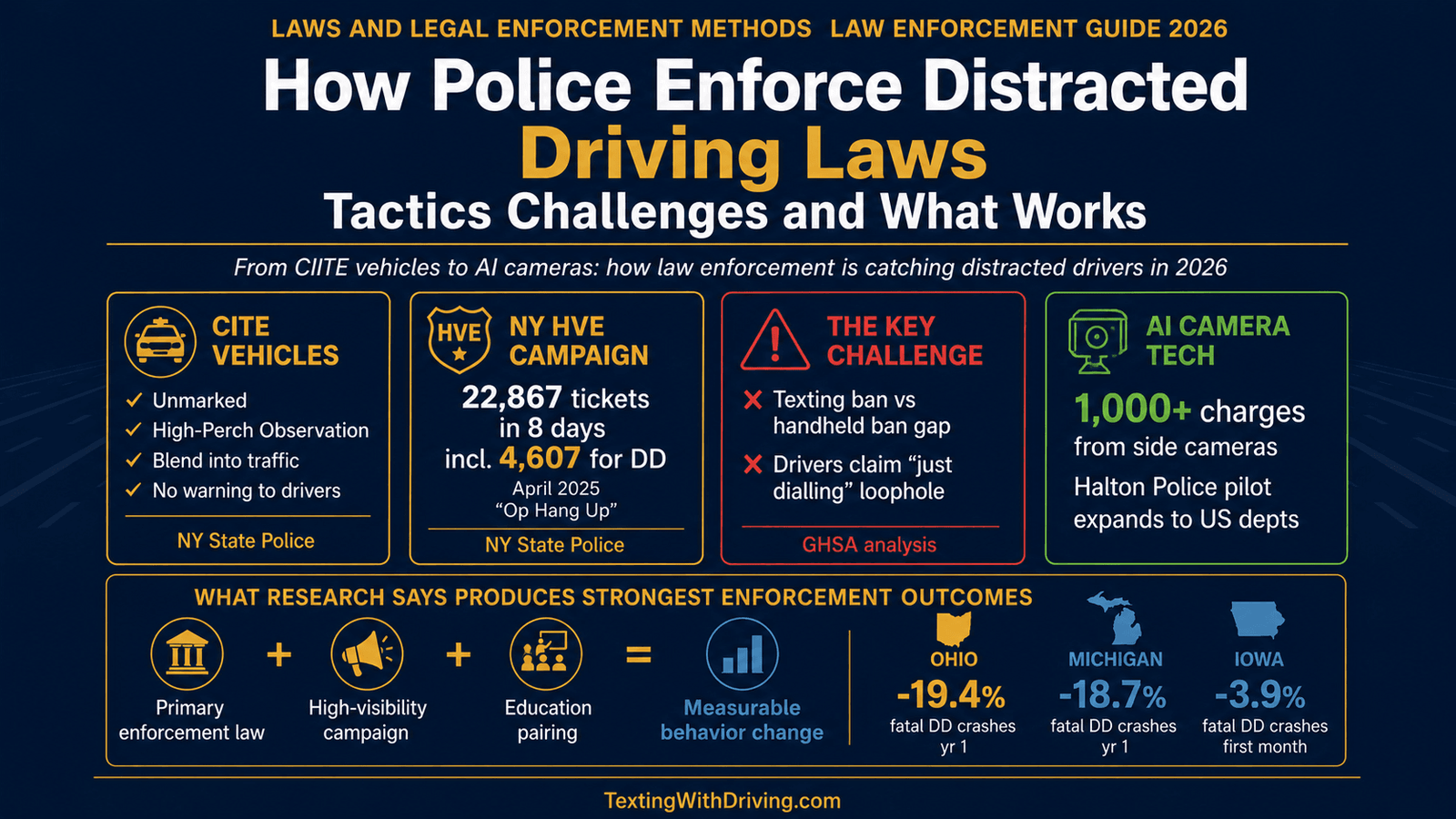
Although texting and handheld bans are both critical, texting bans alone can be difficult to enforce. In states with texting only bans, drivers may claim they were only dialing when stopped by a police officer. Enforcement demonstration projects in New York, Connecticut, Delaware and California have shown that handheld cellphone bans can be enforced effectively and reduce driver use of a cellphone. NHTSA
The texting-only-ban enforcement gap that GHSA identifies is one of the most practically significant challenges in distracted driving law enforcement. When a law prohibits texting but not all handheld use, an officer who stops a driver for phone use faces an immediate challenge: the driver can claim they were dialing rather than texting. The officer observed the phone in the driver’s hand but cannot determine from that observation alone whether the specific prohibited activity of texting was occurring.
This is why comprehensive handheld bans, which prohibit holding the device for any reason regardless of the specific activity, are so much easier to enforce than texting-only bans. When any phone-in-hand observation is a violation, the officer does not need to determine what the driver was doing with the phone. The holding itself is the evidence. The observation is complete.
The CITE Vehicle Program: What Unmarked Enforcement Looks Like
One of the most effective tactical approaches to distracted driving enforcement is the use of Concealed Identity Traffic Enforcement vehicles, which are specifically designed to observe violations that drivers would avoid if they could see marked police cars approaching.
Troopers will utilize both marked State Police vehicles and Concealed Identity Traffic Enforcement vehicles. These specialized vehicles allow troopers to better observe violations from an elevated vantage point. While CITE vehicles blend into everyday traffic, they are clearly identifiable as emergency vehicles when emergency lighting is activated. Trafficsafetymarketing
CITE vehicles address a fundamental problem with marked police car enforcement of distracted driving: drivers are constantly scanning for police vehicles and adjust their behavior the moment they spot one. A driver who has been looking at their phone for the past three minutes will put it down when they see a marked patrol car in their mirror or ahead on the road. The behavioral change is real but temporary: the phone comes back out once the marked car is out of sight.
CITE vehicles are purpose-built to prevent this temporary compliance response. They are typically civilian-looking vehicles, often SUVs or sedans, that blend into ordinary traffic. They may be elevated slightly, providing the officer with a better sight line into the windows of surrounding vehicles to observe driver hand position and screen visibility. The driver being observed has no way to distinguish the CITE vehicle from any other car on the road.
When the officer observes a violation, they radio ahead to a partner in a marked vehicle who initiates the traffic stop. The CITE vehicle operator provides the testimony and evidence. The marked vehicle executes the stop. The driver has no idea they were being observed from a vehicle they assumed was just another commuter.
The New York State Police have deployed CITE vehicles in their Operation Hang Up distracted driving enforcement campaigns for several years. The tactical effectiveness is documented in their citation counts: during the April 2025 Operation Hang Up, NY State Police issued 22,867 total tickets including 4,607 specifically for distracted driving violations in just eight days of enforcement. The previous year’s 2024 campaign produced 21,768 tickets including 4,056 for distracted driving. The CITE-assisted enforcement is a significant contributor to these volumes.
High-Visibility Enforcement: The Research Behind Coordinated Campaigns
The most extensively researched and best-documented approach to distracted driving enforcement is high-visibility enforcement, which combines intensive, publicized police activity with parallel public education campaigns.
The theory behind high-visibility enforcement is grounded in behavioral economics. Drivers are more likely to change behavior when they perceive a high probability of being caught than when they simply know a behavior is prohibited. Awareness of danger is insufficient on its own to change habituated behavior, as we documented in our article on the psychology of phone addiction and distracted driving. But a substantially elevated perceived probability of being caught and fined changes the cost-benefit calculation in a way that produces real behavioral change.
NHTSA’s Put the Phone Away or Pay campaign, which we covered in detail in our Distracted Driving Awareness Month 2026 article, is the most extensively deployed high-visibility enforcement program in the country. The April 2026 campaign included a $5 million national media buy in English and Spanish, combined with a coordinated national enforcement window from April 6 to 13 where law enforcement agencies across all 50 states conducted targeted distracted driving enforcement operations simultaneously.
The national simultaneity of the enforcement window is a key feature of the program’s effectiveness. When drivers see NHTSA advertising about distracted driving enforcement and simultaneously observe heavier-than-normal police presence, the perceived enforcement risk rises across the entire driving population, not just in the immediate vicinity of where a specific officer is deployed.
NHTSA provides funding and resources to support states in running these campaigns, including the Traffic Safety Marketing toolkit at trafficsafetymarketing.gov that makes campaign materials freely available to law enforcement agencies, media outlets, and community organizations.
The Enforcement-Education Pairing: Why Both Are Necessary
The research on enforcement effectiveness consistently shows that enforcement alone produces behavioral change during and immediately after an enforcement campaign, with some regression afterward. Education alone produces attitude change without reliably producing behavior change. The combination of enforcement and education produces the most durable outcomes.
Enforcement is essential to changing risky behavior and reducing road deaths. However, distracted driving enforcement is challenging because distraction occurs in many forms and with varying levels of risk. Some distractions cannot be directly observed on the road, such as daydreaming, and the language in legislation can be difficult to apply precisely in some situations. NHTSA
The National Distracted Driving Coalition makes the fundamental challenge explicit: not all distraction is observable. An officer can observe a driver holding a phone. They cannot observe a driver who is cognitively distracted by a hands-free call, daydreaming, or engaged in an emotionally demanding conversation with a passenger. The enforceable behaviors are those with visible physical manifestations.
This observability limitation means that enforcement can only reach the most visible forms of distraction, primarily handheld device use. The broader category of distraction that produces a significant share of crashes, including the cognitive distraction from hands-free calls that we documented in our article on whether voice-to-text is safe while driving, is outside the reach of enforcement. Only education and behavioral change strategies can address these non-observable forms.
The most effective enforcement programs acknowledge this limitation explicitly and pair enforcement of observable violations with education about the full range of distraction behaviors. NHTSA’s law enforcement toolkit from IACP specifically includes community education components alongside enforcement tactics precisely because enforcement-only approaches address only part of the problem.
The Grace Period Model: Building Awareness Before Enforcement
A significant element of how distracted driving laws are enforced during their initial implementation phase is the deliberate use of warning periods before citations begin. We have covered this approach in the context of several specific laws, including Pennsylvania’s Paul Miller’s Law, Louisiana’s HB 519, and Iowa’s hands-free law.
The grace period model serves several specific enforcement functions beyond simply giving drivers time to adjust.
First, it creates a uniform baseline of public awareness before financial penalties create adversarial interactions. An officer who issues a warning rather than a citation during the grace period is simultaneously an enforcement contact and an education contact. The driver who receives a warning leaves with knowledge of the law’s specific requirements that they may not have had before the stop.
Second, it allows law enforcement agencies to develop and standardize their enforcement protocols. Officers need training on the specific language of new laws, the evidentiary standards for citations, the exceptions and exemptions that apply, and the documentation procedures for violations. A six-month warning period provides this training window while the law is already operationally active.
Third, it allows law enforcement data systems to integrate the new violation type into citation processing, court systems, and DMV records before the volume of actual citations creates administrative pressure. Pennsylvania implemented Paul Miller’s Law with a 12-month warning period specifically to allow maximum preparation time across the commonwealth’s diverse law enforcement jurisdictions.
The Evidence Documentation Challenge
Beyond the primary-versus-secondary enforcement distinction, distracted driving evidence documentation creates specific challenges that other traffic violation enforcement does not face.
A speeding citation is supported by radar or lidar measurement. A red light violation is supported by camera footage or the officer’s direct observation of the vehicle position relative to the stop line. A distracted driving citation is supported primarily by the officer’s direct observation of the driver’s hand position and phone screen visibility.
In states without primary enforcement authority, officers who stop a driver for another violation and observe phone use face an additional evidentiary challenge: documenting what specifically the driver was doing with the phone. A driver who claims they were dialing rather than texting in a state with a texting-only ban has created a credible alternative explanation that the officer’s observation may not definitively rule out.
The legal profession’s response to this challenge is the subpoena of phone records, which we covered in our article on whether you can be sued for texting while driving. In civil litigation, phone records that show a text was sent or received at the time of a crash provide definitive evidence. But obtaining those records requires a subpoena, which takes weeks and is more practical in civil cases with established legal proceedings than in the immediate traffic enforcement context.
The Equity Dimension: Who Gets Stopped
Any discussion of traffic enforcement in the United States must acknowledge the documented disparities in how traffic laws are enforced across different communities.
While law enforcement plays a vital role in reducing distracted driving crashes, injuries and fatalities, it is critical that state laws be equitably applied regardless of race, nationality, gender, sexuality, or any other unique characteristics. NHTSA
GHSA’s explicit statement on equitable enforcement reflects the documented concern in law enforcement policy that primary enforcement traffic laws, which expand officer discretion to initiate stops, can be applied unequally across demographic groups. The broader research on traffic stop disparities shows that driver race and ethnicity are correlated with stop rates in ways that cannot be fully explained by differential driving behavior alone.
The response to this concern in recent distracted driving legislation includes mandatory data collection requirements. Pennsylvania’s Paul Miller’s Law specifically requires collection of race, ethnicity, and gender data from all traffic stops related to the hands-free law, with annual public reporting. This data transparency provision creates accountability for equitable enforcement that law text alone cannot provide.
The Pennsylvania model of mandatory stop data collection alongside primary enforcement authority represents the current best practice for addressing equity concerns in distracted driving enforcement, and advocates have cited it as a template for other states considering similar legislation.
Cameras and Technology: The Expanding Enforcement Toolkit
One of the most significant developments in distracted driving enforcement in 2025 and 2026 is the expansion of automated and camera-based detection systems beyond the traditional officer observation model.
Halton police’s front-line officers have a new tool available that has helped produce over 1,000 distracted driving charges since January. Officers have begun deploying side-camera technology on their police vehicles, modernizing evidence collection for distracted driving enforcement. NHTSA
The side-camera technology being deployed by some departments mounts a camera system on police vehicles that captures high-quality video of driver behavior in adjacent vehicles as the patrol car travels alongside them in traffic. This provides documentary evidence of phone use that the officer’s personal observation alone may not produce in a form that withstands legal challenge.
As we covered in our article on the Textalyzer, the most ambitious technology solution for distracted driving enforcement remains in a pre-legislative stage in every US state. But the expansion of camera technology for evidence collection is actively progressing, with multiple law enforcement agencies incorporating it into their standard toolkit.
AI-linked speed and phone detection cameras in school zones represent a parallel technology development, also covered in our school zone distracted driving laws article. These fixed-location systems can generate citations automatically without requiring officer presence, creating continuous enforcement coverage that cannot be achieved through patrol-based enforcement alone.
The Motorola Avigilon phone detection system and similar AI-powered camera platforms are being piloted by several US law enforcement agencies following successful deployments in Australia and New Zealand, where automated phone detection cameras have produced both significant citation volumes and measurable reductions in observed phone use at monitored locations.
What the Data Shows Actually Works
The strongest evidence for enforcement effectiveness comes from the before-and-after crash data in states that have implemented comprehensive hands-free laws with primary enforcement and concurrent public education campaigns.
In 2024, GHSA and Cambridge Mobile Telematics released a report, A Road Map for Safer Roads, that details how distracted driving has fallen in states like Ohio, Alabama, Michigan, and Missouri after they implemented hands-free laws. NHTSA
The state-level outcome data is unambiguous in its direction. Ohio’s 19.4 percent reduction in fatal distracted driving crashes in year one, Michigan’s 18.7 percent reduction in phone distraction post-law, Missouri’s 7.8 percent first-year improvement, and Iowa’s 3.9 percent first-month improvement all reflect the same pattern: primary enforcement hands-free laws, when properly communicated and actively enforced, produce measurable behavioral change at scale.
The enforcement model that produces these outcomes combines four elements: a comprehensive primary enforcement law that makes the violation easy to observe and difficult to argue against, a public awareness campaign that begins before enforcement citations start and continues throughout the year, high-visibility enforcement campaigns that temporarily intensify the perceived risk of being caught, and consistent baseline enforcement between campaigns that sustains the behavioral change produced during campaign periods.
The Ohio model, which we covered in full detail in our Ohio distracted driving law results 2026 article, is the most extensively documented example of this four-element approach in American history. The 15,400 fewer total crashes in year one are the clearest available evidence that law enforcement, when given the right tools and supported by appropriate legislative frameworks and public communication, can produce road safety outcomes at a scale that justifies every resource invested.
For the complete legal framework in every state that law enforcement is working within, our hands-free driving laws by state 2026 guide covers all 50 states with enforcement types, fine structures, and current legislative status. For the national death toll that all of this enforcement effort is working to reduce, our distracted driving statistics 2026 overview has the complete picture.
Sources Used in This Article
All links verified working before publication.
New York State Police: Put the Phone Away or Pay Enforcement Campaign — CITE vehicle details, April 2026 22,867 ticket data, April 6, 2026
New York State Police: Operation Hang Up April 2025 — April 2025 campaign data, CITE vehicle description
GHSA: Distracted Driving State Laws — Primary vs secondary enforcement, texting ban loophole, equitable enforcement language, October 2025
National Distracted Driving Coalition: Enforcement Page — Enforcement challenges and law enforcement toolkit reference
Kustom Signals: 5 Ways Traffic Enforcement Is Fighting Distracted Driving — Side camera technology, Halton Police 1,000+ charges, January 2026
NHTSA: Put the Phone Away or Pay Campaign — $5M media buy, April 2026 enforcement window
NHTSA Traffic Safety Marketing: Campaign Resources — Free campaign materials for law enforcement
NHTSA and IACP: Distracted Driving Enforcement Toolkit — Comprehensive enforcement best practices guide
PennDOT: Paul Miller’s Law — Mandatory stop data collection requirement
CMT and GHSA: A Road Map for Safer Roads 2024 — State-level improvement data
TextingWithDriving.com is professionally built and maintained to ensure accurate, accessible safety information reaches every driver who needs it. Website development and ongoing support is handled by Budgetic, a digital agency specializing in purpose-driven WordPress websites.

About Texting With Driving
TextingWithDriving.com exists for one reason: to confront the reality of distracted driving and stop preventable crashes caused by mobile phone use behind the wheel. Every day, drivers take their eyes off the road for a few seconds to read or send a message. Those few seconds are enough to cause life-altering consequences. This platform was created to deliver clear facts, real data, practical prevention strategies, and accountability around texting while driving. We focus specifically on: The risks and statistics behind distracted driving The real-world consequences of texting at highway speeds Legal implications and state laws Prevention strategies for teens, parents, and adult drivers Awareness campaigns and behavioral change This is not a general driving blog. It is a focused awareness initiative built around one critical issue: phone distraction behind the wheel. Our content is direct, research-driven, and practical. We prioritize accuracy over opinion and education over sensationalism. The goal is simple — reduce distracted driving incidents by increasing awareness and responsibility. If one article causes one driver to put their phone down, the mission is working. For inquiries or partnerships, contact: privacy@textingwithdriving.com
View all posts by Texting With Driving