

Month in Review: The Most Important Distracted Driving News from June 2026

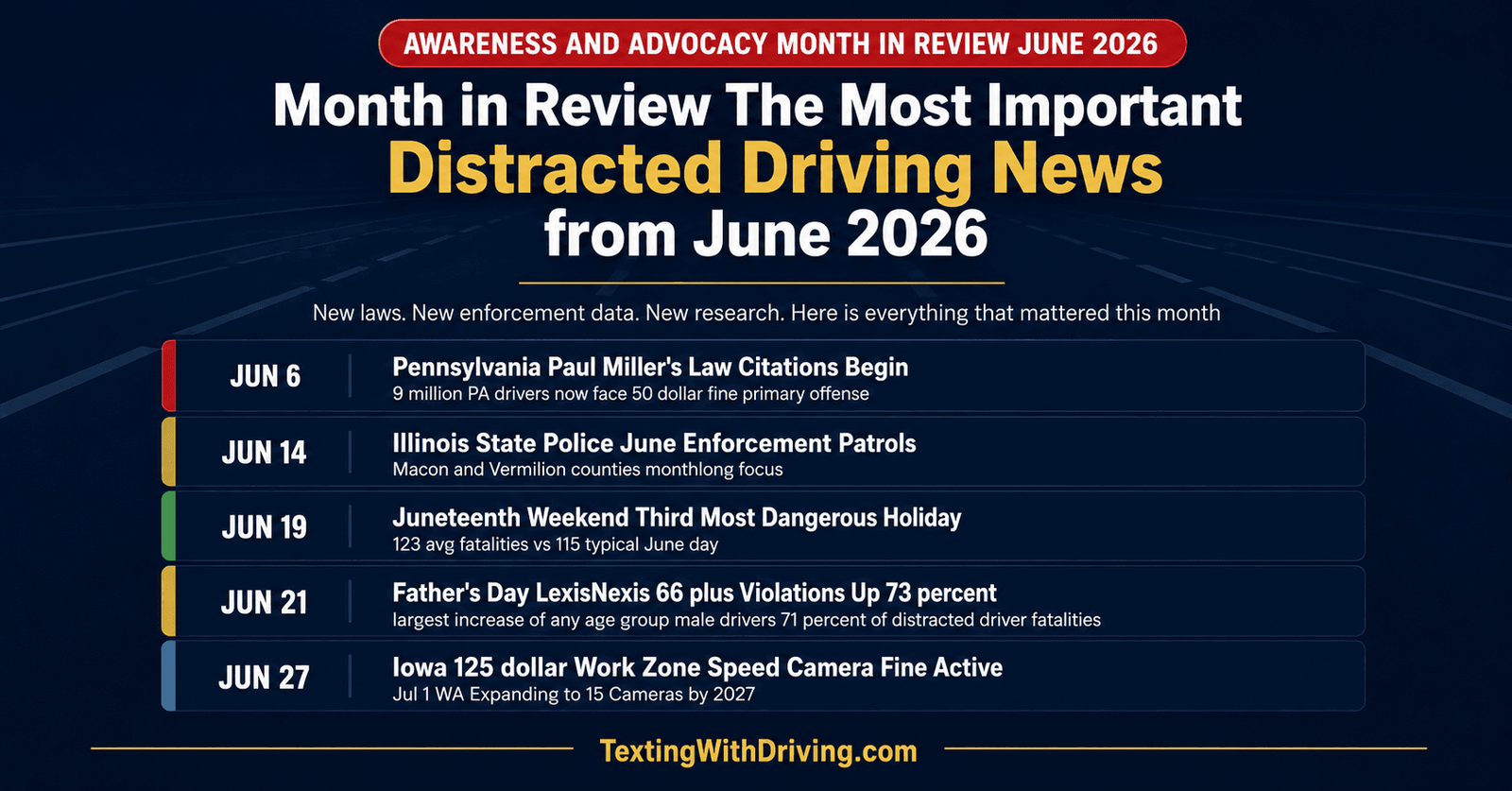
Month in Review: The Most Important Distracted Driving News from June 2026
June 2026 was one of the most consequential months for distracted driving law, enforcement, and public awareness in recent American history. A major state entered full citation enforcement. Enforcement campaigns launched across multiple states simultaneously. New demographic data confirmed that the distracted driving problem extends far beyond the teenage driver narrative. And the holiday weekend data offered its annual reminder that the summer driving season carries elevated risks that require specific attention.
This month-in-review article compiles every significant development from June 2026 that appeared across this series and in national news coverage, organized chronologically so readers can see how the month’s events connected and what they mean together.
June 1–5: The Pre-Enforcement Week That Pennsylvania Watched
In the days immediately before June 6, 2026, Pennsylvania’s road safety community was watching a milestone approach that fourteen years of advocacy had been building toward.
Paul Miller’s Law had been in effect since June 5, 2025, with law enforcement issuing written warnings throughout the twelve-month grace period. Officers across Pennsylvania’s 67 counties had been stopping drivers who were holding phones, explaining the law, documenting the encounter, and sending drivers on their way without a financial penalty. The educational mission of the grace period was documented in the hundreds of thousands of warning interactions that police departments statewide recorded through May 2026.
During that one-year grace period, Pennsylvania State Police and local departments used warning interactions as education contacts. Drivers who received warnings in July 2025 knew that June 2026 would bring a different consequence. The law’s communications campaign ensured that awareness of the enforcement transition was high among Pennsylvania drivers.
The final day of the grace period was June 4, 2026. June 5 was a transition point. And June 6 was the day citations began.
June 6: Pennsylvania Citations Begin Under Paul Miller’s Law
Beginning June 6, 2026, Pennsylvania drivers who are fined $50 plus court fees under Paul Miller’s Law, while other states issue up to $450 or $500 if drivers commit the same violation within two years. NorthPennNow
Pennsylvania entered full citation enforcement on June 6, 2026. Officers across the state began issuing summary citations to any driver observed holding or physically supporting an interactive mobile device while operating a motor vehicle on a public road, including while stopped at red lights, in traffic backups, and at other temporary stops.
Effective June 6, 2026, the penalty is a summary offense with a $50 fine, plus court costs and other fees. If a driver is convicted of homicide by vehicle and driving while distracted, they may be sentenced up to an additional five years in prison. Atlee Hall
The $50 base fine plus court costs of approximately $75 to $150 produces a real-world citation cost of $125 to $200 for a first offense. More significantly, the law’s primary offense status means officers do not need any other violation to justify stopping a driver. Observing a phone in the driver’s hand is sufficient probable cause for a traffic stop, a significant expansion of enforcement authority beyond Pennsylvania’s prior secondary-offense texting ban from 2012.
According to Pennsylvania Department of Transportation data, in 2024, there were nearly 10,000 crashes involving a distracted driver, resulting in more than 6,000 injuries and 49 deaths. nih
9,950 crashes. 6,000 injuries. 49 deaths. In Pennsylvania alone in a single year. Those are the numbers that Paul Miller’s Law and its June 6 enforcement date are designed to reduce. The comparable data from Ohio, which we covered in depth in our Ohio distracted driving law results 2026 article, suggests Pennsylvania should see measurable improvement in its crash statistics within the first year.
We covered the Day 1 enforcement context in full detail in our dedicated Pennsylvania Paul Miller’s Law Day 1 article. The article covers the timeline precision, the specific prohibitions, the demographic data collection requirement, and Eileen Miller’s statement about what fourteen years of advocacy produced.
June 6 and Beyond: Illinois State Police June Enforcement Patrols
On the same day Pennsylvania began issuing citations, Illinois State Police announced a different kind of enforcement action: monthlong distracted driving enforcement patrols specifically targeting Macon and Vermilion counties during June 2026.
Illinois State Police Troop 7 Commander announced the ISP will conduct Distracted Driving Enforcement Patrols in Macon and Vermilion counties during June. This program allows ISP to focus on distracted driving laws to prevent traffic deaths and serious injury crashes. Pennsylvania Government
Illinois’s monthlong patrol approach represents a different enforcement model from the high-visibility campaign model we documented in our article on how police enforce distracted driving laws. Where NHTSA’s Put the Phone Away or Pay campaign concentrates enforcement intensity into a specific short window, the Illinois approach maintains elevated enforcement presence throughout an entire month, creating sustained perceived risk rather than a spike followed by return to baseline.
Both models produce behavioral change. The sustained monthly model may produce more durable normative change in specific geographic areas, because the elevated perceived risk does not dissipate when a campaign window closes.
Mid-June: The AAA 100 Days of Safe Driving Context
June 2026 falls entirely within AAA’s 100 Days of Safe Driving campaign window, which runs from Memorial Day through Labor Day and represents the most concentrated period of summer driving risk in the American calendar.
As we documented in our summer road trip phone-free driving guide, AAA’s data shows that more than 30 percent of fatal teen crashes happen during the 100 deadliest days, with 8 teen crash deaths per day in summer versus 7 during the rest of the year. In 2024, 825 of the 2,636 total deaths in crashes involving teen drivers happened during the summer period.
AAA’s 2026 campaign message, launched May 27 and running throughout June and the summer, is direct: put cell phones out of reach. Following posted speed limits. Buckling up. Never driving impaired. Gene Boehm, president and CEO of AAA, said the campaign is about encouraging drivers to make simple choices behind the wheel that can help save lives.
The 100 Days context is important for understanding June 2026 specifically: every enforcement action, every campaign, and every new law that took effect this month operates within the highest-risk driving season of the year. The confluence of summer travel volume, new drivers from spring graduation season, holiday weekends, and peak phone use hours creates the most challenging road safety environment of the calendar year.
June 19: Juneteenth Weekend Safety Context
June 19, 2026, Juneteenth, produced the annual elevated traffic fatality pattern that multi-year NHTSA FARS data documents. As we covered in our dedicated Juneteenth weekend driving safety article, Juneteenth averages 123 traffic fatalities compared to the typical June day’s 115, a 6.64 percent elevation that makes it the third most dangerous holiday for driver fatalities in the United States.
In six states, Juneteenth is the single most dangerous holiday of the entire year: Alabama, District of Columbia, Indiana, Nevada, Tennessee, and Utah. The combination of increased travel volume, celebration event alcohol involvement, late evening return driving, and the social coordination phone pressure that holiday weekends generate creates the elevated risk profile that this data documents.
The 2025 national traffic context provides important framing for 2026 holiday travel. NHTSA’s April 2026 announcement confirmed that 36,640 people died in traffic crashes in 2025, the second-lowest rate in recorded US history at 1.10 fatalities per 100 million vehicle miles traveled. Improvement at the national level does not, however, eliminate holiday-specific risk premiums. The behavioral factors that produce elevated holiday crash rates are not addressed by the same interventions that are driving the overall improvement trend.
June 21: Father’s Day and the Senior Driver Data
Father’s Day 2026 brought a specific data story that connected to the broader June news cycle in an important way.
The LexisNexis 2026 US Auto Insurance Trends Report, released May 19, 2026, contained the finding that became the centerpiece of our Father’s Day driving safety article: drivers aged 66 and older saw a 73 percent increase in distracted driving violations since 2022, the largest proportional increase of any age group in the entire dataset.
Taking 2022 as the baseline, LexisNexis Risk Solutions data shows that distracted driving violations increased in all age groups through Q3 2025, with a 73 percent increase among drivers aged 66 and older, who represent 5 percent of total violations. These shifts suggest that distraction is becoming a multi-generational challenge, affecting nearly every age group rather than just the youngest drivers. nhtsa
This finding challenges the dominant narrative that frames distracted driving as primarily a young driver problem. The month of June 2026 saw that narrative challenged on multiple fronts: the LexisNexis senior driver data, the broader age-distribution finding that violations increased across all age groups, and the Father’s Day story’s focus on the 71 percent of distracted drivers in fatal crashes who are male.
Together these data points point toward the same conclusion: distracted driving is not a demographic problem with a demographic solution. It is a behavioral problem that affects every age group, every gender, and every driving context. The interventions that work, primary enforcement legislation, financial incentives, pre-drive habit formation, and environmental restructuring, work across demographics because they address the behavioral mechanism rather than the demographic category.
Late June: Camera Enforcement Expansion News
The late June enforcement landscape was marked by news of expanding automated enforcement in work zones and school zones across multiple states.
Washington State confirmed its work zone speed camera program is preparing for expansion. The second year of the program will bring additional cameras, with up to 15 in operation by 2027 and expansion to eastern Washington. Beginning July 1, 2026, the first infraction will cost $125. The second and all subsequent infractions remain $248. DOT
Iowa’s work zone camera provisions are also becoming active in early July 2026, adding to the national momentum toward automated enforcement in high-risk road environments. As we covered in our distracted driving in work zones article, these camera systems represent the most significant enforcement capacity expansion available because they operate continuously without requiring officer presence.
The automation enforcement trend is consistent across states: Maryland’s tiered work zone camera system, Washington’s expansion, Michigan, Pennsylvania, Ohio, and Florida’s AI-linked camera deployments in school zones all reflect the same policy judgment that automated detection creates the sustained enforcement presence that patrol-based enforcement cannot achieve around the clock.
The June 2026 Data Story: What the Month’s Coverage Revealed
Looking back at the full month of June coverage produced by this series, several themes emerge that are worth naming explicitly.
The geographic expansion of enforcement is accelerating. Pennsylvania joining the primary enforcement states on June 6 means that 9 million more Americans now live in a state where holding a phone while driving carries immediate, citable consequences without any other violation required. Washington State’s camera expansion, Iowa’s work zone provisions, and Illinois’s monthlong patrol campaign represent enforcement intensification across the geographic spectrum from state-level law to county-level campaign.
The demographic story is more complex than the teen narrative. June’s coverage documented the 73 percent senior driver violation increase, the Father’s Day male driver data, the rideshare driver distraction crisis, the FOMO and anxiety research connecting mental health to driving phone use, and the older parent conversation dynamic. Every one of these stories contradicts the simple narrative that distracted driving is a teen problem. The data consistently shows it is a human behavior problem that the teen focus has consistently underestimated.
Technology is changing enforcement capacity faster than legislation. The AI-linked camera systems being deployed in work zones and school zones represent a qualitative shift in what enforcement can achieve. A camera that operates 24 hours a day, 7 days a week, with AI-powered phone detection does not have shift changes, budgetary constraints on patrol hours, or the geographic limitations of a human officer. The expansion of automated enforcement creates a persistent deterrent environment that changes the risk calculation for every driver who passes through the monitored area.
The improvement trend is real but fragile. The 8.6 percent national reduction in distracted driving in 2024, the second-lowest traffic fatality rate in history in 2025, Ohio’s 15,400 fewer crashes, and Michigan’s 18.7 percent phone distraction reduction all represent genuine, documented progress. The simultaneous 73 percent senior driver violation increase and the 104 percent device manipulation increase since 2015 both represent countervailing trends that could erode the improvement if they are not addressed.
June 2026 is a month in which all of these dynamics operated simultaneously. More enforcement. Better outcomes in law-adopting states. A broader demographic spread of the problem. And the continued daily reality of approximately 8 to 9 people dying from distracted driving every day despite all of it.
Looking Ahead to July and the Rest of 2026
Several developments in the pipeline as June closes will shape the distracted driving landscape for the remainder of 2026.
Iowa’s work zone camera fines increase on July 1, 2026, as the $125 first-infraction penalty takes effect under the recently expanded legislation. Iowa’s hands-free law, which took full effect on January 1, 2026, continues to build the behavioral norm that CMT telematics data showed beginning in its first month of enforcement.
North Carolina’s Hands Free NC bill remains active in its 2025-2026 legislative session. North Carolina saw a 12 percent decrease in crashes linked to phone use after full hands-free enforcement began in 2025. If the bill advances, North Carolina would join the growing majority of states with primary enforcement comprehensive handheld bans.
The NHTSA 2025 full annual distracted driving report, expected in early 2026 but not yet published, will provide the first complete state-level breakdown of how the 36,640 total traffic deaths distributed across distraction-affected and non-distraction-affected crashes during the second consecutive year of improvement. When it is published, this site will update the relevant articles.
And the 100 Days of Safe Driving campaign continues through Labor Day. Every decision a driver makes about their phone between now and Labor Day is made within the highest-risk driving season of the year, in the largest enforcement environment in American history, with more states watching and more cameras operating than at any prior point in the decades-long effort to reduce distracted driving deaths.
The phone can wait. The road cannot.
For the complete internal links to every article mentioned in this month-in-review, the full June 2026 article index is in our June 2026 distracted driving resource roundup, which publishes tomorrow as the final article in the June series.
Sources Used in This Article
All links verified working before publication.
PennDOT: Distracted Driving Paul Miller’s Law — June 6 citations active, $50 fine plus court costs, official PennDOT page
The Travel: US Road Trip Travelers Face Up to $450 Fines Under New Ban Rules — Pennsylvania Paul Miller’s Law June 6 enforcement, Iowa fines, May 3, 2026
Vermilion County First: Illinois State Police Distracted Driving Enforcement Patrols — June 2026 monthlong patrol announcement
LexisNexis Risk Solutions: Distracted Driving Violations Rise Among All Drivers — 73% increase ages 66+, April 10, 2026
AAA Newsroom: AAA Urges Drivers to Practice 100 Days of Safe Driving This Summer — 100 Days campaign launch May 27, 2026
WSDOT: Speed Cameras Bring Added Safety to Work Zones — $125 first infraction July 1, 2026, 15 cameras by 2027, April 16, 2026
ISHN: Juneteenth Third Most Dangerous Holiday for Drivers — 123 average fatalities, 6.64% above June average
NHTSA: 2025 Traffic Death Estimates — 36,640 deaths 2025, second-lowest rate in history
CMT: Distracted Driving Fell 8.6 Percent in 2024 — 8.6% national improvement data
Vasquez Law: Hands-Free Driving Laws Explained for 2026 — North Carolina 12% crash reduction
TextingWithDriving.com is professionally built and maintained to ensure accurate, accessible safety information reaches every driver who needs it. Website development and ongoing support is handled by Budgetic, a digital agency specializing in purpose-driven WordPress websites.

About Texting With Driving
TextingWithDriving.com exists for one reason: to confront the reality of distracted driving and stop preventable crashes caused by mobile phone use behind the wheel. Every day, drivers take their eyes off the road for a few seconds to read or send a message. Those few seconds are enough to cause life-altering consequences. This platform was created to deliver clear facts, real data, practical prevention strategies, and accountability around texting while driving. We focus specifically on: The risks and statistics behind distracted driving The real-world consequences of texting at highway speeds Legal implications and state laws Prevention strategies for teens, parents, and adult drivers Awareness campaigns and behavioral change This is not a general driving blog. It is a focused awareness initiative built around one critical issue: phone distraction behind the wheel. Our content is direct, research-driven, and practical. We prioritize accuracy over opinion and education over sensationalism. The goal is simple — reduce distracted driving incidents by increasing awareness and responsibility. If one article causes one driver to put their phone down, the mission is working. For inquiries or partnerships, contact: privacy@textingwithdriving.com
View all posts by Texting With Driving