

How to Talk to an Older Parent About Distracted Driving

How to Talk to an Older Parent About Distracted Driving
Most of the distracted driving conversations in this series have run in one direction: parents talking to teenage children. The research, the campaigns, and the school programs are overwhelmingly oriented toward younger drivers who are forming driving habits for the first time.
This article reverses that dynamic entirely.
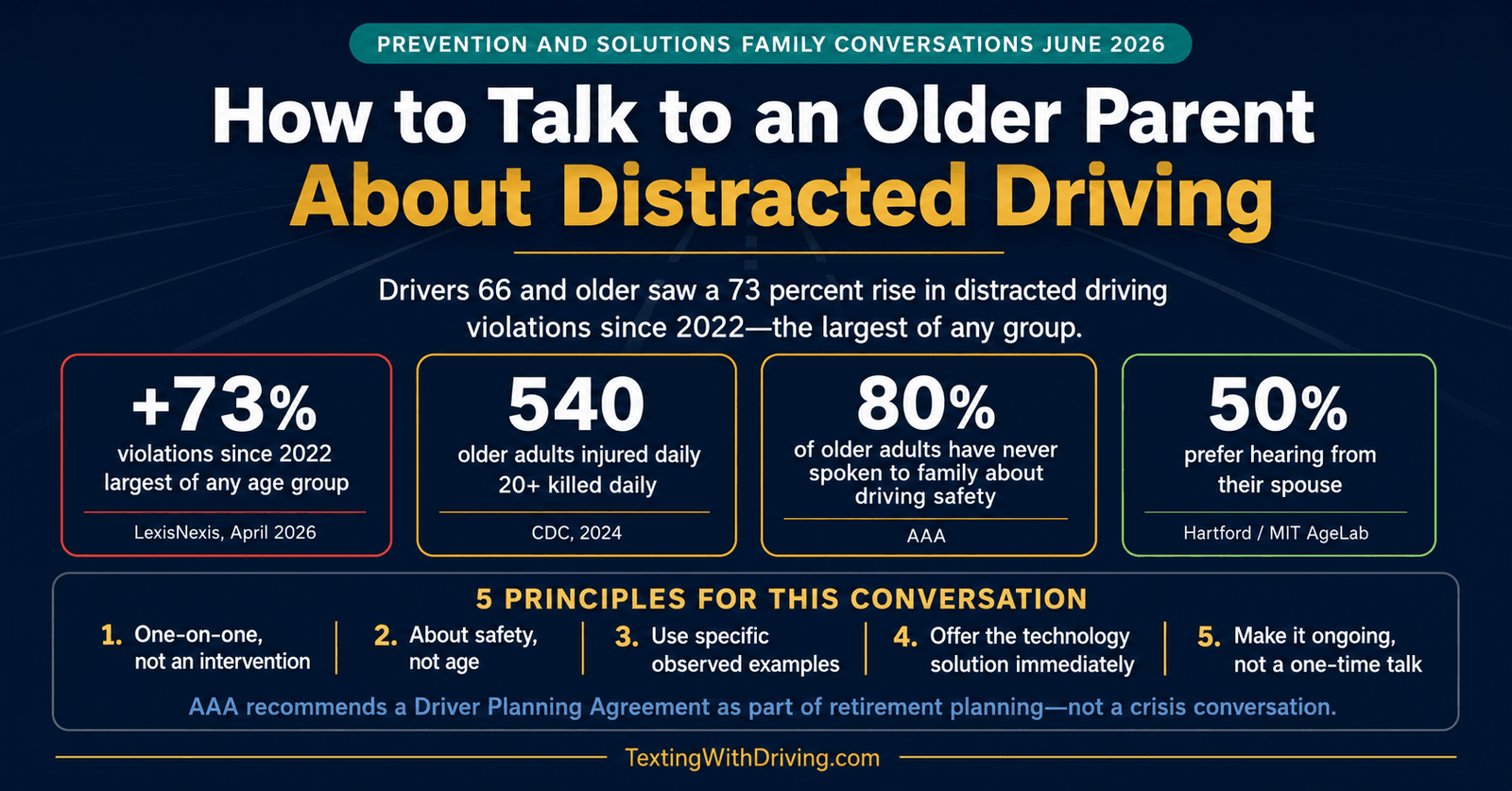
The 2026 LexisNexis US Auto Insurance Trends Report, released May 19, 2026, contains a data point that received far less attention than it deserved: drivers aged 66 and older saw a 73 percent increase in distracted driving violations since 2022. That is the largest proportional increase of any age group in the entire dataset, tied only with the 36 to 45 cohort.
Drivers 66 and older. 73 percent more violations than four years ago. A generation of drivers who adopted smartphones later than their children and grandchildren are now engaging in distracted driving at a rate that is growing faster than any other demographic group.
If you have an older parent who drives, this article is about the conversation you may need to have and how to have it in a way that preserves the relationship, respects their autonomy, and actually produces a change in behavior.
Why This Conversation Is Different From the Teen Driving Conversation
The conversation about phone use while driving with a teenager is challenging because teens are forming habits and may feel invulnerable. The conversation about phone use while driving with an aging parent is challenging for a fundamentally different reason: it touches on independence, identity, and the feared loss of both.
Driving is not just transportation for most older adults. It represents the ability to get to medical appointments, visit friends, handle their own errands, and maintain the self-sufficiency that defines adult life. Any conversation about driving safety carries the implicit shadow of a conversation about losing that independence entirely, even when that is not what the conversation is actually about.
This context means that an adult child who approaches their parent with “I’m worried about your driving” is often heard as “I’m thinking about taking your keys.” Even when that is genuinely not the intent, the emotional resonance of the conversation is shaped by the parent’s awareness that this is the direction these conversations sometimes eventually go.
Understanding this emotional landscape is the prerequisite for having the conversation effectively.
The Data That Makes This Conversation Necessary
Before the conversation framework, understanding why this conversation is statistically urgent in 2026 rather than just emotionally difficult.
Taking 2022 as the baseline, LexisNexis Risk Solutions data shows that distracted driving violations increased in all age groups through Q3 2025, with a 73 percent increase among drivers aged 66 and older, who represent 5 percent of total violations. These shifts suggest that distraction is becoming a multi-generational challenge, affecting nearly every age group rather than just the youngest drivers. nhtsa
73 percent. The Silent Generation and older Baby Boomers, many of whom are in their late sixties, seventies, and eighties, are now showing the steepest distracted driving violation increase of any demographic group in the country.
The explanation is not generational recklessness. It is smartphone adoption trajectory. Older Americans adopted smartphones later than younger generations, meaning that the habitualization of constant phone checking developed later in their driving lives — at an age when driving habits were already established and when the cognitive resources available for habit change are somewhat reduced compared to younger adults. The result is a demographic that is now managing the same phone-notification impulses that younger generations have been managing for a decade, but without the earlier exposure to the consequences and without the same formation of phone-free driving habits during their initial years of smartphone ownership.
As of 2024, almost 540 older adult drivers are injured and more than 20 are killed in auto accidents in the US each day, according to the Centers for Disease Control and Prevention. The Global Statistics
540 injured and 20 killed every single day. The broader older driver safety context, which includes age-related vision, reaction time, and cognitive changes in addition to distracted driving, makes this one of the most significant road safety challenges in the country. The specific distracted driving dimension of that challenge is now growing faster than for any other age group.
The 80 Percent Conversation Gap
Before discussing how to have the conversation, it is worth noting how rarely it actually happens.
More than 80 percent of older adults never speak to a family member or physician about their ability to drive safely, according to a AAA study. NHTSA
Four out of five older drivers never have a conversation with family or their doctor about driving safety. The conversation that this article is about is not only important when it happens. It is the exception rather than the rule, and its absence is the norm even when concerns exist.
AAA’s specific recommendation addresses this gap directly. Rather than a single high-stakes conversation, AAA recommends an ongoing dialogue that starts early and is framed as part of broader life planning rather than as a crisis intervention. Mobility planning should be as much a part of retirement planning as healthcare, housing, and finances.
The implication is that the most effective timing for this conversation is before you are deeply worried, not after an incident has occurred. A conversation about phone-free driving when your parent is driving well is easier to frame as proactive, collaborative, and mutually beneficial than the same conversation after a fender bender or a near-miss.
Who Should Have the Conversation
Before deciding what to say, there is an important prior question: who is the right person to say it.
According to a Hartford/MIT AgeLab survey, 50 percent of married drivers prefer to hear about driving concerns first from their spouses, and those living alone prefer to have these conversations with their doctors, adult children, or a close friend. Some older adults may also be open to hearing from a sibling, adult child’s spouse, or if necessary, a police officer. Baderlaw
Half of married older drivers would prefer to hear concerns from their spouse rather than their adult children. If your parent is married and their spouse shares your concern, the more effective first conversation may be one between the couple rather than between you and your parent. Your parent may be more receptive to hearing this from the person who knows them best and who they trust most completely.
For parents who are widowed or divorced, adult children are often the preferred source. If there are multiple adult children with concerns, the single most trusted sibling is a better choice than a group conversation. Inviting the whole family to the talk will alienate and possibly anger the recipient of the conversation.
The doctor is also a meaningful option for parents who are highly resistant to family conversations about driving. A physician who raises the subject of distracted driving in the context of a routine medical appointment carries a different authority than a family member raising it. If the family conversation has not gone well or if you anticipate significant resistance, asking your parent’s doctor to include a distracted driving discussion in their next visit is a legitimate approach.
The Five Principles for an Effective Conversation
Principle 1: One-on-one, not an intervention.
Before discussing driving with an aging parent, involve family members to align concerns, but ensure the conversation is one-on-one to avoid making them feel overwhelmed or confronted.
Align the family perspective privately before the conversation happens. Ensure agreement on what the concern is, what the desired outcome is, and who is going to raise it. Then have the conversation one-on-one in a private, comfortable setting.
Choose a moment when your parent is relaxed, not tired or rushed, and when there is enough time for a genuine dialogue rather than a brief exchange. Do not have this conversation in the car, immediately after a driving incident, or in a public setting where the emotional response cannot be fully expressed.
Principle 2: Frame it as safety, not age.
Make the conversation about their abilities, not their age. Saying “you’re getting older and I worry about you driving” is heard very differently from “I’ve noticed you’ve been using your phone more while driving and I want to talk about what we can do together.”
The distracted driving conversation with an older parent has a specific advantage over the broader aging driver conversation: it is not about age at all. Distracted driving is equally dangerous for a 35-year-old. It is equally illegal in 33 states plus DC regardless of the driver’s age. Framing it as a specific behavioral concern rather than an age-related capability concern is both accurate and significantly easier to receive.
Nobody wants to be called a dangerous driver, so avoid making generalizations about older drivers or jumping to conclusions about their skills or abilities behind the wheel. Be positive, supportive, and focus on ways to help keep them safely on the go.
Principle 3: Use specific observed examples, not general worry.
General statements like “I worry about you” or “I’ve heard you can be dangerous on your phone” invite defensiveness. Specific examples invite reflection.
While your parents probably don’t want to hear a play-by-play of everything they’re doing wrong while driving, having specific examples that support your concerns can be very persuasive.
If you have been in the car when your parent checked their phone at a red light, described a text they received while driving, or handled navigation by looking at their phone screen, these are specific, non-accusatory, concrete examples that ground the conversation in observable reality rather than general concern.
If you have not personally observed the behavior, the LexisNexis data is a useful starting point: “I read that drivers in your age group are seeing the biggest increase in distracted driving violations in the country, and I wanted to make sure we talked about it.”
Principle 4: Come with the solution, not just the problem.
The most effective version of this conversation does not just identify a concern. It brings the specific, practical, and easy solution that addresses the concern immediately.
The solution for most older drivers is the same two-minute setup we have covered throughout this series: iPhone Driving Focus or Android driving mode, which silences all notifications when the car is moving and sends auto-replies to anyone who messages during the drive. Our Do Not Disturb while driving setup guide covers both platforms from scratch.
Offer to set it up together. Right now, during the conversation. Take five minutes and configure the feature on their phone while they are present. This transforms the conversation from a complaint about behavior to a collaborative problem-solving session that produces an immediate, tangible outcome.
The auto-reply feature specifically addresses the social obligation anxiety that drives much of the impulse to check messages while driving. When every sender receives an automatic message saying “I’m driving and will respond when I arrive,” the pressure to respond immediately is managed by the technology. Your parent can let the phone manage the social obligation while they focus on driving.
Principle 5: Make it ongoing, not a one-time event.
AAA is explicit that this should not be “The Talk” — a single high-stakes conversation that either goes well or goes badly and is then never revisited. It should be an ongoing conversation that is embedded in the relationship over time.
Have an ongoing conversation, not “The Talk.” Mobility planning should be as much a part of retirement planning as healthcare, housing, and finances — and the conversation should start early.
After the initial conversation about phone-free driving, follow up. Ask how the driving mode is working. Mention when you noticed they had their phone in the back seat when you were in the car together. Reinforce the positive behavior rather than focusing exclusively on the concern.
The Driver Planning Agreement that AAA has developed is a useful framework for this ongoing approach. It allows families to plan together for future changes in driving abilities before they become a crisis, covering everything from phone-free driving habits to what transportation alternatives are available in the community.
When the Distracted Driving Conversation Is Part of a Broader Safety Concern
For some adult children, the distracted driving concern is part of a larger set of observations about a parent’s driving that may include other age-related changes: slower reaction times, difficulty maintaining lane position, problems judging gaps at intersections, or confusion about familiar routes.
In these situations, the distracted driving conversation is still the right starting point because it is the most neutral and least threatening framing. But it may need to be followed by a broader conversation about driving evaluation.
Signs that it may be time to stop driving include delayed responses while driving. Elderly drivers may face various challenges, including slower reaction times, reduced vision, hearing impairments, and the impact of medications or age-related health issues such as arthritis or dementia.
If your observation suggests that the distracted driving concern is accompanied by other capability changes, a driving evaluation by a certified driver rehabilitation specialist is available through occupational therapy programs and some AAA offices. This provides an objective professional assessment that removes the family relationship from the judgment process and gives the parent a more authoritative framework for understanding their own driving capabilities.
If your talks aren’t going well, suggest visiting your local DMV. They can take a driving and vision test or a refresher course for senior drivers. If they’re not worried about their driving skills, they should be confident about their ability to prove it.
The Transportation Alternative Framework
One reason the conversation about driving is so difficult is that it feels like it ends at subtraction: less driving, less independence, less freedom. The most effective versions of this conversation also include the addition of alternatives.
Transportation services like Paratransit, which provides rides as needed for disabled or elderly individuals; taxis or rideshare services like Lyft and GoGo Grandparent, which are specifically designed for older adults; county transportation services for seniors through Area Agency on Aging and Disability programs; grocery and food delivery services; and scheduling coordination with family members for specific trips all expand the conversation from a pure restriction to a practical planning discussion.
If your parent can picture what their life looks like if they reduce phone use while driving or eventually reduce driving frequency, with specific transportation alternatives already identified and discussed, the conversation becomes genuinely collaborative rather than feeling like a removal of something essential.
The Conversation You Are Actually Having
Here is what this conversation is really about when it is done well.
It is not about taking away independence. It is about protecting the independence that driving provides for as long as possible. A parent who causes a serious crash because they were looking at their phone faces consequences that are far more limiting to their independence than a Driving Focus mode that silences their notifications. The citation, the insurance increase, the potential license consequences, the injury to themselves or others — all of these are more serious threats to ongoing independence than the behavioral change you are asking for.
Frame it that way. You are not trying to reduce their freedom. You are trying to make sure the freedom they have now continues for as long as possible.
For the statistical context that frames the urgency of this conversation, our distracted driving statistics 2026 overview covers the national picture. For the technology setup that addresses the specific behavioral concern immediately, our Do Not Disturb while driving setup guide covers both platforms. And for the insurance implications of the 73 percent violation increase in older drivers, our article on distracted driving insurance statistics covers what the LexisNexis 2026 report reveals for all age groups.
Sources Used in This Article
All links verified working before publication.
LexisNexis Risk Solutions: Distracted Driving Violations Rise Among All Drivers — 73% increase ages 66+, by-age breakdown, April 10, 2026
PR Newswire: 2026 LexisNexis US Auto Insurance Trends Report — 57% all-ages increase, 73% for 66+, May 19, 2026
AAA: How to Talk to Elderly Parents About Driving — 80% never spoken to family, Driver Planning Agreement, ongoing conversation approach
AAA: Talk to Seniors About Driving — One-on-one principle, communication framework
Where You Live Matters: How to Know When Your Parents Should Stop Driving — CDC 540 injured 20 killed daily, one-on-one conversation guidance, July 2025
Medicare.org: How to Talk with Seniors About Their Unsafe Driving — Hartford/MIT AgeLab 50% spouse preference, transportation alternatives
National Church Residences: How to Speak with Your Elderly Parent About Giving Up Driving — Empathy framework, warning signs, compassion principles, December 2025
Senior Services of America: Aging Parents and Driving — Specific examples approach, capability signs, October 2025
SiebenCarey: Talking to Elderly Parents About Safe Driving — Age-related changes affecting driving
WebMD: Your Elderly Parents — Should They Still Be Driving — One-on-one principle, give reasons approach
TextingWithDriving.com is professionally built and maintained to ensure accurate, accessible safety information reaches every driver who needs it. Website development and ongoing support is handled by Budgetic, a digital agency specializing in purpose-driven WordPress websites.

About Texting With Driving
TextingWithDriving.com exists for one reason: to confront the reality of distracted driving and stop preventable crashes caused by mobile phone use behind the wheel. Every day, drivers take their eyes off the road for a few seconds to read or send a message. Those few seconds are enough to cause life-altering consequences. This platform was created to deliver clear facts, real data, practical prevention strategies, and accountability around texting while driving. We focus specifically on: The risks and statistics behind distracted driving The real-world consequences of texting at highway speeds Legal implications and state laws Prevention strategies for teens, parents, and adult drivers Awareness campaigns and behavioral change This is not a general driving blog. It is a focused awareness initiative built around one critical issue: phone distraction behind the wheel. Our content is direct, research-driven, and practical. We prioritize accuracy over opinion and education over sensationalism. The goal is simple — reduce distracted driving incidents by increasing awareness and responsibility. If one article causes one driver to put their phone down, the mission is working. For inquiries or partnerships, contact: privacy@textingwithdriving.com
View all posts by Texting With Driving