

Juneteenth Weekend Driving Safety: What the Holiday Statistics Show

Juneteenth Weekend Driving Safety: What the Holiday Statistics Show
Juneteenth became a federal holiday in 2021. In the years since, it has joined the calendar of American celebration days that also, consistently, produce elevated traffic fatality counts. The data is specific, documented, and worth understanding before anyone gets behind the wheel on June 19, 2026.
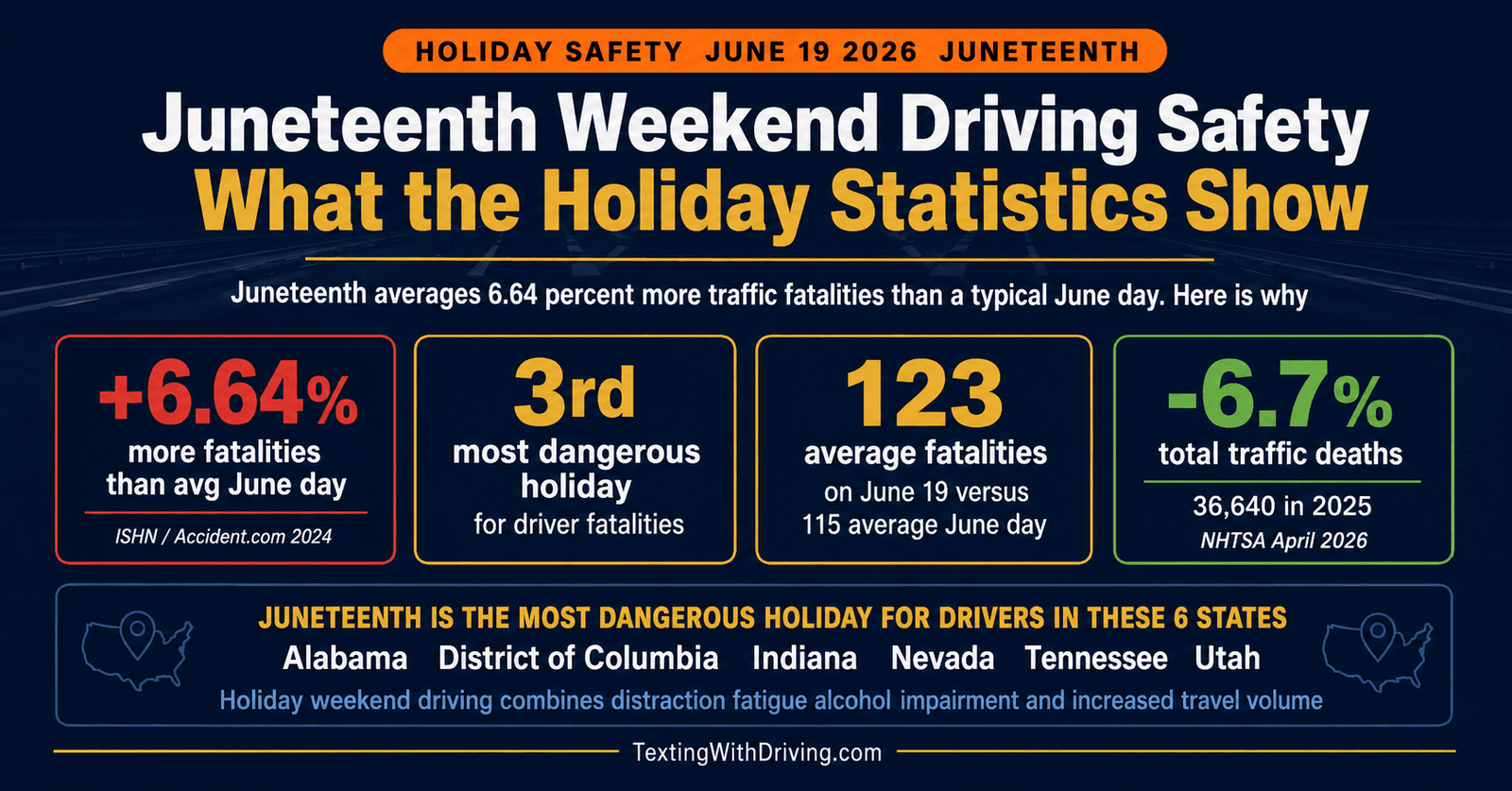
In June, there are an average of 3,460 fatalities during the month and 115 per day, while Juneteenth has an average of 123 fatalities, 6.64 percent more than the average day. Juneteenth is the third most dangerous holiday for drivers. Texasinjurylawyersblog
123 average fatalities on Juneteenth versus 115 on a typical June day. 6.64 percent above the June baseline. Third most dangerous holiday for driver fatalities in the United States according to multi-year NHTSA FARS data analysis. These are not projections or advocacy organization estimates. They are historical averages from actual crash death counts across multiple years of federal data.
This article covers what the holiday traffic data shows about Juneteenth specifically, what makes holiday weekends in general more dangerous, how distracted driving intersects with the holiday risk profile, and what every driver should know before traveling on or around June 19.
Why Juneteenth Is More Dangerous Than a Typical June Day
The elevated fatality count on Juneteenth is not random variation. It reflects identifiable patterns in how holiday days change driving behavior and road conditions.
Holiday driving produces a specific risk profile that differs from ordinary weekday or weekend driving in several documented ways. Travel volume increases significantly as families travel for celebrations, reunions, and events. The mix of drivers on the road shifts toward less-experienced drivers who may not typically drive long distances. Evening travel extends later than typical non-holiday patterns as events conclude after dark. And alcohol involvement in crashes increases sharply because social celebration events are a consistent contributing factor in holiday weekend crashes.
Juneteenth is the most dangerous state for drivers in six states, including Alabama, District of Columbia, Indiana, Nevada, Tennessee, and Utah. Texasinjurylawyersblog
The state-specific pattern is significant. In six states, Juneteenth is not just above the national average. It is the single most dangerous holiday of the entire year for driver fatalities. Understanding why this geographic concentration exists requires looking at the specific characteristics of road networks, travel patterns, and celebration event concentrations in these states.
The District of Columbia, Nevada, and Tennessee all have high-density urban celebration event concentrations that draw significant out-of-area travel on Juneteenth specifically. Alabama, Indiana, and Utah reflect different patterns, including interstate corridor traffic increases as Juneteenth travelers move between family gathering destinations. In all six states, the combination of increased travel volume, evening return travel after events, and the celebration-associated alcohol impairment pattern produces a fatality spike that makes Juneteenth the statistically most dangerous day to drive in those states across the entire calendar year.
The 2025 National Context: Improvement That Does Not Eliminate Holiday Risk
Before getting deeper into the Juneteenth-specific data, the broader 2025 national traffic safety context provides important framing.
With an estimated 36,640 traffic fatalities in 2025, a 6.7 percent decrease from 2024, the nation saw its second-lowest traffic fatality rate in recorded history at 1.10 fatalities per 100 million vehicle miles traveled. Versus Texas
2025 produced the second-lowest traffic fatality rate in recorded American history. 36,640 total deaths versus 39,254 in 2024, a reduction of 2,614 fewer people killed on American roads in a single year. Under Secretary of Transportation Sean Duffy, NHTSA credited partnerships with law enforcement, distracted driving education campaigns, drunk driving enforcement, and seatbelt enforcement as contributing factors.
This genuinely significant national improvement does not, however, eliminate the holiday risk premium. When overall safety improves, the holiday spike pattern tends to persist because the behavioral factors that produce it, increased travel, celebration events, late-night return driving, are not eliminated by improvements in ordinary driving conditions. The percentage elevation above baseline may moderate slightly, but the fundamental pattern remains.
Preliminary data from Memorial Day 2025 is instructive. Virginia State Police reported seven people killed in crashes over Memorial Day weekend 2025, a significant drop from 13 deaths in 2024. But the state police superintendent’s statement remains instructive: our goal remains to see a holiday weekend where there are no fatal crashes. Even in an improving year, holiday weekends produce preventable deaths that would not have occurred on non-holiday days.
Holiday Weekend Traffic: The Volume Factor
One of the most consistent contributors to elevated holiday fatality counts is simply the volume of additional vehicles on American roads during celebration periods.
Based on the current medically consulted injury to death ratio and the NSC estimate methodology, the 2025 Memorial Day weekend projected approximately 44,800 nonfatal medically consulted injuries resulting from crashes during the holiday period. This is in addition to projected fatal crashes. Rasansky
The NSC uses a ratio of approximately 114 medically consulted injuries for every traffic death to estimate the full injury burden of holiday weekends. At the Juneteenth daily average of 123 fatalities, the estimated same-day injury count would approach approximately 14,000 people receiving medical attention for crash injuries in a single day. Not all of these injuries are severe, but all of them represent crashes that would not have occurred if traffic volume had remained at typical June weekday levels.
The volume effect is not uniform across road types. As we documented in our article on distracted driving on highways versus city streets, urban arterial roads produce the highest absolute concentration of distracted driving fatal crashes. Holiday weekends intensify this arterial road risk because celebration travel involves driving to and from specific event locations, typically through urban commercial and entertainment corridors on exactly the arterial road types that produce the most crashes.
The Distraction Dimension on Holiday Weekends
Every risk factor that makes holiday weekends more dangerous than ordinary driving days intersects with distracted driving in ways that amplify rather than simply add to the baseline distraction risk.
Navigation unfamiliarity. Holiday travel often involves driving to unfamiliar locations, which increases manual and visual GPS interaction. Drivers navigating to a Juneteenth celebration event they have not visited before are more likely to interact with their navigation apps, adjust routes mid-drive, and struggle with the competing demands of unfamiliar road environments and app management. We covered the specific pre-trip GPS setup that eliminates this risk in our 10 proven ways to stop texting while driving guide.
Social coordination pressure. Celebration events create social coordination demands that peak exactly when drivers are in transit. Group messages coordinating arrival times, parking arrangements, and plan changes arrive continuously during the drive to the event. Each incoming notification is a distraction trigger of the type we documented in our psychology of phone addiction and distracted driving article. The social pressure to respond to coordination messages while in a moving vehicle is higher on celebration days than on ordinary commutes.
Evening return driving. Juneteenth events, like most summer celebration events, extend into the evening. Return driving occurs in the 6 PM to 11 PM window that Cambridge Mobile Telematics data identifies as the peak period for phone use while driving, as we covered in our article on distracted driving at night. The combination of peak phone use hours, celebration-related fatigue, possible alcohol impairment among drivers who have attended events, and unfamiliar return routes on urban arterials concentrates multiple risk factors in a single driving window.
Passenger distraction. Holiday celebration travel often involves full vehicles with multiple passengers, including children, creating the passenger distraction dynamic we documented in our article on distracted driving and children. Children who have been at a celebration event and are tired or overtired in the back seat create the same 12-times-more-distracting-than-a-phone dynamic that Monash University documented in family driving research.
What the Independence Day Data Shows for the Weekend Ahead
While the Juneteenth-specific data covers June 19 itself, the broader Independence Day holiday context is relevant for the full June 19 through July 4 period that encompasses the peak of summer holiday driving season.
The National Safety Council estimates 437 people may die in preventable traffic crashes during the 2025 Independence Day holiday period, from 6 PM Central Time on Thursday, July 3, to 11:59 PM on Sunday, July 6. Data shows 38 percent of fatalities during Independence Day weekend involve an alcohol-impaired driver, one of the highest percentages among all major holidays. ConsumerShield
437 projected deaths in the Independence Day period alone. 38 percent involving alcohol impairment. The two-week window from Juneteenth through Independence Day is among the most concentrated high-risk driving periods on the American calendar, combining elevated daily fatality rates on Juneteenth itself with the nation’s deadliest holiday weekend just over two weeks later.
For drivers planning any travel during this period, the practical implication is that the pre-drive phone-free setup that we recommend for every drive is not optional during this window. It is essential. The road environment around holiday weekends combines every risk factor that makes distracted driving more dangerous: higher traffic volume, more unfamiliar drivers, more evening driving, more social coordination demands, and higher rates of impaired drivers.
The Alcohol Factor: How It Intersects With Distraction
The elevated alcohol impairment rate on holiday weekends, reaching 38 percent of Independence Day fatalities and elevated rates on Juneteenth as well, is not directly a distracted driving statistic. But it intersects with distracted driving in a way that deserves specific mention.
Alcohol-impaired drivers are not exclusively the ones dying in holiday crashes. They are causing crashes that kill sober occupants, pedestrians, and cyclists who made no unsafe choice. The 30 percent of all US traffic fatalities involving alcohol impairment in 2024 represents crashes where both the impaired driver and the other people in or near the crash are victims.
The practical driving safety implication for Juneteenth weekend is the same as for any major holiday: the road environment includes a statistically elevated share of impaired drivers, regardless of your own driving choices. Defensive driving awareness is more important, not less, when the overall risk environment is elevated.
The Virginia State Police statement from Memorial Day 2025 captures this dual responsibility precisely: buckle up, slow down, drive sober, and avoid distractions. All four simultaneously. Not as alternatives but as complements.
The Historical Context: Juneteenth as a Federal Holiday Since 2021
Juneteenth’s elevation to federal holiday status in 2021 is directly relevant to the traffic safety data because federal holiday designation changes travel patterns in ways that affect crash rates.
When a day becomes a federal holiday, more businesses close, more people have days off work, and travel patterns shift toward longer-range celebration and family visit travel. The travel volume increase on Juneteenth since 2021 is partly a product of its federal recognition creating a dedicated day off that encourages the kind of multi-family gathering travel that produces the elevated road use visible in the crash data.
The multi-year average of 123 fatalities on Juneteenth predates its federal holiday status in some of the historical data, but the more recent years since 2021 show the pattern maintained and in some analyses strengthened as federal recognition has increased the cultural significance and associated travel volume of the celebration.
Practical Safety Recommendations for Juneteenth Weekend
The combination of holiday risk factors and distracted driving amplifiers on Juneteenth weekend creates a specific practical checklist that differs from ordinary driving advice mainly in its urgency rather than its content.
Set up your phone before leaving for any Juneteenth celebration or travel. This means GPS destination entered, Driving Focus or driving mode activated, phone in the back seat, and Bluetooth connected if calls are expected. Do all of this before the car starts moving, not after.
Plan for traffic and build in time margins. Rushed driving on unfamiliar roads to reach a celebration event on time produces aggressive driving combined with navigation app management, one of the highest-risk distraction combinations in any driving context.
Designate a navigator in the car who handles the phone, responds to coordination messages, and manages any app interactions while the driver drives. The designated texter approach we covered in our summer road trip safety guide applies with equal force for the shorter holiday celebration trip.
Plan your return timing. Late-evening return from Juneteenth celebrations concentrates return traffic in the 9 PM to midnight window that produces the highest phone use while driving rates in CMT telematics data and the highest teen crash rates per AAA. If you can depart earlier, the safety benefit is real and documented.
For the complete national statistics context that frames the holiday risk profile, see our distracted driving accident statistics article. For the technology setup that removes phone temptation before it competes with your driving attention during holiday travel, our Do Not Disturb while driving guide covers both iPhone and Android from scratch. And for the full summer driving safety picture, our summer road trip phone-free driving guide covers the complete seasonal context.
Sources Used in This Article
All links verified working before publication.
ISHN: Memorial Day is the Fourth Most Dangerous Holiday for Driver Fatalities — Juneteenth 123 average fatalities, 6.64% above June average, third most dangerous holiday, six states, May 2024
NHTSA: 2025 Traffic Death Estimates and 2024 Annual Data — 36,640 deaths in 2025, 6.7% decline, second-lowest rate in history, April 2026
NSC Injury Facts: Memorial Day Motor Vehicle Fatality Estimates — Holiday fatality methodology and injury ratio, 2025
NSC: Independence Day 437 Projected Deaths — July 1, 2025
ConsumerAffairs: Which US Holiday is the Deadliest Traffic Day 2026 — Independence Day 16.1% above non-holiday
Virginia State Police: 7 Killed in Crashes Over Memorial Day Weekend in VA — Memorial Day 2025 comparison data, May 2025
NHTSA CrashStats: Early Estimate Q1 2025 — 6.3% decline Q1 2025, 12 consecutive quarterly declines
NHTSA: Distracted Driving — National distraction statistics
Cambridge Mobile Telematics: Distracted Driving Fell 8.6 Percent in 2024 — Peak phone use 6 PM to 11 PM data
TextingWithDriving.com is professionally built and maintained to ensure accurate, accessible safety information reaches every driver who needs it. Website development and ongoing support is handled by Budgetic, a digital agency specializing in purpose-driven WordPress websites.

About Texting With Driving
TextingWithDriving.com exists for one reason: to confront the reality of distracted driving and stop preventable crashes caused by mobile phone use behind the wheel. Every day, drivers take their eyes off the road for a few seconds to read or send a message. Those few seconds are enough to cause life-altering consequences. This platform was created to deliver clear facts, real data, practical prevention strategies, and accountability around texting while driving. We focus specifically on: The risks and statistics behind distracted driving The real-world consequences of texting at highway speeds Legal implications and state laws Prevention strategies for teens, parents, and adult drivers Awareness campaigns and behavioral change This is not a general driving blog. It is a focused awareness initiative built around one critical issue: phone distraction behind the wheel. Our content is direct, research-driven, and practical. We prioritize accuracy over opinion and education over sensationalism. The goal is simple — reduce distracted driving incidents by increasing awareness and responsibility. If one article causes one driver to put their phone down, the mission is working. For inquiries or partnerships, contact: privacy@textingwithdriving.com
View all posts by Texting With Driving