
Distracted Driving on Highways vs. City Streets: Where Are You Most at Risk?

Distracted Driving on Highways vs. City Streets: Where Are You Most at Risk?
Most drivers have a mental model of where distracted driving is most dangerous. The 70-mph highway. The empty interstate at night. The fast-moving freeway where a five-second glance at a phone covers a full football field of blind driving.
That mental model is wrong.
The data from NHTSA’s Fatality Analysis Reporting System is clear and consistent across multiple analysis years: the most dangerous road environment for distracted driving crashes is not the interstate highway. It is the suburban arterial road, the four to six lane divided road outside your local shopping center, running through the heart of your suburb, where the speed limit is 45 miles per hour and traffic signals create regular stop-and-go patterns that make drivers feel like the driving is easy.
Understanding where distracted driving crashes actually happen most frequently changes both how you should think about your own risk and where society should concentrate prevention and enforcement resources.
The Core Finding: Urban Roads Dominate
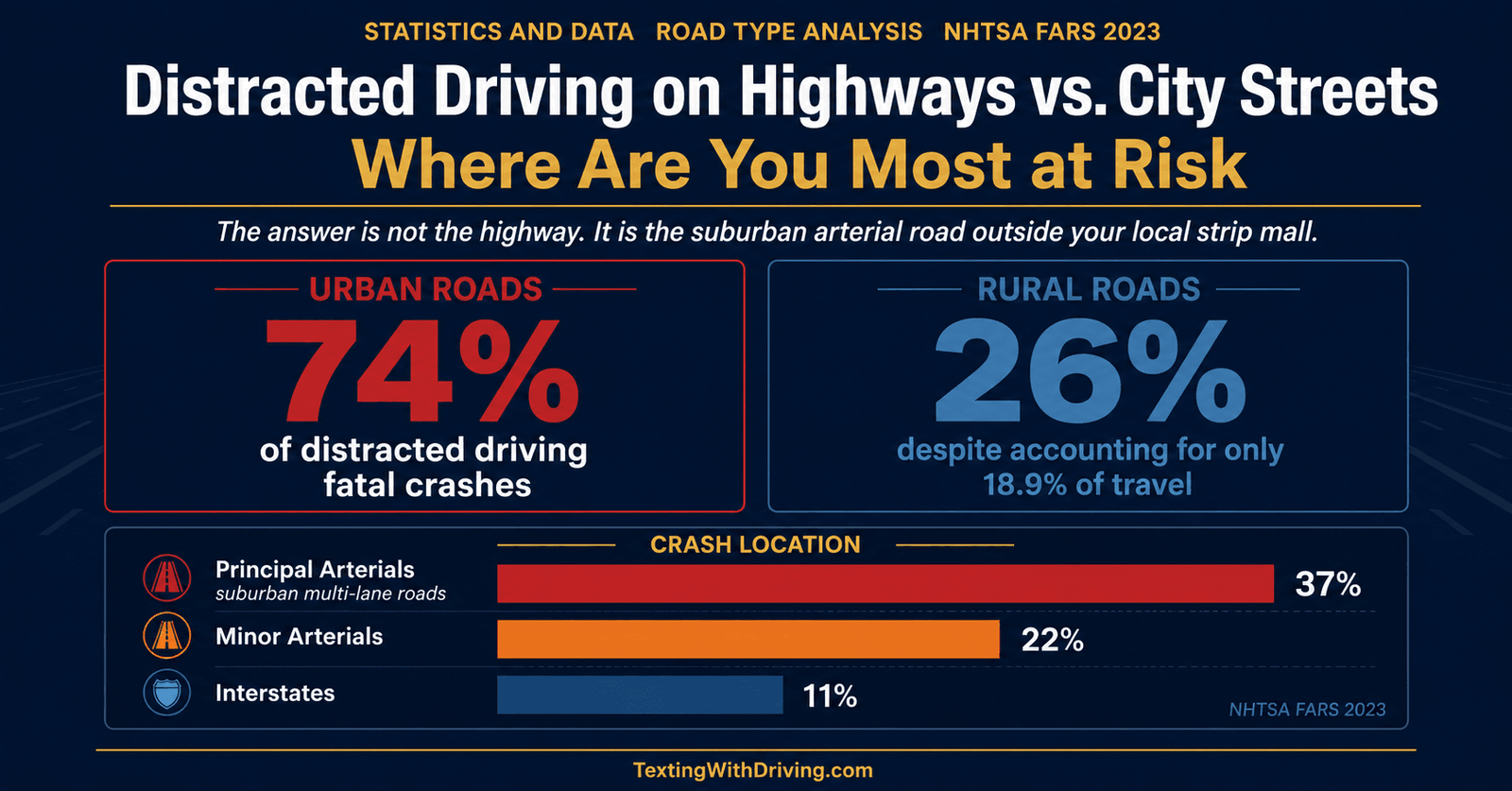
Urban crashes accounted for 74 percent of all distracted driving fatal crashes compared to the 26 percent that occurred on rural roads. For comparison, 18.9 percent of travel in 2022 occurred on rural roads. Lemonade
Three-quarters of all distracted driving fatal crashes occur on urban roads. Rural roads, which account for roughly 19 percent of all vehicle miles traveled, produce only 26 percent of distracted driving fatal crashes. Urban roads, which account for approximately 81 percent of all vehicle miles traveled, produce 74 percent.
When you normalize these figures for miles traveled, the rural-versus-urban picture changes somewhat, because rural roads carry a disproportionately small share of total travel miles. But the absolute counts are unambiguous: if you are trying to understand where distracted driving is killing people in the greatest numbers, the answer is definitively urban and suburban roads, not rural highways.
This finding is consistent across multiple years of NHTSA FARS analysis. In the 2022 data analyzed by SafeTREC Berkeley, urban crashes accounted for over 82 percent of all distracted driving fatal crashes compared to the 18 percent that occurred on rural roads. The 74 percent figure from 2023 data represents a slight shift, but the fundamental pattern remains: urban roads account for approximately three-quarters of all distracted driving fatalities.
The Road Type Breakdown: Why Arterials Are the Most Dangerous
Within the urban road category, the NHTSA FARS data provides a more granular picture of exactly which road types are most associated with distracted driving fatal crashes.
Principal arterials were the most common location for distracted driving fatal crashes accounting for 37 percent. Minor arterials, followed by interstates, made up the second and third most common crash locations in distracted driving fatal crashes accounting for 22 and 11 percent respectively. Lemonade
Principal arterials at 37 percent. Minor arterials at 22 percent. Interstates at only 11 percent.
The road that produces the highest concentration of distracted driving fatal crashes in the United States is the principal arterial, which is the technical classification for the high-volume multi-lane divided roads that carry traffic through urban and suburban areas. These are the roads with a speed limit typically between 35 and 55 miles per hour, multiple lanes in each direction, a center median or two-way left turn lane, and signalized intersections every quarter to half mile. They are the roads that connect suburban neighborhoods to commercial corridors, carry commuters between residential areas and employment centers, and provide access to strip malls, big box stores, schools, hospitals, and every other commercial land use that characterizes American suburban geography.
The fact that principal arterials produce 37 percent of all distracted driving fatal crashes, more than three times the rate of interstates at 11 percent, requires explanation. Because intuitively, a 70-mph interstate where a five-second phone glance covers 513 feet sounds more dangerous than a 45-mph arterial where the same glance covers 330 feet.
Why Arterials Are More Dangerous Than Interstates for Distracted Driving
The apparent paradox of lower-speed roads producing more distracted driving deaths than higher-speed roads dissolves when you understand the specific crash mechanisms involved.
Intersection density. Principal arterials have signalized intersections at regular intervals, typically every quarter to half mile. Each intersection is a location where turning vehicles, pedestrians crossing, cyclists, and merging traffic create a complex, rapidly changing environment that requires full attentive engagement to navigate safely. A driver who is looking at their phone for five seconds while approaching an intersection may miss a red light, fail to perceive a pedestrian in the crosswalk, miss a turning vehicle entering their path, or not respond to a lead vehicle slowing to stop. The intersection is where the phone-in-hand moment most frequently coincides with the collision event.
Interstates have no intersections at grade. Every entrance and exit is a controlled ramp with a single conflict point rather than the multi-directional conflict of an arterial intersection. The driving environment on an interstate, while faster, is actually simpler and more predictable than an arterial with intersections every quarter mile.
Access points and turning movements. Principal arterials serve commercial land uses through numerous driveways and access points that are not formally signalized. Vehicles turning left from the arterial into a parking lot, pulling out of a parking lot onto the arterial, and crossing the arterial from a driveway all create conflict points that are not present on limited-access highways. Each of these events requires a driver to perceive and respond to an unpredictable vehicle movement, and a distracted driver may not perceive it until the collision is unavoidable.
Pedestrian and cyclist presence. As we documented in our article on distracted driving and pedestrian safety, pedestrians and cyclists are concentrated on the same arterial roads that carry the highest volumes of commercial traffic. The strip mall, the grocery store, the school, the transit stop are all on the arterial. Pedestrians crossing arterials at intersections and mid-block, cyclists in inadequate bike lanes, and delivery workers in parking lots create a pedestrian risk environment that interstates simply do not have.
The stop-and-go phone temptation. Traffic signals on arterial roads create regular stops where drivers perceive a window to check their phones. A red light feels like a momentary safe harbor from the driving task. As every hands-free law in the country explicitly confirms, it is not, and the cognitive distraction from checking a phone at a red light persists for up to 27 seconds into the next stretch of driving after the light turns green, as we documented in our article on how distracted driving affects your brain. The stop-and-go rhythm of arterial driving creates more of these temptation windows per mile than either highway driving or residential street driving.
The Interstate: More Severe but Less Frequent
The 11 percent of distracted driving fatal crashes that occur on interstates and freeways are not less important than the arterial crashes, but they require a different contextual framing.
Interstate crashes are less frequent in absolute terms because the driving environment is simpler, pedestrian conflicts are absent, and intersection conflicts do not exist. But when a distracted driving crash does occur on a highway, the outcome is more likely to be severe because of the higher speeds involved. A rear-end collision at 65 miles per hour produces vastly more kinetic energy than the same collision at 40 miles per hour, and the injury severity difference is proportional.
The specific highway distraction scenario that produces the most deaths involves sudden traffic slowdowns that catch distracted drivers without enough time to brake at highway speeds. A driver who has been looking at their phone for five seconds at 65 miles per hour has covered 477 feet without any hazard monitoring. If traffic ahead has come to a stop within that 477-foot window, the closing speed at the moment the driver looks up may be too high for any emergency response to prevent a crash.
Highway construction zones compound this risk specifically because they create sudden and significant speed changes that are not reflected in the driver’s memory of the last few seconds of road conditions. The enhanced fines in construction zones that we covered in our distracted driving in work zones article exist precisely because of this risk: the consequences of distraction at a construction zone transition point, where traffic drops from 70 to 45 mph within a quarter mile, are severe.
The Rural Road Paradox
The 26 percent of distracted driving fatal crashes on rural roads, occurring on roads that account for only 18.9 percent of all vehicle miles traveled, suggests that rural roads are actually slightly overrepresented in distracted driving fatalities relative to their travel share.
This rural overrepresentation has a specific cause: rural road crashes are more fatal even when they occur less frequently, because the distances from emergency medical services are greater, crash speeds tend to be higher on long undivided two-lane rural roads, and there are fewer safety features like medians and guardrails that mitigate crash severity.
As we noted in our worst states for distracted driving 2026 article, states with large rural road networks, like New Mexico, Kansas, and Wyoming, rank disproportionately high in distracted driving severity precisely because their road environment means that crashes which might be minor fender-benders on an urban arterial become fatalities on long, empty rural highways at higher speeds with no nearby trauma center.
The specific rural distraction risk involves the monotony effect: long, straight, empty roads with minimal traffic and minimal visual variety create exactly the understimulation conditions that drive phone use as a stimulation-seeking behavior. A driver on a rural two-lane highway in Kansas at 2 PM on a Tuesday has far more opportunity and temptation to reach for their phone than a driver navigating a congested urban arterial where the driving environment demands continuous active engagement.
Crash Timing: When Distracted Driving Crashes Peak by Road Type
The timing of distracted driving crashes differs between highway environments and urban road environments in ways that reflect the different uses of these road types.
Distracted driving crashes peak in the afternoon hours between 3 PM and 6 PM, correlating with commute traffic volume and phone use patterns, according to NHTSA telematics data. This afternoon peak is concentrated on arterials, which carry the highest commute traffic volumes.
As we documented in our article on distracted driving at night, phone use while driving peaks between 6 PM and 11 PM according to Cambridge Mobile Telematics data. The evening peak creates a second elevated risk window that falls on both arterials, where commuters are driving home through commercial corridors, and on recreational roads where young drivers are traveling to and from social activities.
Highway distraction is less tied to commute patterns because highway use is more broadly distributed across times of day and purposes of travel. The highway distraction risk is elevated during the summer road trip season, during holiday weekends when total travel volume peaks, and during early morning and late evening hours when fatigue combines with phone engagement as we covered in our summer road trip safety guide.
What This Means for Your Own Driving
The finding that 74 percent of distracted driving fatal crashes happen on urban roads, with principal arterials accounting for 37 percent alone, has a direct implication for how every driver should think about when and where their phone-free habits matter most.
The driving that carries the highest absolute risk from distraction is not the occasional long highway trip. It is the daily commute on the arterial that connects your neighborhood to your workplace. The trip to the grocery store on the suburban multi-lane road. The school run on the arterial. These are the drives where your distracted driving risk is highest in absolute terms because they are the road environments that produce three-quarters of all distracted driving deaths.
The driver who treats the highway as the high-danger zone and the local arterial as easy, familiar driving has the risk model inverted. The arterial’s stop-and-go rhythm, its intersections, its pedestrians and cyclists, its access points and turning vehicles, and its phone-check temptation at every red light make it the most consistently dangerous environment for distracted driving in America.
Every drive on a principal arterial is a drive where your phone-free habits matter most. Every red light on an arterial is the exact moment where the temptation to check your phone is highest and the cognitive distraction from doing so extends furthest into the subsequent block of driving.
Phone in the back seat. Driving mode active. Before every drive, including the familiar ones. Especially the familiar ones.
For the full national context of all distracted driving deaths and how they break down, see our distracted driving statistics 2026 overview. For the neuroscience of why the familiar arterial drive creates specific cognitive vulnerability, our article on how distracted driving affects your brain covers the working memory and visual processing mechanisms. And for the technology setup that makes every drive phone-free regardless of road type or familiarity, our Do Not Disturb while driving setup guide is the starting point.
Sources Used in This Article
All links verified working before publication.
SafeTREC Berkeley: 2025 SafeTREC Traffic Safety Facts Distracted Driving — 74 percent urban crashes, principal arterials 37 percent, NHTSA FARS 2023 analysis
SafeTREC Berkeley: 2024 SafeTREC Traffic Safety Facts Distracted Driving — 82 percent urban crashes 2022, historical comparison
NHTSA CrashStats: Distracted Driving in 2024 — DOT HS 813 790, road type and location data
NHTSA: Distracted Driving Dangers and Statistics — National statistics and contextual data
NSC Injury Facts: Distracted Driving — Updated 2025 crash data
Nexar: Distracted Driving Statistics 2026 — Afternoon crash peak timing data, April 2026
Defensive Drivers Institute: Distracted Driving Statistics 2025 — Road type analysis context
GHSA: Distracted Driving State Laws — Enforcement context
TextingWithDriving.com is professionally built and maintained to ensure accurate, accessible safety information reaches every driver who needs it. Website development and ongoing support is handled by Budgetic, a digital agency specializing in purpose-driven WordPress websites.

About Texting With Driving
TextingWithDriving.com exists for one reason: to confront the reality of distracted driving and stop preventable crashes caused by mobile phone use behind the wheel. Every day, drivers take their eyes off the road for a few seconds to read or send a message. Those few seconds are enough to cause life-altering consequences. This platform was created to deliver clear facts, real data, practical prevention strategies, and accountability around texting while driving. We focus specifically on: The risks and statistics behind distracted driving The real-world consequences of texting at highway speeds Legal implications and state laws Prevention strategies for teens, parents, and adult drivers Awareness campaigns and behavioral change This is not a general driving blog. It is a focused awareness initiative built around one critical issue: phone distraction behind the wheel. Our content is direct, research-driven, and practical. We prioritize accuracy over opinion and education over sensationalism. The goal is simple — reduce distracted driving incidents by increasing awareness and responsibility. If one article causes one driver to put their phone down, the mission is working. For inquiries or partnerships, contact: privacy@textingwithdriving.com
View all posts by Texting With Driving