

The Ultimate Distracted Driving Resource Guide 2026: Everything You Need in One Place

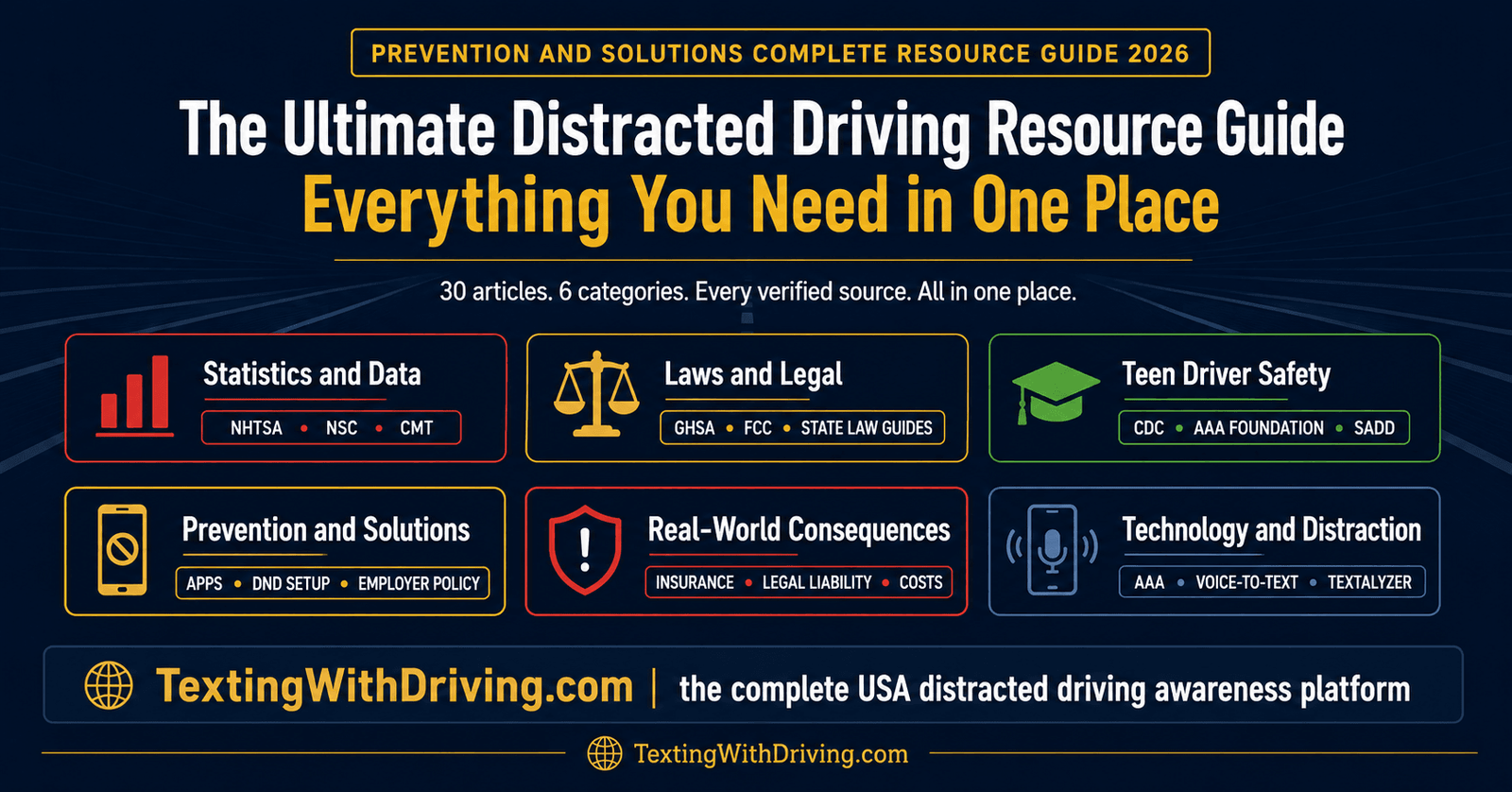
The Ultimate Distracted Driving Resource Guide: Everything You Need in One Place
This is the final article in the TextingWithDriving.com May 2026 publishing series. Thirty articles. Six content categories. Hundreds of verified sources. And one mission running through every single one of them: if one driver puts their phone down because of something they read here, the work is working.
This guide exists to make every resource on this platform findable in one place. Whether you are a driver looking for a quick answer, a parent researching how to talk to your teen, an employer building a workplace policy, a student writing a research paper, or an advocate preparing testimony for a state legislature, everything published here is organized below by topic with direct links to every article.
Bookmark this page. Share it. Use it as your starting point every time you need to find something specific about distracted driving.
Before You Start: The Three Things That Will Actually Change Your Behavior
Before the resource categories, here are the three most practical actions drawn from the research across all thirty articles. These work. The evidence is consistent.
Action 1: Set up Do Not Disturb While Driving on your phone right now. It takes 90 seconds. It silences every notification automatically when your car is moving. Zero willpower required after setup. Full guide at /do-not-disturb-while-driving-setup-guide.
Action 2: Put your phone in the back seat before every drive. Not the cupholder. Not face-down on the passenger seat. The back seat. Physical separation outperforms willpower in every behavioral study on this topic.
Action 3: If you have a teen driver at home, have the specific conversation today. Not a general warning. A specific conversation about what they will actually do when a notification arrives while driving. The research on what that conversation should sound like is in /parent-guide-teen-texting-while-driving.
Everything else below builds on these three foundations.
Category 1: Statistics and Data
These are the numbers behind the problem. Every figure in these articles is sourced from NHTSA, NSC, GHSA, AAA Foundation, or Cambridge Mobile Telematics and linked to the original source.
Distracted Driving Statistics 2026: The Complete USA Data Overview The cornerstone article for the entire site. Distracted driving is dangerous, claiming 3,208 lives in 2024 according to NHTSA. This article covers the full national picture including year-over-year trends, injury counts, age breakdowns, economic costs, and what the underreporting problem means for these official figures. Textingndriving
How Many People Die From Texting While Driving Each Year? The specific cell phone death figures separated from the broader distracted driving total. Includes NHTSA and FCC data on cell phone-attributed fatalities and the age group breakdown of who is dying.
The Worst States for Distracted Driving in 2026: State-by-State Rankings New Mexico leads with approximately 40 percent of fatal crashes attributable to distracted drivers, compared to the national average of around 8 percent. Full rankings methodology and best-performing states covered.
Gen Z Behind the Wheel: Why 68% Still Text While Driving Despite Knowing the Risks The demographic data on the generation that knows the statistics better than any other and still engages in the behavior at higher rates. Insurify 2025 and Lemonade/Talker Research data with behavioral science analysis.
Distracted Driving at Night: Why Evening Hours Are the Most Dangerous Time to Text Phone use peaks 6 PM to 11 PM. Nighttime driving is nine times deadlier than daytime. Cambridge Mobile Telematics data explains why these two facts combine to create the highest-risk window of the day.
The Economic Cost of Distracted Driving in America: $98 Billion and Counting NHTSA’s full economic cost analysis: $98.2 billion in direct losses, $395 billion in total societal harm, and what the 8.6 percent drop in 2024 phone distraction actually prevented in dollar terms.
Category 2: Laws and Legal
These articles cover what the law requires in every state, recent legislation changes, fine structures, and what happens legally when a distracted driver causes a crash.
Is Texting While Driving Illegal in Every State? The Complete 2026 Law Guide 49 states ban texting for all drivers. 33 states plus DC have full handheld bans. One state still has no statewide restriction for adult drivers. The full national picture with primary versus secondary enforcement explained.
Hands-Free Driving Laws by State 2026: The Complete 50-State Guide The most comprehensive state law reference on the site. Every state’s handheld ban status, novice driver restrictions, enforcement type, and school zone provisions in one place. Updated with all 2025 and 2026 legislative changes.
Texting While Driving Fines by State 2026: How Much Could You Actually Owe? First offense fines range from $20 in California to $10,000 in Alaska. But the real three-year cost including insurance increases averages $1,000 to $3,000. Full state-by-state fine breakdown with the hidden cost calculation.
Pennsylvania Distracted Driving Law 2026: Paul Miller’s Law Explained Full enforcement began June 5, 2026. Pennsylvania’s Paul Miller’s Law is a primary offense, meaning officers can stop drivers solely for phone use. Complete guide to what is banned, what is allowed, fines, and the story behind the name.
Missouri’s Hands-Free Driving Law 2026: What Every Driver Must Know The Siddens Bening Hands-Free Law with full enforcement since January 1, 2025. Complete fine structure from $150 for a first offense to a Class D felony for violations causing death. One-year impact data showing 7.8 percent reduction in distracted driving.
Louisiana Hands-Free Law 2025: What Drivers Need to Know Now House Bill 519 took effect August 1, 2025 with full fines from January 1, 2026. First offense is $100, $250 in school zones. Secondary offense on open roads with important enforcement nuances explained.
Texas Hands-Free Driving Bill 2026: Did SB 47 Finally Become Law? The honest answer is no. Texas remains without a full handheld ban as of mid-2026. This article covers what current Texas law actually says, the history of SB 47 and Allie’s Way, why the bill keeps failing, and what the 29 million unprotected Texas drivers need to know right now.
Can You Be Sued for Texting While Driving? Understanding Your Legal Liability Yes. Civil lawsuit, criminal charges up to seven years prison for fatal crashes, employer vicarious liability up to $25 million, and third-party sender liability in some states. How phone records become evidence and what the four elements of negligence require in court.
Category 3: Teen Driver Safety
Teen drivers are the highest-risk group for distracted driving. These five articles cover the statistics, the behavioral science, the school programs, and what parents can actually do.
Why Teen Drivers Are the Most At-Risk Group for Distracted Driving in America Six percent of drivers aged 15 to 20 involved in fatal crashes were distracted, the highest proportion of any age group. Distraction is involved in 58 percent of teen crashes overall. The full data picture with AAA Foundation naturalistic study findings.
A Parent’s Complete Guide to Talking to Your Teen About Phone Use While Driving The research-backed conversation that actually changes behavior. Not a general warning but a specific framework built around what behavioral studies show works, including why parent modeling matters more than most parents realize and what the CDC’s parent-teen driving agreement produces.
High School Programs That Are Actually Reducing Teen Distracted Driving B.R.A.K.E.S. graduates are 64 percent less likely to crash. The BITZ program at Vanderbilt. Impact Teen Drivers. SADD. AT&T It Can Wait school programs. The Get the Message hospital-based curriculum with peer-reviewed outcomes. What the research says makes these programs work.
Gen Z Behind the Wheel: Why 68% Still Text While Driving Despite Knowing the Risks Also listed under Statistics, this article has direct relevance to teen safety because it explains the behavioral psychology behind why knowledge of danger does not produce behavior change and what interventions actually work for Gen Z specifically.
Category 4: Prevention and Solutions
These articles give every driver, parent, employer, and organization something specific and actionable to do.
The 10 Best Apps to Block Texting While Driving in 2026 LifeSaver, AT&T DriveMode, OnMyWay, SAFE 2 SAVE, iPhone Driving Focus, Android Auto, Canary, Cellcontrol, and EyezUP. Every app reviewed with download links, cost, platform compatibility, and which type of driver each works best for.
How to Set Up Do Not Disturb While Driving on iPhone and Android (2026 Guide) Step-by-step setup for both platforms. Takes 90 seconds. Free. Automatic after setup. The single most accessible and most underused distracted driving prevention tool available to any driver with a smartphone.
The Psychology of Phone Addiction: Why Drivers Cannot Ignore Notifications Americans check their phones 186 times per day. 44 percent feel anxious without their phone. The dopamine notification loop and the 27-second residual distraction effect explain why willpower fails and pre-drive commitments succeed.
How to Create a Distracted Driving Policy for Your Employees in 2026 Motor vehicles are the number one cause of workplace deaths at 36.8 percent of fatal work injuries. Employers face up to $25 million in liability. The complete six-element policy framework with free NSC and OSHA templates and how to make hands-free-only policies that actually work.
Category 5: Real-World Consequences
What actually happens after a distracted driving crash: the science, the legal exposure, the insurance impact, and the financial costs.
5 Seconds. A Football Field. Blindfolded. The Real Danger of Texting While Driving Texting is considered the most dangerous type of distracted driving because it combines visual, manual and cognitive distraction. Sending or reading a text takes your eyes off the road for 5 seconds at 55 mph, like driving the length of an entire football field with your eyes closed. The full science behind why this specific behavior is uniquely dangerous. The Zebra
Texting While Driving vs. Drunk Driving: Which Is Actually More Dangerous? University of Utah research shows texting drivers are six times more likely to crash than drunk drivers. 11,904 alcohol-impaired deaths versus 3,208 officially attributed distracted driving deaths in 2024, and why those numbers do not tell the full story.
The Three Types of Distraction: Why Texting While Driving Is the Perfect Storm Visual, manual, and cognitive distraction defined with NHTSA’s framework. Most distractions trigger one or two types. Texting triggers all three simultaneously. Why 23.2 times more likely to crash than the Virginia Tech Transportation Institute finding makes sense when you understand the mechanism.
What Happens to Your Car Insurance After a Distracted Driving Ticket? Average 43 percent rate increase. Lasts three to five years. Total three-year cost of $1,000 to $3,000 from a single ticket. State-by-state variation from Connecticut’s 64 percent increase to New York’s 4 percent. The LexisNexis 2025 Auto Insurance Trends data on the 50 percent surge in distracted driving citations.
Can You Be Sued for Texting While Driving? Understanding Your Legal Liability Also listed under Laws and Legal because the consequences sit at the intersection of both categories. Civil personal injury claims, criminal charges, employer vicarious liability, third-party sender liability, and the evidence tools that make phone records the most powerful tool in distracted driving litigation.
The Economic Cost of Distracted Driving in America: $98 Billion and Counting Also listed under Statistics because the economic data is inseparable from the crash data. $98.2 billion in direct losses, $395 billion in societal harm, and why the 2024 improvement that prevented 105,000 crashes saved $4.2 billion in economic damages.
Category 6: Technology and Distraction
The two most important technology-focused articles on the site: one that debunks the most widespread safety myth about phone use while driving, and one that covers the enforcement technology that could change the accountability landscape.
Is Voice-to-Text Actually Safe While Driving? The Science Says No The AAA Foundation and University of Utah cognitive distraction scale. Apple Siri scores 3.7. Microsoft Cortana scores 4.1. Both higher than a handheld phone call at 2.5. The most distracting in-car technology ever measured. Plus the 27-second residual impairment finding that means putting your phone down does not immediately end the distraction.
The Textalyzer: The Device That Could Prove You Were Texting When You Crashed Like a breathalyzer for phones. Developed by Cellebrite. Produces a result in 90 seconds without accessing content, only interaction timestamps. No US state has passed legislation authorizing its use as of mid-2026. The constitutional debate, the legislative push led by New York’s Evan’s Law, and what this technology could mean for distracted driving accountability if it ever passes.
Category 7: Awareness and Advocacy
The campaigns and legislative efforts that have produced documented results, and what every driver, parent, educator, and employer can do to extend those efforts.
Distracted Driving Awareness Month 2026: Everything You Need to Know About April’s Campaign NHTSA’s April 1, 2026 kickoff releasing 2024 crash data. The Put the Phone Away or Pay enforcement window April 6 to 13. The $5 million national media buy. New York State Police’s 22,867 tickets in 8 days. The free downloadable campaign materials available to any organization.
National Distracted Driving Awareness Campaigns That Actually Moved the Needle AT&T’s 36 million pledges. Ohio’s 15,400 fewer crashes in year one of its hands-free law. The seven evidence-based lessons about what campaigns produce real behavior change versus what generates awareness without outcomes. Which approaches work for which audiences and why.
The Primary External Resources: Verified and Authoritative
These are the most important external sources used across all thirty articles on this site. Every link was verified working before publication.
Government Sources
NHTSA Distracted Driving — Primary source for all national death and injury statistics. Updated as new data is released.
NHTSA Put the Phone Away or Pay — Official campaign page with current enforcement calendar and free resources.
NHTSA April Is Distracted Driving Awareness Month — April campaign history and current year details.
Traffic Safety Marketing: Campaign Resources — Free downloadable campaign materials for organizations, schools, and communities.
NSC Injury Facts: Distracted Driving — National Safety Council injury and death data with annual updates.
FCC: Dangers of Texting While Driving — Federal Communications Commission overview with state resource links.
CDC: Teen Driver Risk Factors — Centers for Disease Control teen driver data, updated August 2025.
CDC: Parents Are the Key — Parent-teen driving agreement templates and the eight danger zones framework.
OSHA: Motor Vehicle Safety for Employers — Employer liability framework and workplace safety requirements.
Research Organizations
GHSA: Distracted Driving State Laws — The most authoritative current reference for all 50 state distracted driving laws, updated by state highway safety offices.
AAA Foundation for Traffic Safety — Home of the cognitive distraction research, teen driver naturalistic studies, and the Traffic Safety Culture Index.
AAA Foundation: Measuring Cognitive Distraction in the Automobile — The landmark voice-to-text and hands-free research that established the distraction scale.
IIHS: Distracted Driving Research — Insurance Institute for Highway Safety state law effectiveness research.
Cambridge Mobile Telematics: 2024 Distracted Driving Report — Real-world telematics data from over one billion US car trips showing the 8.6 percent improvement in 2024.
Employer and Workplace Resources
NSC: Distracted Driving for Employers — Free Safe Driving Kit with policy templates, training materials, and campaign resources.
NSC: Just Drive Distracted Driving Awareness Month — Year-round employer resources including pledge programs and workplace toolkits.
SHRM: Distracted Driving Policies Save Lives — HR-focused policy language guidance from the Society for Human Resource Management.
State-Specific Law Resources
GHSA State Laws Interactive Map — Click any state for current law status, enforcement type, and fine structure.
Road Law Guide: Distracted Driving Laws 2026 — Plain English explanation of current laws in every state with fine references, updated February 2026.
DriversEd.com: State-by-State Texting and Driving Fines — Comprehensive fine reference updated annually.
Teen Safety Programs
B.R.A.K.E.S.: Teen Safe Driving Program — Free hands-on driving education with a 64 percent crash risk reduction outcome.
Impact Teen Drivers: School Programs — Evidence-based high school presentations and peer leadership programs.
SADD: Students Against Destructive Decisions — Peer chapter information and resources for schools nationally.
AT&T It Can Wait: School Resources — Pledge campaign and school toolkit for the 36-million-pledge national initiative.
Technology Resources
Apple Support: Stay Focused While Driving — Official iPhone Driving Focus setup guide.
Google Play: Android Auto — Official Android Auto download for hands-free driving mode.
LifeSaver Mobile: Official Website — Best-reviewed third-party distracted driving blocker app for individuals and fleets.
OnMyWay: Official Website — Reward-based safe driving app that pays drivers for phone-free miles.
What This Platform Is and Why It Exists
NHTSA leads the national effort to save lives by preventing distracted driving. Get the facts, get involved, and help us keep America’s roads safe. Textingndriving
TextingWithDriving.com exists to serve the same mission from an independent, platform-focused perspective. Not a government agency. Not an insurance company. Not a driving school. A focused awareness initiative built around one issue: phone distraction behind the wheel.
Every article published here is research-driven, every source is verified and linked, and every recommendation is backed by what the evidence actually supports rather than what makes intuitive sense or what is easiest to promote.
You cannot drive safely unless the task of driving has your full attention. Any non-driving activity you engage in is a potential distraction and increases your risk of crashing. The Zebra
That is the whole message. Everything on this site is built around it.
The 3,208 people who died in distracted driving crashes in 2024 did not have to die. The 315,167 people injured did not have to be hurt. Every crash was preventable. Not most of them. Every one.
If one article on this site changes one driver’s decision about their phone before one drive, the mission is working. Share this guide with anyone who drives. Bookmark it for the next time you need a resource. And come back when new laws pass, new data is released, or new research changes what we know.
The road is shared. The phone can wait.
Sources Used in This Article
All links verified working before publication.
NHTSA Distracted Driving — National Highway Traffic Safety Administration, 2024 data
NHTSA Put the Phone Away or Pay — Campaign page with enforcement and statistics
NHTSA April Is Distracted Driving Awareness Month — Campaign history
NSC Injury Facts: Distracted Driving — National Safety Council data
GHSA Distracted Driving State Laws — Governors Highway Safety Association
AAA Foundation for Traffic Safety — Research library
FCC Dangers of Texting While Driving — Federal Communications Commission
CDC Teen Driver Risk Factors — Centers for Disease Control and Prevention
Cambridge Mobile Telematics 2024 Distracted Driving Report — 2024 improvement data
IIHS Distracted Driving and Cell Phone Use Laws — Insurance Institute for Highway Safety
Traffic Safety Marketing Resources — Free campaign materials
NSC Distracted Driving for Employers — Workplace resources
OSHA Motor Vehicle Safety for Employers — Federal employer guidance
TextingWithDriving.com is professionally built and maintained to ensure accurate, accessible safety information reaches every driver who needs it. Website development and ongoing support is handled by Budgetic, a digital agency specializing in purpose-driven WordPress websites.

About Texting With Driving
TextingWithDriving.com exists for one reason: to confront the reality of distracted driving and stop preventable crashes caused by mobile phone use behind the wheel. Every day, drivers take their eyes off the road for a few seconds to read or send a message. Those few seconds are enough to cause life-altering consequences. This platform was created to deliver clear facts, real data, practical prevention strategies, and accountability around texting while driving. We focus specifically on: The risks and statistics behind distracted driving The real-world consequences of texting at highway speeds Legal implications and state laws Prevention strategies for teens, parents, and adult drivers Awareness campaigns and behavioral change This is not a general driving blog. It is a focused awareness initiative built around one critical issue: phone distraction behind the wheel. Our content is direct, research-driven, and practical. We prioritize accuracy over opinion and education over sensationalism. The goal is simple — reduce distracted driving incidents by increasing awareness and responsibility. If one article causes one driver to put their phone down, the mission is working. For inquiries or partnerships, contact: privacy@textingwithdriving.com
View all posts by Texting With Driving