

A Parent’s Complete Guide to Talking to Your Teen About Phone Use While Driving

A Parent’s Complete Guide to Talking to Your Teen About Phone Use While Driving
Here is something most parents do not realize: you are the single most powerful influence on how your teen drives.
Not their friends. Not the law. Not a driver’s ed class. Not the news story about a crash that made them look up from their phone for a week. You.
The research on teen driving behavior is consistent and has been replicated across multiple studies. Parents who model safe driving, who establish clear expectations, and who have specific conversations, not general warnings, about phone use while driving produce measurably safer teen drivers. The effect is real, it is documented, and it is available to every parent regardless of their teen’s personality or their family’s circumstances.
This guide gives you everything you need: the research behind what works, the exact conversations to have, the rules that actually hold up, and the common mistakes parents make that unintentionally undermine the message they are trying to send.
Why This Conversation Is Different From Most Safety Talks
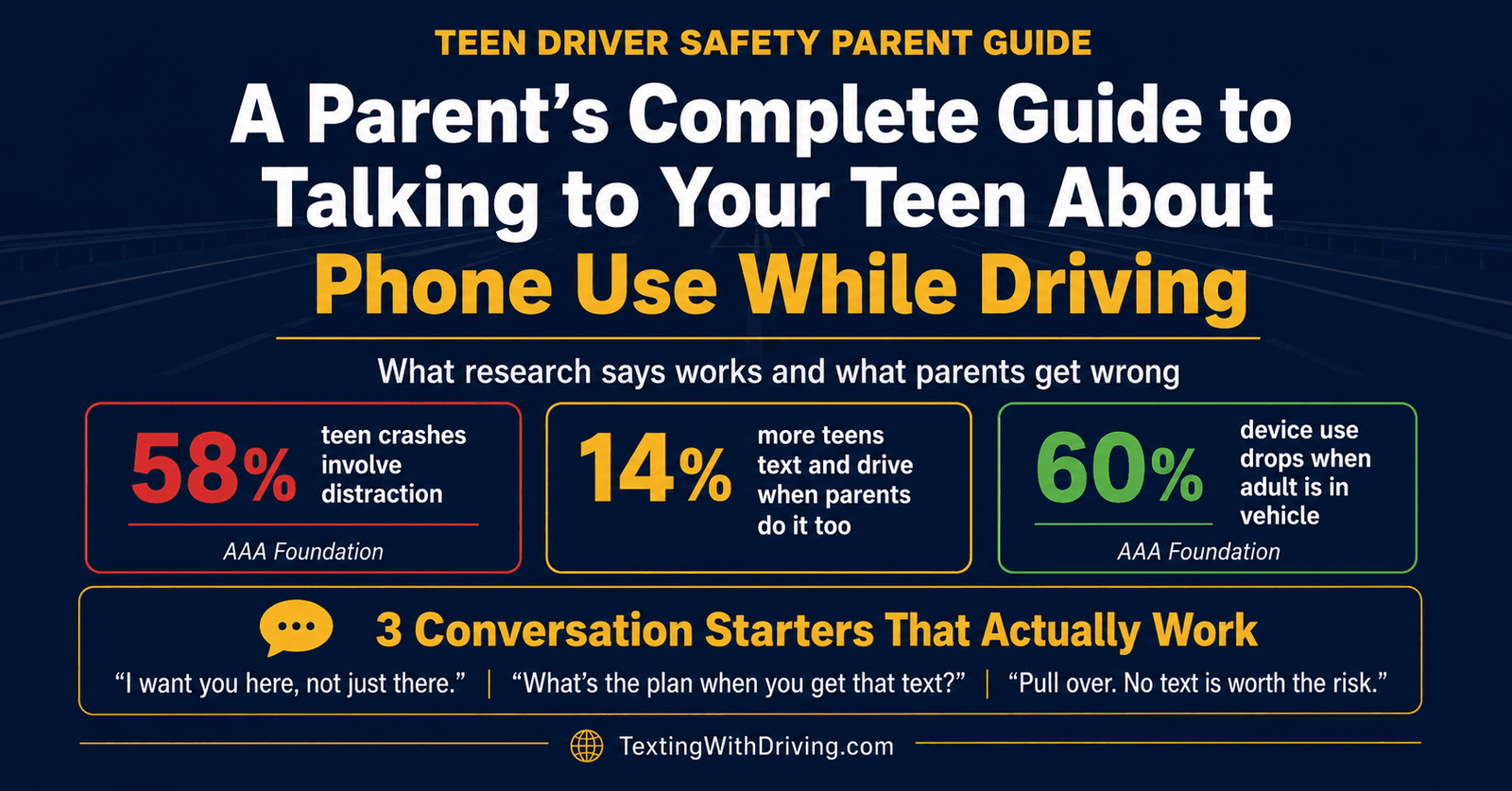
An AAA Foundation for Traffic Safety naturalistic study found that teen drivers were inattentive or engaged in some non-driving-related activity in 58 percent of crashes overall, with cell phone use appearing in 12 percent of all recorded crash events. Cmtelematics
Motor vehicle crashes are the leading cause of death for US teens. The risk of motor vehicle crashes is higher among teens ages 16 to 19 than among any other age group. Teen motor vehicle crashes are preventable, and proven strategies can improve the safety of young drivers on the road.
Those two facts together are important to hold at the same time. Teen crashes are the leading cause of teen death in America, and distraction is involved in the majority of them. And they are preventable. Not somewhat preventable. The CDC uses the word preventable directly.
The conversation about phone use while driving belongs in a different category than most safety talks parents have with teens. It is not a one-time warning. It is not a scary statistic shared over dinner. It is an ongoing, specific, behavior-focused conversation that research shows produces real changes in how teens handle their phones behind the wheel.
The difference between a conversation that works and one that does not comes down to specificity. “Be careful with your phone while driving” does not work. “Before you start the car, your phone goes in the back seat” works. This guide is built around that distinction.
The Research on Parent Influence: Why You Matter More Than You Think
Teen driving behavior is heavily influenced by parental driving behaviors. A recent study found that the proportion of teens who text while driving is 14 percent higher when they have observed their parents doing the same. Based on previous findings, it is unlikely that teens will reduce their texting while driving unless their parents do the same. USClaims
That finding deserves a moment of honest reflection for every parent reading this. If you pick up your phone at red lights, if you glance at a notification at highway speed, if you take calls without hands-free in the car, your teen sees it. And they are 14 percent more likely to replicate that behavior behind the wheel.
This is not a guilt trip. Most parents who do these things have not connected their own behavior to their teen’s driving habits because the connection is not obvious. The research makes it explicit. You cannot have a credible conversation about phone-free driving if you are not practicing it yourself.
AAA Foundation research found that electronic device use was most common when teen drivers carried no passengers, and least common when a parent or other adult was in the vehicle. Drivers were 60 percent less likely to use an electronic device when carrying one teenage peer than when driving alone, and significantly less likely to engage in distracted behaviors in the presence of a parent. AgencyAnalytics
That 60 percent reduction in device use when a parent is present tells you something important. It is not just that teens fear getting caught. It is that parental presence creates a driving environment that changes behavior. The goal of this guide is to help you extend that influence beyond the moments when you are physically in the car.
What the CDC Recommends for Parents
The CDC’s Parents Are the Key program, updated in August 2025, is the most authoritative and current guidance available on effective parent-teen driving interventions. It identifies several evidence-backed strategies that consistently appear in research on successful outcomes.
The CDC’s Parents Are the Key program emphasizes that parents should use a parent-teen driving agreement, which puts driving rules in writing to clearly set expectations and limits. The program also highlights the eight danger zones for teen drivers and encourages ongoing conversations rather than a single safety talk. Tech Trendz
CDC research through the Youth Risk Behavior Survey found that of approximately 60 percent of high school students who drove a car during the past 30 days, 39 percent texted or emailed while driving at least once. Students who engage in one transportation risk behavior are more likely to engage in other transportation risk behaviors, which means addressing phone use also reduces overall risk. GHSA
The parent-teen driving agreement is worth specific attention. It is not a punitive contract. It is a written, mutual agreement between a parent and teen that puts expectations in concrete terms before driving begins. The act of writing it down, discussing it, and signing it together has been shown to increase compliance compared to verbal-only conversations. The CDC provides a downloadable template at cdc.gov/teen-drivers.
The Eight Danger Zones Every Parent Should Know
The CDC identifies eight specific high-risk situations for teen drivers. Understanding these helps parents know where to focus the conversation rather than trying to cover everything at once.
Teen drivers are more at risk when driving at night or on weekends, with 54 percent of teen traffic crash deaths occurring on Friday, Saturday, or Sunday. Other danger zones include driving with teen passengers, driving after drinking, not wearing a seat belt, distracted driving including phone use, speeding, and drowsy driving. AVR
For the purposes of this guide, phone distraction intersects most dangerously with two other danger zones: night driving and teen passengers. The combination of evening hours, social media activity peaking, teen passengers creating social pressure around the phone, and reduced visibility at night produces the highest-risk driving environment a new driver encounters. The phone conversation therefore needs to specifically address what your teen will do in those conditions, not just in a general daytime solo drive.
The Conversation That Actually Changes Behavior
Most parents have the wrong conversation. It sounds like this: “I need you to be careful with your phone when you’re driving. It’s really dangerous and people die. Promise me you won’t text and drive.”
The teen says they promise. The parent feels like something was accomplished. And two weeks later the teen is at a red light with their phone in their hand because nothing about that conversation gave them a specific plan for the specific moment when the phone buzzes.
The conversation that actually works sounds different. Here is a framework based on what the behavioral research supports.
Conversation 1: Before the first solo drive
Sit down before the keys are handed over for the first independent trip. Not in the car. Not on the way somewhere. At a table, with time, without distraction.
Say something like this: “Before you start the car from now on, your phone goes in the back seat or the glove box. Not the cupholder. Not face down on the passenger seat. In the back. I do the same thing when I drive. We both do this, every time.”
Then do it together in the car so they physically practice the habit before they need it. The behavioral research on habit formation shows that physically rehearsing a behavior in context makes it significantly more likely to occur automatically when the moment arrives.
Conversation 2: The specific decision for specific situations
“When your phone buzzes while you’re driving and you want to check it, what are you going to do?”
Ask the question and let them answer. You are not looking for “I won’t check it.” You are looking for a specific action plan. The right answer sounds like: “I’ll leave it until I stop.” Or: “I’ll pull into a parking lot if I really need to look at it.” Or: “I’ll ask whoever’s with me to check it.”
AAA Foundation research found that teen drivers are significantly less likely to use their phone when a parent is in the vehicle. The research suggests that parental presence shifts the behavioral environment in a way that extends beyond fear of consequences alone. AgencyAnalytics
The conversation is designed to achieve the same effect on behavior that your physical presence achieves. You are building an internalized decision that already happened before the car starts moving.
Conversation 3: Passengers and social pressure
This one is often skipped and it is one of the most important.
“If you’re driving and one of your friends hands you their phone or asks you to look at something, what are you going to do?”
The social pressure dynamic in a car full of teens is real and it operates differently from individual temptation. A teen who has genuinely committed to phone-free driving and has the internal language to respond, “I can’t look at that while I’m driving, show me when we stop,” is in a different position than one who has simply told themselves they will be good.
Give them the script explicitly. “You’re driving. You don’t have to explain or justify it. You just say: I can’t look at that right now, show me when we park.”
Rules That Hold Up vs. Rules That Fall Apart
Not all driving rules parents set for teens are equally effective. Some create clear, unambiguous expectations. Others are easy to rationalize around. Here is how to tell the difference.
Rules that hold up are specific and observable. “Your phone is in the back seat before the car starts” is specific. There is no gray area. Either the phone is in the back seat or it is not. It cannot be rationalized as technically compliant while still being within reach.
Rules that fall apart are vague or loophole-prone. “Don’t use your phone while driving” fails because it leaves open questions. Does a red light count? What about a long stop in traffic? What about looking at it for a second? Each of these becomes a rationalization point.
The same principle applies to the rules themselves. Specificity beats generality. “Before the car starts” beats “while you’re moving.” “Back seat” beats “put it away somewhere.” “Every trip without exception” beats “most of the time.”
The rules that research supports for new teen drivers are consistent with what Graduated Driver Licensing programs recommend in most states:
No handheld phone use at any point during the drive. This aligns with the laws in the majority of US states as we covered in our texting while driving laws by state 2026 guide.
No passenger use of the driver’s phone during a drive. A passenger reaching across to show the driver something, or handing their own phone to the driver to look at, carries the same distraction risk as the driver initiating the interaction.
If you need to check your phone, you park completely and safely before doing so. Not at the shoulder of the highway. In a parking lot or side street, engine off.
Using Technology to Support the Conversation
The conversation establishes the expectation. Technology can reinforce it automatically.
The most accessible tool for most families is the built-in driving mode on the teen’s phone. iPhone’s Driving Focus and Android’s equivalent features silence all notifications automatically when the phone detects vehicle motion, and send an auto-reply to anyone who messages saying the driver is unavailable. Setup takes about two minutes and once activated, it removes the incoming stimulus that triggers the impulse to check in the first place.
For parents who want an additional layer of accountability with younger or less experienced teen drivers, monitoring apps like LifeSaver or Canary send real-time alerts when phone use is detected in a moving vehicle. These tools work best not as surveillance but as agreed-upon accountability systems, established in a conversation where the teen understands the purpose and agrees to the arrangement.
We cover the full range of options, from free built-in features to family-focused apps, in our guide to the best apps to block texting while driving.
The important thing about technology tools is that they supplement the conversation, not replace it. An app that a teen resents and circumvents produces less behavior change than a clear family expectation the teen genuinely understands and has agreed to.
The Modeling Problem: What You Do Matters More Than What You Say
This section is the hardest one for many parents to read, but it is also the most important.
Research has found it is unlikely that teens will reduce their texting while driving unless their parents do the same. The proportion of teens that text while driving is 14 percent higher when they have observed their parents doing the same. USClaims
Every time you reach for your phone at a red light while your teen is in the car, you are teaching them something. Every hands-free call you take, every glance at a notification at highway speed, every “just one second” response to a text while driving creates an implicit permission structure that no conversation can fully override.
The most powerful thing most parents can do to improve their teen’s driving safety is to make their own driving phone-free, visibly, consistently, and explain why.
Not: “Do as I say, not as I do.”
Something like: “When I get in the car, my phone goes in the back seat. I’ve done this since we started talking about you learning to drive. It’s the right habit and I want you to see that I actually do it.”
That framing does two things. It models the behavior. And it gives the teen a narrative that connects the parent’s behavior to the expectation rather than making the expectation feel like a rule only the teen has to follow.
When the Conversation Does Not Go Well
Some teens push back hard. They have been driving safely, they say. Everyone does it. The rule is too strict. They are not going to crash.
This is where the research on what does not work is useful to know. Fear-based responses, sharing graphic accident stories or statistics in response to pushback, can backfire. The behavioral research on teen risk communication consistently shows that teens who feel their autonomy is being threatened by fear tactics sometimes respond by asserting that autonomy in exactly the direction the parent is worried about. We discussed this in our article on why teen drivers are the most at-risk group for distracted driving.
What tends to work better is the pre-commitment framing: “This is not about whether you are a good driver. I know you are. This is about what happens in the five seconds when you are not looking at the road. That is enough time to cover a football field at highway speed. I make the same rule for myself.”
It removes the judgment. It keeps the expectation. And it connects to something specific and physical rather than an abstract danger.
Practical Resources for Parents Right Now
The CDC’s Parents Are the Key program includes downloadable parent-teen driving agreements, an overview of the eight danger zones, and resources for parents of teens at various stages of the licensing process. It is free and up to date as of August 2025.
The AAA Foundation for Traffic Safety publishes the naturalistic driving research on newly licensed teen drivers, including the specific data on how teen driving behavior changes based on who is in the vehicle. It is the best primary source for the research underlying this guide.
The NHTSA teen driving parent guidance page provides federally backed guidance on safe driving topics for parents, updated with the most current data.
For the full national picture on teen distracted driving statistics, our distracted driving statistics 2026 overview covers everything in one place. For the specific data on why teen drivers carry higher risk than any other age group, see our detailed breakdown of why teen drivers are the most at-risk group for distracted driving.
The Last Thing
The research gives parents clear and consistent direction. Model the behavior you want. Have specific conversations, not general warnings. Set rules that are concrete and loophole-free. Use written agreements. Revisit the conversation regularly, not just before the first drive.
Your teen’s phone habits behind the wheel are not fixed. They are formed in the environment you create around driving. The conversation in this guide is not a one-time event. It is an ongoing relationship between a parent and a driver who is learning the most complex skill most people ever learn.
The data shows clearly that parents who engage with that process produce safer outcomes. The question is not whether the conversation matters. It does. The question is whether you will have the specific one.
Sources Used in This Article
All links verified working before publication.
CDC: Parents Are the Key to Safe Teen Drivers — Centers for Disease Control and Prevention, updated August 2025
CDC: Risk Factors for Teen Drivers — CDC, updated August 2025
CDC: Teen Driver Publications and Research — Youth Risk Behavior Survey data, September 2025
AAA Foundation: Distracted Driving Among Newly Licensed Teen Drivers — Naturalistic driving study with in-vehicle cameras
AAA Foundation: Effectiveness of Distracted Driving Countermeasures — Research brief on what works
EndDD.org: AAA Study on Teen Crashes and Distraction — 58 percent distraction finding, June 2025
EndDD.org: Research and Statistics — Comprehensive distracted driving research library
NHTSA: Parents Talk to Your Teen Driver About Safe Driving — Federal guidance updated with 2024 data
Colorado DOT: AAA Study Distracted Driving Remains an Issue — July 2025
GHSA: Distracted Driving State Laws — National state law reference
TextingWithDriving.com is professionally built and maintained to ensure accurate, accessible safety information reaches every driver who needs it. Website development and ongoing support is handled by Budgetic, a digital agency specializing in purpose-driven WordPress websites.

About ClouDenTech
TextingWithDriving.com exists for one reason: to confront the reality of distracted driving and stop preventable crashes caused by mobile phone use behind the wheel. Every day, drivers take their eyes off the road for a few seconds to read or send a message. Those few seconds are enough to cause life-altering consequences. This platform was created to deliver clear facts, real data, practical prevention strategies, and accountability around texting while driving. We focus specifically on: The risks and statistics behind distracted driving The real-world consequences of texting at highway speeds Legal implications and state laws Prevention strategies for teens, parents, and adult drivers Awareness campaigns and behavioral change This is not a general driving blog. It is a focused awareness initiative built around one critical issue: phone distraction behind the wheel. Our content is direct, research-driven, and practical. We prioritize accuracy over opinion and education over sensationalism. The goal is simple — reduce distracted driving incidents by increasing awareness and responsibility. If one article causes one driver to put their phone down, the mission is working. For inquiries or partnerships, contact: privacy@textingwithdriving.com
View all posts by ClouDenTechCATEGORIES
- Annual Statistics Reports
- App Reviews & Tech Solutions
- Awareness & Advocacy
- Behavior Change Strategies
- Crash Impact & Injury Analysis
- Demographic Breakdowns
- Device Feature Guides
- Future Tech & Autonomous Driving
- Hands-Free Technology Analysis
- Insurance Rate Impacts
- Laws & Legal
- National Campaign Coverage
- National Law Overviews
- New Legislation Updates
- Parent Action Guides
- Prevention & Solutions
- Real-World Consequences
- School & Education Programs
- State-by-State Data
- Statistics & Data
- Technology & Distraction
- Teen Driver Safety
- Teen Statistics & Risk Data