

Why Teen Drivers Are the Most At-Risk Group for Distracted Driving in America

Why Teen Drivers Are the Most At-Risk Group for Distracted Driving in America
Traffic crashes are the leading cause of death for American teenagers. Not illness. Not violence. Car crashes.
And when researchers look at what drives that risk, one factor appears again and again: distraction. Specifically, phone distraction from a generation that grew up with a screen in their hand and is now learning to drive with that same screen sitting in the cupholder.
This article lays out exactly why teen drivers carry the highest distraction-related risk of any age group on American roads, what the most recent data actually shows, and what parents and teens can do with that information today.
The Baseline: Teen Crash Risk Before You Even Add a Phone
To understand how distraction amplifies teen risk, you first need to understand the baseline risk that already exists for new drivers.
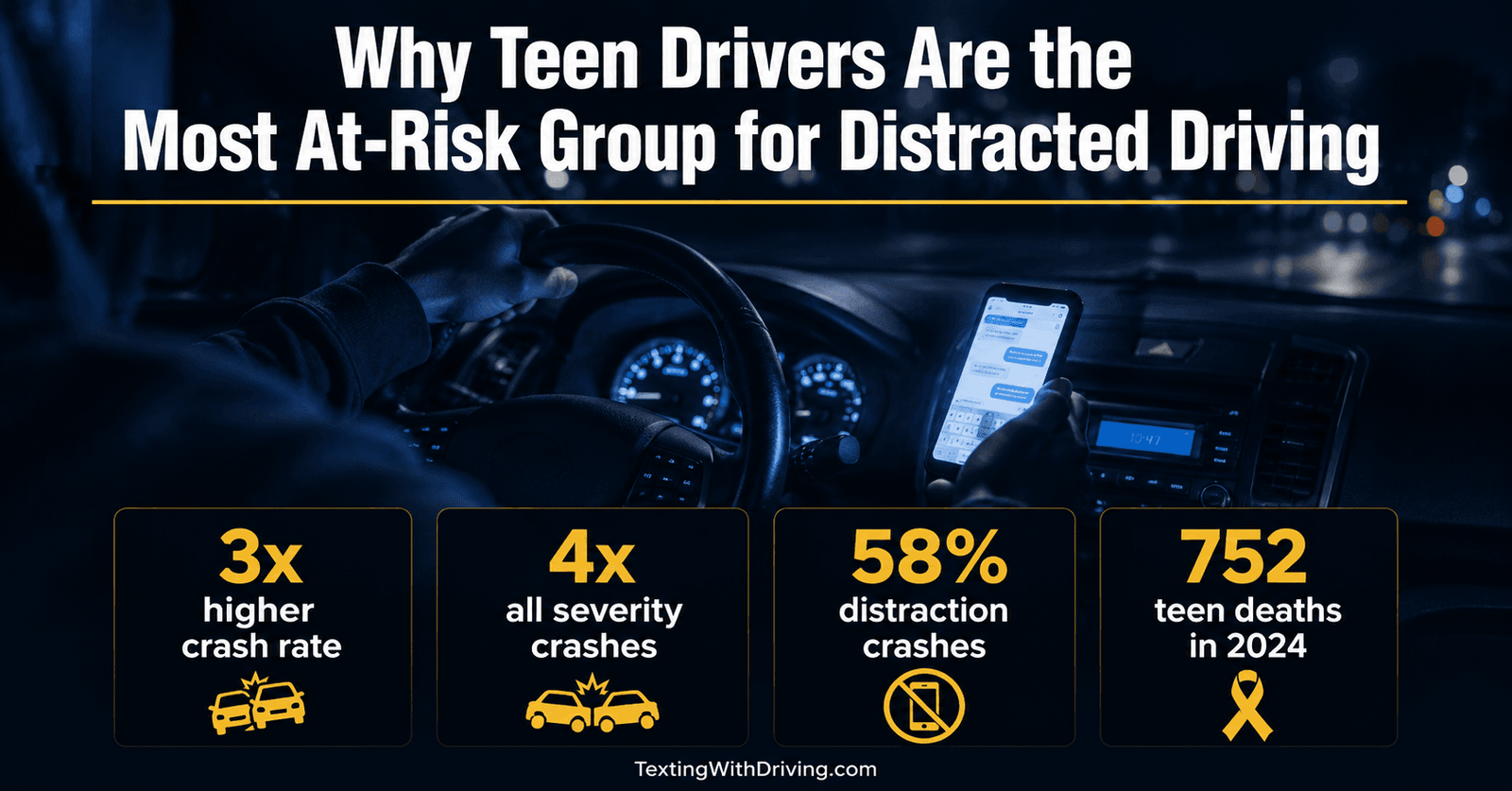
The fatal crash rate per mile driven for 16 to 17-year-olds is about three times the rate for drivers aged 20 and older. Based on police-reported crashes of all severities, the crash rate for 16 to 19-year-olds is nearly four times the rate for drivers aged 20 and older. NHTSA
This gap exists before a single phone notification arrives. It exists because new drivers lack the automated, split-second hazard recognition that experienced drivers develop over years behind the wheel. They scan less efficiently, react more slowly to unexpected events, and are more likely to freeze or overcorrect when something goes wrong.
In 2024, 752 teen drivers died in crashes, and a total of 2,320 teen drivers were involved in crashes where someone died, according to NHTSA’s most recent teen driving data. National Safety Council
That is the cost of inexperience alone, on well-maintained roads, without any additional risk factors. Now add a phone.
What Distraction Does to a Driver Who Is Already Operating Near Their Limit
Here is what makes phone distraction especially dangerous for teen drivers specifically.
Experienced adult drivers have a large reserve of cognitive capacity that allows them to handle unexpected situations, divide attention between the road ahead and the mirrors, and make rapid decisions based on pattern recognition built up over thousands of hours of driving. They are not at the edge of their capacity under normal driving conditions.
New teen drivers frequently are operating near that edge under normal conditions. They are actively concentrating on the tasks that experienced drivers do automatically. Maintaining lane position. Judging following distance. Reading intersection signals. Anticipating merging traffic.
When a phone notification arrives and a teen reaches for their device, they are not drawing from a reserve of spare attention. They are removing attention they were already fully using. The result is that the same distraction that might briefly slow an adult driver’s hazard response can eliminate a teen driver’s ability to respond at all.
An AAA Foundation for Traffic Safety naturalistic study found that teen drivers were inattentive or engaged in some non-driving-related activity in 58 percent of crashes overall, with cell phone use appearing in 12 percent of all recorded crash events. The study noted that distraction due to cell phone use appears to be much more prevalent than is reflected in official government statistics derived from police reports. AAA Foundation for Traffic Safety
That 58 percent figure is striking. More than half of all teen crashes captured by in-vehicle cameras involved some form of inattention in the seconds before impact. Not speeding. Not alcohol. Distraction.
The 2024 Data: What NHTSA Shows Right Now
The most current verified figures from NHTSA and federal traffic safety authorities paint a clear picture.
About 10 percent of all teen drivers involved in fatal crashes in recent years were distracted at the time of the crash, according to NHTSA’s parent guidance page updated with 2024 data. National Safety Council
Six percent of drivers aged 15 to 20 involved in fatal crashes in 2024 were reported as distracted at the time of the crash. This age group has the largest proportion of distracted drivers in fatal crashes of any age group in the country.
And from NHTSA’s 2023 teen-specific crash report, published in 2025: there were 286 people killed in traffic crashes in 2023 involving distracted teen drivers aged 15 to 19, and 267 teen drivers aged 15 to 19 involved in fatal crashes in 2023 were distracted at the time of the crash. Nine percent of all teen fatalities in motor vehicle crashes in 2023 were in distraction-affected crashes.
These figures come directly from NHTSA’s Traffic Safety Marketing data page and the NHTSA Teen Driving parent guidance page, both updated with the most recent available federal data.
Young Drivers Are Most Likely to Manipulate Their Devices
One of the most telling data points comes not from crash reports but from roadside observation studies.
Younger drivers aged 16 to 24 have the highest observed rate of manipulating handheld devices while driving at 7.7 percent, compared to 2.8 percent for drivers aged 25 to 69.
That nearly three-to-one gap in observed phone handling is significant. It reflects not just attitude differences but also behavioral habits formed during years of intensive phone use before ever getting behind the wheel. Teens have an ingrained reflexive relationship with their devices that does not automatically switch off when they start the car.
Distracted driving, including texting, is a factor in more than 58 percent of crashes involving teen drivers, and 39 percent of high school students admit to texting or emailing while driving. NHTSA
Nearly four in ten high schoolers who drive admit to it. And that is only the ones who admit to it in a survey. Researchers consistently note that self-reported rates undercount actual behavior.
Passengers Make It Worse, Not Better
One of the counterintuitive findings in teen driving research is that having friends in the car, something that feels like a social safety net for many teens, actually significantly increases crash risk.
The presence of teen or young adult passengers increases the crash risk of unsupervised teen drivers, and this risk increases with each additional teen or young adult passenger. AAA Foundation for Traffic Safety
The mechanism is social. Teens drive differently when they know their peers are watching. They are more likely to respond to group conversation, more likely to show off, and more likely to check their phones to engage with whatever the passenger is reacting to on social media. The phone becomes part of the group social experience rather than a separate distraction.
This is one of the reasons why Graduated Driver Licensing laws in most states restrict the number of passengers teen drivers can carry in their first months of licensure. The restriction is backed by research showing meaningful crash reductions when enforced.
Nighttime Driving Adds Another Layer of Risk
The fatal crash rate at night among teen drivers aged 16 to 19 is about three times as high as that of adult drivers aged 30 to 59 per mile driven. Forty-four percent of motor vehicle crash deaths among teens aged 13 to 19 occurred between 9 PM and 6 AM, and 50 percent occurred on Friday, Saturday, or Sunday. AAA Foundation for Traffic Safety
Evening and weekend driving combine reduced visibility with increased social activity, higher likelihood of passenger presence, and peak social media engagement hours. It is the highest-risk environment for teen drivers by every available measure, and it is also when phones are most likely to be buzzing with social notifications.
Fifty-four percent of motor vehicle crash deaths among teenagers occur on Friday, Saturday, or Sunday. Injury Facts
These are not random patterns. They reflect the intersection of when teens drive most, when phones are most active, and when supervision is lowest.
Why Fear Campaigns Often Miss the Mark
Here is something road safety researchers have learned that challenges conventional wisdom about how to reach teen drivers.
NHTSA research notes that fear appeals are generally ineffective and in some cases may actually encourage greater distracted driving, especially among young adults. This boomerang effect of fear appeals is thought to occur because people deny the threat or feel their personal freedom is threatened, making the undesirable behavior even more attractive. NHTSA
This finding matters enormously for parents and educators. The instinct is to show teens shocking statistics or graphic consequences to scare them into safer behavior. The research suggests this approach can backfire. Teens who feel their autonomy is threatened by fear-based messaging sometimes respond by asserting that autonomy in exactly the way the campaign was trying to prevent.
What the research supports instead is a combination of specific pre-drive behavior commitments (like the phone-in-back-seat habit), parent modeling, peer-led conversations, and clear rule-setting in a non-confrontational environment. Not “this could kill you” but “here is the specific thing I do every time I get in the car and here is why I do it.”
NHTSA’s teen driving guidance page for parents has practical resources built around what the behavioral research actually supports, rather than fear-based messaging.
What Actually Changes Teen Driving Behavior
The research on effective interventions gives parents and educators real tools rather than just alarming statistics.
Parent modeling matters more than most parents realize. Teens whose parents drive distraction-free are significantly more likely to do the same. Parents who reach for their phone at red lights, who glance at notifications during short trips, who use their devices hands-on while driving send a message that contradicts every safety conversation they have at home. The CDC teen drivers risk factors page emphasizes consistent parental behavior as one of the most evidence-backed factors in teen driving outcomes.
Graduated Driver Licensing works. States with comprehensive GDL programs in place report as much as a 40 percent drop in the number of fatal crashes among 16-year-old drivers. The programs that produce the best outcomes combine a minimum intermediate license age of 17, at least 70 required hours of supervised practice, nighttime restrictions, and a ban on teen passengers during the early months of licensure. NHTSA
Specific pre-drive rituals outperform in-trip willpower. The behavioral research consistently shows that decisions made before driving, like putting the phone in the back seat before starting the engine, are more effective than relying on teenagers to resist the phone once they are behind the wheel. The AAA Foundation for Traffic Safety has studied this in detail, and the conclusion is consistent: the decision point needs to shift from the moment of temptation to the moment before the car starts.
Peer influence can work in both directions. The same social pressure that makes phone use more likely when peers are in the car can also make it less likely if the right norms are established. Teens who openly commit to phone-free driving among their friend groups, and who speak up when a friend drives distracted, reduce the social permissiveness that otherwise makes the behavior feel acceptable.
The Conversation Every Parent Should Have Before the Keys Are Handed Over
NHTSA’s parent guidance is direct: parents should talk to their teen about safe driving early and often, before they reach driving age, and should not stop there. National Safety Council
The most effective version of that conversation is not a general warning. It is a specific one about exactly what the teen will do when a notification arrives while they are driving. Not whether they will feel tempted. They will. What they will actually do in that moment.
Some practical framing that research supports:
Before you start the car, your phone goes in the back seat or glove box. This is the rule, not a suggestion.
If something feels urgent while you are driving, you pull into a parking lot and stop the car completely before looking at your phone. Not the shoulder of the road. A parking lot.
If a passenger starts insisting you look at their phone or check something on your phone, the answer is no. You are the driver. You make that call, not them.
These are not complicated rules. What makes them work is that they are specific and established in advance, rather than left to willpower at the moment a phone lights up on the seat.
A Final Note on These Numbers
The statistics in this article are not meant to alarm parents into paralysis or teens into resentment. They exist because the risk is real and quantifiable, and because knowing exactly where the risk comes from makes it possible to address it specifically.
Teen drivers are not reckless by nature. They are inexperienced. They are navigating the most complex skill most people ever learn during a developmental stage when impulse control is still maturing and peer influence is at its peak. The conditions are genuinely difficult. The good news is that the interventions that help are well understood and available to every family.
For the full national distracted driving picture across all age groups, see our distracted driving statistics 2026 overview. For a breakdown of the legal picture in your state, including laws that specifically apply to novice drivers, see our texting while driving laws by state 2026 guide. And for how many people are dying specifically from phone use, the numbers are in our annual death toll breakdown.
Sources Used in This Article
All links verified working before publication.
NHTSA: Parents, Talk to Your Teen Driver About Safe Driving — National Highway Traffic Safety Administration, 2024 data
NHTSA Traffic Safety Marketing: Distracted Driving Facts — 2024 statistics
NHTSA: Young Drivers Countermeasures — Fatal crash rates per mile driven
IIHS: Teenagers Research Page — Insurance Institute for Highway Safety
CDC: Risk Factors for Teen Drivers — Centers for Disease Control and Prevention, updated August 2025
AAA Foundation: Distracted Driving Among Newly Licensed Teen Drivers — AAA Foundation for Traffic Safety
AAA Foundation: Teen Driver Crash Causation Study — Naturalistic driving data, 58 percent distraction finding
NHTSA: Understanding the Problem of Distracted Driving — Including research on fear appeals and teen behavior
GHSA: Teen Speeding and Crash Data — Governors Highway Safety Association, 2025
NHTSA Distracted Driving in 2023, Report DOT HS 813 704 — Teen-specific crash data published April 2025
TextingWithDriving.com is professionally built and maintained to ensure accurate, accessible safety information reaches every driver who needs it. Website development and ongoing support is handled by Budgetic, a digital agency specializing in purpose-driven WordPress websites.

About Texting With Driving
TextingWithDriving.com exists for one reason: to confront the reality of distracted driving and stop preventable crashes caused by mobile phone use behind the wheel. Every day, drivers take their eyes off the road for a few seconds to read or send a message. Those few seconds are enough to cause life-altering consequences. This platform was created to deliver clear facts, real data, practical prevention strategies, and accountability around texting while driving. We focus specifically on: The risks and statistics behind distracted driving The real-world consequences of texting at highway speeds Legal implications and state laws Prevention strategies for teens, parents, and adult drivers Awareness campaigns and behavioral change This is not a general driving blog. It is a focused awareness initiative built around one critical issue: phone distraction behind the wheel. Our content is direct, research-driven, and practical. We prioritize accuracy over opinion and education over sensationalism. The goal is simple — reduce distracted driving incidents by increasing awareness and responsibility. If one article causes one driver to put their phone down, the mission is working. For inquiries or partnerships, contact: privacy@textingwithdriving.com
View all posts by Texting With Driving