

Can You Be Sued for Texting While Driving? Understanding Your Legal Liability

Can You Be Sued for Texting While Driving? Understanding Your Legal Liability
The answer is yes. Unambiguously, clearly, and with significant financial consequences that can extend far beyond whatever a traffic ticket costs.
Most drivers who think about the consequences of texting while driving think about the fine. A few think about license points or insurance rates. Almost none of them think about a lawsuit that could pursue their personal savings, their home equity, or their future earnings. But that is the full picture of what texting while driving liability looks like in the American legal system in 2026.
This article covers both the civil and criminal dimensions of distracted driving liability, how courts have handled these cases, what evidence is used, who else besides the driver can be sued, and what all of this means practically for every driver in the country.
The Legal Framework: Two Separate Types of Liability
When a driver who was texting causes a crash, two entirely separate legal processes can run simultaneously.
Criminal liability is initiated by the state. A prosecutor can charge the driver with criminal offenses based on their violation of traffic law and the harm caused. The severity of the charges depends on the outcome of the crash. A texting violation without a crash is typically a traffic infraction or misdemeanor. A crash causing serious injury escalates to more serious charges. A crash causing death can result in felony charges including vehicular homicide or manslaughter.
Civil liability is initiated by the injured person or their family. A personal injury lawsuit claims that the distracted driver was negligent, that their negligence caused harm, and that the injured party is entitled to financial compensation. Criminal and civil proceedings are independent. A driver can be criminally acquitted and still lose a civil lawsuit. A driver can avoid criminal charges entirely and still face a devastating civil judgment.
All drivers assume a duty of care when they operate a vehicle. The driver of a vehicle is responsible for operating under a duty of reasonable care. This means drivers must take an ordinary amount of care to ensure the safety of passengers and others on the road. If a driver breaches the duty of care and that breach results in harm or injury to others, the driver is liable for negligence. World Population Review
That duty of reasonable care is the foundation of every civil lawsuit arising from a distracted driving crash. It is not a complex legal concept. It simply means that when you drive, you are legally obligated to operate your vehicle with the level of care that a reasonable person would exercise. Picking up your phone and texting while in control of a multi-thousand-pound vehicle is not consistent with reasonable care. That breach of duty is the core of every successful civil claim.
The Four Elements of a Negligence Claim
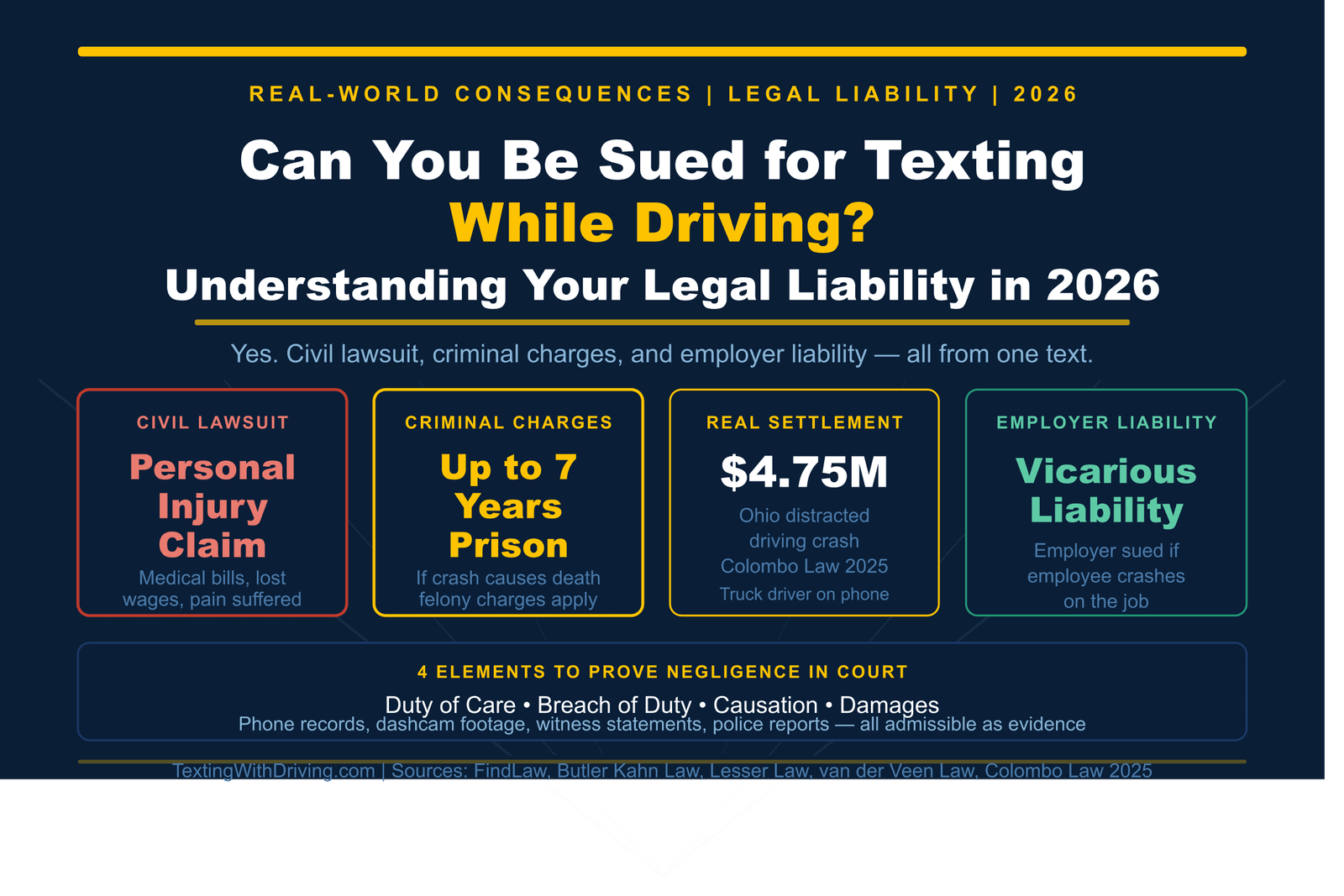
To sue a driver for texting while driving, you need to establish negligence on their part. Negligence is a legal concept that involves proving four key elements: duty of care, breach of duty, causation, and damages. In the context of texting while driving, you must demonstrate that the driver had a duty to operate their vehicle safely, breached that duty by texting, their actions directly caused the accident, and you suffered injuries or damages as a result. World Population Review
Breaking down each element in the context of a distracted driving claim:
Duty of care is the easiest element to establish. Every licensed driver on a public road owes a legal duty of care to every other person on that road, including other drivers, passengers, cyclists, and pedestrians. This duty is not disputed.
Breach of duty in a texting while driving case requires showing that the driver was using their phone at the time of the crash. In states with handheld bans, the mere act of holding the phone is a violation of law, which makes establishing breach of duty particularly straightforward. The violation of a traffic law is generally treated as per se negligence in most states, meaning the breach is legally presumed from the violation itself.
Causation requires connecting the phone use to the crash. This is where evidence becomes critical. Attorneys and investigators look for a causal chain: the driver was texting, which took their attention from the road, which prevented them from perceiving a hazard, which led directly to the collision.
Damages requires showing that the plaintiff suffered real, compensable harm. This includes medical expenses, lost wages, rehabilitation costs, property damage, pain and suffering, and in fatal cases, wrongful death damages including lost future income and loss of companionship.
If texting while driving results in an accident, the driver can be sued for damages including medical expenses, lost wages, and pain and suffering. Drivinglaws101
What Evidence Is Used to Prove Texting While Driving
The question most defendants in these cases ask is: how can anyone prove I was texting? This is often less difficult than drivers assume.
Building a strong case requires compelling evidence. In texting while driving cases, evidence can include eyewitness accounts from individuals who witnessed the driver texting, police reports noting observations regarding distracted driving, and phone records. Obtaining the at-fault driver’s phone records can establish whether they were texting at the time of the accident. World Population Review
Phone records are the most powerful evidence available. When a lawsuit is filed, attorneys can subpoena a defendant’s cell phone records through the carrier. These records show the precise timestamp of every text sent or received, every call made or received, and in some cases every app opened. If a text was sent or received in the seconds before a crash, that timestamp appears in the records alongside the crash timestamp from police reports and emergency response logs.
Cellphone records are a powerful tool in distracted driving lawsuits. Attorneys can subpoena a driver’s phone records to determine whether they were sending or receiving texts at the time of the accident. Timestamped data showing text activity seconds before a crash can be compelling evidence of negligence. Drivinglaws101
Beyond phone records, plaintiffs can use eyewitness testimony from other drivers or pedestrians who observed phone use, dashcam footage from the plaintiff’s or a nearby vehicle, traffic camera footage showing the vehicle’s behavior in the seconds before impact, the police accident report including any admission of phone use by the driver, vehicle black box data showing speed and braking patterns consistent with distracted driving, and expert testimony from accident reconstruction specialists.
Even if the driver denies texting, this kind of evidence can make the truth clear. Even without direct proof of texting, the driver’s behavior such as delayed braking, drifting across lanes, or failing to stop can suggest distraction. If the timing lines up and other facts back it up, a jury can still conclude the driver was using their phone. The law does not require a smoking gun. It just requires evidence that more likely than not the driver was negligent. NHTSA
Real Settlements: What These Cases Actually Pay Out
Colombo Law secured a $4.75 million settlement on behalf of an elderly Ohio couple who were rear-ended by a distracted driver. The husband ultimately died as a result of his injuries while the wife was injured in the accident. The attorneys were able to show that the truck driver was using his cell phone at the time of the wreck and that the trucking company failed to enforce policies against cell phone use. Wikipedia
That case illustrates two important points. First, the settlement scale: $4.75 million for a single distracted driving crash is not unusual when serious or fatal injuries are involved. Second, the employer dimension: the trucking company was part of the liability picture because it failed to enforce a phone policy. The legal exposure extended beyond the individual driver to the organization that employed them.
Other documented settlements and verdicts in distracted driving cases run into the millions routinely when serious injuries are involved. The specific amount in any case depends on the severity of injuries, the jurisdiction, the strength of the evidence, and whether punitive damages are sought. Punitive damages, which are awarded not to compensate the victim but to punish particularly egregious conduct, can multiply a compensatory award significantly when a court finds the defendant’s behavior was especially reckless.
Criminal Liability: When Texting While Driving Becomes a Felony
The criminal dimension of distracted driving liability is where the consequences become most severe.
If texting and driving causes an accident resulting in great bodily harm or death, the driver may face felony charges including aggravated use of an electronic communication device, with penalties of up to 7 years in prison. These laws establish a clear standard of care for drivers. Violating them not only results in criminal penalties but also serves as evidence of negligence in civil lawsuits, increasing the likelihood of liability. Drivinglaws101
Seven years in prison represents the upper range available in some states for the most serious outcomes. The specific charge and sentence range varies by state, but the directional pattern is consistent nationally. A texting violation without a crash is a traffic infraction in most states. A crash with serious injury escalates to a misdemeanor or felony. A crash causing death can result in vehicular manslaughter or homicide charges.
In Pennsylvania, as we covered in our Pennsylvania distracted driving law 2026 guide, Paul Miller’s Law includes an enhanced sentencing provision that adds up to five additional years in prison on a homicide by vehicle conviction when phone use was a contributing factor. In Missouri, the Siddens Bening Hands-Free Law includes a Class D felony provision with up to seven years for violations causing death, which we covered in our Missouri hands-free driving law 2026 guide.
The legal system treats a driver who kills someone while texting differently from a driver who kills someone in an unavoidable accident. The deliberate choice to pick up and use a phone while driving, knowing it is dangerous and knowing it is often illegal, is treated as conduct beyond ordinary negligence and is reflected in the criminal charge categories available to prosecutors.
Employer Liability: The Dimension Most Drivers Do Not Know About
Employers can be sued for an employee’s car crash if the accident occurred within the scope of the employee’s job duties. This is accomplished through the doctrine of vicarious liability, which allows a non-driver to be held liable if they were acting for the owner of the vehicle in some way. DOT
This is one of the most significant and underappreciated dimensions of distracted driving liability. When an employee is driving as part of their job, whether making deliveries, traveling between client sites, or driving a company vehicle for any work-related purpose, and causes a crash while texting, the employer faces civil liability alongside the employee.
The legal basis is the doctrine of respondeat superior, which holds employers responsible for the actions of employees performed within the scope of employment. If an employer allows or fails to prevent employees from using phones while driving on company business, and an employee causes a crash while texting, the employer’s failure to enforce a phone policy becomes part of the liability picture.
This is precisely why the $4.75 million Ohio settlement cited above included the trucking company alongside the individual driver. The company had failed to enforce a cell phone policy. That failure made it a defendant alongside the employee who violated the policy.
For employers, this creates a direct financial incentive to implement and enforce a distracted driving policy. The NSC’s free resources at nsc.org/road/distracted-driving-awareness-month include workplace policy templates for exactly this purpose.
Can the Person Who Sent You the Text Be Sued?
This question has been tested in US courts, and the answer is a qualified yes under specific circumstances.
In both New Jersey and Pennsylvania, judges have ruled that third parties who sent a text to someone who was driving at the time can be included as defendants in lawsuits resulting from texting-and-driving accidents. While a plaintiff must prove that the defendant knew or should have known the text recipient was driving when the text was sent, in order to state a cause of action the plaintiff only has to allege that the third party who sent the text knew or should have known that the driver was driving and would likely read the texts while behind the wheel, and that the third party aided and abetted the driver’s violation of motor vehicle law. NHTSA
This legal theory has not been widely adopted across all states, and it faces significant evidentiary challenges. Proving that a text sender knew the recipient was driving requires evidence of that specific knowledge. But the legal precedent exists. In states that have adopted this theory, someone who knowingly sends texts to a friend they know is currently driving assumes some degree of civil exposure if that distraction contributes to a crash.
The practical implication: if you know someone is driving, do not send them texts that demand immediate attention or response. Your exposure may be limited, but it is not zero in all jurisdictions.
Fault Systems and What They Mean for Compensation
The rules around how fault is allocated vary significantly by state, and they affect what compensation is available to crash victims.
You can still recover damages in no-fault states, but you may still be able to obtain a settlement for your injuries if your injuries surpass your personal injury protection (PIP) policy. Your level of fault may reduce your settlement. You can file a claim against the negligent driver, but your percentage of fault will reduce your settlement, so if you are given 30 percent fault you will receive a settlement amount of less than 30 percent of the total. Fault may block you from appropriating damages in some states. In a contributory negligence state, drivers cannot file a claim if they are found to be at fault in any way. DOT
Most states use comparative fault rules, meaning that if a plaintiff is found to share some responsibility for the crash, their award is reduced proportionately. A handful of states still use contributory negligence, where any fault on the plaintiff’s part can bar recovery entirely.
For the at-fault driver in a texting crash, the fault allocation is typically straightforward. Texting while driving, particularly in states where it is explicitly illegal, creates a strong presumption of fault that is difficult to shift. Defendants who were visibly using their phones at the time of a crash face an uphill battle in comparative fault arguments.
Statute of Limitations: Time Limits on Filing
It is crucial to be aware of the statute of limitations, which sets a time limit on filing a lawsuit. In Pennsylvania, the statute of limitations for personal injury cases including those related to texting while driving accidents is generally two years from the date of the accident. Failing to file a lawsuit within this timeframe may result in losing your right to seek compensation. DOT
Two years is common across many states for personal injury claims, but the specific timeframe varies. Some states allow three years. Some have shorter windows for specific claim types. Claims against government entities often have much shorter notice requirements. The key practical point for anyone who has been injured in a distracted driving crash is that time limits are real and consequential. Waiting too long to consult an attorney, even if you are still in treatment and the full extent of your injuries is not yet clear, can result in losing the right to sue entirely.
What This Means for Every Driver
The legal picture of distracted driving liability is more serious, more comprehensive, and more financially consequential than most drivers realize when they reach for their phone at a red light.
A traffic fine is visible and immediate. A civil lawsuit is delayed, unpredictable in outcome, and potentially unlimited in the damages it can produce. A criminal charge can follow a driver for the rest of their life. Employer liability can produce corporate financial consequences alongside individual ones. And the evidence tools available to plaintiffs, particularly subpoenaed phone records, make the “no one can prove I was texting” belief much more fragile than most drivers assume.
The prevention measures are the same regardless of which dimension of liability concerns you most. Phone in the back seat before the drive starts. Driving mode activated. Navigation set before moving. The legal exposure from a distracted driving crash is the most expensive possible argument for the simplest possible behavior change.
For the full picture of the financial consequences that follow a distracted driving ticket before any lawsuit is involved, see our article on what happens to your car insurance after a distracted driving ticket. For the national data on how many crashes result from distracted driving annually, the distracted driving statistics 2026 overview covers the full scope. And for what the law requires in your specific state, our hands-free driving laws by state 2026 guide covers all 50 states.
Sources Used in This Article
All links verified working before publication.
Colombo Law: Can You Sue for a Texting and Driving Accident — $4.75M Ohio settlement, October 2025
Butler Kahn Law: Could You Sue Someone for Texting While Driving — Georgia negligence elements and evidence guide, August 2025
Florin Roebig: Who Is at Fault If I Was Hit by Someone Texting While Driving — Florida civil liability overview, February 2026
van der Veen Law: Can You Sue a Driver for Texting While Driving in Pennsylvania — Pennsylvania negligence framework, February 2026
Jack Shapiro Law: How Texting While Driving Increases Your Risk of a Lawsuit — Illinois criminal and civil liability, June 2025
Lesser Law Firm: Civil Liability for Texting and Driving — NJ and PA third-party sender liability rulings, May 2024
FindLaw: Can You Be Sued for Texting a Driver — Sender liability legal framework
Injury Attorney of Dallas: Can You Be Sued for Texting a Driver — Duty of care and causation framework
Anidjar Levine: Could You Sue Someone for Texting While Driving — Compensation types and filing process
Mokaram Injury Lawyers: Penalties for Texting and Driving — Civil and criminal liability overview
NSC: Distracted Driving Awareness Month Workplace Resources — Employer policy templates
NHTSA: Distracted Driving — National data context
TextingWithDriving.com is professionally built and maintained to ensure accurate, accessible safety information reaches every driver who needs it. Website development and ongoing support is handled by Budgetic, a digital agency specializing in purpose-driven WordPress websites.

About Texting With Driving
TextingWithDriving.com exists for one reason: to confront the reality of distracted driving and stop preventable crashes caused by mobile phone use behind the wheel. Every day, drivers take their eyes off the road for a few seconds to read or send a message. Those few seconds are enough to cause life-altering consequences. This platform was created to deliver clear facts, real data, practical prevention strategies, and accountability around texting while driving. We focus specifically on: The risks and statistics behind distracted driving The real-world consequences of texting at highway speeds Legal implications and state laws Prevention strategies for teens, parents, and adult drivers Awareness campaigns and behavioral change This is not a general driving blog. It is a focused awareness initiative built around one critical issue: phone distraction behind the wheel. Our content is direct, research-driven, and practical. We prioritize accuracy over opinion and education over sensationalism. The goal is simple — reduce distracted driving incidents by increasing awareness and responsibility. If one article causes one driver to put their phone down, the mission is working. For inquiries or partnerships, contact: privacy@textingwithdriving.com
View all posts by Texting With Driving