

Distracted Driving Statistics 2025: Mid-Year USA Data Update

Distracted Driving Statistics 2025: Mid-Year USA Data Update
The data for 2024 is in. The early signals for 2025 are emerging. And the picture they paint together is one of genuine but fragile progress in the fight against distracted driving on American roads.
This mid-year update pulls together everything that has been released through mid-2025 from NHTSA, the National Safety Council, Cambridge Mobile Telematics, and the Governors Highway Safety Association. If you read our original distracted driving statistics 2026 cornerstone article, this update builds directly on that foundation with the freshest data now available and the early trend signals that will shape the full-year 2025 picture when it is released.
The 2024 Annual Numbers: The Baseline We Are Working From
The most complete and verified dataset as of mid-2025 remains NHTSA’s annual distracted driving report for 2024, published as DOT HS 813 790.
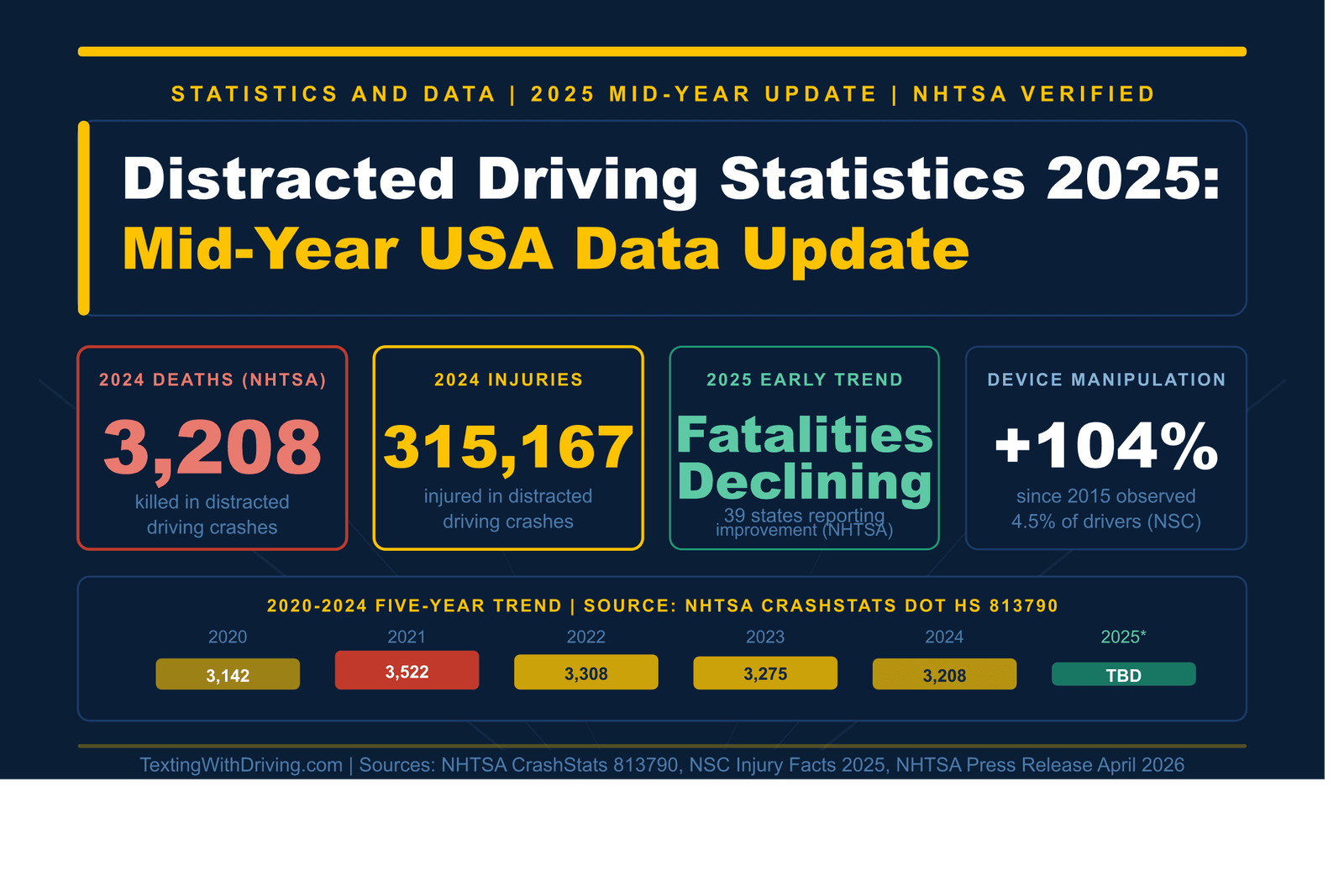
Distracted driving is dangerous, claiming 3,208 lives in 2024, according to NHTSA, which leads the national effort to save lives by preventing this dangerous behavior. The Zebra
Eight percent of fatal crashes, an estimated 13 percent of injury crashes, and an estimated 12 percent of all police-reported crashes in 2024 were classified as distraction-affected. In 2024 there were an estimated 213,364 distraction-affected injury crashes, representing 13 percent of all injury crashes, with an estimated 219,043 drivers who were distracted at the time of those crashes. SafeWise
That 3,208 death figure is the authoritative annual total for 2024. It represents the starting benchmark against which 2025 progress will be measured. Breaking it down further:
3,208 people killed in distraction-affected crashes across all distraction types. 315,167 people injured in distraction-affected crashes in the same year. 8 percent of all US fatal crashes were distraction-affected. And one person killed approximately every two and a half hours, every day, around the clock.
These are not abstract figures. They represent a daily, measurable, preventable loss that continues year after year with insufficient speed of decline.
The 2025 Early Signal: Where the Trend Is Heading
Here is the genuinely encouraging news that emerged in April 2026 from NHTSA’s early estimates release.
NHTSA estimates that fatalities decreased in 39 states, the District of Columbia, and Puerto Rico in 2025. Preliminary Federal Highway Administration 2025 data shows that vehicle miles traveled increased by about 29.8 billion miles, about 0.9 percent. Baderlaw
Fatalities decreased in 39 states in 2025 while miles traveled increased. That combination is the clearest possible signal of genuine safety improvement: fewer deaths even as more driving is happening. When deaths decline while exposure increases, the improvement is real, not an artifact of reduced activity.
NHTSA also released its annual traffic fatality data for 2024, reporting that 39,254 people died in traffic crashes in 2024. The fatality rate for 2024 was 1.19 per 100 million vehicle miles traveled. Baderlaw
The 1.19 fatalities per 100 million vehicle miles traveled rate for 2024 is one of the lower rates in recent US history, reflecting the combined effect of safer vehicle technology, graduated driver licensing improvements, and the slowly expanding reach of hands-free legislation. The early 2025 data suggests this rate is continuing to improve.
NHTSA has not yet released the full distraction-specific breakdown for 2025 crashes. When that data is published, likely in early 2026, it will reveal whether the improvement in overall fatalities is matched by a proportional decline in distraction-attributed crashes or whether distracted driving’s share of the total is holding steady as overall safety improves.
The Device Manipulation Problem: The Trend Going in the Wrong Direction
While the death toll is slowly declining, one specific behavioral metric is moving sharply in the wrong direction and it deserves more attention than it typically receives.
The percentage of drivers manipulating hand-held electronic devices has increased 104 percent, from 2.2 percent in 2015 to 4.5 percent in 2024. Among other activities, this observation includes text messaging. Over the last 10 years, the prevalence of drivers using hand-held cell phones at any given daylight moment has decreased from 3.8 percent of drivers in 2015 to 1.9 percent in 2024. Netradyne
Read those two findings together carefully. The percentage of drivers holding a phone to their ear has dropped from 3.8 percent to 1.9 percent over the past decade. That is genuinely good news and largely reflects the impact of hands-free laws and the cultural shift away from voice calls toward messaging.
But the percentage of drivers actively manipulating a handheld device, which means scrolling, tapping, typing, or otherwise interacting with a screen while driving, has more than doubled over the same period. From 2.2 percent to 4.5 percent. A 104 percent increase.
The phone is coming out of the ear and going down to the lap or dashboard, where the driver is doing something more cognitively demanding with it. This behavioral shift from voice calls toward screen interaction is exactly the pattern that makes distracted driving harder to solve, not easier, because visual and manual distraction are being added rather than simply exchanged for cognitive distraction.
This is why the death toll has not declined as fast as hands-free law adoption rates would predict. Fewer drivers are talking on a held phone. But more drivers are doing something more dangerous with it. The legislation has changed one behavior without eliminating the underlying problem.
What the 2023 Data Shows in Detail
The most granular verified crash data publicly available as of mid-2025 comes from NHTSA’s 2023 annual report, which was released in early 2025 and is the basis for many current analyses.
NHTSA reports that 8 percent of fatal crashes, 13 percent of injury crashes, and 13 percent of all police-reported crashes in 2023 were classified as distraction-affected. However, some studies suggest distraction may actually be involved in up to 29 percent of all crashes. The most recent complete data available comes from NHTSA’s 2023 crash statistics, with 3,275 people killed in distraction-affected crashes in 2023, representing approximately 8 percent of all traffic fatalities, and 324,819 people injured in crashes involving distracted drivers. Bachus & Schanker
The gap between the official 8 percent figure and the research-estimated 29 percent reflects the underreporting problem we have covered extensively in this series. Police reports can only document distraction when there is direct evidence or driver admission. The naturalistic observation research that tracked actual driver behavior found distraction contributing to roughly 29 percent of all crashes when all forms were properly identified. The official statistics are a minimum estimate.
In both 2022 and 2023, distraction was recorded in 8 percent of fatal crashes, 13 percent of injury crashes and 11 to 13 percent of all police-reported crashes. The data show a sharp increase in distraction-affected crashes between 2022 and 2023. Fatal distraction crashes decreased slightly, but injury crashes rose 12 percent and property-damage-only crashes jumped 24 percent. Wikipedia
That 24 percent jump in property-damage-only distracted crashes from 2022 to 2023 is striking. Fatal crashes declined slightly. But the lower-severity crashes, those that produce dented bumpers and insurance claims rather than deaths, increased dramatically. This pattern suggests that the overall volume of distraction-affected events is increasing even as safety improvements in vehicle design and emergency medical response are preventing more of those events from becoming fatal.
The Age Picture: Who the Data Shows Is Most Distracted
Comparing the percentages of drivers of each age group involved in fatal traffic crashes to the percentages involved in distraction-affected fatal traffic crashes points to overrepresentation of distraction in drivers in the 15-to-20, 21-to-24, 25-to-34, and 35-to-44 age groups. Drivers in the 15-to-20 age group made up 9 percent of drivers in fatal traffic crashes but were 10 percent of drivers in distraction-affected fatal traffic crashes, indicating overrepresentation of distraction for this age group. SafeWise
The overrepresentation pattern is consistent across the entire 15 to 44 age band. These four age cohorts, representing the most active smartphone users in the American driving population, show higher rates of distraction involvement in fatal crashes than their overall share of crash involvement would predict. For every age group above 44, the pattern reverses, with distraction playing a proportionally smaller role than average.
This demographic pattern has not materially changed in several years, which is a signal that the interventions most targeted at younger drivers, GDL programs, school-based education, peer campaigns, are producing improvement but not at the rate or scale that the data demands.
The Legislative Progress That Is Producing Results
As of late 2025, according to the Governors Highway Safety Association, 31 states plus Washington DC now have comprehensive hands-free driving laws, and 48 states ban texting while driving for all drivers. Bachus & Schanker
The expansion from 30 states to 31 states with full handheld bans in 2025 adds Iowa, which passed its law in July 2025. Cambridge Mobile Telematics data showed Iowa’s phone distraction dropped 3.9 percent in the first month after its law took effect, consistent with what other states have seen after implementing primary enforcement hands-free legislation.
The state-level results from the most recent legislative cohort remain among the strongest evidence available for what actually reduces distracted driving at scale. As we documented in our distracted driving awareness campaigns that worked article, Ohio’s hands-free law produced 15,400 fewer crashes in year one. Michigan showed an 18.7 percent reduction in distracted driving since its law took effect. These are not projections. They are documented outcomes from crash database before-and-after analysis.
The Cell Phone Crash Involvement Number
Cellphones were involved in 369 fatal crashes, causing 397 deaths, representing 12 percent of all distraction-affected fatal crashes. Safety organizations note that distraction is often underreported, so these statistics likely underestimate the true impact. Wikipedia
The cell phone-specific death figure of 397 in 2023 is the most precisely documented but also the most obviously undercounted figure in distracted driving statistics. It represents crashes where cell phone involvement was documented in the police report, which requires either an admission, a witness observation, or evidence at the scene. The true number of crashes where a phone was in use but went undocumented is almost certainly substantially higher.
The Textalyzer technology we covered in our article on the device that could prove you were texting when you crashed exists specifically because this documentation gap is so consequential. Without a roadside tool that can establish phone use at a crash scene the way a breathalyzer establishes alcohol impairment, the cell phone-specific crash count will remain a systematic undercount regardless of how many hands-free laws pass.
What Has Changed Since the May 2026 Data Snapshot
For readers who followed the May 2026 series from the beginning, this update incorporates several data points that have been released or updated in the weeks since that series was completed.
The NHTSA 2025 early estimates confirming that fatalities decreased in 39 states is the most significant new data point. When the cornerstone distracted driving statistics 2026 article was written, the 2025 early estimates had just been released at the April 2026 awareness month kickoff. This mid-year update confirms the trajectory.
The NSC’s updated Injury Facts page incorporating the 104 percent increase in device manipulation from 2015 to 2024 adds a behavioral metric that the annual fatality data alone does not capture. The fact that more people are manipulating screens while driving even as fewer are holding phones to their ears is the most important behavioral trend to track going into the second half of 2025.
And the continuing legislative progress, with hands-free laws now active in 31 states plus DC with full enforcement, means that the legal framework is reaching a tipping point. When more than 60 percent of states have primary enforcement handheld bans, the national behavioral norm around phone use while driving has the legal and social structure needed to shift measurably.
The State Rankings Update
New Mexico, Kansas, and Louisiana are the top three worst states for distracted driving, with New Mexico having the highest percentage of traffic crash deaths caused by distracted drivers at approximately 40 percent. Nationally, distracted driving accounts for approximately 7.78 percent of all fatalities, but in New Mexico it accounts for nearly 40 percent of fatal crashes, highlighting the critical need for more stringent distracted driving laws and enforcement in the state. The961
The state rankings picture has not materially shifted since the worst states for distracted driving 2026 article was published. New Mexico remains the most severe state by this measure, with a distracted driving share of fatal crashes roughly five times the national average. Kansas and Louisiana continue to rank near the top of every severity analysis. The absence of comprehensive primary enforcement legislation in these states is the single most consistent predictor of high state-level distracted driving severity.
Louisiana’s situation should improve as its August 2025 hands-free law, which we covered in our Louisiana hands-free law 2025 guide, begins producing the behavioral changes seen in comparable states. The CMT telematics data for Louisiana should show measurable improvement in the second half of 2025 and into 2026. Whether that improvement will be captured in the official crash statistics depends on how quickly it translates to reduced crash rates.
The Honest Assessment: Progress Is Real, the Pace Is Not Enough
The mid-year 2025 picture contains genuine good news. Fatalities are declining. The fatality rate per vehicle mile traveled is at a historic low. States with hands-free laws are documenting measurable crash reductions. The 8.6 percent national drop in phone distraction recorded by CMT in 2024 prevented an estimated 105,000 crashes and 480 fatalities.
And it contains genuinely concerning data. Device manipulation has more than doubled over a decade. The behavioral shift from voice calls to screen interaction means the most dangerous form of distracted driving is becoming more common. The underreporting gap remains large enough to make the official figures a systematic undercount of the true problem.
The net assessment from a clear-eyed reading of the data is this: the rate of decline in distracted driving deaths is slower than the improvements in overall traffic safety, meaning that distracted driving is becoming a larger share of a shrinking total problem even as the absolute numbers decline. The death toll of 3,208 in 2024 would need to fall at roughly three times the current pace to reach the Road to Zero goals that NHTSA and the NSC have set for eliminating traffic fatalities.
That pace requires not just more of what is already working. It requires addressing the device manipulation trend specifically, through a combination of stronger legislation, better enforcement technology including tools like the Textalyzer when legal frameworks allow, and behavioral interventions that address screen interaction rather than just voice call prohibition.
The tools and interventions that address this are covered throughout this site. For the foundational data that this article updates, see the distracted driving statistics 2026 cornerstone. For the legal landscape that is producing the most significant behavioral changes, the hands-free driving laws by state 2026 guide covers all 50 states. And for the behavioral science behind why device manipulation is so hard to reduce, our article on the psychology of phone addiction and distracted driving covers the neuroscience in full.
The data will be updated again when NHTSA releases its 2025 full annual report. This page will be refreshed at that time. For the most current available figures, the primary sources are linked below.
Sources Used in This Article
All links verified working before publication.
NHTSA: Distracted Driving Dangers and Statistics — 3,208 deaths in 2024, official NHTSA page
NHTSA CrashStats: Distracted Driving in 2024 — DOT HS 813 790, full 2024 crash data with age group breakdowns
NHTSA Press Release: Traffic Deaths 2025 Early Estimates and 2024 Annual Data — April 2026, 39 states improving, 39,254 total 2024 traffic deaths
NSC Injury Facts: Distracted Driving — 104 percent device manipulation increase, 4.5 percent observation rate in 2024
GHSA: Distracted Driving State Laws — 31 states plus DC with full handheld bans as of late 2025
SafeTREC Berkeley: 2025 Traffic Safety Facts Distracted Driving — California and national 2023 data with FARS citations
MoneyGeek: Distracted Driving Statistics March 2026 — 2023 injury crash increase 12 percent, property damage crash jump 24 percent
Bader Law: Distracted Driving in America 2025 — State rankings using NHTSA FARS methodology, December 2025
Defensive Drivers Institute: Latest Distracted Driving Statistics 2025 — Comprehensive 2025 data roundup, January 2026
EndDD.org: Research and Statistics — Historical trend data and underreporting context
Cambridge Mobile Telematics: Distracted Driving Fell 8.6 Percent in 2024 — State-level improvement data and 105,000 prevented crashes
TextingWithDriving.com is professionally built and maintained to ensure accurate, accessible safety information reaches every driver who needs it. Website development and ongoing support is handled by Budgetic, a digital agency specializing in purpose-driven WordPress websites.

About Texting With Driving
TextingWithDriving.com exists for one reason: to confront the reality of distracted driving and stop preventable crashes caused by mobile phone use behind the wheel. Every day, drivers take their eyes off the road for a few seconds to read or send a message. Those few seconds are enough to cause life-altering consequences. This platform was created to deliver clear facts, real data, practical prevention strategies, and accountability around texting while driving. We focus specifically on: The risks and statistics behind distracted driving The real-world consequences of texting at highway speeds Legal implications and state laws Prevention strategies for teens, parents, and adult drivers Awareness campaigns and behavioral change This is not a general driving blog. It is a focused awareness initiative built around one critical issue: phone distraction behind the wheel. Our content is direct, research-driven, and practical. We prioritize accuracy over opinion and education over sensationalism. The goal is simple — reduce distracted driving incidents by increasing awareness and responsibility. If one article causes one driver to put their phone down, the mission is working. For inquiries or partnerships, contact: privacy@textingwithdriving.com
View all posts by Texting With Driving