

Indiana Distracted Driving Law 2026: What Every Hoosier Driver Must Know

Indiana Distracted Driving Law 2026: What Every Hoosier Driver Must Know
The Indiana distracted driving law has an origin story that distinguishes it from most other state hands-free laws: Indiana’s original 2011 texting ban was declared unenforceable by the 7th Circuit Court of Appeals because it was too narrowly tailored. That federal court ruling — combined with the documented rise in distraction-related crashes — is what drove Indiana’s comprehensive hands-free law in 2020. Governor Eric Holcomb made the new law part of his 2020 legislative agenda and signed it March 18, 2020, with overwhelming bipartisan support.
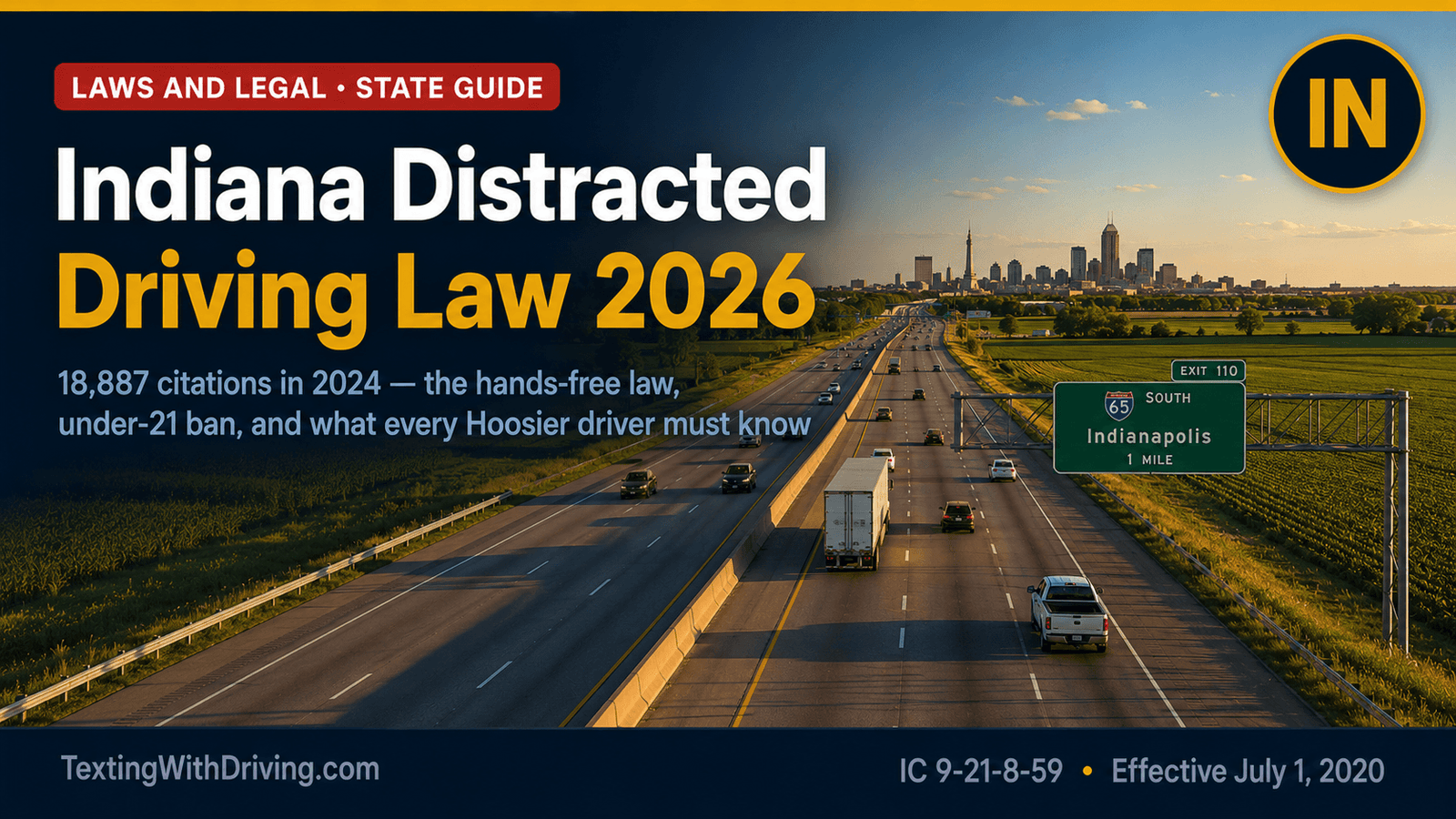
Indiana Code § 9-21-8-59, which took effect July 1, 2020, prohibits all drivers from holding or using a telecommunications device while the vehicle is in motion. The law is primary enforcement, carries up to $500 in fines, assigns 4 BMV points per violation, and — in a provision that distinguishes Indiana from most other states — applies a complete device ban to all drivers under the age of 21, not just those under 18.
In 2024, Indiana law enforcement issued 18,887 citations for hands-free law violations, a substantial increase demonstrating the state’s growing enforcement efforts. And Indiana is one of six states where Juneteenth is the most dangerous holiday of the entire year, reinforcing the urgency of distracted driving enforcement on Indiana’s roads.
This guide covers exactly what the Indiana distracted driving law requires in 2026, what the court-unenforceable 2011 law history means, the specific under-21 provision that differs from every surrounding state, the complete fine and points structure, what remains legal, and what every Indiana driver and visitor needs to know.
The Legal History: Why Indiana Needed a New Law
Indiana’s 2011 texting ban, which made texting while driving illegal, was found to be unenforceable by the 7th Circuit Court of Appeals because it was too narrowly tailored. The court’s reasoning was that the law’s specific focus on the typing and sending of electronic messages created a behavior so difficult to distinguish from other legal phone uses at a glance that it created constitutional enforcement problems.
An officer observing a driver with a phone could not definitively establish from outside the vehicle whether the driver was texting (illegal) or browsing (legal under the 2011 ban) or dialing (legal) or reading an email (legal). The narrow focus of the 2011 ban made it nearly impossible for police officers to enforce, as it was nearly impossible for the officer to ascertain if the person on the phone was actually sending or reading a text while driving.
Indiana Code § 9-21-8-59 solved the enforcement problem by changing the standard from what the driver was doing with the phone to whether they were holding the phone at all. The current Indiana distracted driving law prohibits holding or using a telecommunications device — full stop. An officer who sees a driver with a phone in their hand observes a violation regardless of what the driver is doing with it. The observable act of holding the device is the violation, which produces an enforceable and constitutionally sound standard.
This legal history is important because it explains why Indiana’s law is structured the way it is, why the holding standard matters, and why the previous enforcement gap produced the crash trend that motivated the 2020 legislation.
What the Indiana Distracted Driving Law Prohibits
Indiana Code § 9-21-8-59 is direct in its prohibition. A person may not hold or use a telecommunications device while operating a motor vehicle, unless the device is used in conjunction with hands-free or voice-operated technology.
The prohibited behaviors under the Indiana distracted driving law cover the full range of device interactions:
Holding a phone for any reason. The holding standard means any phone in hand while the vehicle is moving is a violation. Holding it to make a call. Holding it to check a notification. Holding it to read a message. Holding it to operate GPS. All prohibited.
Texting, emailing, or any text-based communication while holding the device. Even with hands-free technology, manual text entry while driving is prohibited. The hands-free standard applies to the technology that the interaction occurs through, not just the call function.
Browsing the internet while holding the device. Any internet use requiring manual device contact while driving is prohibited.
Social media access while holding the device. Scrolling, posting, or accessing any social media platform while holding the phone is prohibited.
Video watching while holding the device. Video consumption of any kind while holding the phone is prohibited.
The red light question. Indiana’s statute applies while the motor vehicle is in motion. At red lights, the law’s application is less explicitly stated than in some other states. However, Indiana police and legal professionals generally treat temporary stops at signals as within the prohibition’s scope because the driver remains in operational control of the vehicle on a public road. Drivers who pick up their phones at red lights face citation risk in Indiana.
Primary Enforcement: Officers Can Stop You Without Another Violation
The Indiana distracted driving law is a primary offense. Indiana uses primary enforcement. This means that if an officer sees you texting while driving, you can be pulled over and cited even if you’ve been in full control of your vehicle the entire time.
Primary enforcement authority applies from the moment the violation is observed. An officer who sees a driver holding a phone, using a phone in their hand, or interacting with a device while driving can initiate a traffic stop based solely on that observation. No speeding. No lane departure. No other violation needed. The 18,887 citations issued in 2024 reflect this primary enforcement authority being actively exercised across the state.
Your Phone Privacy Rights During an Indiana Traffic Stop
The Indiana distracted driving law includes a specific provision protecting drivers from warrantless phone searches that mirrors the protection we documented in Ohio and Virginia.
A police officer may not, without the consent of the person: confiscate a telecommunications device for the purpose of determining compliance with this section; confiscate a telecommunications device and retain it as evidence pending trial for a violation of this section; or extract or otherwise download information from a telecommunications device for a violation of this section unless the officer has probable cause to believe that the device was used in the commission of a crime, the information is extracted under a valid search warrant, or the person provides voluntary consent.
This statutory protection means that during an Indiana traffic stop for a hands-free violation, you are not required to hand over your phone, allow the officer to examine it, or permit any data extraction. The officer can issue the citation based on their visual observation of the violation. What is in the phone’s memory, what apps were open, what messages were on screen — none of this is accessible without your consent or a valid warrant.
Understanding this protection is practical knowledge for any driver who receives an Indiana citation. The citation documents the officer’s observation. The phone’s contents are separately protected.
The Fine and Points Structure
The Indiana distracted driving law fine structure uses a five-year lookback window and presents differently depending on whether the driver pleads guilty or contests the citation.
If you plead guilty:
- First offense: $35.50 maximum fine
- Second offense within five years: $250.50 maximum fine
- Third or subsequent offense within five years: $500 maximum fine
If you contest and lose:
- First offense within five years: $35.50 maximum fine
- Second offense within five years: $250.50 maximum fine
- Third or subsequent offense within five years: $500 maximum fine
BMV points: 4 points are added to the Indiana driver’s license for each violation. The Indiana BMV began adding points to records on July 29, 2021. Points accumulate and potentially lead to a suspension of driving privileges, especially if combined with other Indiana traffic violations.
The low base fine for a guilty plea — $35.50 — is notably modest compared to states like New York ($50 to $450), Virginia ($125 to $250), New Jersey ($200 to $800), and others we have covered in this series. The $500 maximum for a contested third or subsequent offense is more significant, but the first-offense financial deterrent is among the lowest of any comprehensive hands-free state.
This fine structure is worth comparing to Tennessee’s $50 first offense, which we identified in our Tennessee distracted driving law article as a potential explanation for why Tennessee’s law has not produced the crash reduction documented in higher-fine states. Indiana’s $35.50 guilty-plea fine is even lower than Tennessee’s first-offense baseline, which may partially explain why Indiana has seen 1,500-plus crashes caused by using cell phones and other electronic devices over recent years with numbers that are steadily rising despite the law being in effect since 2020.
The Under-21 Provision: Indiana’s Unique Age Standard
The most distinctive element of the Indiana distracted driving law compared to other states in this series is the age cutoff for the stricter complete device ban. Most states with novice driver complete bans use under-18 as the threshold. Indiana uses under-21.
For drivers who are younger than 21 years old, operating a motor vehicle while using a telecommunications device is prohibited. Unlike its laws for older drivers, Indiana prohibits drivers who are younger than 21 from using hands-free or voice-operated devices. The only exception to this ban is for making 911 calls.
An 18-year-old or 20-year-old driver in Indiana cannot use Bluetooth for a call. Cannot use voice commands. Cannot use any hands-free technology. The only permitted phone use is a 911 call in a genuine emergency. This complete ban applies to every driver who has not yet reached their 21st birthday, regardless of how long they have held a license.
This under-21 standard is the broadest age-based complete device ban of any state in this series. Illinois’s complete ban applies to drivers under 19. Most other states use under-18. Indiana applies the complete prohibition to a full three additional years of licensed driving beyond the minimum legal driving age.
For parents of Indiana drivers between 18 and 20: these young adults may have their own vehicles, their own insurance policies, and full adult legal status for most purposes. But under the Indiana distracted driving law, their phone use while driving is subject to the same complete prohibition as a 16-year-old with a learner’s permit. A hands-free call that is legal for a 21-year-old Indiana driver is illegal for a 20-year-old Indiana driver in the same car on the same road.
As we covered in our distracted driving laws for teen drivers state guide, the under-21 distinction is one of the most important state-specific compliance facts for this age group and their parents to understand precisely.
What Remains Legal Under the Indiana Distracted Driving Law
For drivers aged 21 and older, the Indiana distracted driving law permits the following:
Hands-free calls through Bluetooth earpiece, speakerphone on a mounted device, or vehicle-integrated system, provided the phone is not physically held.
Voice commands for any phone function — calls, navigation, music — that requires no physical holding of the device.
Mounted GPS navigation where the phone is secured in a mount and the destination is pre-set before the vehicle moves. Using GPS navigation on your cell phone is legal as long as the directions were programmed before driving began.
Single-touch activation on a mounted device to accept a call, end a call, or activate a voice function.
Emergency calls under genuine emergency circumstances, even in handheld mode. A telecommunications device may be used or held to call 911 to report a bona fide emergency.
Legal parking. When the vehicle is fully stopped in a lawful parking position off the travel lane, phone use is unrestricted.
Indiana doesn’t have any other laws addressing distracted driving beyond the telecommunications device prohibition, meaning it’s technically legal to do things like apply makeup or eat food while driving — though just because these distracting activities are legal doesn’t mean they won’t be used against a driver in a civil lawsuit if they cause an accident.
Commercial Driver Rules and the Federal Layer
Commercial drivers operating commercial vehicles in Indiana are subject to the FMCSA federal framework we covered in our FMCSA commercial driver distracted driving rules article on top of Indiana state law. Federal civil penalties of up to $2,750 per violation for drivers and $11,000 for employers apply alongside the state Class C infraction classification.
Commercial vehicle drivers may not begin or end a phone call unless they can do so by pressing a single button. This single-button standard is the most practical compliance guidance for CDL holders operating commercial vehicles in Indiana.
The Indianapolis Motor Speedway Connection: What Race Culture Tells Us About Indiana Roads
Indiana occupies a specific place in American automotive culture. The Indianapolis Motor Speedway — home of the Indianapolis 500, the largest single-day sporting event in the world — represents the most concentrated celebration of driving skill, vehicle performance, and road safety engineering in American culture.
The Indianapolis 500 field in 2026 will achieve average lap speeds above 230 mph through 4 miles of oval track, with reaction times measured in fractions of seconds and concentration as the absolute prerequisite for survival. The professional race driver’s complete focus on the driving task, maintained across 500 miles, is the most extreme possible expression of the principle that underlies the Indiana distracted driving law: the road demands your complete attention.
The cultural resonance between Indiana’s racing heritage and its hands-free law is not merely symbolic. The same attention management that separates safe drivers from distracted drivers on Indiana state highways is the same attention management that separates competitive racers from those who cannot maintain focus through the Brickyard’s corners. The race driver’s phone is in the pit. Every driver’s phone should be in the back seat.
Indiana’s Crash Data Context
More than 200,000 car accidents occur every year in Indiana. Drivers using a phone are up to six times more likely to cause a crash, according to INDOT data. Over three recent years since passing the Indiana texting and driving law, the state saw over 1,500 crashes caused by using cell phones and other electronic devices — a number that is steadily rising.
Indiana is one of six states where Juneteenth is the most dangerous holiday of the entire year, as we documented in our Juneteenth weekend driving safety article. The combination of holiday travel, evening celebration, and return-trip driving in the late night hours creates the most dangerous driving window of Indiana’s calendar, and phone use during that window compounds every other risk factor.
Despite the law’s intent, highway fatality rates have increased, with 949 deaths reported in 2022, up from 897 in 2020. The same pattern documented in Tennessee — a comprehensive primary enforcement hands-free law that has not yet produced the documented crash reduction seen in Ohio, Michigan, Colorado, and Georgia — suggests that enforcement intensity and financial deterrent level both factor into whether a law produces measurable safety outcomes.
The low guilty-plea fine ($35.50), combined with the 18,887 citations issued in 2024 but with an uncertain enforcement intensity distribution, makes Indiana a state where the law exists and enforcement is active but may not yet have reached the high-visibility campaign threshold that produces norm-shift behavioral change in the broader driving population.
What Every Indiana Driver Should Do in 2026
The Indiana distracted driving law requires a specific and achievable behavioral standard: no phone held in the hand for any reason while the vehicle is moving on any Indiana public road.
If you are 21 or older: Phone mounted on dashboard or windshield, GPS pre-set before moving, Bluetooth connected for calls, Driving Focus or Android driving mode active, no manual device contact while moving.
If you are under 21: Phone must be completely inaccessible during every drive. Not in the cupholder. Not on the passenger seat. Not in a mount where you can reach it. In the back seat or glove compartment. No phone interaction of any kind except a 911 call during a genuine emergency. The under-21 standard is complete and has no hands-free exception.
For the complete technology setup that makes Indiana compliance automatic for all drivers, our hands-free while driving complete setup guide covers iPhone, Android, Bluetooth, and CarPlay from scratch. For the national comparison showing where Indiana’s law fits among all 50 states, our hands-free driving laws by state 2026 covers every state’s specific provisions.
Sources Used in This Article
All links verified working before publication.
INDOT: Hands-Free Indiana Official Page — IC 9-21-8-59 overview, Governor Holcomb signing, NHTSA 12-state improvement data, FAQ
Keffer Hirschauer: Navigating the Indiana No-Hands Law — 18,887 citations in 2024, 4 BMV points, 949 fatalities 2022 vs 897 2020, October 2025
Driving Laws: Indiana’s Cell Phone-Use and Texting-While-Driving Laws — Under-21 complete ban IC 9-24-11-3.7, fine structure $35.50 to $500, December 2025
FindLaw: Indiana Code § 9-21-8-59 — Complete statute text, phone search protection, consent requirement
McNeely Law: Indiana’s Hands-Free Law Explained — July 1, 2020 effective date, Class C infraction, suspension risk, March 2026
Truitt Law Offices: Texting and Driving in Indiana — $500 maximum fine, 1,500 crashes since law, primary enforcement, April 2025
Enjuris: Indiana Distracted Driving Laws — 2011 unenforceable law history, 7th Circuit ruling, civil negligence standard
Insured Better: Your Guide to Indiana Distracted Driving Laws — Guilty plea vs contested fine structure, five-year lookback, 200,000 annual Indiana accidents
Banks and Brower: Overview of Indiana’s Hands-Free Driving Law — HB 1070 background, IC 9-21-8-59 text, July 2021 points start
NHTSA: Distracted Driving — 3,208 deaths 2024, national context
TextingWithDriving.com is professionally built and maintained to ensure accurate, accessible safety information reaches every driver who needs it. Website development and ongoing support is handled by Budgetic, a digital agency specializing in purpose-driven WordPress websites.

About Texting With Driving
TextingWithDriving.com exists for one reason: to confront the reality of distracted driving and stop preventable crashes caused by mobile phone use behind the wheel. Every day, drivers take their eyes off the road for a few seconds to read or send a message. Those few seconds are enough to cause life-altering consequences. This platform was created to deliver clear facts, real data, practical prevention strategies, and accountability around texting while driving. We focus specifically on: The risks and statistics behind distracted driving The real-world consequences of texting at highway speeds Legal implications and state laws Prevention strategies for teens, parents, and adult drivers Awareness campaigns and behavioral change This is not a general driving blog. It is a focused awareness initiative built around one critical issue: phone distraction behind the wheel. Our content is direct, research-driven, and practical. We prioritize accuracy over opinion and education over sensationalism. The goal is simple — reduce distracted driving incidents by increasing awareness and responsibility. If one article causes one driver to put their phone down, the mission is working. For inquiries or partnerships, contact: privacy@textingwithdriving.com
View all posts by Texting With Driving