

Distracted Driving Statistics 2026: The Complete USA Data Overview

Distracted Driving Statistics 2026: The Complete USA Data Overview
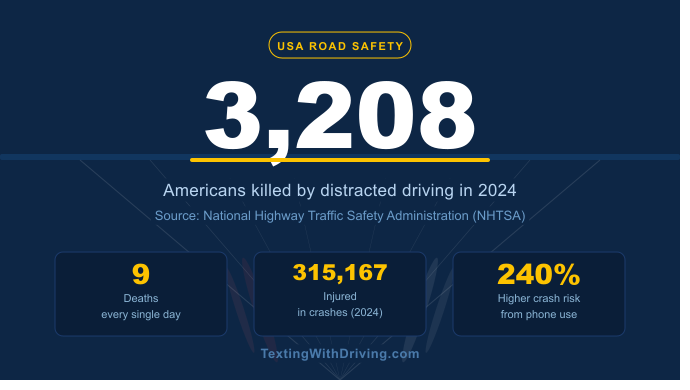
Nine people.
That is how many Americans die in distracted driving crashes every single day. Not in a hypothetical projection. Not in a worst-case estimate. That is what the real data shows, day after day, year after year.
If that number feels distant right now, keep reading. Because once you see the full picture, it stops feeling abstract very quickly. The deaths, the injuries, the age groups most at risk, what the science says about hands-free technology, what actually reduces these crashes and what does not. Everything you need is in this article, drawn entirely from verified primary sources.
Let’s get into it.
The Number That Defines This Problem
In 2024, 3,208 people were killed in motor vehicle crashes involving distracted drivers in the United States, according to the National Highway Traffic Safety Administration. That works out to roughly 8.7 deaths every single day, seven days a week, 365 days a year. Weekly Safety
The 2023 data tells the same story. NHTSA reported 3,275 people died in distraction-affected crashes in 2023, a decrease of about 1 percent from 3,315 deaths in 2022. Wikipedia
So yes, the number is technically declining. But at this pace it would take generations to reach zero, and researchers are clear that even these figures are likely undercounts of the true toll.
Here is why they are probably undercounts. Self-reported data elements, such as admitting to texting while driving, are always subject to bias. In some cases, the only source of distraction information for an investigating police officer may be the surviving driver’s account of the crash, and the likelihood that the driver might admit to a negative behavior such as texting while driving might be small. Texting With Driving
Think about what that means. The person most likely to know whether distraction caused a crash is also the person with the strongest reason not to say so. Which means 3,208 is a floor, not a ceiling.
Five Years of Data: Are Things Getting Better?
Here is the honest answer. A little. But not nearly fast enough.
| Year | Distraction-Affected Deaths |
|---|---|
| 2020 | 3,142 |
| 2021 | 3,522 |
| 2022 | 3,308 |
| 2023 | 3,275 |
| 2024 | 3,208 |
Sources: NHTSA Distracted Driving and NSC Injury Facts: Distracted Driving
The 2021 spike is notable. It happened when post-pandemic driving volume returned in full force while phone habits had worsened during lockdowns. The gradual improvement since 2021 is real, but here is what makes it frustrating. Overall US traffic fatalities have been declining faster than distracted driving deaths specifically. Distracted driving’s share of all road deaths is actually holding steady or increasing as a percentage even while other road safety metrics improve.
What that tells researchers is important. Most road safety problems respond reasonably well to engineering improvements, speed limit enforcement, and seatbelt laws. Distracted driving is different. It is a behavior problem rooted in technology that has been specifically designed to feel impossible to ignore. And that makes it one of the most stubborn challenges in the entire field of road safety.
The Injuries Nobody Hears About
Fatalities get the headlines. But the injury numbers reveal how much larger this problem actually is.
In 2024, an estimated 315,167 people were injured in traffic crashes involving distracted drivers. That represents 5 percent of fatal crashes, an estimated 13 percent of injury crashes, and an estimated 12 percent of all police-reported traffic crashes reported as distraction-affected. Bachus & Schanker
For every person killed, roughly 98 more are injured. Some of those injuries are minor. Many are not. Spinal cord damage. Traumatic brain injuries. Surgeries and rehabilitation lasting years. For some people, no meaningful recovery at all.
The National Safety Council confirms that distracted driving kills nearly nine people every day, and safety experts believe the actual number could be higher because no standardized method exists to reliably capture distraction as a contributing factor in crashes. Ad Council
This is a slow-motion public health crisis happening in every state, on every type of road, every single day.
Who Is Actually Most at Risk?
This section matters especially if you have a teen or young adult in your life who drives.
Teen drivers face the highest rate of distraction-related crashes of any age group. Six percent of drivers aged 15 to 20 involved in fatal crashes were reported as distracted, the largest proportion of any age group. Bachus & Schanker
Research from the AAA Foundation for Traffic Safety’s study on newly licensed teen drivers found that electronic device use was the most common distracted driving behavior observed via in-vehicle cameras. One finding stood out particularly. Teens were significantly less likely to use their devices when a parent or adult was present in the vehicle. That single detail tells you something important about how much conversation and parental influence actually matters.
Then there is the young adult paradox, which is genuinely uncomfortable to look at. The AAA Foundation’s 2024 Traffic Safety Culture Index surveyed 2,704 licensed US drivers and found that about 97 percent of drivers perceived scrolling through social media as extremely or very dangerous, and 94 percent said the same about texting while driving. Despite those perceptions, 11 percent reported scrolling through social media, 28 percent reported sending a text or email, and 37 percent reported reading one while driving. NHTSA
Read that again. 94 percent of people know it is dangerous. More than a third do it anyway.
That gap between knowing something is wrong and actually stopping is the central challenge of this entire problem. It explains why awareness campaigns alone, without legislation, technology, and real behavior change tools, produce limited long-term results. Information is not enough on its own. The phone is engineered to feel more urgent than the abstract risk.
Older adults are not exempt from this problem either. Phone use while driving exists across every age group. The behaviors shift as people age (older drivers trend toward voice calls and navigation use rather than social media), but the cognitive impairment those activities create is real regardless of the form the distraction takes.
The Hands-Free Myth: What Research Actually Shows
Here is the belief most drivers hold that the science consistently contradicts.
Most people assume that using their phone hands-free, whether through voice calls, Siri, Google Assistant, or voice-to-text, is safe. It is not. Not fully. Not according to the most rigorous research available.
The AAA Foundation for Traffic Safety, working with cognitive distraction researcher Dr. David Strayer at the University of Utah, has produced some of the most widely cited work in this field. Their conclusion is direct and unambiguous. Even when a driver’s eyes are on the road and hands are on the wheel, sources of cognitive distraction cause significant impairments to driving, including suppressed brain activity in areas needed for safe driving, increased reaction time, missed cues and decreased accuracy, and decreased visual scanning of the driving environment. Baderlaw
Their distraction scale ranks tasks from 1 (least distracting) to 5 (most distracting). Listening to the radio sits around 1.2. A passenger conversation scores about 2.3. A handheld phone call scores 2.5. And voice-to-text? Driver interactions with in-vehicle speech-to-text systems create the highest level of cognitive distraction among the tasks assessed. Simply put, hands-free does not mean risk free. Baderlaw
You can read the full AAA Foundation cognitive distraction study here.
This finding matters enormously for understanding the crash statistics. Many states with hands-free laws still permit voice calls and voice-to-text. Millions of drivers who believe they are complying with both the law and their own conscience may still be meaningfully impaired. The crashes that result often go unattributed to distraction in police reports because there is nothing visible to point to.
How Much Phone Use Is Actually Happening Right Now?
More than most people assume. Here is what observed behavior data shows.
Over the last 10 years, the prevalence of drivers using hand-held cell phones at any given daylight moment decreased from 4.3 percent of drivers in 2014 to 2.1 percent in 2023. However, the percentage of drivers manipulating hand-held electronic devices increased 36 percent, from 2.2 percent in 2014 to 3.0 percent in 2023. Wikipedia
What that tells us is that fewer people are holding the phone to their ear (voice calls have declined as texting and apps have grown), but more people are actively touching and interacting with their screens. The behavior is shifting form. It is not disappearing.
At any given moment during daylight hours, more than 326,000 US drivers, roughly half the population of Vermont, are holding a cell phone to their ear while driving. And that is just the ones holding it to their ear. The ones looking down at their screen are not captured in that particular observation count. GHSA
Your Crash Risk Goes Up 240 Percent With Your Phone In Hand
This is the number that should permanently change how you think about your phone while driving.
According to a report from the Governors Highway Safety Association and Cambridge Mobile Telematics, drivers who use their phones behind the wheel are 240 percent more likely to crash. AVR
Not 20 percent more likely. Not 50 percent. Two hundred and forty percent.
The same report found that high rates of hard braking are associated with 103 percent higher expected losses and excessive speeding with a 71 percent increase in predicted losses, but phone use stands alone as the single largest crash risk factor in their analysis of millions of US drivers. AVR
This data comes from the same actuarially validated models that insurance companies use to price risk across their entire customer base. It is not a safety campaign estimate. It is what real-world driving data shows when phone use is directly linked to crash outcomes at scale. You can read the full GHSA and Cambridge Mobile Telematics report here.
The Economic Cost: This Goes Beyond Individual Lives
At a national NHTSA distracted driving event, a senior official cited that distracted driving crashes cost Americans collectively $98 billion in 2019 alone. Since then, medical costs, vehicle repair costs, and legal costs have all increased significantly. The961
For employers, the numbers become very direct. If any of your employees drive as part of their work, whether for deliveries, sales, field service, or anything else, the average cost of a work-related motor vehicle crash runs into tens of thousands of dollars per incident. Fatal crashes involving employees carry costs in the hundreds of thousands when legal, insurance, administrative, and productivity factors are all included. Organizations that allow employees to drive without a formal distracted driving policy are carrying a financial risk that scales directly with every trip their employees take.
The National Safety Council’s Just Drive program provides free workplace policy resources if you are looking for a practical starting point.
What Hands-Free Laws Actually Accomplish
Here is the genuinely encouraging finding in the research.
In 2024, GHSA and Cambridge Mobile Telematics released a report showing that distracted driving has fallen in states like Ohio, Alabama, Michigan and Missouri after they implemented hands-free laws. These results underscore the effectiveness of legal frameworks in enhancing road safety. GHSA
The critical factor is how clearly those laws are written and how actively they are enforced. Primary enforcement laws, where a police officer can pull a driver over specifically for phone use without needing another violation first, produce faster reductions in crashes compared to secondary enforcement laws. Research consistently shows the most effective laws have unambiguous statutory language that clearly defines when and how a wireless device can and cannot be used, plus penalties and fines in line with other traffic citations. GHSA
As of 2026 the legislative picture across the US remains uneven. Some states have comprehensive, strongly enforced hands-free laws. Others only ban texting. A small number still have no meaningful statewide restriction. For the most current state-by-state breakdown, the GHSA distracted driving laws page is the best reference available.
What You Can Do Starting Today
Data without action is just noise. So here is what this research should actually mean for your life.
If you drive: The single most effective thing you can do right now costs nothing and takes about ten seconds. Put your phone in your back seat before you start the car. Not the cupholder. Not face-down on the passenger seat. The back seat. Physical separation from the device is more reliable than willpower in the moment. The research consistently backs this up across multiple behavior studies.
If you have a teen driver at home: Your conversations about this topic matter more than any app or any law. The AAA Foundation for Traffic Safety has found across multiple studies that teen drivers who have specific, direct conversations with parents about phone use while driving are measurably less likely to engage in it. Not a general “be careful” warning. A specific conversation about exactly what to do when a notification arrives while they are behind the wheel.
If you are an employer: If your employees drive as part of their work, the National Safety Council’s distracted driving resources include free policy templates you can put in place immediately at nsc.org/road/distracted-driving-awareness-month.
If you are a policymaker or advocate: Primary enforcement legislation is, according to the available evidence, the single policy intervention with the strongest measurable impact on crash outcomes. The GHSA state laws resource shows exactly where your state stands and what other states have done successfully.
Why This Platform Exists
Every number in this article represents something real.
A family that got a knock on the door instead of a phone call. A person in rehabilitation instead of at work. A driver who made a decision in a fraction of a second that changed or ended a life permanently.
The National Safety Council calls distracted driving one of the most persistent and preventable threats on American roadways. Ad Council
Preventable. That word is the entire point.
This platform exists because the information that could change a driver’s decision at the right moment is not always in the right place. Every article published here is an attempt to put it there. Come back regularly as new data is released. Share this with anyone you know who still reaches for their phone while driving. And if you want to go deeper on any part of this, whether state laws, teen safety, prevention tools, or the science behind why distraction is so hard to resist, we cover all of it here at TextingWithDriving.com.
Sources Used in This Article
Every link below was verified working before publication.
NHTSA Distracted Driving Statistics and Data — National Highway Traffic Safety Administration
NSC Injury Facts: Distracted Driving — National Safety Council
NHTSA Traffic Safety Marketing: Facts and Stats — US DOT
GHSA Distracted Driving Laws and Research — Governors Highway Safety Association
GHSA and CMT Report: Distracted Driving Raises Crash Risk 240 Percent — GHSA
AAA Foundation: Measuring Cognitive Distraction in the Automobile — AAA Foundation for Traffic Safety
AAA Foundation: 2024 Traffic Safety Culture Index — AAA Foundation for Traffic Safety
AAA Foundation: Distracted Driving Among Newly Licensed Teen Drivers — AAA Foundation for Traffic Safety
NSC Distracted Driving Awareness Month Resources — National Safety Council
TextingWithDriving.com is professionally built and maintained to ensure accurate, accessible safety information reaches every driver who needs it. Website development and ongoing support is handled by Budgetic, a digital agency specializing in purpose-driven WordPress websites.TextingWithDriving.com is professionally built and maintained to ensure accurate, accessible safety information reaches every driver who needs it. Website development and ongoing support is handled by Budgetic, a digital agency specializing in purpose-driven WordPress websites.

About Texting With Driving
TextingWithDriving.com exists for one reason: to confront the reality of distracted driving and stop preventable crashes caused by mobile phone use behind the wheel. Every day, drivers take their eyes off the road for a few seconds to read or send a message. Those few seconds are enough to cause life-altering consequences. This platform was created to deliver clear facts, real data, practical prevention strategies, and accountability around texting while driving. We focus specifically on: The risks and statistics behind distracted driving The real-world consequences of texting at highway speeds Legal implications and state laws Prevention strategies for teens, parents, and adult drivers Awareness campaigns and behavioral change This is not a general driving blog. It is a focused awareness initiative built around one critical issue: phone distraction behind the wheel. Our content is direct, research-driven, and practical. We prioritize accuracy over opinion and education over sensationalism. The goal is simple — reduce distracted driving incidents by increasing awareness and responsibility. If one article causes one driver to put their phone down, the mission is working. For inquiries or partnerships, contact: privacy@textingwithdriving.com
View all posts by Texting With Driving