

Is Texting While Driving Illegal in Every State? The Complete 2026 Law Guide

Is Texting While Driving Illegal in Every State? The Complete 2026 Law Guide
You are sitting at a red light. Your phone buzzes. You reach for it and glance at the screen for a second before the light changes. Is that illegal where you live?
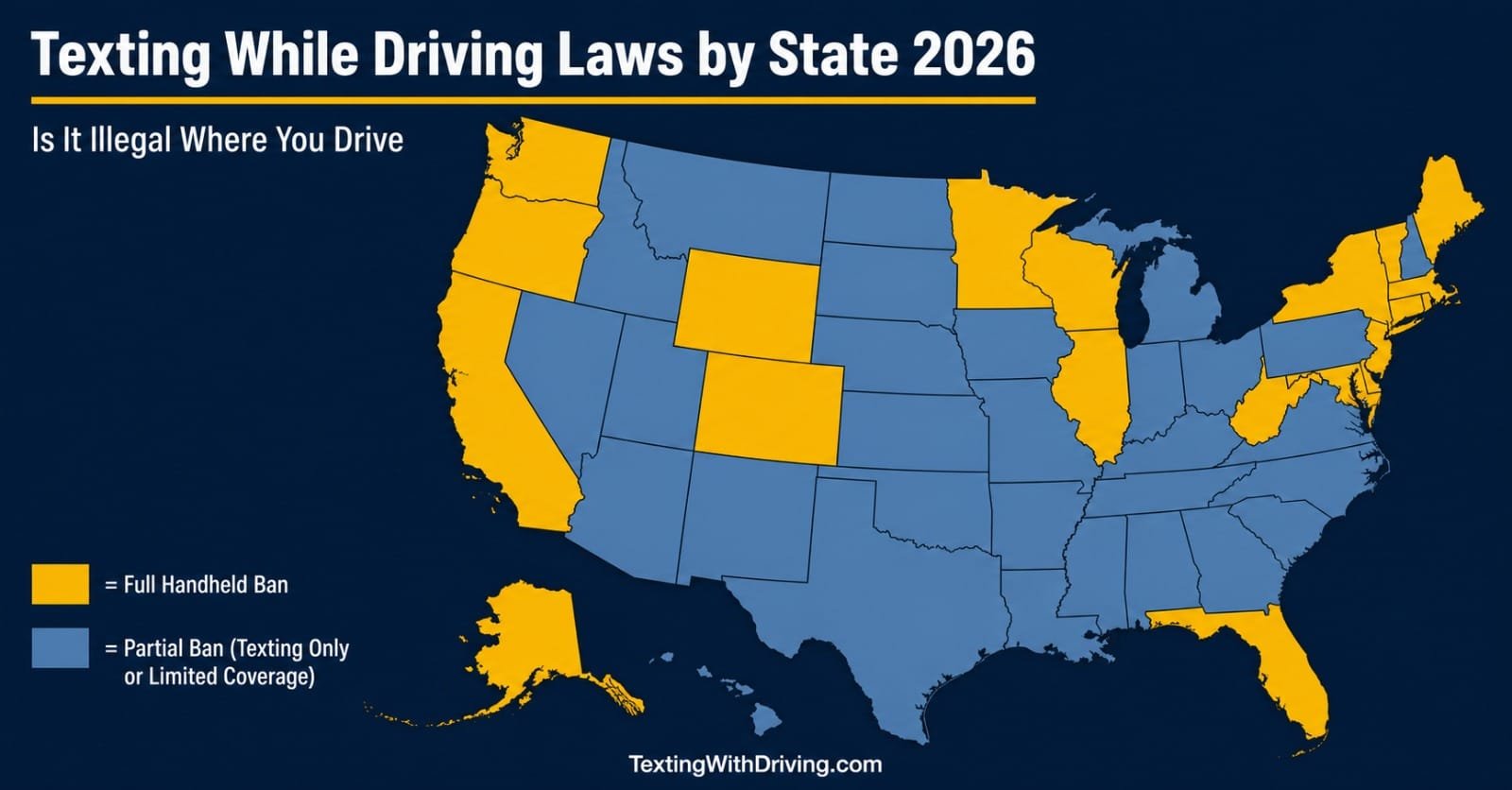
The answer depends on your state, and in 2026 it is more complicated than most drivers realize. Some states ban any hand touching a phone while driving. Others only ban texting specifically. Two states still have essentially no meaningful statewide restriction for most drivers. And the fines, enforcement types, and exceptions vary enormously depending on where you are.
This guide breaks it all down clearly so you know exactly where things stand, in your state and in every state you drive through.
The Quick Answer Most People Want First
As of 2026, 49 states, the District of Columbia, Puerto Rico, the US Virgin Islands, the Northern Mariana Islands, and Guam have banned texting while driving for all drivers. All but six states enforce this as a primary law.
A primary offense means a police officer can pull you over and cite you specifically for texting while driving, even if you were not breaking any other traffic rule. A secondary offense means an officer can only issue the citation if they stopped you for something else first, like speeding or running a red light.
So texting while driving is banned in almost every corner of the United States. But texting bans and full phone bans are two very different things. And that distinction is where most drivers get confused.
Texting Bans vs. Handheld Bans: Understanding the Difference
This is the part that catches people off guard.
Banning texting while driving means it is illegal to read or send a text message while operating a vehicle. That sounds comprehensive until you realize it leaves a lot of gray area. Under a texting-only ban, a driver could technically scroll through social media, browse a website, or film a video while driving and argue they were not technically texting.
A handheld ban goes much further. It means you cannot hold your phone at all while driving, period. No calls. No scrolling. No holding the device in your hand for any reason.
According to GHSA, 33 states, the District of Columbia, Puerto Rico, the US Virgin Islands, the Northern Mariana Islands, and Guam have banned drivers from hand-held phone use while driving. All but Alabama and Missouri are primary enforcement laws, meaning an officer may cite a driver for using a handheld cellphone without any other traffic offense taking place.
That means in 33 states plus DC, if a police officer sees you holding your phone while driving, that alone is enough for a traffic stop and a fine. No other reason needed.
In the remaining states, you might legally be able to hold your phone to make a call while still being banned from texting. It creates a patchwork of rules that is easy to violate simply by not knowing what applies in the state you are driving through.
For the most current, state-by-state breakdown, the GHSA distracted driving laws page is updated regularly by state highway safety offices and is the most authoritative public reference available.
The Two States With the Weakest Protections
Montana and Missouri are the only US states where texting and driving are still legal for most adult drivers.
Let’s look at each one.
Montana currently has no statewide texting ban and no handheld device ban for any drivers. While some Montana cities have passed their own local ordinances, at the state level there is no law restricting phone use while driving for adult drivers. Although it is technically legal to use your phone while driving in Montana, if you cause an accident as a result, you can still be charged with negligent driving. That is a meaningful but very different kind of deterrent from an upfront ban.
Missouri has a more nuanced situation. Missouri’s current law bans drivers aged 21 and younger from texting while driving, with a consequence of a $200 fine and two points against the license. However, Missouri does not have a statewide ban on texting for all adult drivers. Missouri does have a new hands-free law that took effect in recent months covering all drivers in certain contexts, but the full statewide adult texting ban remains a legislative work in progress as of 2026. For the latest status of Missouri’s laws, check the Missouri Department of Transportation page.
If you live in or regularly drive through these states, you are driving in an environment with less legal deterrence than almost anywhere else in the country. That does not make it less dangerous. It just means the responsibility rests more heavily on individual drivers rather than the law.
How Fines Work Across the Country
Fines for texting while driving vary so widely that they barely feel like the same offense from one state to the next.
In Alaska, texting while driving is a Class A misdemeanor criminal offense where you can face up to a year in jail and up to $10,000 in fines for a first offense. In Texas, fines start at $25 to $99 for a first offense. In Utah, a conviction adds 50 points to your driving record, while most states only add one to five points, and repeat offenses can result in up to six months in jail and up to $1,000 in fines.
Here is a practical snapshot of what you might face:
| State | First Offense Fine | Enforcement Type |
|---|---|---|
| Alaska | Up to $10,000 | Primary |
| New York | $50 to $200 | Primary |
| California | $162+ | Primary |
| Texas | $25 to $99 | Primary |
| Alabama | $25 | Primary |
| Nebraska | $200 | Primary |
| Utah | Up to $100 | Primary |
Sources: DriversEd.com State Fines Guide and GHSA State Laws
The variation is striking. Alaska treats it as a criminal matter. Texas starts at the cost of a cheap lunch. Neither approach fully reflects the actual danger of the behavior, but states with higher fines and strong primary enforcement consistently show faster reductions in phone use after laws are passed. The deterrent effect of financial consequences is real but highly dependent on the size of the penalty and the likelihood of enforcement.
Beyond fines, a texting while driving conviction typically adds points to your driving record, which directly affects your insurance rates. We cover the full financial picture of what a distracted driving ticket actually costs you, far beyond the fine itself, in our breakdown of distracted driving statistics 2026.
Primary vs. Secondary Enforcement: Why This Distinction Matters a Lot
Most states have primary enforcement laws, which means a police officer can stop and ticket the driver specifically for the violation of texting and driving. Secondary enforcement means the officer is only permitted to stop and ticket the driver for texting and driving if there is another act of violation, such as speeding.
In practice, this matters enormously for how much deterrent effect a law actually produces.
Think about it from a driver’s perspective. If you know an officer cannot pull you over unless they already caught you doing something else, the risk calculus changes. Drivers in secondary enforcement states are statistically less likely to change their behavior than drivers in primary enforcement states, because the perceived risk of being caught is lower.
GHSA recommends that states prohibit handheld cellphone use by all drivers. Although texting and handheld bans are both critical, texting bans alone can be difficult to enforce. In states with texting only bans, drivers may claim they were only dialing when stopped by a police officer. Enforcement demonstration projects in New York, Connecticut, Delaware and California have shown that handheld cellphone bans can be enforced effectively and reduce driver use of a cellphone.
This is a key reason why the push for comprehensive handheld bans is growing across the US. Texting bans create enforcement ambiguity. Handheld bans do not. If your phone is in your hand, that is the violation. It is cleaner, clearer, and ultimately more effective.
Teen Drivers Face Stricter Rules in Most States
If you are a parent of a teen driver, this section is particularly relevant.
According to the FCC, 36 states and the District of Columbia prohibit all cell phone use by novice drivers. That is a much broader restriction than what applies to adult drivers in those same states. A teenager with a learner’s permit or a provisional license may be prohibited from using any phone at all while driving, including hands-free calls, even in states where adult drivers are only restricted from texting.
In 37 states, drivers under the age of 18 are also not allowed to use their phones at all while driving, regardless of the type of phone use.
These stricter teen driver restrictions exist because the data is so clear on the elevated risk that young and newly licensed drivers carry. Teen drivers are the highest proportion of distracted driving fatalities of any age group, as we covered in detail in our distracted driving statistics overview. The logic of applying stricter rules during the period of highest risk makes sense both in the data and in practice.
If you have a teen driver at home, the safest conversation you can have is not about what the law technically allows but about what the safest behavior looks like regardless of what is technically permitted.
Commercial and Bus Drivers Have Federal Restrictions
The legal picture for commercial drivers is different from personal vehicle drivers and is governed partly at the federal level.
The Federal Motor Carrier Safety Administration (FMCSA) prohibits commercial motor vehicle drivers from using hand-held mobile phones while driving. This means truck drivers, bus drivers, and other commercial vehicle operators face a federal restriction on top of any state law. 23 states, including the District of Columbia, have prohibited cell phone handling by bus drivers specifically.
For commercial drivers, violating the federal restriction can mean significant fines and disqualification from operating a commercial vehicle. The stakes are high and the enforcement is more systematic than for personal vehicle drivers.
What Hands-Free Actually Means Under the Law
Here is something many drivers misunderstand. When a state says you must drive hands-free, that does not mean your phone must be silent or put away. It means you cannot physically hold the device. You can still legally use your phone for navigation, calls, or music through a mounted device, a Bluetooth connection, or your vehicle’s built-in system.
What you cannot do in a hands-free state is hold the phone in your hand at any point while the vehicle is in motion. Not to answer a call. Not to skip a song. Not to check a notification while stopped at a red light. The hands-free requirement applies continuously while you are operating the vehicle, not just while you are moving.
This distinction matters because many drivers believe that stopping at a red light creates a safe window to check their phones. In states with comprehensive handheld bans, it does not. You are still operating the vehicle.
The science behind why this matters goes beyond the law itself. Research from the AAA Foundation for Traffic Safety demonstrates that cognitive distraction, the mental engagement with a conversation or message, persists for up to 27 seconds after you put the phone down. Even if you looked at your phone only while stopped, the residual distraction carries into the next stretch of driving. You can read more about this in the AAA Foundation’s research on cognitive distraction.
What Happens If You Cause an Accident While Texting
This is where the legal consequences escalate significantly beyond a traffic fine.
If a distracted driver causes a crash that injures or kills another person, the legal exposure expands from a traffic violation to potential criminal charges and civil liability. Depending on the state and the severity of the crash, charges can include reckless driving, vehicular assault, or vehicular manslaughter. Civil lawsuits in cases involving distracted driving deaths have resulted in settlements in the millions of dollars.
While we could use more studies, the studies we do have show that cell phone restriction laws work in the reduction of fatal crashes, specifically when they are paired with primary law enforcement and high-visibility enforcement. More people are likely to follow the law when there is high-visibility enforcement, such as police enforcement of cell phone use laws and increased awareness through the media.
The legal framework is not just about fines. It is about creating an environment where the social and legal consequences of distracted driving are clear enough to actually change behavior before a crash happens rather than after.
Where Things Are Heading in 2026
The legislative trend in the US is clearly moving toward stricter, more comprehensive handheld bans. States that previously had only texting bans are passing full handheld bans. States with secondary enforcement are moving toward primary enforcement.
In July 2025, Iowa passed a hands-free law that limits drivers from handling their phones while driving. According to data from Cambridge Mobile Telematics, phone distraction fell 3.9 percent in the first month after the law took effect. Governor’s Traffic Safety Committee
That result, a measurable reduction in phone distraction within a single month of a new law taking effect, is consistent with what researchers have found in other states. The law does not eliminate the behavior. But it shifts the baseline significantly and relatively quickly.
An IIHS study shows how strong state laws, equitable enforcement and public awareness can help reduce distracted driving, confirming that a comprehensive approach that includes all three elements is more effective than any single intervention alone.
The states most likely to see meaningful improvements in their distracted driving statistics in the coming years are those that combine a clear handheld ban with primary enforcement and visible public campaigns reinforcing the message.
Know Your State, Know the Law
The most practical thing you can take from this article is to know exactly what applies where you drive. The rules are different in every state and they are changing regularly.
The GHSA distracted driving laws page is updated by state highway safety offices and is the most reliable public reference. The FCC distracted driving resource page provides a clear national overview with links to state-specific information.
And regardless of what the law technically permits in your state, the data we covered in our distracted driving statistics 2026 article makes the case more clearly than any fine or penalty: the risk is real, the impairment is real, and the safest behavior is the same everywhere. Phone in the back seat, every trip, no exceptions.
Sources Used in This Article
All links were verified working before publication.
NHTSA Distracted Driving — National Highway Traffic Safety Administration
GHSA Distracted Driving Laws by State — Governors Highway Safety Association
FCC: The Dangers of Texting While Driving — Federal Communications Commission
AAA Foundation: Measuring Cognitive Distraction — AAA Foundation for Traffic Safety
DriversEd.com: State-by-State Texting and Driving Fines
IIHS and GHSA: New Study Confirms Need for Comprehensive Approach
State Farm: Hands-Free Driving Laws Save Lives
USClaims: Texting and Driving Laws by State
TextingWithDriving.com is professionally built and maintained to ensure accurate, accessible safety information reaches every driver who needs it. Website development and ongoing support is handled by Budgetic, a digital agency specializing in purpose-driven WordPress websites.

About ClouDenTech
TextingWithDriving.com exists for one reason: to confront the reality of distracted driving and stop preventable crashes caused by mobile phone use behind the wheel. Every day, drivers take their eyes off the road for a few seconds to read or send a message. Those few seconds are enough to cause life-altering consequences. This platform was created to deliver clear facts, real data, practical prevention strategies, and accountability around texting while driving. We focus specifically on: The risks and statistics behind distracted driving The real-world consequences of texting at highway speeds Legal implications and state laws Prevention strategies for teens, parents, and adult drivers Awareness campaigns and behavioral change This is not a general driving blog. It is a focused awareness initiative built around one critical issue: phone distraction behind the wheel. Our content is direct, research-driven, and practical. We prioritize accuracy over opinion and education over sensationalism. The goal is simple — reduce distracted driving incidents by increasing awareness and responsibility. If one article causes one driver to put their phone down, the mission is working. For inquiries or partnerships, contact: privacy@textingwithdriving.com
View all posts by ClouDenTechCATEGORIES
- Annual Statistics Reports
- App Reviews & Tech Solutions
- Awareness & Advocacy
- Behavior Change Strategies
- Crash Impact & Injury Analysis
- Demographic Breakdowns
- Device Feature Guides
- Future Tech & Autonomous Driving
- Hands-Free Technology Analysis
- Insurance Rate Impacts
- Laws & Legal
- National Campaign Coverage
- National Law Overviews
- New Legislation Updates
- Parent Action Guides
- Prevention & Solutions
- Real-World Consequences
- School & Education Programs
- State-by-State Data
- Statistics & Data
- Technology & Distraction
- Teen Driver Safety
- Teen Statistics & Risk Data