

Louisiana Hands-Free Law 2025: What Drivers Need to Know Now

Louisiana Hands-Free Law 2025: What Drivers Need to Know Now
Louisiana joined the majority of the United States in banning handheld phone use while driving, and as of January 1, 2026, the warnings are over and the fines are real.
House Bill 519, signed into law and effective August 1, 2025, made Louisiana the 29th state to adopt a comprehensive hands-free driving law. After a five-month grace period during which officers issued written warnings only, full fine enforcement began on New Year’s Day 2026. If you are a Louisiana driver and you have not adjusted your habits yet, this guide covers everything you need to know: exactly what the law bans, what it still allows, how the fine structure works, and what the enforcement picture looks like across the state.
The Law’s Origins: Why Louisiana Acted in 2025
Louisiana has consistently ranked among the worst states in the country for distracted driving fatalities. In our worst states for distracted driving 2026 analysis, Louisiana ranked third nationally for the percentage of fatal crashes attributable to distracted drivers at 17.33 percent. The national average is around 8 percent. Louisiana’s rate was more than double.
The statewide hands-free driving law expands beyond school zones, where signs already designated hands-free zones, to cover all Louisiana roads. Officials said the goal is not to write citations but to help prevent crashes from distracted driving. The Calcasieu Parish Sheriff’s Office Assistant Chief Deputy Franklin Fondel noted the problem has grown significantly since the late 1990s as technology has expanded. Tech Trendz
Prior to HB 519, Louisiana had a texting ban but no comprehensive restriction on holding a phone while driving. Drivers could legally hold their phone to make calls, adjust navigation, or use apps as long as they were not technically texting. The new law closes that gap entirely.
Under HB 519, holding a phone while driving is prohibited, making Louisiana the 29th state to adopt a hands-free law. The law prohibits drivers from holding or using a handheld wireless device while operating a motor vehicle on a public road. Insurify
The Complete Timeline: From Law to Full Enforcement
Understanding where Louisiana sits in the enforcement timeline matters for any driver who received a warning during the transition period.
August 1, 2025: House Bill 519 officially takes effect. From this date, holding a phone while driving is illegal under Louisiana law, La. R.S. 32:300.5 as amended by Act No. 453.
August 1, 2025 through December 31, 2025: Officers may issue written warnings only for violations. No fines can be imposed during this period. Law enforcement officers could only issue a written warning for violations of the hands-free law occurring before January 1, 2026, according to the Louisiana Highway Safety Commission. GHSA
January 1, 2026: Full enforcement begins. Beginning January 1, 2026, law enforcement agencies across Louisiana began issuing citations, not just warnings, to drivers who violate the state’s hands-free driving law.
If you are reading this in 2026, the grace period ended five months after the law took effect. Citations are now being issued statewide.
What Louisiana’s Law Specifically Bans
The language of HB 519 is comprehensive and covers far more than just texting. Understanding the full scope of the ban is essential for compliance.
Under the law, drivers are prohibited from holding or physically supporting a phone or wireless telecommunications device while operating a motor vehicle on public roads and highways. This includes talking, texting, browsing apps or social media, composing or reading messages, or using any feature that requires manual input. Simply having a phone in hand, even if using speaker mode, while driving is not permitted, including while stopped at traffic lights or in traffic.
That last clause is one of the most important and most misunderstood aspects of the law. A driver who holds their phone on speakerphone while driving through Baton Rouge or New Orleans is in violation, regardless of whether they are technically texting. The phone must not be in your hand at all.
The law prohibits holding or touching a phone to read, write, or send messages, scroll social media, or watch videos. Drivers may only use their phones via hands-free technology such as Bluetooth or speakerphone placed in a mount, unless the vehicle is lawfully stationary, which means parked or pulled off the road, not stopped at a red light. World Population Review
The lawfully stationary definition is a source of genuine confusion for many Louisiana drivers. Being stopped at a red light does not make you lawfully stationary under the law. Lawfully stationary means parked in a lot, pulled off the road to the shoulder, or otherwise fully removed from traffic. If the engine is on and you are in traffic, you are operating a motor vehicle under Louisiana law regardless of whether you are moving.
Can I hold my phone at a red light? No. Being lawfully stationary means parked or pulled off the road, not stopped at traffic signals. Insurify
This is identical to how most other states with hands-free laws define operating a vehicle. The stoplight is not a legal window to check your phone.
What the Law Still Allows
Louisiana’s law is a handheld restriction, not a total communication ban. Drivers have several legal options for staying connected.
The law does allow for hands-free usage through Bluetooth connections, voice commands, and phone mounts that do not require drivers to remove their hands from the steering wheel. Emergency calls to 911 remain permitted, and the law includes specific exceptions for law enforcement, emergency responders, and certain commercial drivers operating within the scope of their employment. Ad Council
If you need to use your phone for navigation, it must be mounted and cannot be held. Always enter your GPS information before driving. Doing it while moving, even at a stoplight, is illegal. USClaims
The navigation rule has a practical implication that many drivers initially find surprising. You can use Google Maps, Apple Maps, or any GPS app legally while driving as long as the phone is in a mount and you are not physically holding it. But you must enter your destination before the car is in motion. Typing an address into Google Maps while stopped at a red light is a violation because you are holding and manually inputting into the device while operating a vehicle on a public road.
Exceptions under the law include viewing data or images related to navigation of a motor vehicle using a hands-free global positioning system, and dialing 911 to report a crime in progress. GHSA
Additional legal uses include Bluetooth phone calls where the phone remains in a mount or your vehicle’s Bluetooth system handles the call, voice commands through Siri, Google Assistant, or built-in vehicle systems, and single-touch call answering or ending where the phone is not lifted or held.
The law also includes a privacy protection that is worth noting. To protect privacy, officers may not search your phone or vehicle solely based on this violation unless another offense is involved. World Population Review
The Fine Structure: First Offense Through Crash Involvement
Louisiana’s fine structure escalates clearly with repeat offenses and is significantly higher in protected zones.
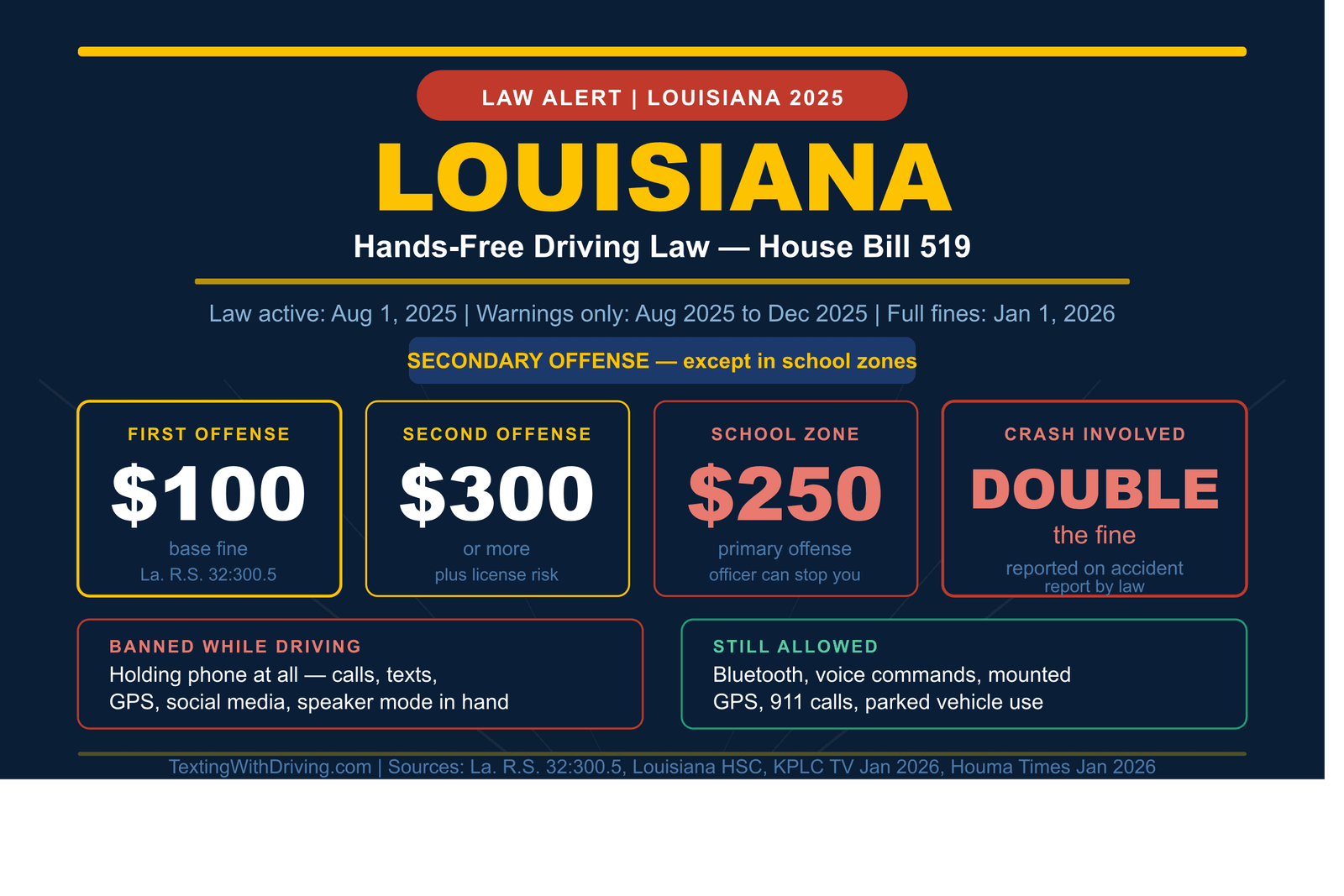
Penalties took effect January 1, 2026. A first offense carries a $100 fine, with higher fines for violations committed in school zones or construction zones. Repeat offenses result in increased fines, and more serious consequences may apply.
A first offense carries up to a $100 fine. A second offense carries up to $300. A third offense or more carries up to $300 plus possible license suspension. In school zones and construction zones, fines rise to $250. USClaims
The crash-involvement provision is one of the most important elements of the fine structure and reflects a pattern seen in other state laws.
If a person is involved in a crash at the time of the violation, the fine will be equal to double the amount of the fine imposed, and the law enforcement officer investigating the crash must indicate on the written accident report that a wireless telecommunications device was used at the time of the crash. GHSA
That mandatory crash report notation is significant beyond the doubled fine. It creates an official record that the driver was using a handheld device at the time of the crash, which directly affects insurance claims, civil liability, and any personal injury proceedings that follow.
Violations of the hands-free law can significantly impact liability in the event of an accident, potentially affecting insurance claims and legal proceedings. When a driver violates the hands-free law and causes an accident, that violation can serve as powerful evidence of negligence in personal injury cases. Proving that the at-fault driver was using a handheld device at the time of the crash can substantially strengthen a victim’s case. Ad Council
Louisiana operates under a pure comparative fault system, meaning fault can be divided between drivers in a crash. A handheld phone violation that is officially recorded on an accident report shifts the fault calculation meaningfully toward the distracted driver.
Primary vs. Secondary Enforcement: The Critical Detail
Here is the aspect of Louisiana’s law that affects how and when officers can stop drivers.
If a violation occurs in any location other than a school zone or highway construction zone, it constitutes a secondary offense when the officer detains the driver for an alleged violation of another provision of the Motor Vehicle Code. GHSA
This is the same enforcement limitation we saw with Missouri’s law, which we covered in detail in our Missouri hands-free driving law 2026 guide. Outside of school zones and construction zones, an officer cannot pull you over specifically because you are holding your phone. They need another violation first, such as speeding, running a red light, or an equipment violation, before they can also cite the phone offense.
However, in school zones and construction zones, the phone violation is a primary offense.
If a violation occurs in a school zone or a highway construction zone, it is a primary offense and is punishable by a fine of $250. GHSA
This two-tier enforcement structure means that the practical deterrent effect of the law is somewhat limited on open roads compared to states like Pennsylvania where Paul Miller’s Law operates as a primary offense everywhere. Drivers who know the law well understand that on a highway, holding their phone carries lower risk of an independent traffic stop than in a school zone.
That said, secondary enforcement still creates real consequences. An officer who stops a driver for speeding, a broken taillight, or any other violation has full legal authority to also cite the phone violation if they observe it during the stop. Secondary enforcement does not make distracted driving safe or legal. It simply changes the trigger for the initial stop.
Louisiana’s Distracted Driving Context: Why This Law Was Overdue
The safety data behind Louisiana’s legislative decision has been building for years.
The timing of this law reflects the urgent need to address distracted driving in Louisiana. Texting while driving is particularly dangerous, taking a driver’s eyes off the road for an average of five seconds. At highway speeds that is equivalent to driving the length of a football field while blindfolded. Ad Council
Louisiana’s road fatality rate per vehicle miles traveled has been among the highest in the country for more than a decade. The state’s combination of high-speed rural highways, urban expressways with heavy traffic, and a historically light regulatory framework around phone use while driving created conditions where distracted driving could persist without meaningful deterrence.
The data from other states that enacted hands-free laws before Louisiana suggests the new law will produce measurable improvement over time. As we noted in our hands-free driving laws by state 2026 guide, GHSA and Cambridge Mobile Telematics data from 2024 showed that states like Ohio, Alabama, Michigan, and Missouri all saw distracted driving fall after implementing hands-free laws. Missouri specifically saw a 7.8 percent reduction in its first year. Louisiana can expect a similar trajectory as full enforcement matures.
What Louisiana Drivers Should Do Immediately
Practical compliance with HB 519 requires a few specific habit changes that are simpler to implement than many drivers initially assume.
Mount your phone before you start driving. A phone in a dashboard or windshield mount displaying GPS directions is fully legal. The same phone held in your hand displaying the same directions is a violation. The mount is a one-time $15 to $30 purchase that eliminates the most common compliance issue.
Set your navigation before the car moves. Enter your destination before you pull out of the parking lot or driveway. Do not enter it at a red light. The phone must be mounted and the address must be entered before you are operating on a public road.
Set up Bluetooth in your vehicle if you have not done so. Most vehicles built since 2010 have Bluetooth capability. Pairing your phone takes about five minutes and allows completely hands-free calls that are fully legal under HB 519. If your vehicle does not have Bluetooth, a standalone Bluetooth speakerphone that clips to the sun visor is a low-cost solution.
Use Driving Focus on iPhone or Android’s driving mode. These built-in features, which we cover in complete step-by-step detail in our guide to setting up Do Not Disturb While Driving on iPhone and Android, automatically silence notifications when you are in motion. If no notification arrives, there is no temptation to pick up the phone in the first place.
Be especially careful in school and construction zones. The $250 primary offense fine in these areas means officers can and will stop you specifically for phone use. The zones are clearly marked. There is no ambiguity about when you are in them.
How This Connects to the Broader Legal Picture
Louisiana’s HB 519 brings the state into alignment with the majority of US states that now have comprehensive handheld bans. As of 2026, Louisiana joins more than 30 states where holding a phone while driving is illegal for all drivers regardless of what they are doing with it.
For a complete state-by-state comparison of how Louisiana’s law compares to the rest of the country in terms of fine levels, enforcement type, and scope of restrictions, see our hands-free driving laws by state 2026 guide. For the full national distracted driving data that explains why these laws are necessary, the distracted driving statistics 2026 overview covers everything in one place.
Louisiana’s law is real, the fines are active, and the enforcement footprint will grow as officers become more familiar with the legislation. The safest approach for any Louisiana driver is straightforward: phone mounted before driving, Bluetooth active for calls, navigation entered before moving, and Do Not Disturb enabled for everything else.
Sources Used in This Article
All links verified working before publication.
Louisiana Highway Safety Commission: Traffic Safety Laws — Official statutory reference, La. R.S. 32:300.5
KPLC TV: Louisiana Hands-Free Driving Law Brings $100 Minimum Fines Starting New Year’s Day — January 1, 2026
Houma Times: Hands-Free Driving Law Now in Effect Across Louisiana — January 1, 2026
Blake Jones Law Firm: Louisiana’s New Hands-Free Law Takes Effect August 1 — August 7, 2025
The Current LA: Louisiana’s New Hands-Free Cell Phone Law What You Need to Know — August 4, 2025
GetGordon Law: Louisiana Hands-Free Driving Law 2026 — January 13, 2026
Glenn Armentor Law: Louisiana’s New Hands-Free Cell Phone Law HB 519 — September 16, 2025
Call Corzo: What Drivers Need to Know About Louisiana’s Hands-Free Law — February 24, 2026
Mark W. Smith and Associates: New Hands-Free Law Takes Effect — August 26, 2025
GHSA: Distracted Driving State Laws — National comparison data
NHTSA: Distracted Driving — National statistics
TextingWithDriving.com is professionally built and maintained to ensure accurate, accessible safety information reaches every driver who needs it. Website development and ongoing support is handled by Budgetic, a digital agency specializing in purpose-driven WordPress websites.

About Texting With Driving
TextingWithDriving.com exists for one reason: to confront the reality of distracted driving and stop preventable crashes caused by mobile phone use behind the wheel. Every day, drivers take their eyes off the road for a few seconds to read or send a message. Those few seconds are enough to cause life-altering consequences. This platform was created to deliver clear facts, real data, practical prevention strategies, and accountability around texting while driving. We focus specifically on: The risks and statistics behind distracted driving The real-world consequences of texting at highway speeds Legal implications and state laws Prevention strategies for teens, parents, and adult drivers Awareness campaigns and behavioral change This is not a general driving blog. It is a focused awareness initiative built around one critical issue: phone distraction behind the wheel. Our content is direct, research-driven, and practical. We prioritize accuracy over opinion and education over sensationalism. The goal is simple — reduce distracted driving incidents by increasing awareness and responsibility. If one article causes one driver to put their phone down, the mission is working. For inquiries or partnerships, contact: privacy@textingwithdriving.com
View all posts by Texting With Driving