

5 Seconds. A Football Field. Blindfolded. The Real Danger of Texting While Driving

5 Seconds. A Football Field. Blindfolded. The Real Danger of Texting While Driving
Read that three times.
Five seconds. One football field. Completely blind.
That is what happens every single time someone reads a text message while driving at highway speed. Not a long distraction. Not a moment of carelessness with the radio. Just one text. Five seconds. And your vehicle has traveled the length of an American football field with zero input from the driver.
This article breaks down the science behind why texting while driving is uniquely dangerous, not just dangerous in a general sense, but specifically and measurably more impairing than almost every other distraction a driver faces. The research is clear, the physics are exact, and the consequences are both predictable and entirely preventable.
Where the Football Field Statistic Comes From
This is not a campaigner’s estimate or a worst-case calculation. It comes directly from NHTSA, the National Highway Traffic Safety Administration.
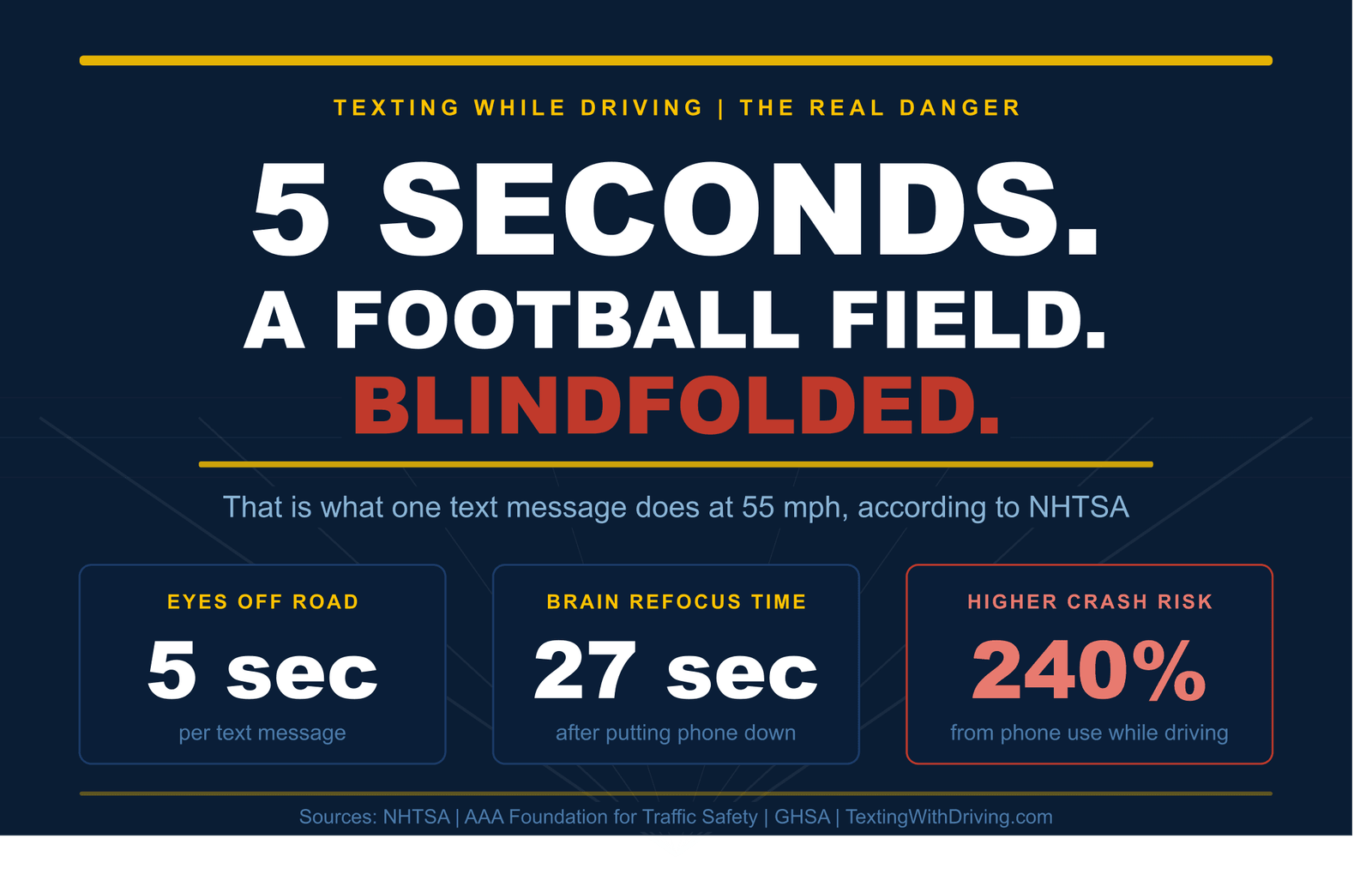
Sending or reading a text takes your eyes off the road for 5 seconds. At 55 mph, that is like driving the length of an entire football field with your eyes closed, according to NHTSA’s official distracted driving guidance. World Population Review
The math behind it is straightforward. At 55 miles per hour, a vehicle travels approximately 80.7 feet per second. Over five seconds, that is just over 400 feet, or roughly 133 yards. A standard American football field from end zone to end zone is 100 yards, or 300 feet. So by any calculation, five seconds of inattention at 55 mph means traveling well beyond the length of an entire football field with no visual input from the driver.
At 65 mph, which is the posted limit on many US interstate highways, the math gets worse. Five seconds at 65 mph covers approximately 477 feet, which is closer to one and a half football fields. At 70 mph, it is over 513 feet.
Most drivers who text on the highway are doing it at exactly these speeds. And most of them, if asked, would say they only looked down for a second.
They did not look down for a second.
The Three Types of Distraction That Make Texting Uniquely Dangerous
Not all distractions are equal. Road safety researchers categorize driving distractions into three distinct types, and the reason texting is so dangerous is that it activates all three simultaneously.
Visual distraction takes your eyes off the road. When you look at your phone screen, you have removed the visual input you need to detect hazards, read road conditions, and monitor the vehicles around you.
Manual distraction takes your hands off the wheel. When you hold a phone, scroll, or type, at least one hand is no longer on the steering wheel. Your ability to react to an emergency is reduced before you even process that the emergency exists.
Cognitive distraction takes your mind off driving. Even when your eyes return to the road, your brain is still partially engaged with the content of the message, composing a reply, or processing what you just read. The driving task is competing with an active mental process for attention.
Most distractions trigger one or two of these types. Adjusting the radio is primarily manual with a brief visual component. Talking to a passenger is primarily cognitive. Texting while driving triggers all three at the same time, which is why researchers consistently describe it as the most dangerous form of driver distraction in terms of measured impairment.
According to the FCC, cellphone use was cited as the distraction in 14 percent of all distraction-affected fatal traffic crashes in 2024, with police reports stating that at least one involved driver was talking on, listening to, or engaged in some other cellphone activity at the time of the crash.
The 27-Second Problem Nobody Talks About
Here is the part of this story that most drivers do not know, and it changes how you should think about checking your phone at a red light.
Research funded by the AAA Foundation for Traffic Safety and conducted by Dr. David Strayer and Dr. Joel Cooper at the University of Utah discovered something that upends a common assumption about distracted driving.
It takes up to 27 seconds to regain full attention after issuing voice commands. In the study, researchers found that potentially unsafe levels of mental distraction can last for as long as 27 seconds after completing a distracting task in the worst-performing systems studied. When using the least distracting systems, drivers remained impaired for more than 15 seconds after completing a task. NHTSA
And this was for voice commands only, with hands on the wheel and eyes on the road. For texting, where the visual, manual, and cognitive disruption is all three at once, the residual impairment is substantial even after the phone goes down.
The researchers concluded that drivers should use caution while using voice-activated systems, even at seemingly safe moments when there is a lull in traffic or the car is stopped at an intersection. The reality is that mental distractions persist and can affect driver attention even after the light turns green. AAA Foundation for Traffic Safety
Think about what this means for the common behavior of quickly checking a message at a red light. Even if a driver looks up the moment the light turns green, their brain is not fully re-engaged with driving for up to 27 more seconds. During that 27-second window, at a 35 mph city driving speed, the vehicle travels nearly three football fields while the driver’s cognitive attention is still partially elsewhere.
The full AAA Foundation research on this is available at the AAA Newsroom’s 2015 research release and remains one of the most significant findings in distracted driving science.
Texting While Driving Compared to Drunk Driving
The comparison between texting while driving and drunk driving comes up frequently, and the research behind it is genuinely striking.
According to a study by the University of Utah, using a cell phone while driving actually slows a driver’s reaction time to the same speed as a driver with a blood alcohol concentration at the legal limit of 0.08 percent. AAA Foundation for Traffic Safety
The University of Utah’s research, led by Dr. David Strayer, compared the cognitive performance of drivers using handheld and hands-free phones against drivers at the legal BAC limit. The results showed equivalent impairment in reaction time, hazard response, and ability to maintain safe following distances.
But the comparison gets even more alarming when you look at what each type of impairment actually does to the driving task.
A drunk driver is cognitively impaired but visually present. Their eyes are on the road. Their reaction time is slow and their judgment is compromised, but they are at least receiving visual information from the road environment. A texting driver removes visual input entirely for the duration of the glance, on top of the cognitive and manual distraction.
Forbes has reported that texting is six times more dangerous than driving while intoxicated, a figure drawn from University of Utah simulation research showing a sixfold increase in distraction-related crashes when drivers were texting compared to when they were intoxicated. AAA Oregon/Idaho
This does not minimize the danger of drunk driving, which kills approximately 13,500 Americans per year according to NHTSA data. Both behaviors are genuinely life-threatening. The point is that the widespread social acceptance of phone use while driving stands in stark contrast to the equivalent or greater impairment it produces.
What the Crash Statistics Show
The science of impairment explains the mechanism. The crash statistics show the outcome.
A September 2025 report from the Governors Highway Safety Association and Cambridge Mobile Telematics found that drivers with a high level of cell phone distraction are 240 percent more likely to crash.
Two hundred and forty percent. This figure comes from telematics analysis of millions of real-world US drivers, linking their actual phone use behavior to their actual crash outcomes. It is not a simulation. It is not a survey. It is real drivers on real roads, and the risk premium for phone use is enormous.
For the complete national death toll data and year-by-year trend analysis, see our distracted driving statistics 2026 overview. For the legal framework around phone use in your state, the texting while driving laws by state guide has the full current picture. And for the annual death count specifically from phone use, see our detailed breakdown of how many people die from texting while driving each year.
The Reaction Time Math
Reaction time is where the danger of texting while driving becomes most measurably lethal.
Under normal, attentive driving conditions, the average driver reaction time to a hazard is approximately 1.5 seconds. That includes the time to perceive the hazard, process the threat, decide to brake, and begin applying the brake pedal.
At 55 mph, 1.5 seconds of reaction time means the vehicle travels approximately 121 feet before braking even begins. Add braking distance on top of that, and a fully attentive driver needs roughly 200 to 250 feet to stop from highway speed.
Now remove the driver’s visual attention for five seconds before the hazard appears. The 1.5-second reaction clock does not start until the driver’s eyes return to the road. During those five seconds of the text glance, the driver has traveled over 400 feet and has zero awareness of what changed ahead.
If a vehicle stops suddenly, a child runs into the road, or road debris appears in the lane during those five seconds, the driver has no opportunity to react at all. The crash is already determined by the moment the phone goes down.
A Texas Transportation Institute study measuring driver reaction time found that texting roughly doubled response time compared to unimpaired driving. Without texting, drivers typically responded within one to two seconds. With texting, that extended to three to four seconds, meaning the stopping distance required increased substantially on top of the blindness already incurred during the glance.
Why “It Only Takes a Second” Is Not True
The most common rationalization for phone use while driving is that a quick glance is safe. “I just checked it for a second.” “I looked down for a moment.”
The research directly contradicts this belief on multiple levels.
First, the actual duration of a text glance is consistently longer than drivers estimate. Studies using in-vehicle cameras find that text-related glances average closer to four to five seconds, not the one or two seconds drivers report when asked. Self-assessment of glance duration is inaccurate because people are, by definition, not fully attending to time while they are attending to their phone.
Second, even a genuine one-second glance is not without consequence. At 55 mph, one second means approximately 80 feet of road covered without visual monitoring. One second is enough time for the car ahead to apply brakes, for a merge to begin from an adjacent lane, or for a pedestrian to step off a curb.
Third, the cognitive reorientation after the glance takes far longer than the glance itself. As the AAA research above shows, brain re-engagement after a distraction event is not instantaneous. The 27-second cognitive recovery period means that a one-second phone glance produces a distraction footprint that extends nearly half a minute into the subsequent driving.
The Passenger Question: Why Talking to Someone in the Car Is Different
One question drivers frequently ask is: if phone calls are dangerous, why is talking to a passenger acceptable? Both are conversations. Both involve cognitive distraction. Why is one dangerous and the other largely not?
The answer lies in what the passenger does that a phone caller does not.
A passenger in the vehicle shares the driver’s road environment. When traffic becomes complex, when a merge appears, when a pedestrian steps into the road, an observant passenger naturally reduces conversation or stops entirely. They provide a real-time environmental adjustment to the cognitive load they are adding.
A phone caller has no access to the road environment. They continue talking through exactly the moments when the driver’s full attention is most needed. The cognitive demand does not adjust to the road conditions.
Additionally, a passenger provides a second set of eyes that can actually warn a driver of hazards. Phone callers can only add distraction. They cannot subtract it at the right moment.
This distinction is part of why the AAA Foundation’s research rates hands-free phone calls as more distracting than passenger conversations on their cognitive distraction scale, despite both being auditory. You can read the full scale and methodology in the AAA Foundation’s cognitive distraction research.
What the Science Says Actually Helps
The research on reducing phone-related distraction while driving points to a few interventions that actually work, and they are notably different from the awareness campaigns that dominate public education on this topic.
Pre-drive phone placement is the most effective single behavior. Placing the phone in the back seat, glove box, or any location out of arm’s reach before starting the car removes the temptation before it arrives. Research consistently shows that pre-commitment strategies outperform in-moment willpower. If the phone is not physically accessible, the decision to look at it cannot happen impulsively.
Driving Focus on iPhone and Do Not Disturb While Driving on Android automatically silence notifications while in motion. When there is nothing arriving on the screen, the pull toward the phone is substantially reduced. Setup takes about 30 seconds and requires no willpower to maintain once activated.
High-visibility enforcement paired with primary enforcement laws produces measurable behavior change at scale, as documented by the GHSA. Drivers respond to perceived risk of being caught more than to awareness of danger. The GHSA state laws page shows which states have primary enforcement and how they perform relative to secondary enforcement states.
None of these interventions are complicated. The physics of a football field driven blind is already clear enough. What these strategies do is remove the decision from the moment of highest temptation and place it somewhere safer.
The Bottom Line on Why This Matters
NHTSA states directly: you cannot drive safely unless the task of driving has your full attention. Any non-driving activity you engage in is a potential distraction and increases your risk of crashing. Wikipedia
Five seconds. A football field. Blindfolded.
Every time.
No trip is short enough, no message urgent enough, no notification important enough to justify those five seconds of blindness on a public road shared with other drivers, cyclists, and pedestrians. The science is not ambiguous about this. The outcomes are not random.
If this article convinced you of one thing, let it be the pre-drive habit: phone in the back seat, driving mode on, before you start the engine. Not as a restriction on your freedom. As an acknowledgment that the road is not a place where divided attention is ever a safe gamble.
For everything on the legal side of distracted driving, including what is and is not permitted in your state right now, see our guide to texting while driving laws by state 2026. For the full picture on how these crashes affect teen drivers specifically, see our overview of why teen drivers are the most at-risk group for distracted driving.
Sources Used in This Article
All links were verified working before publication.
NHTSA Distracted Driving — National Highway Traffic Safety Administration
FCC: The Dangers of Texting While Driving — Federal Communications Commission, updated 2025
AAA Foundation: Measuring Cognitive Distraction in the Automobile — AAA Foundation for Traffic Safety
AAA Newsroom: New Hands-Free Technologies Pose Hidden Dangers for Drivers — 27-second residual distraction research, October 2015
AAA Exchange: Distracted Driving Research Hub — AAA Foundation infotainment system research
GHSA: Distracted Driving Raises Crash Risk 240 Percent — GHSA and Cambridge Mobile Telematics, September 2025
GHSA State Distracted Driving Laws — Current state law reference
University of Utah: Drivers on Cell Phones Are as Bad as Drunks — Dr. David Strayer research
Illinois Secretary of State: Distracted Driving Facts — Including 27-second refocus statistic and enforcement data
TextingWithDriving.com is professionally built and maintained to ensure accurate, accessible safety information reaches every driver who needs it. Website development and ongoing support is handled by Budgetic, a digital agency specializing in purpose-driven WordPress websites.

About Texting With Driving
TextingWithDriving.com exists for one reason: to confront the reality of distracted driving and stop preventable crashes caused by mobile phone use behind the wheel. Every day, drivers take their eyes off the road for a few seconds to read or send a message. Those few seconds are enough to cause life-altering consequences. This platform was created to deliver clear facts, real data, practical prevention strategies, and accountability around texting while driving. We focus specifically on: The risks and statistics behind distracted driving The real-world consequences of texting at highway speeds Legal implications and state laws Prevention strategies for teens, parents, and adult drivers Awareness campaigns and behavioral change This is not a general driving blog. It is a focused awareness initiative built around one critical issue: phone distraction behind the wheel. Our content is direct, research-driven, and practical. We prioritize accuracy over opinion and education over sensationalism. The goal is simple — reduce distracted driving incidents by increasing awareness and responsibility. If one article causes one driver to put their phone down, the mission is working. For inquiries or partnerships, contact: privacy@textingwithdriving.com
View all posts by Texting With Driving
