

Hands-Free Driving Laws by State 2026: The Complete 50-State Guide

Hands-Free Driving Laws by State 2026: The Complete 50-State Guide
If you drive across state lines, you are crossing into different legal territory every time. The phone call you make legally in Georgia might earn you a ticket in Ohio. The mounted navigation screen you glance at freely in Florida carries different rules in California. And in one state, an adult driver can legally text at the wheel while sitting at a red light with no legal consequence whatsoever.
The patchwork of US distracted driving law is one of the most confusing areas of traffic law for everyday drivers. This guide cuts through that confusion with a clear, complete, verified overview of what every state requires in 2026 — which ones have full handheld bans, which ones only ban texting, what the key exemptions are, and which states still have meaningful gaps in their laws.
The National Picture in 2026: Three Tiers of Coverage
Before diving into individual states, it helps to understand how distracted driving laws fall into distinct categories.
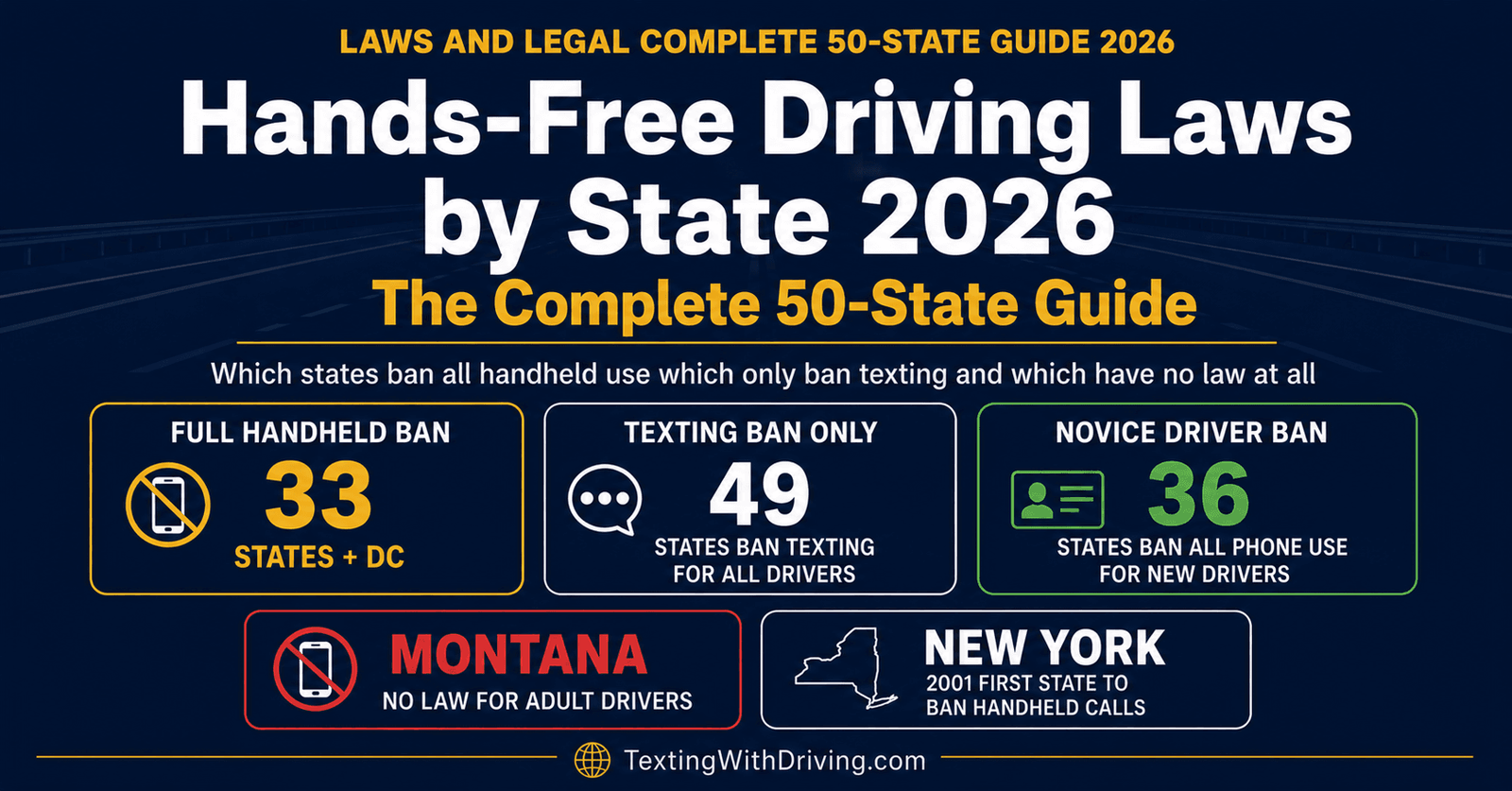
According to the Governors Highway Safety Association, 33 states and DC prohibit all drivers from using handheld cellphones while driving, and 36 states and DC ban all cell phone use by novice drivers. World Population Review
49 states, DC, Puerto Rico, Guam, the Northern Mariana Islands, and the US Virgin Islands ban text messaging for all drivers. All but six states have primary enforcement for the texting ban. Washington was the first state to pass a texting ban in 2007. AAA Exchange
Those three figures capture where the country stands. Nearly every state bans texting. Roughly two-thirds of states go further and ban holding the phone at all. And almost all states apply stricter restrictions to new teen drivers than to experienced adult drivers.
In 2001, New York became the first state to ban hand-held phone conversations by all drivers. Currently, 32 states and the District of Columbia ban hand-held calls and texting for all drivers, while another 17 states only ban texting. Of the jurisdictions that ban calls and texting, 20 states specifically ban all drivers from holding electronic devices. AAA Foundation for Traffic Safety
The IIHS and GHSA data reflects updates through October 2025, making it the most current authoritative reference available. For the very latest on any individual state, always cross-check against that state’s Department of Motor Vehicles or highway safety office, as laws can and do change between legislative sessions.
Tier 1: States With Full Handheld Bans (All Drivers)
These states have enacted the most comprehensive laws, prohibiting all drivers from holding a phone while operating a vehicle, regardless of what they are doing with it.
As of late 2025, the GHSA reports that 33 states plus DC have laws banning handheld phone use for all drivers. While enforcement specifics can vary between primary and secondary enforcement, these states generally prohibit holding a device while driving.
States with full all-driver handheld bans as of 2026 include: Alaska, Arizona, Arkansas, California, Colorado, Connecticut, Delaware, Georgia, Hawaii, Idaho, Illinois, Indiana, Iowa, Kansas, Kentucky, Louisiana, Maine, Maryland, Massachusetts, Michigan, Minnesota, Missouri, Nebraska, Nevada, New Hampshire, New Jersey, New York, North Carolina, Ohio, Oregon, Pennsylvania, Rhode Island, Tennessee, Utah, Vermont, Virginia, Washington, West Virginia, and the District of Columbia, along with US territories including Puerto Rico, Guam, the Northern Mariana Islands, and the US Virgin Islands.
Several of these states deserve specific mention for the strength or recency of their laws.
New York was first in the nation with a full handheld ban in 2001, giving it 25 years of enforcement experience. New York also applies 5 license points for a cell phone violation, one of the stiffest point penalties in the country.
California bans all handheld use but, as IIHS research has noted, the law’s specific language about “holding and using” rather than simply “holding” has created some interpretive ambiguity that has affected enforcement consistency. The lesson from California’s experience directly informed how later states wrote their laws.
Oregon and Washington passed comprehensive holding bans in 2017 and 2017 respectively. IIHS research found that more sweeping cellphone laws that use plain straightforward language to ban all hand-held cellphone use while driving, including simply holding a phone, may not only boost driver compliance but also make police more willing to issue tickets by making infractions easier to identify and less likely to be dismissed in court. The drop in crash rates in Oregon and Washington suggests that both states achieved greater compliance after their broader laws took effect. AAA Foundation for Traffic Safety
Pennsylvania reached full enforcement on June 5, 2026 under Paul Miller’s Law, which we covered in complete detail in our guide to Pennsylvania’s distracted driving law 2026.
Missouri enacted the Siddens Bening Hands-Free Law in 2023 with full enforcement beginning January 1, 2025. We have a full breakdown of how Missouri’s law works and its enforcement challenges in our Missouri hands-free driving law 2026 guide.
Tier 2: States With Texting-Only Bans or Partial Restrictions
These states have laws restricting phone use while driving but do not go as far as prohibiting all handheld device use.
Some states maintain texting-only bans or partial restrictions for novice drivers but do not qualify as comprehensive hands-free mobile device laws. Examples include Wisconsin, which has no statewide handheld ban for all drivers but has handheld and texting restrictions in certain work zones and for some categories of drivers. Florida bans handheld device use in school and work zones specifically. Texas bans texting but has not passed a full handheld ban as of 2026.
Texas is the most prominent state in this category. With approximately 29 million licensed drivers, Texas is one of the most populous states in the country and as of mid-2026 still does not have a full statewide handheld ban for adult drivers. Senate Bill 47, which would implement a comprehensive hands-free law, has advanced through the Texas Senate multiple times but has faced resistance in the House. Texas does ban texting while driving, with fines starting at $25 for a first offense, one of the lowest in the country.
Florida occupies a middle position. Florida is among the states with laws that restrict handheld device use in specific situations such as school or work zones rather than a comprehensive all-circumstances ban for all adult drivers. NHTSA
Wisconsin has no comprehensive statewide handheld ban but does have inattentive driving laws and work zone restrictions. Wisconsin drivers operating a vehicle in a construction zone with workers present can be cited for handheld phone use even without a general hands-free law.
South Carolina, Oklahoma, Mississippi, Wyoming, and South Dakota round out the group of states where adult drivers face texting restrictions but not a full prohibition on holding a phone.
Montana: The Outlier
Montana is the only state with no laws restricting cell phone use while driving for adult drivers at the state level. While some Montana cities have passed their own local ordinances, at the state level there is no law restricting handheld phone use or texting while driving for adult drivers. Montana’s preemption law prevents localities from passing stricter rules than the state. NHTSA
This does not mean Montana drivers face no consequences for distracted driving. Even if you are not texting, having the phone in your hand can still constitute negligent driving if it contributes to a crash. Even in states without a full hands-free rule, a driver who causes an accident while using their phone can face reckless driving charges, civil liability, and potentially criminal charges depending on the outcome.
Montana’s absence of a texting or handheld law is increasingly anomalous. As of 2026 it stands alone as the only US state where adult drivers have no state-level restriction on phone use while driving. Legislative proposals to change this have been introduced in the Montana legislature but have not passed as of the time of publication. Always check current Montana legislative status at the Montana Department of Transportation safety resources.
Novice Driver Laws: Stricter Rules for New Drivers
Across the country, states that have not yet passed full adult handheld bans have often passed stricter restrictions targeting new and young drivers.
36 states and DC ban all cell phone use by novice drivers. 25 states and DC prohibit cell phone use by school bus drivers. No state bans all cellphone use for all drivers, including hands-free use. AAA Exchange
The earliest laws against cellphone use by young novice drivers did not seem to change teens’ behavior as much as laws that apply to all drivers. This suggests that all-driver laws produce stronger behavior change than teen-specific laws alone, partly because all-driver laws change the social environment around the behavior rather than singling out one age group. AAA Foundation for Traffic Safety
This research finding is important for parents who may assume that because their state has a teen driver phone restriction, their teen’s risk is adequately addressed by law. The behavioral evidence suggests otherwise. What changes teen driver behavior most effectively is a combination of an all-driver law, parental modeling, and direct family conversations, as we covered in our parent’s guide to talking to your teen about phone use while driving.
Primary vs. Secondary Enforcement: The Critical Difference
For drivers in states with distracted driving laws, the enforcement type matters enormously for how much deterrent effect the law actually produces.
Of the 33 states plus DC with full handheld bans, all but Alabama and Missouri are primary enforcement laws, meaning an officer may cite a driver for using a handheld cellphone without any other traffic offense taking place. AAA Exchange
As we covered in our detailed breakdown of the texting while driving laws by state 2026 guide, primary enforcement produces measurably faster reductions in phone-related crashes than secondary enforcement. When drivers know an officer can pull them over specifically for phone use alone, the perceived risk of being caught changes their behavior. Secondary enforcement, where the officer needs another reason to stop the vehicle first, substantially reduces that deterrent effect.
Missouri’s law, despite being a full handheld ban, operates as a secondary offense in practice, which is one reason the behavioral improvement in Missouri has been real but gradual.
Preemption Laws: When Cities Cannot Go Further
One area of distracted driving law that rarely gets discussed but matters significantly for local communities is state preemption.
Some states have preemption laws that prohibit local jurisdictions from enacting their own distracted driving bans. States with such laws include but may not be limited to Florida, Iowa, Kentucky, Louisiana, Mississippi, Nevada, Pennsylvania, Oklahoma, Oregon, and South Carolina. NHTSA
In preemption states, a city cannot pass a stricter local ordinance than the state law. This is relevant for urban areas where local officials and communities have wanted to implement stronger protections than the state legislature has passed. Missouri, as we noted in our Missouri law guide, also has local preemption, which is why Kansas City and other Missouri municipalities cannot enforce the hands-free law as a primary offense even when the city government would prefer to.
What Research Says About Which Laws Work Best
Not all distracted driving laws produce equal results. The IIHS and GHSA research over the past decade gives a fairly clear picture of what elements make a law effective.
IIHS research found that using plain straightforward language to ban all hand-held cellphone use while driving, including simply holding a phone, not only boosts driver compliance but also makes police more willing to issue tickets by making infractions easier to identify and less likely to be dismissed in court. AAA Foundation for Traffic Safety
California’s law, which banned “holding and using” rather than simply “holding,” created enough interpretive ambiguity that citations declined over time as drivers and courts found room for argument. Oregon and Washington, which banned “holding” alone without requiring the “using” element, produced stronger behavioral outcomes.
In 2024, GHSA and Cambridge Mobile Telematics released a report showing that distracted driving has fallen in states like Ohio, Alabama, Michigan, and Missouri after they implemented hands-free laws. These results underscore the effectiveness of legal frameworks in enhancing road safety. The report also discusses how incentive-based programs motivating drivers to refrain from engaging in risky driving behaviors have led to reductions in crashes. NHTSA
The ingredients of an effective law, based on the research literature: a clear comprehensive ban on holding the device, primary enforcement authority, meaningful fine levels, visible high-enforcement campaigns, and parallel public education. States that combine all of these elements consistently show better outcomes than states with any one element missing.
Arizona passed a comprehensive holding ban in 2019 and found that the law successfully cut handheld phone calls by 26 percent, but had little impact on cellphone manipulation, which covers scrolling, swiping, and typing. The researchers concluded that sustained high-visibility enforcement efforts are likely needed to make drivers take new laws seriously over the long term. AAA Oregon/Idaho
That Arizona finding is an honest check on expectations. Laws reduce some phone behaviors significantly. They do not eliminate the behavior entirely. The reduction in holding and calling is real and measurable. The harder-to-detect behaviors of screen manipulation require both legal coverage and sustained enforcement to address.
The Financial Consequences of Violations
Fine ranges vary enormously across states, but the cost of a distracted driving violation extends well beyond the ticket itself.
First-time violation fines typically range from a $20 to $250 base fine, with substantial variation by state. Actual costs often substantially exceed base fines due to court costs, surcharges, and administrative fees that can double or triple the total penalty. Some jurisdictions assess lower base fines but add fees reaching $150 to $300 total. Financial penalties represent only part of the consequence. Violations typically create insurance rate increases of 5 to 20 percent that persist for three to five years, ultimately costing far more than the ticket itself.
New York applies 5 license points per cell phone violation, one of the most significant point penalties in the country. Alaska treats a first texting offense as a Class A misdemeanor with potential fines up to $10,000. Pennsylvania’s Paul Miller’s Law base fine starts at $50 but includes an enhanced sentencing provision of up to 5 additional years in prison for violations causing a fatality.
The fine structure matters less than drivers often assume. The insurance impact over three to five years typically dwarfs the initial fine. A $50 ticket in Pennsylvania or a $150 ticket in Missouri, multiplied by a 10 to 20 percent insurance rate increase maintained for three or four years, becomes a $1,500 to $3,000 consequence in practice.
School Zone and Work Zone Enhancements
Nearly every state that has a distracted driving law of any kind includes enhanced penalties for violations in school zones or active construction work zones.
Many states impose enhanced penalties for cell phone violations in designated safety zones. A distracted driving penalty in a school or active work zone may be doubled or tripled compared to regular roadway violations.
Missouri’s law, for example, applies a $500 fine for a first offense in a school zone or active work zone, compared to $150 on a standard roadway. Pennsylvania similarly enhances penalties for school zone violations. Florida, which does not have a general handheld ban, specifically restricts handheld use in school and work zones. Even in states without broad phone restrictions, school and work zone restrictions often exist independently.
The Best Reference for Current State Laws
Because laws change regularly through legislative sessions, the most reliable ongoing references for current state-by-state law status are:
The GHSA distracted driving state laws page, last updated by State Highway Safety Offices in June 2025, is the most authoritative public reference.
The IIHS electronic device laws page provides detailed statutory information including footnotes on specific legal nuances by state.
The FCC distracted driving resource page provides a national overview with links to state-specific resources.
For individual states that have passed significant laws recently, including Missouri, Pennsylvania, and Iowa, we have published dedicated guides. Missouri’s full breakdown is at Missouri hands-free driving law 2026. Pennsylvania’s guide covering Paul Miller’s Law is at Pennsylvania distracted driving law 2026. The complete overview of what texting bans cover versus handheld bans is in our guide to texting while driving laws by state 2026.
The Bottom Line for Every Driver in 2026
GHSA’s message to all drivers is simple: do not use cellphones or other electronic devices while driving, regardless of the current law. Keep your hands on the wheel and your eyes and mind on the road. NHTSA
That guidance cuts through all the state-by-state variation. Whether your state has a full handheld ban or only a texting restriction, whether your violation is a primary or secondary offense, whether your fine is $25 or $10,000, the behavior the law is targeting is the same behavior the research shows kills thousands of Americans every year.
The safest approach for any driver in any state is to treat it as if they are in the strictest hands-free state. Phone in the back seat before the car starts. Driving Focus or Do Not Disturb mode activated. Navigation set before the drive begins. Calls handled through Bluetooth or not at all.
That is the standard that the data supports, regardless of what the law in your specific state currently requires.
For a complete national picture of the death toll that makes these laws necessary, see our distracted driving statistics 2026 overview. For the science of why phone use is so dangerous even in states where it remains legal, see our article on the real danger of texting while driving. And for the best technology tools that make hands-free driving automatic rather than dependent on willpower, see our guide to the best apps to block texting while driving.
Sources Used in This Article
All links verified working before publication.
GHSA: Distracted Driving State Laws — Governors Highway Safety Association, last updated October 2025
IIHS: Electronic Device Laws by State — Insurance Institute for Highway Safety
IIHS: More Sweeping Cellphone Laws Reduce Crash Rates — Oregon and Washington research, August 2022
IIHS: Arizona No-Holding Law Study — October 2025
IIHS: Distracted Driving Research Overview — Comprehensive research summary
State Farm: Hands-Free Driving Laws Save Lives — Updated 2026
FCC: The Dangers of Texting While Driving — Federal Communications Commission
GHSA: Distracted Driving Has Fallen in States with Hands-Free Laws — GHSA and Cambridge Mobile Telematics, 2024 report
Credible Law: Hands-Free Driving Laws Complete Guide — December 2025
Mercury Insurance: No-Touch Law States — February 2026 update
NHTSA: Distracted Driving — National data and state resources
TextingWithDriving.com is professionally built and maintained to ensure accurate, accessible safety information reaches every driver who needs it. Website development and ongoing support is handled by Budgetic, a digital agency specializing in purpose-driven WordPress websites.

About Texting With Driving
TextingWithDriving.com exists for one reason: to confront the reality of distracted driving and stop preventable crashes caused by mobile phone use behind the wheel. Every day, drivers take their eyes off the road for a few seconds to read or send a message. Those few seconds are enough to cause life-altering consequences. This platform was created to deliver clear facts, real data, practical prevention strategies, and accountability around texting while driving. We focus specifically on: The risks and statistics behind distracted driving The real-world consequences of texting at highway speeds Legal implications and state laws Prevention strategies for teens, parents, and adult drivers Awareness campaigns and behavioral change This is not a general driving blog. It is a focused awareness initiative built around one critical issue: phone distraction behind the wheel. Our content is direct, research-driven, and practical. We prioritize accuracy over opinion and education over sensationalism. The goal is simple — reduce distracted driving incidents by increasing awareness and responsibility. If one article causes one driver to put their phone down, the mission is working. For inquiries or partnerships, contact: privacy@textingwithdriving.com
View all posts by Texting With Driving
