

National Distracted Driving Awareness Campaigns That Actually Moved the Needle

National Distracted Driving Awareness Campaigns That Actually Moved the Needle
Not every awareness campaign changes behavior. Most of them, if we are being honest, produce awareness and not much else. People see an ad, acknowledge the danger, and continue doing the same thing.
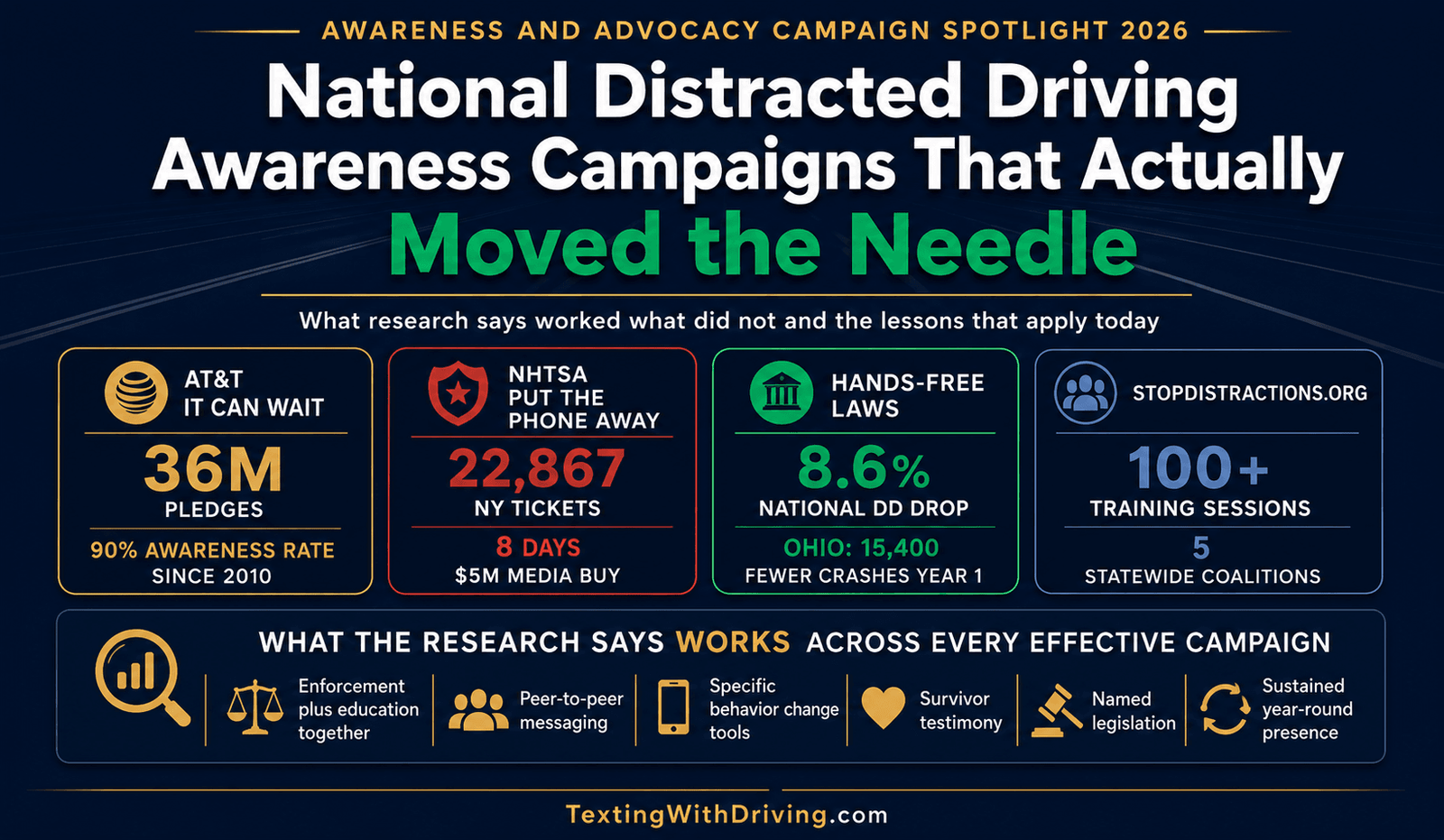
But some campaigns have produced results that are measurable, documented, and significant. Results like 36 million Americans pledging to never drive distracted. Results like 15,400 fewer crashes in a single state in the first year after a law change. Results like a nationally documented 8.6 percent reduction in phone use while driving.
This article covers the campaigns and legislative efforts that actually moved the needle on distracted driving in the United States, what specifically produced those results, and what the evidence says about which approaches work versus which ones generate impressions without producing behavior change.
Why Most Awareness Campaigns Fall Short
Before examining what works, it is worth understanding the structural challenge that most distracted driving campaigns face.
The fundamental problem is what behavioral scientists call the knowledge-behavior gap. Awareness of danger does not reliably produce behavior change. Americans have known texting while driving is dangerous for more than a decade. As we documented in our article on Gen Z texting while driving statistics, 94 percent of drivers describe texting while driving as extremely or very dangerous, yet more than a third do it anyway.
A campaign that produces awareness is therefore not producing the outcome that matters. The outcome that matters is a change in what drivers do with their phones when the car starts moving. Every effective campaign reviewed in this article addressed that specific behavioral outcome rather than stopping at awareness.
AT&T It Can Wait: The Most Scaled Distracted Driving Campaign in US History
AT&T launched the It Can Wait campaign in March 2010, initially focusing on its own employees before rapidly expanding to a national public awareness and pledge effort. Over the following 15 years it became the largest corporate-backed distracted driving awareness initiative in American history.
In 2010, AT&T launched the It Can Wait program, educating distracted drivers that no call, text, email, or notification is worth dying for. Over the years, AT&T has turned It Can Wait into a social movement, achieving tremendous success by inspiring over 36 million Americans to take the pledge. QuatriniRafferty
Thirty-six million pledges is a number that commands attention on its own. But the more meaningful question is what those pledges actually produced in terms of behavior change.
When AT&T reached its first 10 million pledges, new research found that almost half of people who pledged said they now do not use their smartphones while driving. Those who shared their promise or pledge with others were even more likely to stop, and more likely to speak up to others. Of those who shared their promise, four in ten asked a friend or family member not to use their smartphone while driving, nearly one-third asked a driver not to use their smartphone while riding as a passenger, and nearly four in ten asked a passenger to operate their smartphone while they were driving. SafeWise
The social diffusion effect documented in that research is one of the most important findings about pledge-based campaigns. The pledge itself changed individual behavior for roughly half of takers. But pledges shared with others produced an additional layer of social accountability that changed not just the pledger’s behavior but also how they interacted with distracted drivers around them. The campaign produced advocates, not just individual commitments.
In the six years since AT&T launched It Can Wait, the campaign helped grow awareness of the dangers of smartphone distracted driving to more than 90 percent of audiences surveyed, inspired more than 5 million downloads of the free AT&T DriveMode app, and worked with state departments of transportation in Texas, Kentucky, and other states on research that suggests a correlation between It Can Wait campaign activities and a reduction in crashes. SafeWise
The correlation between campaign activities and crash reductions documented by state DOT research is significant. It is not a randomized controlled trial. But it represents real-world evidence that the campaign’s geographic and temporal concentration produced measurable safety outcomes at the state level.
The honest assessment of It Can Wait also includes its limitations. Despite all the efforts over the years to reduce texting and driving, AT&T has struggled to restrict fatalities and injuries on the road, although 24 million people took the pledge that they will never drive distracted. Awareness and pledges at scale did not eliminate the behavior. The death toll from distracted driving continued to hover above 3,000 per year throughout the campaign’s active period. What the campaign achieved was a normative shift, a change in how the behavior is socially regarded, that laid groundwork for legislative action without producing the full behavioral transformation its creators sought. Bachus & Schanker
The key lesson from It Can Wait: pledge-based campaigns produce their strongest outcomes when they are social and visible, when they include specific behavioral tools like the DriveMode app rather than just commitments, and when they are paired with enforcement and legislative activity rather than operating in isolation.
NHTSA’s Put the Phone Away or Pay: Enforcement-Integrated Campaign Design
NHTSA’s Put the Phone Away or Pay campaign, which runs every April during National Distracted Driving Awareness Month, represents a fundamentally different approach from pure awareness campaigns. It pairs public advertising with high-visibility law enforcement in a coordinated national mobilization.
As we covered in detail in our dedicated article on Distracted Driving Awareness Month 2026, the April 2026 campaign included a $5 million national media buy in English and Spanish, a coordinated April 6 to 13 enforcement window targeting drivers aged 18 to 34, and a keynote address from NHTSA Administrator Jonathan Morrison releasing 2024 crash data.
The Put the Phone Away or Pay campaign educates drivers about the deadly dangers and legal consequences of distracted driving. NHTSA’s high-visibility enforcement of state distracted driving laws specifically targets drivers ages 18 to 34 who according to NHTSA data are more likely to die in distraction-affected crashes than any other age group. Driving School
The enforcement results during the campaign window give the clearest picture of scale. During New York’s equivalent eight-day campaign enforcement window in 2025, state troopers issued 22,867 total tickets, including 4,607 specifically for distracted driving violations. Multiplied across 50 states running similar enforcement operations simultaneously, the April campaign represents one of the largest coordinated traffic safety enforcement operations of the year.
The campaign design reflects what behavioral research consistently shows about what actually changes driving behavior. Awareness of danger is insufficient. Perceived risk of being caught and fined is a significantly stronger behavioral motivator. Put the Phone Away or Pay leans into this research directly. The campaign name is not about awareness. It is about consequences.
This enforcement-first approach also addresses one of the most persistent weaknesses of pure awareness campaigns: the gap between knowing something is wrong and changing behavior anyway. When drivers know that officers are actively targeting phone use during a specific, publicized enforcement window, the perceived risk calculation changes in a way that knowledge alone does not produce.
The Ohio Hands-Free Law: The Single Most Measured Campaign-Policy Combination
If you want to understand what a well-designed awareness campaign paired with strong legislation can actually produce in documented outcomes, Ohio’s experience is the clearest case study available.
Ohio passed a comprehensive distracted driving law in 2023 that made handheld phone use a primary offense statewide. The law was paired with public education, enforcement training, and a sustained communication campaign explaining exactly what the law required and why.
Ohio has reported nearly 15,400 fewer motor vehicle crashes and 138 fewer traffic fatalities in the first year after implementing its hands-free law. Michigan leads with an 18.7 percent reduction in distracted driving since its law took effect. LuccaAM
15,400 fewer crashes. 138 fewer deaths. In a single year in a single state from a single legislative and communications effort.
Those are not projections. They are documented outcomes from before-and-after crash data analysis comparing Ohio’s crash rates in the year before the law to the year after. The magnitude reflects what happens when a legislative change is communicated clearly and enforced visibly, creating the combination of awareness, social norm shift, and legal deterrence that the research consistently identifies as the most effective approach.
The lesson from Ohio is the most important in this entire article: campaigns that are directly paired with legislative change produce stronger outcomes than campaigns operating without legal backing. The law creates the legal deterrent. The campaign ensures the law is known and the social norm shifts. Together they produce outcomes that neither produces alone.
The NHTSA 2010 Executive Order: Federal Modeling and Employer Influence
One of the least-discussed but genuinely significant distracted driving policy actions in the campaign history is a federal executive order from 2009.
In 2009, the federal government took a strong stance against distracted driving by banning federal employees from texting while driving when on official business or using government-issued phones. This executive order set a precedent for other employers and organizations to establish similar rules for their workers. Since then, many private organizations have adopted policies that prohibit employees from using their phones while driving. Penske Truck Leasing
The modeling effect of that executive order is difficult to measure precisely, but its direction is clear. When the federal government publicly committed its entire civilian workforce to no phone use while driving on official business, it sent a signal to private employers about what responsible organizational policy looked like. The resulting spread of employer distracted driving policies across American organizations represents a systemic behavior change intervention that operated through workplace policy rather than public advertising.
We covered how employers can implement and enforce these policies in our complete employee distracted driving policy guide. The federal modeling that began in 2009 created a template that HR departments and risk managers have been adapting and implementing ever since.
StopDistractions.org: Coalition-Based Community Advocacy
StopDistractions.org represents a different model from the national corporate or federal campaigns: a focused advocacy organization that works at the state and community level to translate national awareness into local legislative and behavioral change.
StopDistractions.org is a national nonprofit advocacy organization founded by families affected by distracted driving crashes. The organization partners with law enforcement, government agencies, and communities to reduce distracted driving through education, outreach, and policy advocacy. In 2024, StopDistractions.org was recognized as a partner by the US Department of Transportation and conducted more than 100 training sessions, helped form five statewide distracted driving coalitions, and organized over 20 community safety events nationally. Zutobi
The coalition model that StopDistractions.org exemplifies is important because it addresses a structural weakness of top-down national campaigns: local ownership. A campaign run by a federal agency or a large corporation lacks the authenticity and personal connection that drives the deepest behavior changes. When a campaign is led by community members who lost someone to a distracted driver, the message carries a different weight that changes how audiences receive it.
The five statewide coalitions built through StopDistractions.org’s 2024 work create ongoing, self-sustaining advocacy infrastructure that continues operating between national campaign moments. Rather than producing a spike in awareness during April Distracted Driving Awareness Month that fades by June, coalition-based advocacy maintains year-round pressure on legislators and community norms.
The Ad Council and NHTSA Eyes Forward Campaign
The Ad Council has partnered with NHTSA on distracted driving awareness campaigns over multiple years, with the current campaign concept focusing on the specific human moment of decision rather than the abstract danger.
The Ad Council and NHTSA launched the Eyes Forward campaign as part of ongoing public service advertising efforts to reduce distracted driving. The campaign specifically targets the moment of decision, the phone lights up, the driver reaches for it, what happens in that fraction of a second, and aims to make the safe choice feel like the natural one rather than the effortful one. Michigan Auto Law
The shift from consequences-based messaging, showing crash outcomes, to decision-moment messaging reflects an evolution in what behavioral research shows about effective road safety communication. Consequences-based campaigns work for some audiences and backfire for others, particularly younger drivers who have a strong optimism bias about their own crash risk. Decision-moment campaigns bypass the risk assessment entirely and address the specific behavioral moment that determines outcomes.
This approach aligns with the pre-drive commitment research we covered in our article on the psychology of phone addiction and distracted driving. The most effective interventions address the decision before the drive starts rather than trying to overcome dopamine-driven impulses in the moment of temptation.
Survivor Testimony Campaigns: The Evidence for What Actually Persuades
At the NHTSA Distracted Driving Awareness Month kickoff in April 2026, Administrator Morrison included Patty Kruszewski, who lost her daughter in a distracted driving crash, as a central voice of the event. Research on road safety messaging consistently shows that survivor and victim family testimony produces stronger emotional resonance and behavior change intent than statistics-only presentations. Geotab
The research behind this approach is consistent across multiple studies of risk communication. Statistical information activates analytical thinking. Personal stories activate emotional processing. Behavior change is more reliably produced through emotional engagement than through analytical reasoning, which is why the most effective distracted driving campaigns use data for credibility and human stories for persuasion.
This explains why named legislation, like Paul Miller’s Law in Pennsylvania, Missouri’s Siddens Bening Hands-Free Law, and Texas’s proposed Allie’s Way Act, consistently generates stronger public support than numerically-named bills covering identical content. A name creates a person. A person creates emotional engagement. Emotional engagement drives the legislative and behavioral momentum that numbers alone cannot produce.
What Campaigns Do Not Work
Understanding what has produced results is incomplete without acknowledging what the evidence suggests does not work.
Fear-based campaigns showing graphic crash outcomes have been studied extensively in road safety research. The findings are consistently mixed at best and counterproductive at worst for certain audiences. As we discussed in our article on why teen drivers are the most at-risk group for distracted driving, NHTSA’s own research notes that fear appeals can trigger a boomerang effect in younger drivers, where the threat to autonomy makes the prohibited behavior more attractive rather than less.
One-time assembly presentations in schools, without follow-up, skills-based components, or peer reinforcement, produce short-term attitude change that fades without behavior change. The high school programs we covered in our article on programs actually reducing teen distracted driving distinguish themselves from this model by including skills components, peer delivery, and sustained reinforcement rather than single-event shock presentations.
And campaigns that produce awareness without providing specific behavioral tools leave drivers knowing more about the danger without knowing what to do differently. Every effective campaign reviewed in this article included a specific, accessible behavioral recommendation, whether it was taking the pledge and downloading DriveMode, activating a phone’s built-in driving mode, or simply putting the phone in the back seat before starting the car.
The Seven Lessons That Apply to Every Future Campaign
Looking across all of the campaigns and legislative efforts reviewed in this article, seven evidence-based lessons emerge consistently.
Enforcement and education together produce stronger outcomes than either alone. Every state that paired a new hands-free law with a public education campaign saw better results than states that passed laws without communication campaigns, and better results than campaigns that ran without legal backing.
Peer-to-peer messaging outperforms top-down authority messaging for younger audiences. AT&T’s research found that pledge-sharers produced behavior change in others beyond their own changed behavior. School programs using peer delivery outperform adult-delivered presentations for teen audiences.
Specific behavioral tools produce better outcomes than general warnings. Campaigns that give audiences something specific to do, download this app, activate this phone feature, put the phone in the back seat, produce more behavior change than campaigns that deliver only information about danger.
Survivor and victim family testimony creates the emotional engagement that statistics cannot. Every major campaign that has produced documented behavior change has included human stories alongside data.
Named legislation produces stronger advocacy momentum than anonymously-titled bills. The personal story behind a law name creates sustained advocacy energy that generic bill numbers cannot generate.
Sustained year-round presence outperforms campaign spikes. April Distracted Driving Awareness Month is valuable. But the campaigns that produce lasting change maintain presence throughout the year rather than concentrating everything into a single month.
And the campaigns that work hardest are the ones that address the specific behavioral moment rather than the general awareness landscape. The phone lights up. The driver reaches for it. That is the moment every effective campaign is ultimately trying to change.
For the complete picture of what these campaigns are working against in terms of crash numbers and death toll, see our distracted driving statistics 2026 overview. For how the legislative framework supports campaign outcomes state by state, the hands-free driving laws by state 2026 guide covers the full legislative landscape. And for what every driver can do individually to make their own behavior permanently phone-free, the practical tools are in our Do Not Disturb while driving setup guide and our guide to the best apps to block texting while driving.
Sources Used in This Article
All links verified working before publication.
AT&T: It Can Wait Campaign Overview — Official campaign page and pledge data
AT&T Blog: 10 Million Pledges and Why It Matters — Behavior change research following pledge-takers
Shorty Awards: AT&T It Can Wait Campaign Results — 36 million pledges, 18.2 million reach, 13.3 percent awareness lift
NHTSA: Put the Phone Away or Pay Campaign — Official campaign page with enforcement details
NHTSA: April Is Distracted Driving Awareness Month — Campaign history and 2026 details
New York State Police: Put the Phone Away or Pay Enforcement Campaign — 22,867 tickets in 8 days, April 2025 data
Cambridge Mobile Telematics: Distracted Driving Fell 8.6 Percent in 2024 — Ohio and Michigan crash reduction data, April 2025
GHSA: Distracted Driving Has Fallen in States With Hands-Free Laws — State-level legislative outcomes
StopDistractions.org: About and Programs — Coalition model and 2024 program outcomes
USDOT: Partnership Announcement StopDistractions.org — Federal partnership recognition 2024
Traffic Safety Marketing: Put the Phone Away or Pay Resources — Free campaign materials for organizations
NHTSA: Countermeasures That Work Distracted Driving Chapter — Research on campaign effectiveness and what works
NSC: Distracted Driving Awareness Month Resources — Year-round employer and community resources
TextingWithDriving.com is professionally built and maintained to ensure accurate, accessible safety information reaches every driver who needs it. Website development and ongoing support is handled by Budgetic, a digital agency specializing in purpose-driven WordPress websites.

About Texting With Driving
TextingWithDriving.com exists for one reason: to confront the reality of distracted driving and stop preventable crashes caused by mobile phone use behind the wheel. Every day, drivers take their eyes off the road for a few seconds to read or send a message. Those few seconds are enough to cause life-altering consequences. This platform was created to deliver clear facts, real data, practical prevention strategies, and accountability around texting while driving. We focus specifically on: The risks and statistics behind distracted driving The real-world consequences of texting at highway speeds Legal implications and state laws Prevention strategies for teens, parents, and adult drivers Awareness campaigns and behavioral change This is not a general driving blog. It is a focused awareness initiative built around one critical issue: phone distraction behind the wheel. Our content is direct, research-driven, and practical. We prioritize accuracy over opinion and education over sensationalism. The goal is simple — reduce distracted driving incidents by increasing awareness and responsibility. If one article causes one driver to put their phone down, the mission is working. For inquiries or partnerships, contact: privacy@textingwithdriving.com
View all posts by Texting With Driving