

Pennsylvania Distracted Driving Law 2026: Paul Miller’s Law Explained

Pennsylvania Distracted Driving Law 2026: Paul Miller’s Law Explained
On June 5, 2026, Pennsylvania became a meaningfully different place to drive with a phone in your hand.
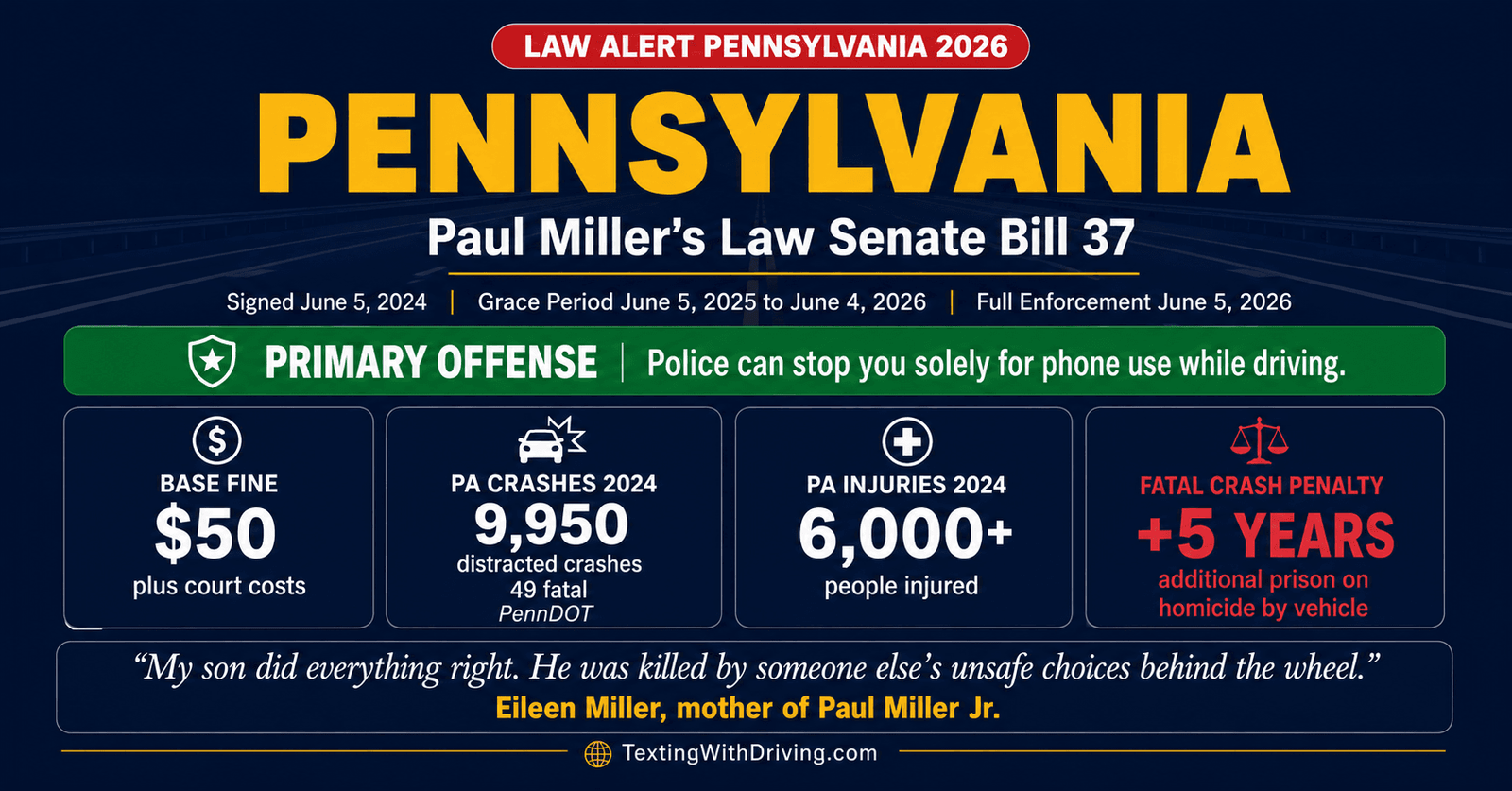
Paul Miller’s Law, formally enacted as Senate Bill 37 and signed by Governor Josh Shapiro on June 5, 2024, entered full enforcement on that date after a one-year grace period during which drivers received written warnings. The warnings are over. Citations are now being issued. And for the first time in Pennsylvania’s history, holding any interactive mobile device while driving is a primary traffic offense, meaning an officer can pull you over specifically for it without needing any other reason.
For Pennsylvania’s roughly 9 million licensed drivers, this is the most significant change to traffic law in a generation. Here is everything you need to know.
The Person Behind the Law
Laws named for individuals carry their stories with them, and understanding Paul Miller Jr.’s story is inseparable from understanding why this law exists and why it matters.
Paul Miller Jr. was tragically killed in a crash with a tractor-trailer in 2010 in Monroe County as the result of a distracted driver who reached for their phone while driving. Since Paul’s death, Eileen Miller, Paul’s mother, has become a national advocate for stronger laws to curb distracted driving. Michigan Auto Law
Paul Miller Jr. was a 21-year-old killed in 2010 when a distracted commercial truck driver crossed the median and struck his vehicle. The tragedy fueled years of advocacy for stronger safety rules. Mattiacci Law
At the law’s announcement, Eileen Miller spoke directly about what it took to get to this point:
“Nearly 15 years ago, two Dunmore state troopers knocked on my door to tell me that my son was killed. My son did everything right. He was killed by someone else’s unsafe choices behind the wheel. This law is for every family in Pennsylvania that doesn’t have to experience two state troopers knocking on their door to tell them that their loved one was killed by distracted driving. Paul Miller’s Law will be a beacon of protection for every driver and passenger in Pennsylvania.” Michigan Auto Law
Fifteen years of advocacy. A mother who turned the worst moment of her life into a sustained campaign for legislative change. That is the human story behind the legal text of Senate Bill 37.
The Full Timeline: How Paul Miller’s Law Reached Full Enforcement
Understanding the timeline helps clarify exactly where the law stands right now for Pennsylvania drivers.
Paul Miller’s Law went into effect on June 5, 2025, and made the use of an interactive mobile device while operating a motor vehicle a primary traffic offense. Until June 5, 2026, anyone found to be in violation of the law was issued a written warning. Governor’s Traffic Safety Committee
Beginning June 5, 2026, under Paul Miller’s Law, police are able to issue fines to drivers caught using handheld mobile devices behind the wheel. The change elevates the law from an educational phase to full enforcement, with violations carrying a $50 fine plus court costs and other fees. It ended a year-long warning period that had been in place since June 5, 2025. NAHB
The timeline in clear terms:
June 5, 2024: Governor Josh Shapiro signs Senate Bill 37 into law.
June 5, 2025: The law takes effect and becomes active. Officers begin issuing written warnings to violators. No fines yet.
June 5, 2026: The grace period ends. Full enforcement begins. Officers are now issuing $50 citations plus court costs and fees to drivers caught holding a phone.
If you are driving in Pennsylvania today, you are operating under full enforcement. The warning phase is behind you.
What Exactly Does Paul Miller’s Law Ban?
The law is written more comprehensively than Pennsylvania’s previous texting-only ban, which had been in place since 2012. Understanding the specific language matters because drivers often assume restrictions are narrower than they actually are.
Paul Miller’s Law prohibits holding or supporting any interactive mobile device for almost any purpose, even while stopped at a red light. An interactive mobile device includes any handheld phone, smartphone, tablet, personal digital assistant, or similar wireless device capable of calling, texting, emailing, browsing the internet, using apps, playing games, recording or sharing media, or sending and receiving electronic data.
The law also defines driving broadly to include not just moving vehicles, but any time a driver is operating a motor vehicle on a public road, even when stopped at a red light, stop sign, or due to traffic delays. Use of a device under the law includes holding it in your hand or supporting it with another part of your body, pressing more than one button to interact with it, or reaching for it in a way that removes you from a proper seated, seat-belted position. Penske Truck Leasing
This is a critical distinction from what many drivers expected. The law applies even when your vehicle is fully stopped at a red light. If you pick up your phone while waiting for the light to change, that is a violation under Paul Miller’s Law. The vehicle does not need to be moving.
Harrisburg Police confirmed that the law defines the use of an interactive mobile device as using at least one hand to hold, dialing or answering a device by pressing more than a single button, or reaching for a device in a way that requires a driver to maneuver so that the driver is no longer in a seated driving position restrained by a seat belt. Federal Motor Carrier Safety Administration
The reach-and-maneuver provision is particularly worth noting. If you stretch across the passenger seat or lean into the back seat to retrieve your phone while the vehicle is on a public road, even if stationary, that action itself may constitute a violation.
What Is Still Permitted Under the Law
Paul Miller’s Law is a hands-free requirement, not a total communication ban. Drivers retain meaningful legal options.
The law allows a single touch to answer or end a call. Texting and driving remains prohibited, but an exception is added allowing a driver to text and drive if it is necessary to communicate with law enforcement or emergency services to prevent injury to persons or property. Zutobi
Additional permitted uses include hands-free calling through Bluetooth or a car’s built-in system, voice-activated features including voice-to-text and virtual assistants, mounted GPS navigation where the phone is secured in a mount and not held, and single-tap call answering or ending without holding the device.
The single-tap exception mirrors what Missouri and other states with hands-free laws allow. One finger. One action. The phone remains unmoved in its mount or on the seat. Anything requiring you to physically pick up, hold, or actively interact with the device goes beyond what the single-tap exception permits.
The Fine and Penalty Structure
Beginning June 5, 2026, drivers convicted of using a hand-held device while driving will pay a $50 fine, plus court costs and other fees. Sentryroad
That base fine is relatively modest compared to states like Alaska where a first offense can reach $10,000, or New York where fines start at $50 and can reach $200. But the consequences extend beyond the initial fine in several meaningful ways.
The law does not add license points for non-commercial drivers, but you will owe the $50 fine and court fees, and insurers may raise your rates. A citation could lead to increased premiums.
The absence of license points for non-commercial drivers is notable. However, insurance company treatment of traffic violations is determined by individual insurers, not by whether the state assigns points. Many insurers treat a distracted driving citation as a risk indicator regardless of the point system, which can produce rate increases that far exceed the original fine over a multi-year policy period.
For commercial drivers, the consequences are more severe. Commercial drivers may face employer discipline or lose certifications under FMCSA rules. A citation under Paul Miller’s Law for a commercial vehicle operator can affect CDL status, which has direct career implications. Penske Truck Leasing
The law’s most serious penalty applies when distracted driving causes a death. If a distracted driver causes a fatal accident and is convicted of homicide by vehicle, the judge may impose up to five additional years in prison under the enhanced sentencing provision of Paul Miller’s Law.
Additionally, depending on the circumstances, drivers who violate Paul Miller’s Law or the existing texting-while-driving ban may also be convicted of Homicide by Vehicle or Aggravated Assault by Vehicle, and given increased sentences.
Five additional years of prison beyond what the underlying homicide conviction already carries. For a distracted driver who kills someone on a Pennsylvania road, the legal exposure is now substantially more serious than it was before June 5, 2026.
Primary Enforcement: Why This Is Different From Before
One of the most significant practical features of Paul Miller’s Law is that it is classified as a primary offense. This is a meaningful distinction that many Pennsylvania drivers do not fully understand.
The law made the use of an interactive mobile device while operating a motor vehicle a primary traffic offense, meaning the offense is serious enough that it alone warrants a stop by a law enforcement officer without needing another reason to do so. Governor’s Traffic Safety Committee
Under Pennsylvania’s previous texting-only ban, which dated to 2012, phone use while driving was a secondary offense. Officers needed to observe another violation first before they could issue a texting citation. A driver who was texting but not speeding, not running a red light, and not committing any other visible violation could not be stopped specifically for phone use.
Paul Miller’s Law changed this completely. An officer who observes a driver holding a phone on a Pennsylvania road now has the legal authority to initiate a traffic stop based on that observation alone. No other violation is required.
This primary enforcement classification puts Pennsylvania ahead of states like Missouri, where the hands-free law remains secondary in practice, and aligns it with states like California, New York, and Oregon where research has shown primary enforcement produces faster reductions in phone use and crash rates.
The Data Behind Why This Law Was Needed
The Pennsylvania-specific crash data makes the legislative urgency clear.
According to PennDOT data, in 2024 there were 9,950 crashes involving a distracted driver, resulting in more than 6,000 injuries and 49 fatalities. Distracted driving crash data is believed to be underreported due to many drivers’ reluctance to admit to being distracted at the time of a crash. Mattiacci Law
Driver behavior is the leading factor in 83 percent of the approximately 1,100 fatal crashes that occur annually on Pennsylvania roadways. These behaviors include driving distracted, impaired, aggressive, and others. Michigan Auto Law
In 2023, Pennsylvania reported over 11,200 crashes involving distracted drivers, surpassing the number of alcohol-related crashes that year. Zutobi
That last figure deserves attention. In 2023, distracted driving crashes in Pennsylvania outnumbered alcohol-related crashes. More crashes from phones than from drunk driving in a single year in one of the most populous US states. That is the context in which Eileen Miller’s 15-year advocacy campaign finally produced a comprehensive law.
How Paul Miller’s Law Handles Bias in Policing
One aspect of Paul Miller’s Law that distinguishes it from most state distracted driving legislation is a specific anti-bias provision.
Paul Miller’s Law is also intended to prevent bias in policing by requiring law enforcement to collect data on drivers pulled over during traffic stops, including race, ethnicity, and gender. This data will be made publicly available in an annual report. Mattiacci Law
This provision reflects a broader conversation in Pennsylvania about ensuring that primary enforcement laws, which grant officers discretion to stop drivers based on a single observed behavior, do not result in disproportionate enforcement against any demographic group. The mandatory data collection and public reporting requirement creates accountability that most state traffic laws do not include.
What Pennsylvania Drivers Need to Do Right Now
The transition from warnings to citations on June 5, 2026 is the kind of change that requires immediate behavioral adjustment. Here is what compliance looks like in practical terms.
If you use your phone for navigation, mount it before you start the car. A mounted phone displaying GPS directions is not a violation. A phone held in your hand showing the same directions is.
Set up hands-free calling through your vehicle’s Bluetooth system or a third-party Bluetooth device before you need to make or receive calls while driving. This requires a one-time setup that takes a few minutes and eliminates the temptation to pick up the phone when a call arrives.
Take advantage of your phone’s built-in driving mode. iPhone’s Driving Focus and Android’s driving features automatically silence notifications and send auto-replies when you are in motion. This removes the incoming stimulus that triggers the impulse to reach for the device in the first place. Our guide to the best apps to block texting while driving covers both built-in and third-party options in detail.
If you absolutely need to interact with your phone in a way that cannot be handled hands-free, pull over completely and park before doing so. The law exempts drivers who are lawfully stopped or parked.
For Pennsylvania employers whose workers drive as part of their jobs, June 5, 2026 is a natural moment to review and update workplace driving policies. The legal landscape for employees in company vehicles or driving personal vehicles for work purposes has changed, and the liability exposure for employers in the event of a crash caused by an employee phone violation is real. The National Safety Council’s workplace distracted driving resources provide free policy templates for exactly this purpose.
How This Connects to the National Picture
Pennsylvania’s full enforcement of Paul Miller’s Law places it among the growing majority of US states with comprehensive, primary-enforcement hands-free laws. As of 2026, Pennsylvania is one of more than 30 states where police can stop drivers specifically for handheld phone use.
The national research on what these laws produce is consistent. States that combine a clear handheld ban with primary enforcement and visible public education campaigns show faster reductions in phone-related crashes than states with secondary enforcement or texting-only bans. Pennsylvania has all three elements in place.
For the full national legal picture including how all 50 states compare on handheld bans, fines, and enforcement types, see our texting while driving laws by state 2026 guide. For the national death toll data that provides context for laws like Paul Miller’s Law, the distracted driving statistics 2026 overview covers everything in one place. And for the science behind why phone use is so dangerous regardless of what state law says, see our breakdown of the real danger of texting while driving.
Paul Miller Jr. was 21 years old. He was not texting. He was not distracted. He was killed because someone else chose to reach for their phone. The law that bears his name is Pennsylvania’s answer to that choice.
Sources Used in This Article
All links verified working before publication.
Lehigh Valley News: Pennsylvania Drivers to Face Fines Under Paul Miller’s Law in 2026 — December 2025
NBC Philadelphia: Expanded PA Ban on Cellphone Use While Driving — May 2026
ABC27: Pennsylvania Drivers to Face Distracted Driving Fine — May 2026
Times Leader: Paul Miller Law Fines Go Into Effect June 5 2026 — April 2026
CrimeWatch: Paul Miller Law Fines Go Into Effect June 5 2026 — PennDOT and PSP official statement, April 2026
Atlee Hall: Paul Miller’s Law PA Hands-Free Rule — Legal breakdown with statutory citation
Edgar Snyder and Associates: Pennsylvania Distracted Driving Law — Comprehensive legal overview
IUP University Police: Paul Miller’s Law Effective June 5 — Statutory and penalty details
NHTSA: Distracted Driving — National data context
GHSA: Distracted Driving State Laws — National state law comparison
NSC: Distracted Driving Awareness Month Workplace Resources — Employer policy tools
TextingWithDriving.com is professionally built and maintained to ensure accurate, accessible safety information reaches every driver who needs it. Website development and ongoing support is handled by Budgetic, a digital agency specializing in purpose-driven WordPress websites.

About Texting With Driving
TextingWithDriving.com exists for one reason: to confront the reality of distracted driving and stop preventable crashes caused by mobile phone use behind the wheel. Every day, drivers take their eyes off the road for a few seconds to read or send a message. Those few seconds are enough to cause life-altering consequences. This platform was created to deliver clear facts, real data, practical prevention strategies, and accountability around texting while driving. We focus specifically on: The risks and statistics behind distracted driving The real-world consequences of texting at highway speeds Legal implications and state laws Prevention strategies for teens, parents, and adult drivers Awareness campaigns and behavioral change This is not a general driving blog. It is a focused awareness initiative built around one critical issue: phone distraction behind the wheel. Our content is direct, research-driven, and practical. We prioritize accuracy over opinion and education over sensationalism. The goal is simple — reduce distracted driving incidents by increasing awareness and responsibility. If one article causes one driver to put their phone down, the mission is working. For inquiries or partnerships, contact: privacy@textingwithdriving.com
View all posts by Texting With Driving