

Virginia Distracted Driving Insurance Rate Increase 2026: The Real Three-Year Cost of One Ticket

Virginia Distracted Driving Insurance Rate Increase 2026: The Real Three-Year Cost of One Ticket
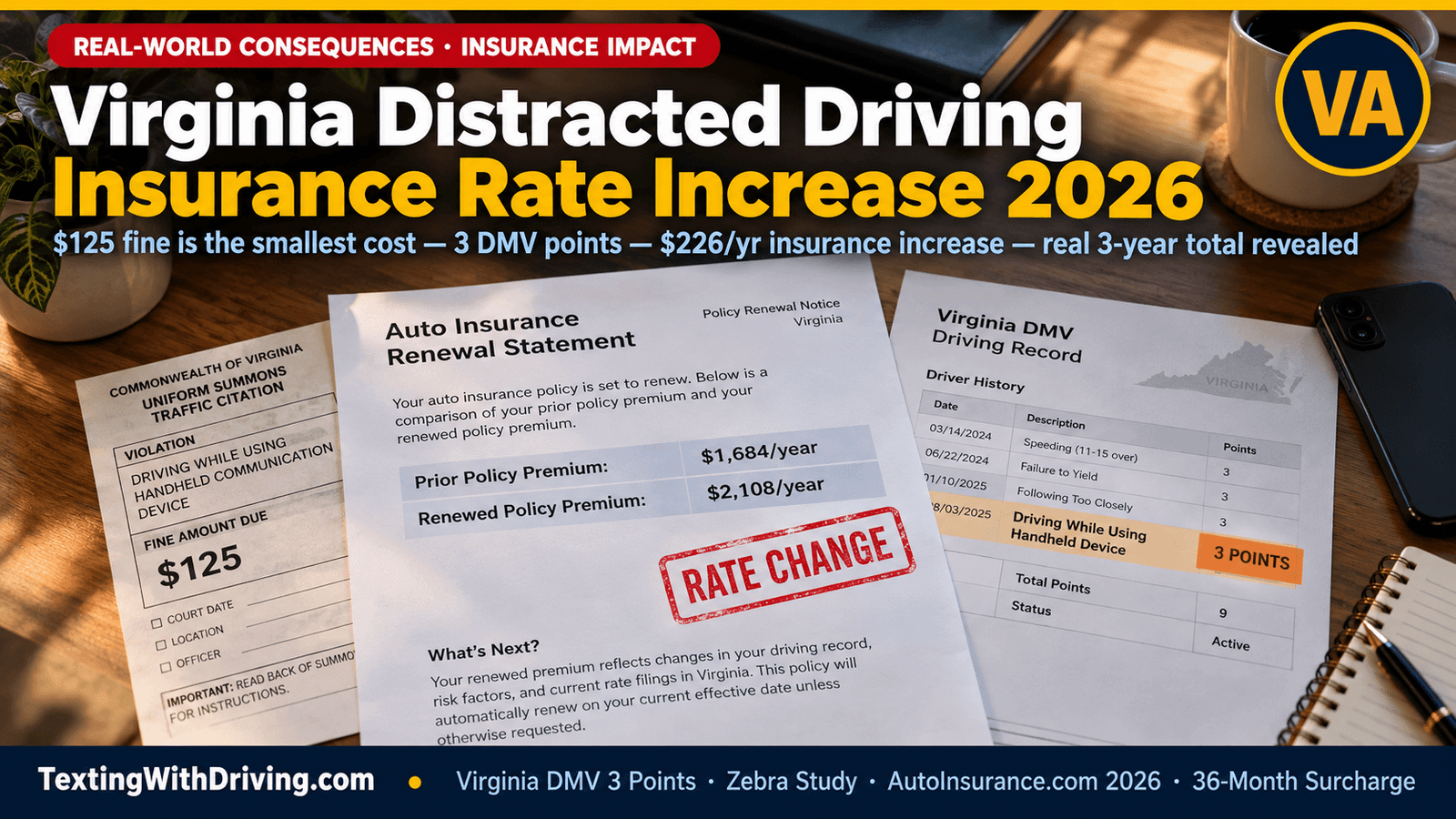
Virginia distracted driving insurance rate increase 2026 reveals a financial reality that most drivers who receive a $125 first-offense citation under Virginia Code § 46.2-818.2 do not calculate until the insurance renewal arrives: the $125 courthouse fine is the smallest component of the real cost of a single distracted driving ticket.
The average insurance premium rate hike applied to a driver who received a ticket for distracted driving comes out to $226 per year. A $226 annual rate increase, sustained for Virginia’s legally mandated maximum surcharge period of 36 months, produces a three-year insurance surcharge of $678. Add the $125 first-offense fine, and the real three-year cost of a single Virginia distracted driving citation for the average driver is approximately $803 — before court costs, before any second-offense consequences, and before the compounding effects that apply to young drivers who already pay above-average premiums.
That calculation changes significantly for drivers under 25, who pay substantially higher baseline premiums: an 18-year-old pays three times the national average insurance rate. A 23% rate increase applied to three times the baseline produces a surcharge that can reach $900 to $1,500 over three years from a single $125 citation.
$125 is the entry cost. The real cost is $800 to $1,600 depending on age, insurer, and driving record — and it continues to compound if a second citation follows before the first surcharge period ends.
This guide covers the complete Virginia distracted driving insurance rate increase 2026 picture: how Virginia’s DMV points system connects to insurance surcharges, what the data shows about average rate increases, how Virginia’s 36-month surcharge maximum works, which insurers penalize distracted driving most severely, what young Virginia drivers face, and what every driver can do to protect their premium after receiving a citation.
Virginia’s DMV Points System: The Insurance Connection
Virginia distracted driving insurance rate increase 2026 begins with the Virginia DMV points system — the mechanism that connects a $125 traffic citation to an insurance company’s premium calculation.
Virginia uses a point system to rate drivers. You receive demerit points for unsafe driving and safe driving points for good driving. The Virginia DMV posts convictions to your driving record and assigns demerit points based on the severity of the offense.
For Virginia Code § 46.2-818.2 distracted driving violations:
First offense: 3 DMV demerit points, $125 fine. The 3-point assessment for a first distracted driving violation places it in the standard traffic violation tier — the same point level as an improper turn or a failure to yield, but below reckless driving’s 6 points. The 3 demerit points remain on the DMV record and affect insurance rating for 18 months from the offense date. The conviction itself remains on the DMV record for the standard moving violation period.
Second offense: 3 DMV demerit points, $250 fine. The same 3-point demerit applies to the second offense, but the $250 fine doubles — and the second citation’s insurance impact compounds with the first if it occurs within the first citation’s surcharge period.
Accumulation thresholds: Acquiring 18 demerit points in 12 months or 24 demerit points in 24 months triggers a 90-day license suspension. A driver who receives multiple traffic violations — including two distracted driving citations at 3 points each and any other moving violations — approaches these thresholds with meaningful consequences beyond the insurance surcharge.
Safe points: Virginia’s DMV rewards good drivers with safe points — one for every year you hold a state license with no driving violations or suspensions. Safe points offset demerit points at a 1-for-1 rate. A driver with 3 accumulated safe points who receives a 3-point distracted driving citation returns to zero net points — but the insurance company’s actuarial records do not reset to zero. The DMV record shows the conviction even when the point balance is neutral.
The bottom line is the more points you have on your Virginia driving record, the higher risk you pose for future claims. Insurance companies access the DMV record — typically through the Insurance Services Office’s CLUE system or direct DMV record purchases — and recalculate risk based on the conviction record. The 3-point distracted driving conviction is visible to every insurance company that quotes or renews the driver’s policy for the period that the conviction remains on the record.
The Insurance Rate Increase: What the Data Shows
Virginia distracted driving insurance rate increase 2026 insurance impact data comes from multiple independent studies:
Zebra study: $226 average annual rate increase. The Zebra insurance quote comparison site’s analysis found that the average insurance premium rate hike applied to a driver who received a ticket for distracted driving — the typical charge of using a phone while operating a vehicle — comes out to $226 per year. The Zebra finding is the most widely cited specific dollar figure for distracted driving’s insurance cost and has been confirmed by multiple subsequent analyses.
Insurance.com survey: 23% average rate increase. A survey of six insurance carriers in 10 zip codes in every state showed that the average rate increase for a texting and driving ticket is 23 percent. The rate increase ranged from 12 percent to 45 percent depending on the insurer and state.
AAA Insurance.com data: 28% average premium increase. Recent data from Insurance.com cited by AAA shows a texting violation results in an average 28 percent increase in car insurance premiums.
The Virginia baseline: $2,003 average full coverage. Virginia’s full coverage car insurance averages $2,003 annually as of June 2026, about 15 percent below the national average of $2,356. A 23 percent distracted driving rate increase applied to a $2,003 Virginia baseline produces an approximately $461/year increase. A more conservative $226/year increase applied to the same baseline represents approximately 11 percent above the pre-citation rate.
The specific Virginia impact using the most commonly cited data points:
| Calculation Basis | Annual Increase | 3-Year Total | Plus $125 Fine |
|---|---|---|---|
| Zebra $226/year | $226 | $678 | $803 |
| 23% of $2,003 baseline | $461 | $1,383 | $1,508 |
| 28% of $2,003 baseline | $561 | $1,683 | $1,808 |
The three-year total ranges from approximately $800 to $1,800 depending on the methodology and the driver’s specific baseline premium. The Zebra figure ($226/year) represents the average across all drivers nationally; Virginia drivers with higher-than-average premiums (urban areas, high-risk corridors, high-credit-score premium adjustments) will experience higher absolute increases.
Virginia’s 36-Month Insurance Surcharge Rule
Virginia distracted driving insurance rate increase 2026 has a specific legal constraint that benefits Virginia drivers: Virginia insurance law stipulates that a surcharge may not be applied for a period longer than 36 months and that the surcharge period may not begin later than 12 months from the date of the motor vehicle accident.
The 36-month maximum means that a Virginia distracted driving citation’s insurance surcharge is legally capped at three years. An insurance company that attempts to apply a surcharge for four or five years on a Virginia-issued citation is violating Virginia insurance law. This is a consumer protection provision that most Virginia policyholders are unaware of but that provides a hard ceiling on the compounded insurance cost of a single violation.
The “no later than 12 months from the date” provision means the surcharge clock begins within one year of the conviction — typically at the next policy renewal after the conviction is posted to the DMV record. A Virginia driver cited in October 2026 may not see the rate increase until their January 2027 renewal (three months later), but the maximum surcharge period ends no later than three years after the surcharge begins — so no later than January 2030 at most.
When shopping for insurance, three to five years of your DMV driving record will most likely impact your insurance rate. This insurance industry practice of reviewing three to five years of history differs from Virginia’s 36-month surcharge rule — the surcharge legally ends at 36 months, but the conviction may still be visible on the driving record and may still influence underwriting decisions (which company is willing to cover the driver, and at what rate) for longer.
The practical implication: switching insurance companies after a distracted driving conviction may produce better rates, because different insurers weight the violation differently. The best way to get cheaper car insurance is by switching companies to one that’s more affordable — the standard recommendation for drivers with points on their license.
The Young Driver Multiplier
Virginia distracted driving insurance rate increase 2026 is most severe for the demographic that Virginia DMV’s own data identifies as the highest-frequency distracted driving age group: drivers aged 21 to 35.
Zebra’s data shows that 18-year-old drivers pay three times the national average insurance rate. If the national average full coverage rate is $2,356 per year, an 18-year-old pays approximately $7,068 per year. A 23 percent rate increase on a $7,068 baseline produces a $1,626 annual surcharge — and a three-year total of $4,878, plus the $125 fine, for a real three-year cost of approximately $5,000 from a single first-offense citation.
Even a 23-year-old driver — past the extreme high rates of the 16-to-20 cohort but still in the above-average premium range — might pay $3,000 to $4,000 per year for full coverage in Northern Virginia’s urban corridor. A 23 percent rate increase on a $3,500 baseline produces an $805 annual surcharge and a $2,415 three-year total — a $2,540 real three-year cost from a $125 citation.
The young driver demographic insight is the most important risk communication available for distracted driving prevention with this age group. The 21-to-35 year old technology worker commuting on Route 28 in Loudoun County who is aware that a single citation could increase their annual insurance bill by $800 to $1,600 for three years has a financial deterrent that is orders of magnitude larger than the $125 fine alone communicates.
How Insurers Access the Virginia DMV Record
Virginia distracted driving insurance rate increase 2026 mechanism requires understanding how insurance companies learn about the distracted driving conviction in the first place.
Insurance companies access Virginia driving records through several channels:
DMV record pull at renewal. Most insurance companies pull the full DMV driving record at each policy renewal — typically annually. A conviction that occurs between renewals appears at the next annual pull and triggers the rate recalculation.
Telematics programs. As documented in our telematics distracted driving 2026 article, drivers enrolled in usage-based insurance programs like Progressive’s Snapshot, State Farm’s Drive Safe and Save, or Allstate’s Drivewise are providing behavioral data to their insurers in real time. A telematics-enrolled driver who is cited for distracted driving also has telematics data showing phone motion events that the insurer’s behavioral scoring algorithm has already captured — producing a compound record of both the DMV conviction and the behavioral data that preceded and follows it.
CLUE reports. The Comprehensive Loss Underwriting Exchange system creates a record of insurance claims that insurers access when underwriting new policies. A distracted driving citation that leads to a crash produces both a DMV conviction record and a CLUE claim record.
Progressive reassesses driving records at policy renewal, typically every six months or once a year. The six-month renewal cycle means a distracted driving citation received in October 2026 may appear in the April 2027 renewal — six months later — or the October 2027 annual renewal — one year later.
The Comparison: What Other Violations Cost
Virginia distracted driving insurance rate increase 2026 is best understood in the context of other violations’ insurance costs:
A speeding ticket in Virginia raises the annual premium to $2,258 — approximately $255/year increase over the $2,003 Virginia baseline. Distracted driving’s $226 average annual increase is comparable to speeding — slightly lower in the Zebra analysis but within the same range.
By comparison, driving too slowly produces a $345 annual insurance increase and passing a school bus produces a $386 increase — both higher than distracted driving’s penalty. By far the most expensive rate increase comes from driving under the influence, which costs an extra $1,095 per year.
The lower-than-DUI, lower-than-school-bus-pass distracted driving penalty represents an underpricing of the actual risk that Zebra analysts describe as shocking. As telematics data accumulates more actuarial evidence of distracted driving’s crash correlation, the insurance pricing for distracted driving violations is likely to increase — making the 2026 $226/year figure a floor rather than a ceiling for what future violations will cost.
The Crash Consequence: Reckless Driving and Liability
Virginia distracted driving insurance rate increase 2026 has a separate and much larger insurance consequence when the distracted driving produces a crash rather than just a citation.
A Virginia driver whose distracted driving causes a crash faces:
Liability claim against their policy. The at-fault driver’s liability insurance covers the other party’s property damage and bodily injury. A significant injury claim — emergency room treatment, lost wages, permanent disability — can produce a liability settlement that exceeds policy limits, creating personal financial exposure beyond the insurance payout.
Comprehensive rate recalculation. A claim against the policy triggers a rate increase independent of the citation — the at-fault accident surcharge compounds with the distracted driving conviction surcharge.
Virginia contributory negligence. As documented in our Virginia distracted driving crash recovery 2026 article, Virginia uses pure contributory negligence — a plaintiff who is even 1 percent at fault cannot recover damages from the defendant. Violating § 46.2-818.2 while causing a crash creates the presumption of negligence that makes the distracted driver the sole at-fault party in most scenarios.
Reckless driving criminal charge enhancement. If the distracted driving produces reckless conduct — as documented in our Virginia reckless driving and distracted driving 2026 article — the 6 DMV points from the reckless driving conviction produce a substantially larger insurance impact than the 3 points from the standard distracted driving citation alone.
The Safe Driver Discount: What You Stand to Lose
Virginia distracted driving insurance rate increase 2026 is not just about the rate increase that results from a citation — it is also about the discounts that citation eliminates.
Most major Virginia insurance carriers — GEICO, State Farm, Progressive, Allstate, USAA — offer safe driver discounts for policyholders who maintain a clean driving record. The specific discount percentages vary by carrier, but typical safe driver discounts range from 5 percent to 22 percent of the base premium.
A Virginia driver currently receiving a 15 percent safe driver discount on a $2,003 annual premium is saving $300 per year — $900 over three years — from that discount. A distracted driving citation eliminates that discount at the next renewal while simultaneously adding the surcharge. The net three-year financial swing is the sum of the lost discount ($900 over three years) plus the added surcharge ($678 at the Zebra average) — approximately $1,578 of combined financial impact from a $125 citation.
Virginia’s DMV rewards good drivers with safe points — one for every year you hold a state license with no driving violations or suspensions. The safe points that a Virginia driver has accumulated over years of clean driving are not eliminated by a single distracted driving citation, but the actuarial weight of the conviction record overrides the safe points’ practical significance in insurance rate calculation during the surcharge period.
What Virginia Drivers Can Do After Receiving a Citation
Virginia distracted driving insurance rate increase 2026 has specific mitigation options for drivers who have already received a citation and are managing the insurance consequences.
Compare rates immediately after the conviction posts. Different insurance companies weight distracted driving violations differently. Some carriers — particularly those with telematics programs that reward current behavioral performance — may offer better rates than a policy that was priced before the violation. Shopping rates annually is always recommended; shopping immediately after a violation posts is specifically recommended because the incumbent carrier’s renewal rate may not be the best available rate.
Enroll in a telematics program. As documented in our telematics distracted driving 2026 article, telematics programs that monitor driving behavior and reward safe driving can produce discounts that partially offset the surcharge from a prior violation. A driver who received a citation 12 months ago, enrolls in Progressive’s Snapshot program, and receives a 20 percent behavioral discount has partially — if not fully — offset the citation’s surcharge.
Complete a driver improvement course. Some Virginia insurers discount premiums for completion of a DMV-approved driver improvement clinic. The discount varies by carrier but can be 5 to 10 percent of the annual premium — offsetting a portion of the distracted driving surcharge.
Raise the deductible. Increasing the comprehensive and collision deductible from $500 to $1,000 can reduce the annual premium by $100 to $300, partially offsetting the distracted driving surcharge.
The most cost-effective action: never receive the citation. The $226 annual insurance increase, the lost safe driver discount, the three-year compound impact — all of these are avoided entirely by the behavioral choice that Virginia Code § 46.2-818.2 requires. The Driving Focus setup that takes 30 seconds before the drive eliminates the $125 fine, the 3 DMV points, the $678 three-year surcharge, and the lost discount in a single behavioral setup.
For the complete Virginia law that creates the citation whose insurance consequences this article documents, our Virginia distracted driving law covers Va. Code § 46.2-818.2. For the reckless driving upgrade that creates the 6-point citation with substantially larger insurance consequences, our Virginia reckless driving and distracted driving 2026 article covers the criminal charge pathway. For the Maryland insurance comparison where zero points first offense creates a different insurance structure, our Maryland distracted driving and insurance 2026 article covers the full Maryland picture. And for the technology setup that protects both safety and the insurance premium that comes with a clean Virginia driving record, our hands-free while driving complete setup guide covers iPhone, Android, Bluetooth, and CarPlay.
Sources Used in This Article
All links verified working before publication.
AutoInsurance.com: Guide to Car Insurance in Virginia June 2026 — Full coverage averages $2,003/year Virginia June 2026, speeding ticket $2,258/year, distracted driving first offense 3 points $125 second offense 3 points $250, Virginia requires all drivers liability insurance, June 2026
NBC24 / Multiple Affiliates: Insurers Don’t Penalize Texting While Driving as Much as Other Violations — Zebra Study — Zebra quote comparison site average distracted driving premium rate hike $226/year, driving too slowly $345 school bus $386 DUI $1,095, distracted driving lower than expected analyst shocked, increased $23 past two years, 18-year-olds three times national average
AAA: Texting While Driving Hidden Insurance Costs — 28% average premium increase Insurance.com data texting violation, states highest increases noted, insurer variables, first offense modest increase, do not disturb feature recommendation
William Mattar Law: Distracted Driving Insurance Rate — Insurance.com survey six carriers 10 zip codes all states average 23% rate increase range 12% to 45%, points added driving record premium goes up
Northern Neck Insurance / NNIns: Virginia Ranks Top State Speeding Reckless Driving — Virginia average high-risk car insurance $1,808 reckless driving conviction average $1,135, three to five years DMV record impact insurance, safe points one per clean year, Virginia points system demerit safe
Virginia General Assembly: Insurance Premium Surcharge 36 Month Maximum HD14 — Virginia insurance law surcharge not applied longer than 36 months, surcharge period not begin later than 12 months from date, at-fault accident requirement points surcharge, 1989 Virginia law governing insurance surcharge maximums
Virginia DMV: Distracted Driving — Young people most distracted driving crashes any age group, rubbernecking talking passengers adjusting radio top actions, texting illegal primary offense Virginia, DMV 2026
NHTSA: Distracted Driving — 3,208 deaths 2024, national context
TextingWithDriving.com is professionally built and maintained to ensure accurate, accessible safety information reaches every driver who needs it. Website development and ongoing support is handled by Budgetic, a digital agency specializing in purpose-driven WordPress websites.


