

How Telematics Is Changing Distracted Driving 2026: Insurance, Fleets and Behavior Change

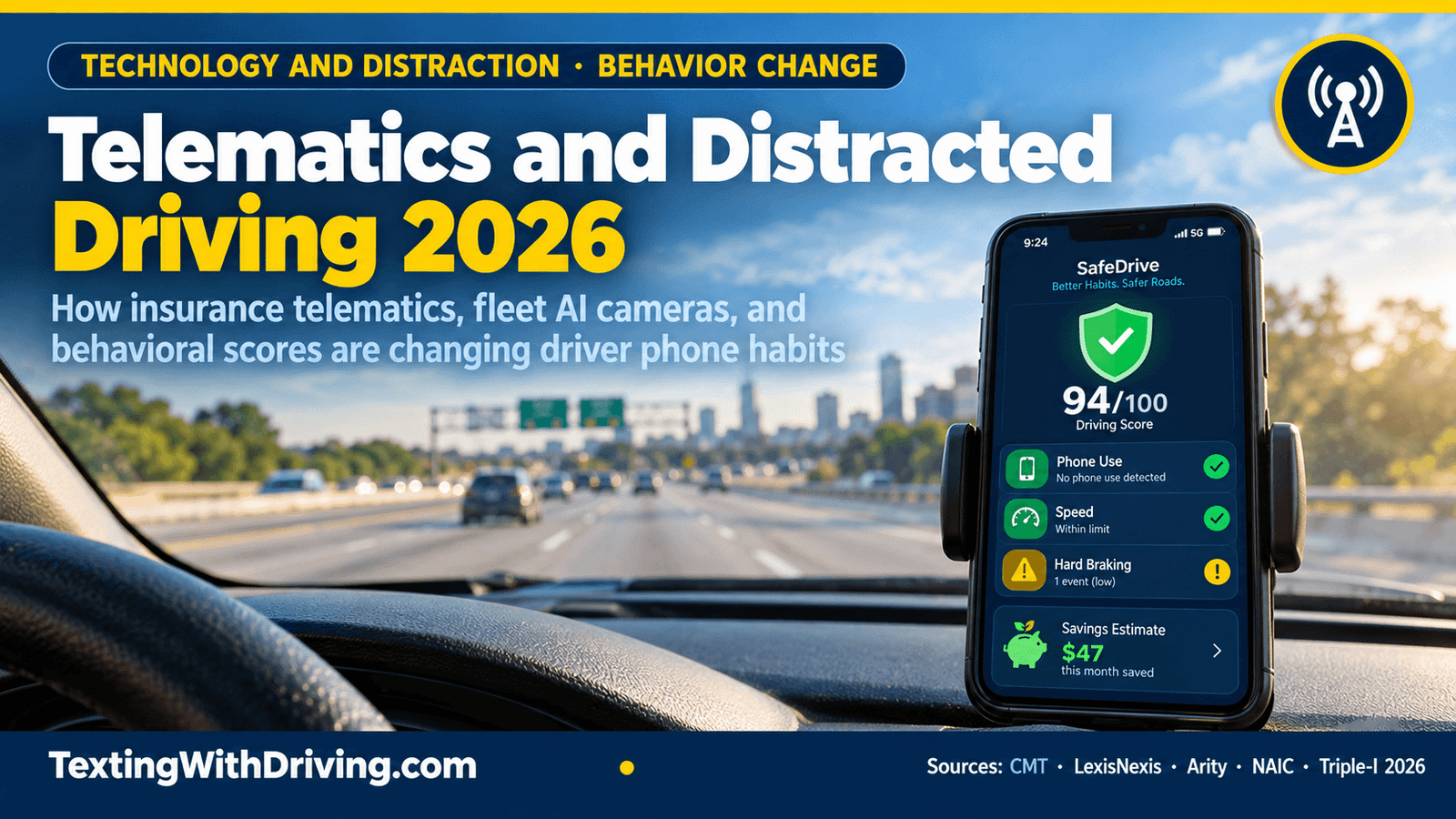
How Telematics Is Changing Distracted Driving 2026: Insurance, Fleets and Behavior Change
Telematics distracted driving 2026 is the convergence of two trends that have been building separately for the past decade and are now reshaping each other in ways that most drivers do not yet fully understand. Telematics — the technology that monitors, records, and transmits vehicle and driver behavior data — has been deployed in commercial fleets since the 2000s. Usage-based insurance programs that use telematics to personalize premiums have been available to consumer drivers since the early 2010s. In 2026, these two streams have converged into the most comprehensive behavioral monitoring infrastructure in the history of traffic safety — one that can detect phone-holding behavior, flag it within two seconds, and translate it into financial consequences that traditional law enforcement cannot match in scale or consistency.
The scale is significant. Cambridge Mobile Telematics analyzes data from over 30 distinct safe driving programs — the source of the Iowa one-year results showing 13.6 percent screen-tapping reduction and 140,700 fewer phone-motion events we documented in our Iowa distracted driving law 2026 article. LexisNexis’s 2026 US Auto Insurance Trends Report — the source of the 57 percent distracted driving violation increase since 2022 and the 73 percent senior driver violation increase documented in our distracted driving statistics 2026 article — is a telematics-powered dataset covering millions of drivers and billions of miles. Arity, Progressive’s telematics data company, tracks billions of miles of driving behavior annually. The telematics data infrastructure behind distracted driving research and enforcement is now larger than anything the traffic safety community has had before.
This guide covers the complete telematics distracted driving 2026 picture: how consumer UBI programs work and what they measure, what the behavioral change evidence shows about financial incentives versus enforcement, how fleet telematics produces the documented 73 percent phone-event reductions we cited in our employer distracted driving policy 2026 article, how telematics data is being used in litigation after crashes, and what the privacy implications of pervasive driving behavior monitoring mean for the future of telematics distracted driving 2026 policy.
What Telematics Actually Measures for Distracted Driving
Telematics distracted driving 2026 begins with a specific technical question: what exactly does a telematics system detect, and how does it know a driver is using their phone?
Telematics devices measure numerous elements of interest to underwriters, including miles driven, time of day, where driving occurs, hard braking, speed, and phone use behaviors.
The phone use detection methods in consumer and fleet telematics fall into three categories:
Phone motion detection. The most widely used approach by consumer UBI apps — including those operated by CMT on behalf of Nationwide, Progressive Snapshot, and others — detects phone motion during driving trips through the phone’s own accelerometer and gyroscope sensors. When the phone moves in ways that are inconsistent with a stably mounted device (the phone being lifted, turned, typed on, or held up to the ear), the app detects the motion event. This is the methodology behind CMT’s “phone-motion events” measurement — the 140,700 fewer phone-motion events in Iowa’s year-one results and the 2:08 minutes per hour of phone motion in Mississippi’s worst-in-nation ranking.
Screen interaction detection. More sophisticated consumer UBI apps detect actual screen-on events during driving — the phone’s screen activating while the vehicle is moving at driving speed. Screen activation during a driving trip is presumptive evidence of phone interaction. The CMT screen-tapping metric — down 13.6 percent in Iowa — is a screen interaction detection measurement rather than a pure motion measurement.
AI camera-based detection. In fleet telematics with AI dash cameras (Lytx DriveCam, Samsara, Mobileye, Netradyne), the detection uses computer vision to identify phone-holding behavior from the driver-facing camera. As documented in our distracted driving AI technology 2026 article, AI models trained on 200 million-plus real-world distraction events classify phone use with 92-plus percent accuracy. This approach detects the specific hand-to-face phone interaction rather than inferring it from phone motion.
UBI programs employ sensors found within smartphones or in-vehicle devices to understand driving behavior and set insurance rates according to driving behavior. Instead of basing insurance premiums on traditional pricing variables such as age, gender, place of residence, and in some states credit score, telematics provides insurers with actual driving behavior data.
The Three UBI Models and What They Mean for Distracted Driving
Telematics distracted driving 2026 operates through three distinct usage-based insurance models that each address phone use behavior differently.
Pay As You Drive (PAYD): Premiums influenced primarily by how much someone drives — mileage-based pricing. Ideal for low-mileage segments or drivers who drive less. The distracted driving relevance: PAYD programs typically include basic safety metrics alongside mileage, so a high-mileage driver who also uses their phone frequently faces the worst premium outcomes while a low-mileage attentive driver receives the best rates.
Pay How You Drive (PHYD): Premiums influenced by how safely someone drives. Inputs include braking, acceleration, speeding, cornering, distraction, timing, location, and road types. This is the model most directly relevant to telematics distracted driving 2026 — the phone use detection is a direct PHYD premium input. A driver with high phone-use events faces higher PHYD premiums than a driver with identical mileage and speed profile who keeps their phone in the back seat.
Manage How You Drive (MHYD): Programs that add coaching and feedback loops to actively shape driver behavior. This is the most sophisticated model — it does not simply measure and price behavior, it actively coaches behavior change through real-time alerts, weekly feedback, gamified scoring, and behavioral rewards. The CMT behavioral score program that produced Iowa’s 13.6 percent improvement and the Nationwide SmartRide program that documented the 85 percent reduction in unsafe events when combined with parental engagement are MHYD implementations.
Auto insurance premiums have risen 45 percent over the past decade, encouraging the adoption of Usage-Based Insurance, especially for cost-conscious consumers. The 45 percent premium increase over a decade has created the financial motivation that was previously absent from UBI adoption: when standard insurance costs significantly more than it did, the 10-to-30 percent savings that UBI programs offer for safe drivers represent a meaningful financial incentive to participate.
The Behavioral Feedback Mechanism: Why Financial Incentives Change Phone Habits
Telematics distracted driving 2026 research establishes that financial incentives applied to behavioral data produce behavior change through a specific mechanism that differs from enforcement-based compliance.
CMT’s Behavioral Score is a two-week score that provides individual trip feedback and helps drivers understand their driving performance. The score combines individual trip scores, which are derived from the frequency and severity of each different risky event observed during a drive — events include harsh braking, distracted phone use, and excessive speeding.
The specific behavioral change mechanism that telematics UBI programs create:
Real-time feedback. Apps now provide feedback to users about speeding, distracted driving, or hard braking, encouraging safer habits. A driver who receives a real-time alert — a vibration or tone when their phone-motion event is detected — gets immediate consequence notification rather than the delayed consequence of a citation by mail or a premium increase at annual renewal.
Trip-level scoring. The immediate post-trip score showing “89/100 — phone use detected during 3 minutes of your drive” is a more specific and actionable behavioral feedback than the citation that arrives six weeks after the violation. The driver can immediately identify which portion of their drive produced the score reduction and adjust the specific behavior for the next trip.
Gamification. Some companies use scores, badges, and rewards to keep drivers engaged and improve behavior. The competitive, game-like structure of weekly driver scoring leaderboards and streak rewards creates the social engagement that makes behavioral change self-reinforcing rather than grudging compliance.
Insurance premium connection. Use insurer mobile apps to check your driving score weekly — it can help you correct bad habits before your next rate review. The connection between the behavioral score and the renewal premium creates sustained financial motivation to maintain the behavioral improvement beyond the initial novelty of the program.
This feedback loop — behavior detected, feedback delivered, score updated, premium implications previewed — is the behavioral change infrastructure that law enforcement enforcement campaigns cannot replicate at the same scale, speed, or consistency. A Road Shark campaign in Fairfax County issues 11,791 citations in one week. A UBI program like Progressive Snapshot or CMT’s commercial programs generates behavioral feedback on every trip for every enrolled driver, every day, without a law enforcement deployment.
The LexisNexis Data: What Telematics Reveals About National Trends
Telematics distracted driving 2026 analysis draws heavily on the LexisNexis 2026 US Auto Insurance Trends Report — which is itself a telematics-powered behavioral dataset covering millions of insured drivers and billions of tracked miles.
The LexisNexis findings we documented throughout this series:
57 percent increase in distracted driving violations since 2022. The violation rate increase documented by LexisNexis across its insurer network reflects the combination of more drivers being cited under expanding primary enforcement laws, more telematics-monitored programs flagging phone events, and the underlying behavioral trend of increasing phone use that CMT’s raw phone-motion data also documents.
73 percent increase for drivers over 66. The senior driver violation increase is the most dramatic demographic finding in the LexisNexis data — establishing that age 66 and older is not a safety-correlated demographic protection as many assume, but rather a high-risk category for distracted driving violations that the telematics data captures in ways that traditional enforcement may undercount.
26 percent increase in bodily injury claim severity. The connection between telematics-documented violation increases and actual crash claim severity establishes that the behavioral data is predictive of real crash risk rather than merely detecting legal violations.
The LexisNexis data is explicitly telematics-driven: the report draws on insurer telematics program data alongside traditional MVR (motor vehicle record) data to build the behavioral risk picture. The violation increases LexisNexis documents are visible precisely because telematics monitoring is more comprehensive than officer-based citation recording — UBI programs detect phone events that would never produce a citation in the current enforcement environment.
Fleet Telematics: The Most Mature Behavioral Change Application
Telematics distracted driving 2026 reaches its most mature behavioral change application in commercial fleet telematics — where the combination of 24-hour monitoring, AI camera detection, and management accountability has produced the most dramatic behavioral change outcomes in the entire telematics ecosystem.
70 percent of commercial fleet crashes involve distracted driving (National Safety Council). AI cameras detect phone use, eating, and drowsiness in real-time. Target: Zero tolerance policy with real-time coaching alerts.
The fleet telematics behavioral change pipeline is the most complete implementation of what telematics distracted driving 2026 can produce:
Detection. AI cameras with 92-plus percent accuracy detect phone use, drowsiness, and inattention within two seconds.
Real-time alert. In-cab alert delivered within two seconds of detection — interrupting the distraction event before it produces a crash.
Management notification. Event clip flagged to fleet manager for review and coaching within four hours.
Safety scoring. Per-driver, per-trip phone-event rate tracked and scored against fleet benchmarks.
Accountability conversation. Manager reviews the clip with the driver — establishing specific, behavioral accountability for the specific documented event.
Premium outcome. Fleets that document improvement earn 10-15 percent discounts on AI dashcam programs. Insurance underwriters in 2026 prioritize specific KPIs when calculating risk profile — fleets with lower-risk driving profiles earn lower premiums. Coaching ROI: fleets that improve driver behavior through telematics-based scoring programs can see premium reductions within a single policy cycle.
The documented behavioral change outcome from this pipeline is the 73 percent phone-event reduction in eight months we cited in our employer distracted driving policy 2026 article. That 73 percent figure represents the most direct available measurement of what comprehensive telematics monitoring produces in commercial fleet environments — a reduction that neither enforcement campaigns nor awareness programs have been able to match in comparable timeframes.
Fleets achieving 76 percent improvement in hard braking compliance earn substantial discounts. The hard braking metric is cited alongside the distracted driving metric precisely because the two are correlated: drivers who use their phones while driving also tend to brake harder, corner faster, and exhibit more generally aggressive driving behavior. Telematics programs that address the phone use behavior frequently see correlated improvement in hard braking and speeding — suggesting that the phone use is symptomatic of a broader risk-tolerance pattern rather than an isolated behavior.
The Crash Reconstruction Application: Telematics in Litigation
Telematics distracted driving 2026 has a specific and growing legal dimension that most drivers enrolled in telematics programs have not considered: the behavioral data that their UBI app or fleet dash camera collects can be used as evidence in litigation after a crash.
Telematics and video evidence speed up claims resolution and reduce disputes. The dashcam footage that fleet telematics systems capture is becoming essential for protection in today’s litigation environment. For commercial fleets, dashcam footage has become essential for protection in today’s litigation environment.
The litigation dimension operates in two distinct directions:
Evidence against the distracted driver. A fleet driver who is captured by an AI dash camera actively handling their phone in the seconds before a crash has produced the most definitive available evidence of distracted driving — the video evidence from inside the vehicle shows the behavior, the telemetry shows the speed and location, and the AI camera’s timestamp establishes the direct causal relationship between the phone interaction and the crash event. In the Virginia contributory negligence environment we documented in our Virginia distracted driving crash recovery 2026 article, this evidence is particularly powerful because it establishes the defendant’s fault beyond any reasonable dispute.
Evidence for the non-distracted driver. A fleet driver who is NOT distracted in the seconds before a crash that was caused by another vehicle’s driver has equally powerful evidence — the AI camera footage showing attentive eyes-on-road and hands-on-wheel behavior in the lead-up to the crash documents the fleet driver’s non-fault status. In crashes where contributory negligence is argued against the fleet driver, pre-crash telemetry and camera footage can definitively establish that the fleet driver’s behavior was not a contributing factor.
For consumer UBI program participants, the data question is more complex. Most consumer UBI programs include data usage and sharing provisions in their terms of service. A driver enrolled in Progressive Snapshot or State Farm Drive Safe and Save whose trip data shows a phone-motion event in the minutes before a crash has potentially produced insurance company-held data that is relevant to post-crash litigation. The specific data retention, sharing, and subpoena vulnerability provisions of individual UBI program agreements are therefore worth understanding before enrollment.
The Privacy Dimension: What Telematics Monitoring Costs
Telematics distracted driving 2026 creates a specific data privacy consideration that the behavioral safety benefits must be weighed against. UBI is a type of auto insurance that tracks mileage and driving behaviors. The basic idea of UBI is that a driver’s behavior is monitored directly while the person drives, allowing insurers to more closely align driving behaviors with premium rates.
“Monitored directly while the person drives.” This is pervasive behavioral surveillance of vehicle occupants on public roads — even if the purpose is safety and the benefit is personalized pricing. The data that telematics programs collect — GPS tracks showing where the driver went and when, speed profiles showing how fast they drove on which roads, phone-motion events documenting communication behavior during drives — is a comprehensive behavioral record that could reveal patterns well beyond safe-versus-unsafe driving.
The privacy tradeoff that telematics distracted driving 2026 creates:
Consumer benefit. Low-mileage drivers, those with set schedules, and people who mostly drive in low-risk conditions tend to see the most benefit from UBI programs. A driver who commutes 20 miles per day in daylight hours without phone interactions can receive substantial premium discounts compared to the demographic pricing that would otherwise apply.
Data risk. The GPS location data in telematics programs reveals where the driver goes, when, and how often. The phone-motion data reveals communication patterns. The hard-braking event locations reveal the specific road segments where the driver had near-miss situations. This behavioral detail is potentially identifiable and potentially useful to parties beyond the insurer who is pricing the driver’s risk.
Regulatory response. State insurance regulators — through the NAIC framework updated September 1, 2026 — are increasingly attentive to the specific data collection, retention, and secondary use provisions of telematics programs. The NAIC’s telematics guidance establishes the regulatory framework within which UBI programs must operate, including data minimization, consent requirements, and limitations on secondary data use.
The South Carolina equity reporting requirement we documented in our South Carolina distracted driving law 2026 article — requiring demographic data on who receives citations — is a legislative response to the same equity concern that applies to telematics programs: do behavioral monitoring systems flag certain demographic groups at higher rates due to correlated variables rather than driving behavior alone? The telematics equity question is an area of active research and regulatory attention in 2026.
What Every Driver Should Know About Telematics and Their Distracted Driving Record
Telematics distracted driving 2026 creates specific awareness needs for every driver who either participates in a UBI program or drives a vehicle equipped with fleet telematics.
If you are enrolled in a consumer UBI program:
Your phone-motion events are being detected and scored on every drive. The score that appears in your app after each trip reflects phone-motion events among other inputs. A driver who is genuinely phone-free — Driving Focus active, phone in back seat — will receive phone-use scores that accurately reflect the absence of phone interaction. A driver who checks their phone during drives will receive scores that accurately reflect that behavior — and those scores will influence the premium adjustment at renewal.
The behavioral feedback that most UBI apps provide is the most accurate and consistent driving behavior monitoring most drivers have ever experienced. Using it as a coaching tool — checking the weekly score, identifying which drives produced phone-motion events, and adjusting behavior accordingly — produces the MHYD behavioral change outcome that the research documents.
If your vehicle is equipped with fleet telematics:
Every phone-interaction event during your work driving is being detected, timestamped, and stored in the fleet management platform. Every event clip is potentially reviewable by your fleet manager. The behavioral accountability that fleet telematics creates is real and comprehensive in ways that officer-based enforcement cannot match.
The specific insight from the 73 percent event reduction data: the accountability is the intervention. Drivers who know that every phone event is captured and potentially reviewed make different in-the-moment decisions than drivers who know only that a law prohibits the behavior but do not expect consistent detection. The perceived catch probability that telematics creates is the behavioral change mechanism.
For every driver regardless of program participation:
The LexisNexis data showing a 57 percent violation increase since 2022 is generated from the intersection of expanding primary enforcement law coverage and growing telematics program detection. As more drivers enter UBI programs — voluntarily for premium savings or as required by employers — the behavioral monitoring coverage of the driving population expands. The driver who is not yet in a UBI program today may be in one within two to three vehicle replacement cycles as connected vehicles with factory telematics become the default.
The phone habits that telematics will eventually monitor universally are the same habits that are safer to establish today. Phone in back seat. Driving Focus active. GPS pre-set before moving. These behaviors produce the same telematics score — zero phone events per trip — whether the drive is monitored by a current UBI program or by a future connected vehicle telematics system.
For the AI camera technology that generates the fleet telematics detection at 92-plus percent accuracy, our distracted driving AI technology 2026 article covers the technical foundation. For the employer fleet policy that puts telematics monitoring in its appropriate business context, our employer distracted driving policy 2026 covers the complete employer framework. For the Iowa behavioral change data that is the clearest available measurement of what telematics-powered behavioral programs produce, our Iowa distracted driving law 2026 covers the CMT/Nationwide one-year study. And for the technology that produces zero phone events on every drive — making the telematics outcome automatic — our hands-free while driving complete setup guide covers iPhone, Android, Bluetooth, and CarPlay.
Sources Used in This Article
All links verified working before publication.
Upper Inc: 9 Telematics Trends Shaping Fleet Management in 2026 — UBI reshaping fleet insurance cost center, behavior-based pricing phone distraction direct premium input, predictive risk alerts crash probability scoring, coaching ROI premium reductions within single policy cycle, March 2026
FleetRabbit: Fleet Insurance and Telematics 2026 — 70% commercial fleet crashes distracted driving NSC, AI cameras phone use eating drowsiness real-time, 76% hard braking improvement substantial discounts, 10-15% discounts AI dashcam programs, insurance fraud $308.6 billion dashcam essential, March 2026
CMT: Motivating Safer Driving with Telematics Study — CMT Behavioral Score two-week individual trip feedback, harsh braking distracted phone use excessive speeding events, auto insurance premiums 45% decade increase, UBI adoption cost-conscious consumers
Arity: Auto Insurance Telematics Explainer — PAYD PHYD MHYD three UBI models, distraction input to PHYD, MHYD coaching feedback loops shape driver behavior, March 2026
The Zebra: Telematics and Usage-Based Insurance What Consumers Think — Behavioral feedback apps feedback speeding distracted driving hard braking, gamification scores badges rewards, weekly score check correct habits before rate review, personalized pricing benefit low-mileage seniors remote workers
Triple-I: Background on Pay-As-You-Drive Auto Insurance Telematics — Distracted driving rose 30%+ February 2020 to February 2022 CMT, 1:35 seconds phone distraction per hour January 2022 high, 10% phone screen interaction time increase every year since 2020, 2:12 seconds per hour 2022
NAIC: Insurance Topics Telematics — UBI definition mileage and driving behaviors, OBD dongles connected cars mobile applications, behavior monitored directly while person drives, updated September 1 2026
LexisNexis 2026 US Auto Insurance Trends Report — 57% violation increase since 2022, 73% senior driver increase age 66+, 26% bodily injury claim severity increase, May 2026
NHTSA: Distracted Driving — 3,208 deaths 2024, national context
TextingWithDriving.com is professionally built and maintained to ensure accurate, accessible safety information reaches every driver who needs it. Website development and ongoing support is handled by Budgetic, a digital agency specializing in purpose-driven WordPress websites.

About Texting With Driving
TextingWithDriving.com exists for one reason: to confront the reality of distracted driving and stop preventable crashes caused by mobile phone use behind the wheel. Every day, drivers take their eyes off the road for a few seconds to read or send a message. Those few seconds are enough to cause life-altering consequences. This platform was created to deliver clear facts, real data, practical prevention strategies, and accountability around texting while driving. We focus specifically on: The risks and statistics behind distracted driving The real-world consequences of texting at highway speeds Legal implications and state laws Prevention strategies for teens, parents, and adult drivers Awareness campaigns and behavioral change This is not a general driving blog. It is a focused awareness initiative built around one critical issue: phone distraction behind the wheel. Our content is direct, research-driven, and practical. We prioritize accuracy over opinion and education over sensationalism. The goal is simple — reduce distracted driving incidents by increasing awareness and responsibility. If one article causes one driver to put their phone down, the mission is working. For inquiries or partnerships, contact: privacy@textingwithdriving.com
View all posts by Texting With Driving