

Oklahoma Distracted Driving Law 2026: Texting Ban, HB2263 School Zone Rule and What Every Driver Must Know

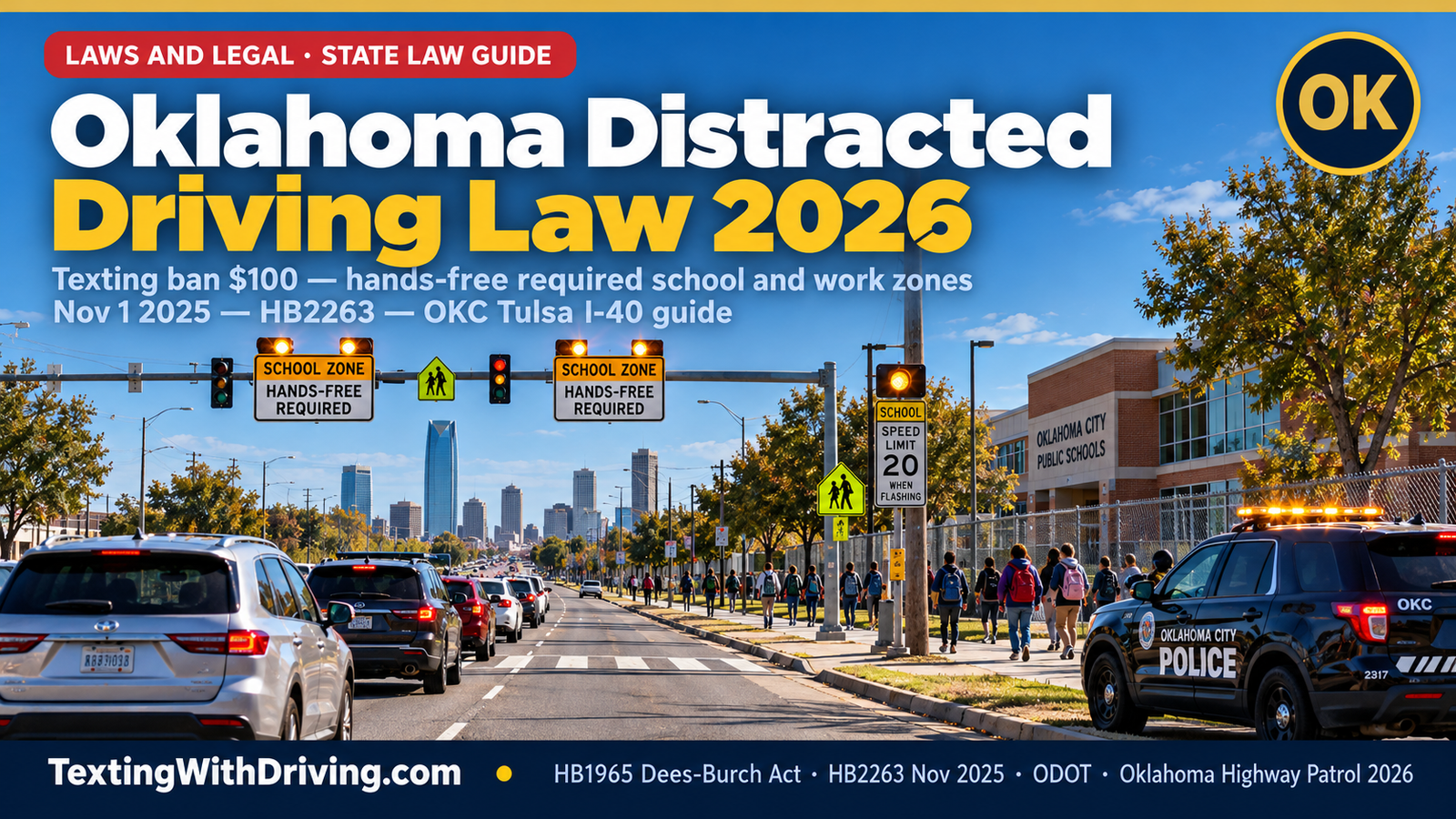
Oklahoma Distracted Driving Law 2026: Texting Ban, HB2263 School Zone Rule and What Every Driver Must Know
Oklahoma distracted driving law 2026 operates under two distinct layers of legal prohibition — the foundational 2015 texting ban that covers all Oklahoma roads as a primary offense, and the more recent HB2263 that took effect November 1, 2025 and added a handheld device ban in active school zones and construction work zones statewide.
Together, these two laws create an enforcement framework that is stricter than a texting-only approach in specific locations while remaining narrower than the comprehensive all-roads handheld bans that 33-plus states have enacted. Every Oklahoma driver on I-40, I-35, and the Oklahoma City and Tulsa metro corridors is subject to both layers of this framework — and the November 2025 addition of HB2263 means the school zone and work zone enforcement is now in its first full year of active operation.
The human context behind Oklahoma’s texting ban is specific and powerful: the Trooper Nicholas Dees and Keith Burch Act of 2015 was named for two Oklahoma Highway Patrol troopers struck by a distracted driver on Interstate 40 in Seminole County in January 2015. Trooper Dees died. Trooper Burch sustained serious injuries. Their families attended the bill-signing ceremony. The law that resulted from their crash is the primary enforcement texting ban that every driver on I-40 through Oklahoma City and Tulsa is subject to every day.
This guide covers the complete Oklahoma distracted driving law 2026 picture: what the texting ban covers, the HB2263 school and work zone addition, the fine structure, the ODOT crash data, the push for comprehensive legislation, and what every Oklahoma City and Tulsa driver must know.
The Oklahoma Texting Ban: Primary Enforcement on Every Road
Oklahoma distracted driving law 2026 begins with the Trooper Nicholas Dees and Keith Burch Act — HB1965 — signed by Governor Mary Fallin on April 5, 2015, effective November 1, 2015.
What it prohibits: Using a hand-held electronic communication device to manually compose, send, or read an electronic text message while operating a motor vehicle that is in motion.
Fine: $100 first offense, primary enforcement.
Primary enforcement: An Oklahoma Highway Patrol trooper or local law enforcement officer who observes a driver texting can stop that driver without any other concurrent violation. The primary enforcement standard has been in effect since November 2015 — making Oklahoma’s texting ban one of the older primary enforcement laws among the states that have not yet enacted comprehensive hands-free bans.
What the texting ban does NOT cover:
Holding a phone for a voice call — legal on regular Oklahoma roads for adult drivers.
Using navigation apps while holding the phone — legal on regular Oklahoma roads.
Browsing social media without sending a text message — legal on regular Oklahoma roads.
Hands-free voice-activated texting: The Act specifically excludes texting via a hands-free, voice-activated system — Siri, Google Assistant, or any system that composes the text by voice without manual typing.
Exceptions: Emergency situations and communications with emergency services. Law enforcement and first responders acting in the performance of their duties.
The texting ban applies specifically when the vehicle is moving. A driver who is composing a text message at a red light is in a gray area — the vehicle is stopped, but the behavior is a clear distraction risk. HB2263 addresses this in school zones specifically.
HB2263: The November 2025 School and Work Zone Addition
Oklahoma distracted driving law 2026 expanded significantly on November 1, 2025 when HB2263 took effect — the law authored by Rep. Nicole Miller (R-Edmond) that added a handheld phone prohibition specifically in active school zones and construction work zones.
What HB2263 prohibits: Operating a motor vehicle while using or holding a hand-held electronic cellular device in a properly marked school zone or in a road construction zone where workers are present, and while the motor vehicle is in motion.
What is permitted: Using hands-free or voice-operated technology — Bluetooth, Apple CarPlay, Android Auto, or any hands-free system that allows device interaction without holding the phone.
Fine: Not more than $100 — same as the texting ban.
No DMV points: Unlike the texting ban’s impact on driving records in some states, HB2263 specifically provides that the Department of Public Safety may not assess points for a violation. A citation under HB2263 does not add DMV demerit points to the driver’s record.
Privacy protection: Law enforcement is prohibited from confiscating or downloading data from a driver’s phone without consent, warrant, or probable cause of a crime. This specific privacy provision was a negotiated component of the bill that addressed civil liberties concerns raised during consideration.
Municipal authority: Municipalities may enact their own ordinances relating to this conduct, but total fines from municipal ordinances cannot exceed $100.
Rep. Miller’s statement on the law captures its intent directly: this law is a practical step toward safer roads. It allows drivers to continue using hands-free technology while ensuring their focus stays on driving, especially in critical areas where workers and students are most at risk.
The Oklahoma Highway Patrol and local police departments conducted awareness campaigns in the early enforcement period — the November 2025 through spring 2026 window — to educate drivers about the new requirement before intensive citation-based enforcement began.
What HB2263 Means on Oklahoma Roads
Oklahoma distracted driving law 2026 HB2263 requirement applies in two specific environments that every Oklahoma driver encounters regularly:
School zones: The law applies in properly marked school zones on any street or highway in Oklahoma — indicated with appropriate warning signs — when school children are present or there is a potential presence of school children. The school zone hours are the specific window when the prohibition is active: typically during morning arrival (7-8:30 AM) and afternoon dismissal (2:30-4 PM) on school days, though the specific hours are posted on school zone signs.
For Oklahoma City drivers navigating the dense residential school zone network in Edmond, Moore, Norman, and the OKC metro area — and Tulsa drivers navigating the Broken Arrow, Jenks, and Tulsa Public Schools corridors — HB2263 means that the routine school-time commute through posted school zones requires full hands-free operation. A driver making a voice call while holding their phone through a school zone marked with flashing amber lights is violating HB2263 even though the same call is legal on the arterial road outside the school zone.
Construction work zones: HB2263 applies in road construction zones where workers are present. The Oklahoma Department of Transportation reports that work zone crashes have increased over recent years, often due to drivers failing to notice lane changes or reduced speeds. The specific work zone application — where workers are physically present within feet of moving traffic — is the highest-consequence context for the phone-holding behavior that HB2263 targets.
Oklahoma’s extensive road construction program — ODOT’s eight-year plan and the ongoing I-40 and I-35 corridor improvements through the Oklahoma City metro — means that a significant percentage of daily commute miles on Oklahoma’s primary interstates pass through active construction zones during the morning and evening peaks. Every one of those zones is an HB2263 enforcement area when workers are present.
The Oklahoma Highway Patrol Naming: Troopers Dees and Burch
Oklahoma distracted driving law 2026’s foundational texting ban carries the name that makes its human cost immediate: the Trooper Nicholas Dees and Keith Burch Act of 2015.
In January 2015, Troopers Dees and Burch were on Interstate 40 in Seminole County investigating an accident — performing exactly the duty that OHP troopers perform on I-40 daily. A distracted driver struck them. Trooper Dees died. Trooper Burch suffered serious injuries.
Governor Fallin’s statement at the signing ceremony: over a dozen Oklahomans die every year in accidents caused by drivers who are distracted by cell phones. Studies show that driving while texting can actually be more dangerous than driving drunk.
The naming of Oklahoma’s distracted driving law for two specific troopers creates a permanence of accountability that abstract statistical legislation cannot achieve. Every Oklahoma driver who passes a law enforcement officer on the shoulder of I-40 — performing the same roadside duty that Troopers Dees and Burch were performing when they were struck — is driving under the law that bears those troopers’ names.
Oklahoma’s Crash Data: The ODOT Picture
Oklahoma distracted driving law 2026 addresses a documented and significant crash problem:
ODOT 2017-2021: Distracted driving led to 250 fatalities and 8,000 injuries in Oklahoma during this five-year period — an average of 50 deaths and 1,600 injuries per year.
2017 crashes: 8,600 crashes attributed to distracted driving in Oklahoma.
2019 crashes: Over 8,000 Oklahoma crashes attributed to distracted driving.
AAA Oklahoma: Oklahoma Highway Patrol and AAA cite distracted driving as the leading cause of injury and death on state roads and highways, noting the rate of distracted driving accidents have risen sharply in recent years.
The ODOT work zone data is separately alarming: work zone crashes have increased over the past several years, often due to drivers failing to notice lane changes or reduced speeds — the specific crash mechanism that HB2263’s work zone handheld ban targets.
Studies show drivers involved in crashes are twice as likely to have used their phones in the minute leading up to the accident — cited in the Oklahoma House’s HB2263 passage announcement.
The Push for Comprehensive Legislation
Oklahoma distracted driving law 2026 remains in the transitional phase between a texting-ban-only framework and the comprehensive all-roads handheld ban that advocacy organizations are pushing for.
Senator Ron Sharp and the campaign around Senate Bill 1088 — which would outlaw using a phone at all while driving with hands-free devices exempt — represents the next legislative step that Oklahoma has not yet taken. The law only prohibits texting and driving in a way that makes enforcement extremely difficult — as Sen. Sharp noted, the only way a police officer can actually give a citation for texting and driving is if the person admits they were texting. Video evidence from body cameras or dashboard cameras is one solution; comprehensive prohibition of all handheld use is another.
The Bobbi White story that motivates advocacy: Gail Lambert’s daughter Bobbi White — an Owasso teacher — was killed by a distracted driver. Lambert has been a persistent advocate for stronger Oklahoma distracted driving legislation through multiple legislative sessions, making the human cost of the enforcement gap specific and personal.
The HB2263 passage in 2025 represents meaningful progress — adding the school and work zone prohibition. But the comprehensive all-roads handheld ban remains the goal that Oklahoma safety advocates are working toward in subsequent legislative sessions.
Oklahoma City and Tulsa: The Metro Enforcement Environment
Oklahoma distracted driving law 2026 on Oklahoma’s two major metropolitan road networks:
Oklahoma City metro: The I-40 west-east corridor, I-35 north-south spine, and the SH-152 and US-270 suburban corridors connect OKC’s sprawling metro area across Edmond, Moore, Norman, Yukon, Midwest City, and Del City. The morning and afternoon commute on these corridors — with their dense school zone networks in suburban OKC communities and active I-40 and I-35 construction zones — creates the daily HB2263 enforcement environment for hundreds of thousands of daily commuters.
Tulsa metro: The I-44 and I-244 Tulsa metro corridors, the Route 66 heritage corridor, and the US-169 Broken Arrow Expressway create Tulsa’s commuter network. Tulsa’s extensive school zone system through Broken Arrow, Jenks, Owasso, and the Tulsa Public Schools district makes HB2263’s school zone provision a daily compliance requirement for Tulsa commuters navigating morning and afternoon school-time traffic.
I-40 through Seminole County: The specific stretch of I-40 where Troopers Dees and Burch were struck remains actively patrolled by Oklahoma Highway Patrol. The naming of Oklahoma’s distracted driving law for these troopers ensures that the institutional memory of their crash persists in every OHP enforcement context.
What Every Oklahoma Driver Must Know
Oklahoma distracted driving law 2026 creates specific compliance obligations for every driver on Oklahoma roads.
Texting is a $100 primary offense on every Oklahoma road. Primary enforcement means OHP troopers and local law enforcement can stop any driver observed texting. The Dees-Burch Act has been in effect since November 2015 — enforcement is not new.
Since November 1, 2025, holding your phone is prohibited in school zones and work zones. HB2263 extended the compliance requirement beyond texting to all handheld device use in these specific environments. A voice call while holding the phone through an active school zone is now a $100 citation under Oklahoma law — whether or not text messaging is involved.
No DMV points from HB2263 citations. The school zone and work zone citations under HB2263 do not add demerit points to the Oklahoma driving record — though they do appear on the citation record and may affect insurance. The texting ban’s citation impacts insurance through the standard MVR pull mechanism.
Commercial drivers face federal FMCSA rules. As documented in our FMCSA commercial driver distracted driving rules article, federal regulations prohibit commercial drivers from handheld device use with a maximum $2,750 fine — regardless of Oklahoma state law’s texting-only framework on regular roads.
Hands-free is the straightforward solution. HB2263 was specifically designed to be hands-free-compatible — Apple CarPlay, Android Auto, Bluetooth, and voice commands are all explicitly permitted in school zones and work zones. The same technology that makes HB2263 compliance automatic also makes complete Oklahoma compliance automatic, including the regular-road texting ban enforcement. Setup takes 30 seconds before the drive begins.
For the comprehensive national framework that places Oklahoma in the 50-state hands-free law landscape, our distracted driving laws all 50 states 2026 article covers every state. For the Arkansas law comparison where a similar zone-specific handheld ban applies, our Arkansas distracted driving law 2026 covers the neighboring state framework. For the FMCSA commercial driver rules that apply on I-40 and I-35 regardless of Oklahoma state law, our FMCSA commercial driver distracted driving rules covers federal enforcement. And for the technology setup that makes Oklahoma compliance automatic in school zones, work zones, and on every Oklahoma road, our hands-free while driving complete setup guide covers iPhone, Android, Bluetooth, and CarPlay.
Sources Used in This Article
All links verified working before publication.
Oklahoma House of Representatives: New Law Requires Drivers Go Hands-Free October 27 2025 — HB2263 effective November 1 2025, active school and work zones handheld prohibited, hands-free permitted, Rep. Miller practical step safer roads quote, distracted driving lead contributor collisions quote, OHP local police awareness campaigns
Oklahoma House of Representatives: House Passes HB2263 March 18 2025 — HB2263 passed House 59-24, authored Rep. Nicole Miller R-Edmond, active school construction zones, Bluetooth CarPlay Android Auto permitted, law enforcement no warrant no phone access, ODOT 2017-2021 250 fatalities 8,000 injuries, drivers twice as likely phone use minute before crash
Oklahoma Legislature: HB2263 Floor Version — Title 47 Section 11-901e, school zone properly marked, road construction zone, hands-free voice-operated device permitted, effective November 1 2025, enforcement same penalties texting ban
Oklahoma Legislature: HB2263 Bill Summary — Fine not more than $100, no DMV points, municipalities authorized ordinances max $100, law enforcement prohibited confiscating extracting without consent
Southwest Ledger: Oklahoma New Hands-Free Law — Nov 1 HB2263 effective oil tanker utility truck family car all covered, ODOT work zone crashes increased lane changes reduced speeds, Miller quotes, OHP local departments awareness campaigns
Automotive Fleet: Oklahoma Governor Signs Driver Texting Ban 2015 — Governor Fallin signed April 5 2015 HB1965 Trooper Nicholas Dees Keith Burch Act, 46th state, primary enforcement November 1 2015, $100 fine, families attended ceremony, NSC solid first step quote
KJRH: New Bill Would Ban Using Phone While Driving Oklahoma — Sen. Ron Sharp SB1088, only way officer cite texting driver admits texting quote, Lambert daughter Bobbi White Owasso teacher killed, 8,600 crashes 2017, AAA 9 killed every day nationally
Enjuris: Oklahoma Distracted Driving Laws — Oklahoma law prohibits texting driving, hands-free generally permitted, 2019 8,000+ crashes distracted driving, liability falls on distracted driver
NHTSA: Distracted Driving — 3,208 deaths 2024, 315,167 injuries, national context
TextingWithDriving.com is professionally built and maintained to ensure accurate, accessible safety information reaches every driver who needs it. Website development and ongoing support is handled by Budgetic, a digital agency specializing in purpose-driven WordPress websites.
