

Virginia Distracted Driving and Insurance 2026: What a Ticket Really Costs You for 3 Years

Virginia Distracted Driving and Insurance 2026: What a Ticket Really Costs You for 3 Years
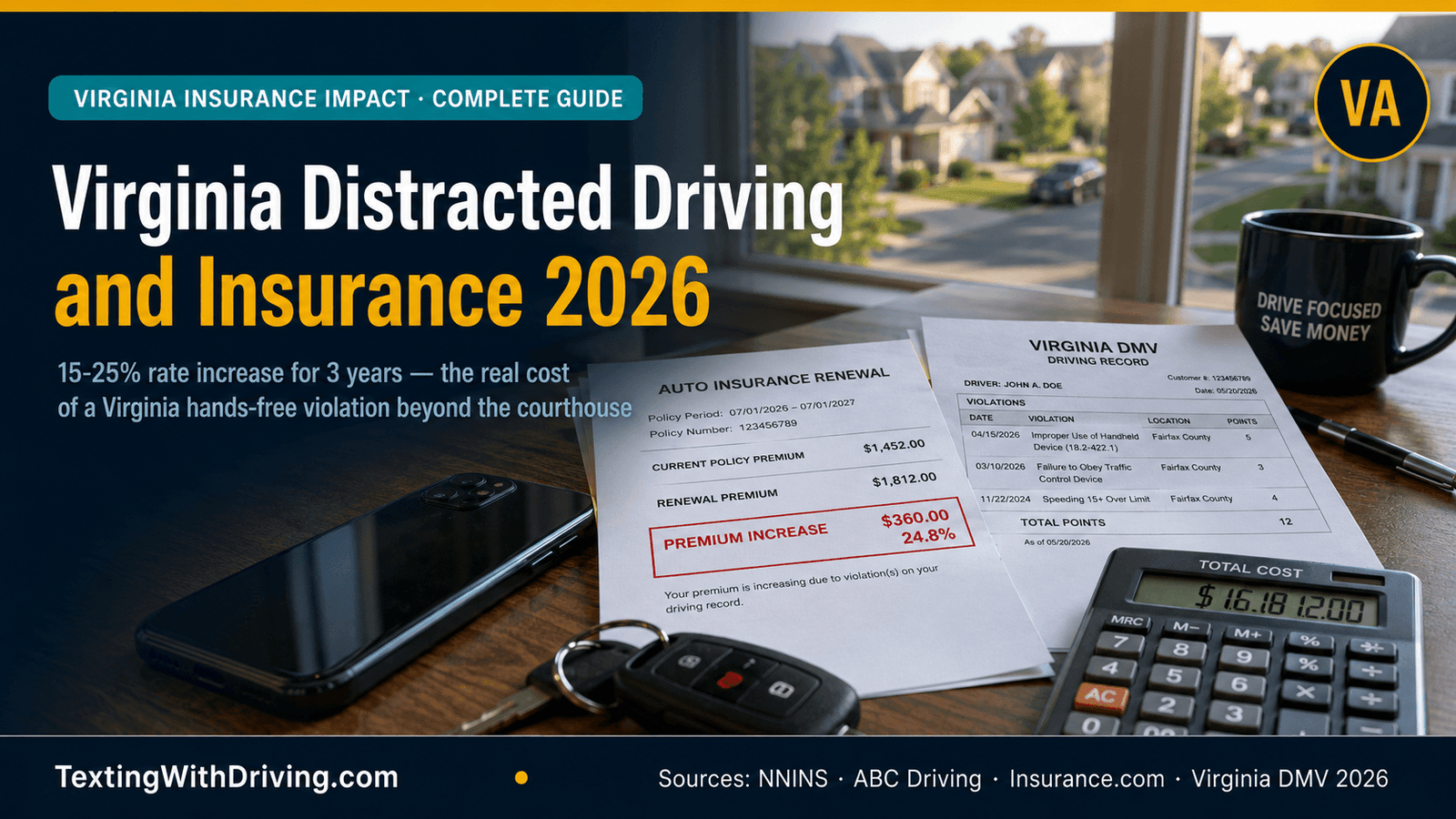
The Virginia distracted driving insurance rate increase 2026 is the financial consequence that most drivers never calculate when they receive a hands-free citation. The $125 first-offense fine is visible on the citation and paid at the courthouse. The 15 to 25 percent insurance rate increase that follows is invisible until the renewal notice arrives — and then arrives again twelve months later, and again twelve months after that.
A Virginia driver paying $1,884 for annual full coverage — the current Virginia average — who receives a single distracted driving citation faces an insurance consequence that begins at approximately $283 to $471 in additional premiums per year for the following three years. The courthouse fine is $125. The insurance consequence over three years is $849 to $1,413. The total real cost of the citation: $974 to $1,538 — eight to twelve times the amount printed on the ticket.
This guide covers the complete Virginia distracted driving insurance rate increase 2026 picture: how Virginia’s specific DMV point system interacts with insurer rate calculations, the specific percentage increases Virginia drivers face for distracted driving versus speeding versus reckless driving, how the 3-year lookback window works, what a reckless driving conviction (the criminal upgrade we documented in our Virginia reckless driving and distracted driving guide) does to insurance rates, and the specific strategies available to Virginia drivers to minimize the insurance impact of a citation they have already received.
How Virginia’s DMV Point System Interacts with Insurance
The Virginia distracted driving insurance rate increase 2026 picture requires understanding a distinction that is specific to Virginia and different from most other states: Virginia does not have a statutory insurance point system.
Virginia does utilize a demerit point system, but this is separate from insurance points. A reckless driving conviction puts six points on your DMV record. However, this does not automatically result in a set percentage increase in insurance rates for Virginia drivers. The points are assessed against the driver’s driving record and can be used to suspend a person’s license if enough points accumulate — but they do not directly translate to a legislatively mandated insurance premium calculation.
Insurance companies consider your DMV points when raising your rates, but they also look at the infractions behind the points. They are most wary of accidents, injuries, and the specific violation type rather than mechanically applying a point-to-premium formula.
This means the Virginia distracted driving insurance rate increase 2026 is not a fixed statewide number. Different Virginia insurance carriers calculate differently. Your specific insurer, your prior driving history, your vehicle, your age, and your location in Virginia all influence how much your specific premium increases from a single distracted driving citation.
What is consistent across Virginia insurers is the pattern of increase: insurance carriers in the Commonwealth currently review your motor vehicle record for the past three years when calculating rates. While the Virginia DMV assesses demerit points that remain on your license longer, the resulting insurance penalty usually expires after 36 months.
Three years. That 36-month window is when the Virginia distracted driving insurance rate increase 2026 financial consequence is active. After 36 months from the conviction date — not the citation date, the conviction date — most Virginia insurers no longer count the violation in their premium calculation, and rates return toward clean-record levels.
The Specific Rate Increase for Distracted Driving in Virginia
Cell phone and distracted driving violations increasingly trigger significant rate increases as insurers recognize the serious accident risk these behaviors create. Expect 15 to 25 percent increases for cell phone violations, similar to moderate speeding.
The 15 to 25 percent range for Virginia distracted driving violations is the Virginia-specific figure. This compares to the national average distracted driving insurance increase of approximately 28 percent, and the Virginia average moving violation increase of approximately 20 percent.
Applied to Virginia’s average full coverage rate of $1,884:
At 15 percent increase: $282.60 additional per year. Over three years: $847.80.
At 20 percent increase: $376.80 additional per year. Over three years: $1,130.40.
At 25 percent increase: $471.00 additional per year. Over three years: $1,413.00.
Adding the courthouse payment ($125 base fine plus $64 court fees = $189 total for a first offense as documented in our Virginia distracted driving fines 2026 article):
Total three-year cost of a first Virginia distracted driving citation:
At 15 percent: $189 + $847.80 = $1,036.80
At 20 percent: $189 + $1,130.40 = $1,319.40
At 25 percent: $189 + $1,413.00 = $1,602.00
The real financial cost of picking up a phone at a Virginia red light ranges from approximately $1,000 to $1,600 depending on which insurance carrier you use and how they rate distracted driving violations. The $125 that appears on the citation is 8 to 12 percent of the real cost.
The Rate Variation by Insurer: Why It Matters to Shop at Renewal
The Virginia distracted driving insurance rate increase 2026 is not uniform across all Virginia carriers because Virginia does not mandate a specific surcharge percentage. Different insurers weight distracted driving violations differently based on their own actuarial data.
Virginia drivers with a speeding ticket pay $1,984 on average for car insurance. The cheapest company for drivers with speeding tickets is Erie Insurance, which charges an average of $1,523 annually.
The $461 annual gap between the average insurer and the cheapest insurer for a driver with a moving violation illustrates the value of shopping at renewal when a citation is on the record. A Virginia driver who receives a distracted driving citation and stays with their current insurer without comparing alternatives may be paying a 30 percent surcharge when another insurer would charge only 15 percent for the same violation.
The specific Virginia insurers known for more favorable rating of moving violations versus those that rate them most harshly include Erie Insurance at the favorable end. Shopping at policy renewal — the point when a new rate based on the updated driving record takes effect — is the most direct available action to minimize the Virginia distracted driving insurance rate increase 2026 financial impact.
The renewal is the moment of impact. The citation goes on the record when convicted. The insurer sees it at the next MVR pull — which happens at policy renewal. A driver who receives a citation in January and has a June renewal will see the rate increase in June. A driver with a December renewal may not see the increase until December, giving them several months before the financial consequence begins.
The Reckless Driving Insurance Consequence: A Different Category
The Virginia distracted driving insurance rate increase 2026 for a standard hands-free infraction under § 46.2-818.2 is in the 15-25 percent range. The reckless driving criminal conviction we documented in our Virginia reckless driving and distracted driving criminal guide produces a categorically more severe insurance consequence.
In 2026, high-risk drivers in Virginia pay an average of approximately $2,388 per year for car insurance. A reckless driving conviction can increase that cost substantially, with some estimates placing average annual premiums at more than $3,361.
A reckless driving conviction — the Class 1 misdemeanor with up to 12 months jail and $2,500 fine potential — places Virginia drivers in the high-risk category that produces $2,388 to $3,361 in annual premiums. Against the Virginia baseline of $1,884, this represents a 27 to 78 percent increase. Over five years (because insurers look back 3-5 years for major violations, and criminal convictions receive longer lookback treatment):
At a $3,361 average for reckless versus $1,884 clean-record baseline: $1,477 additional per year over five years = $7,385 in additional insurance premiums from a reckless driving conviction.
Most insurance companies view a reckless driving conviction following a crash with injury as equivalent to a DUI arrest in their rating systems. This is the most severe insurance category for a driving-related conviction that falls below the DUI threshold.
For the specific scenario where a Virginia driver is simultaneously holding a phone and receives a reckless driving conviction under § 46.2-852 (general recklessness), the insurer sees both the reckless driving conviction and the hands-free infraction on the MVR — and rates both. The combined insurance consequence of reckless driving plus distracted driving on the same record exceeds the consequence of either alone.
How the 3-Year Lookback Works in Practice
The Virginia distracted driving insurance rate increase 2026 operates through a specific timeline that Virginia drivers need to understand to manage the consequence:
Citation date: The date you receive the ticket. No immediate insurance effect.
Conviction date: The date you are convicted — either by paying the fine (which counts as a guilty plea and immediate conviction), contesting and losing, or the court processing the conviction after your court appearance. The conviction is what goes on the MVR.
MVR pull date: The date your insurer pulls your motor vehicle record. This happens at policy renewal. The citation does not appear on your insurance until the insurer pulls your MVR after conviction.
Rate increase effective date: The renewal date when the updated MVR is reflected in your premium. This is when the 15-25 percent increase begins.
Three-year window: 36 months from the conviction date. After 36 months, most Virginia insurers remove the surcharge, and rates return toward clean-record levels assuming no additional violations.
For a driver convicted in August 2026, the three-year insurance window runs until approximately August 2029. Every renewal between now and August 2029 reflects the elevated premium. The August 2029 renewal (or whichever renewal first follows the 36-month anniversary) should return to clean-record pricing.
This timeline also establishes the specific risk of multiple violations within the three-year window. A second distracted driving conviction in 2027 would extend the insurance elevation because a second violation now sits on the record with its own fresh three-year window — meaning the compounded violations could keep the premium elevated through 2030.
The SR-22 Risk: When a Virginia Driver Becomes Uninsurable by Standard Carriers
The Virginia distracted driving insurance rate increase 2026 becomes dramatically more severe in a specific scenario: when violation accumulation moves a Virginia driver from the standard insurance market to the high-risk market requiring an SR-22 certificate.
A long-term impact would be higher insurance premiums, a possible SR-22, which is a Certificate of Insurance for high-risk drivers, and the convictions and points on the person’s driving record for up to 11 years.
Virginia’s SR-22 requirement can be triggered by: license suspension due to point accumulation (12 points in 12 months), DUI or DWI convictions, uninsured accident involvement, and in some circumstances by the accumulation of multiple violations that classify the driver as high-risk under the insurer’s internal standards.
A distracted driving citation alone typically does not trigger an SR-22 requirement. But a distracted driving citation that coincides with a reckless driving conviction, or that accumulates alongside other violations to push the driver above the 12-point threshold, can contribute to the SR-22 situation.
In Virginia, an SR-22 forces the driver into the non-standard insurance market where premiums can reach $3,000-$6,000 annually or higher. The difference between the standard-market rate of $1,884 and the non-standard SR-22 market minimum of $3,000 represents $1,116 more per year — and non-standard policies must typically be maintained for three years before the driver can return to the standard market.
The Defensive Driving Course: Virginia’s Point-Reduction Tool
Virginia’s safe driver point program offers a specific mechanism for partially offsetting the DMV demerit point accumulation that contributes to insurance rate decisions.
Completing a Virginia DMV-approved driver improvement clinic earns 5 safe driver positive points, which can offset negative demerit points from traffic violations. The distracted driving conviction adds 3 negative demerit points. Completing the driver improvement clinic earns 5 positive points. Net result: +2 point balance after the course completion.
The course completion does not remove the conviction from the driving record — which the insurance company can still see and rate. But it reduces the accumulated demerit point balance that affects the DMV’s licensing consequences, potentially preventing the point threshold that would trigger license suspension.
For insurance purposes, some Virginia insurers offer a discount for completing an approved driver safety course independently of the points mechanism. The specific discount varies by insurer and is not guaranteed, but it is worth asking about at renewal time, particularly from insurers like Erie Insurance that are known for favorable treatment of defensive driving efforts.
Northern Virginia’s Specific Insurance Context
The Virginia distracted driving insurance rate increase 2026 in Northern Virginia has a specific dimension related to the region’s exceptionally high concentrations of federal security clearance holders and government contractors.
As we documented in our Virginia reckless driving and distracted driving criminal guide, a Class 1 misdemeanor reckless driving conviction in Virginia has security clearance implications that extend well beyond the insurance consequence. For the Northern Virginia driver whose employer requires a clean driving record — many federal contractors and some government employers impose this requirement — even a standard distracted driving infraction (not criminal, just a moving violation) can require disclosure to the employer depending on the employer’s specific policy.
Virginia’s high-risk driver designation in national insurance data adds another layer: when Insurify nationally ranked speeding tickets in 2021, Virginia landed in second place for the highest number of speeding tickets. By 2023, Virginia was the state with the most reckless drivers in the country, with a 279 percent higher percentage than the national average. This elevated risk profile in national actuarial data means Virginia-based insurers are already calibrating for a higher-risk driving environment than most states, which affects how aggressively they rate individual violations.
What Virginia Drivers Can Do to Minimize the Insurance Impact
The Virginia distracted driving insurance rate increase 2026 is not entirely fixed once a citation is received. Several strategies can minimize the impact:
Contest the citation before paying. Paying the Virginia hands-free citation immediately is a guilty plea that produces the immediate conviction. Requesting a court date to contest the citation preserves the option to negotiate a reduced charge, present mitigating circumstances, or in some cases have the citation dismissed if the officer does not appear or if procedural issues exist. A traffic attorney in Virginia can assess whether contesting is worthwhile for the specific circumstances.
Complete a driver improvement clinic immediately. The 5 positive points earned from a Virginia DMV-approved clinic offset the 3 negative demerit points from the distracted driving conviction, producing a net positive balance that reduces the risk of point-threshold consequences and may be viewed favorably by some insurers at renewal.
Shop the market at renewal. The renewal date when the citation first appears on your insurance MVR pull is the moment to compare quotes from multiple Virginia insurers. Erie Insurance has consistently been identified as offering more favorable rates for drivers with violations. A single rate comparison at renewal may save hundreds of dollars annually compared to staying with an insurer that rates distracted driving violations more harshly.
Maintain a completely clean record for the three-year window. The single most impactful strategy for recovering from the Virginia distracted driving insurance rate increase 2026 is zero additional violations for 36 months from conviction. Each additional violation extends the insurance elevation period and compounds the premium impact. The pre-drive setup — phone in mount, GPS pre-set, Driving Focus active — is the technology that makes this clean-record period achievable without relying on willpower alone.
Understand the reckless driving distinction. A standard hands-free infraction under § 46.2-818.2 produces a 3-demerit-point moving violation with 15-25 percent insurance impact. If the violation escalates to reckless driving under § 46.2-868(C) — as can happen when phone use coincides with speeding or dangerous driving — the insurance consequence jumps to 50 percent or more with a criminal conviction on the record. The specific legal strategy for a situation where reckless driving is charged alongside the hands-free violation requires a Virginia traffic criminal defense attorney, not a self-represented court appearance.
The Two-Minute Investment That Eliminates the Entire Insurance Consequence
The complete Virginia distracted driving insurance rate increase 2026 picture — the 15-25 percent premium increase, the $1,000 to $1,600 total three-year real cost, the potential SR-22 scenario, the security clearance implications in Northern Virginia — is eliminated by the same two-minute pre-drive setup that eliminates the courthouse fine.
iPhone Driving Focus set to Automatic. Android Do Not Disturb while driving active. Phone mounted before the engine starts. GPS destination entered before moving. Bluetooth connected for calls. No phone in hand at any Virginia intersection, at any speed, on any public road.
Two minutes once. No courthouse payment. No insurance renewal increase. No DMV demerit points. No attorney consultation about whether to contest or pay. No explanation to an employer about a moving violation on a background check. No security clearance disclosure requirement.
For the complete technology setup that makes Virginia compliance automatic, our hands-free while driving complete setup guide covers iPhone, Android, Bluetooth, and CarPlay. For the fine structure at the courthouse, our Virginia distracted driving fines 2026 article covers every cost component. For the law itself, our Virginia distracted driving law covers Va. Code § 46.2-818.2 in full.
Sources Used in This Article
All links verified working before publication.
ABC Driving Improvement: How Virginia Traffic Tickets Affect Insurance Rates 2026 — 15-25% cell phone violation increase, 3-5 year rate duration, $200 ticket becomes $2,000-$5,000 total, January 2026
NNINS: Reckless Driving Virginia Top State for Speeding — High-risk Virginia drivers $2,388 average, reckless driving $3,361 estimate, 3-year review standard, 279% above national reckless average, May 2026
Auto Insurance: How a Speeding Ticket Impacts Insurance in Virginia — Virginia baseline $1,884 full coverage, $699 minimum coverage clean record, 36-month insurance penalty expiration, May 2026
InsuranceOpedia: How Speeding Ticket Affects Insurance Virginia — 3-year insurance lookback, 20% average increase, 12 points 12 months suspension, March 2026
Insurance.com: Does Distracted Driving Increase Insurance — $169/year average national increase distracted driving, 3-5 years duration, state variation, April 2026
Insurance.com: Speeding Ticket Calculator Virginia — $1,984 average after speeding ticket Virginia, Erie cheapest at $1,523 with violations, $515 average additional cost, February 2026
Insurance Navy: Do Texting and Driving Tickets Affect Car Insurance — 28% national average increase texting, California 45% highest, New York 9% lowest, Virginia comparison context, June 2026
James Short PLC: Virginia Reckless Driving Ticket Insurance Rate Increase — No statutory insurance point system Virginia, DMV points separate from insurance rating, injury claim equivalent to DUI
Thomas Wilson Law: Effect of Reckless Driving Conviction on Insurance Premiums — Reckless driving 6 demerit points Virginia, insurers consider violation type behind points
Virginia Criminal Laws: Virginia Demerit Point System Insurance — SR-22 high-risk certificate, 11-year conviction record duration, higher premiums long-term impact
NHTSA: Distracted Driving — 3,208 deaths 2024, national context
TextingWithDriving.com is professionally built and maintained to ensure accurate, accessible safety information reaches every driver who needs it. Website development and ongoing support is handled by Budgetic, a digital agency specializing in purpose-driven WordPress websites.

About Texting With Driving
TextingWithDriving.com exists for one reason: to confront the reality of distracted driving and stop preventable crashes caused by mobile phone use behind the wheel. Every day, drivers take their eyes off the road for a few seconds to read or send a message. Those few seconds are enough to cause life-altering consequences. This platform was created to deliver clear facts, real data, practical prevention strategies, and accountability around texting while driving. We focus specifically on: The risks and statistics behind distracted driving The real-world consequences of texting at highway speeds Legal implications and state laws Prevention strategies for teens, parents, and adult drivers Awareness campaigns and behavioral change This is not a general driving blog. It is a focused awareness initiative built around one critical issue: phone distraction behind the wheel. Our content is direct, research-driven, and practical. We prioritize accuracy over opinion and education over sensationalism. The goal is simple — reduce distracted driving incidents by increasing awareness and responsibility. If one article causes one driver to put their phone down, the mission is working. For inquiries or partnerships, contact: privacy@textingwithdriving.com
View all posts by Texting With Driving