

Distracted Driving and Motorcycles 2026: Why Riders Face the Highest Failure-to-Detect Risk

Distracted Driving and Motorcycles 2026: Why Riders Face the Highest Failure-to-Detect Risk
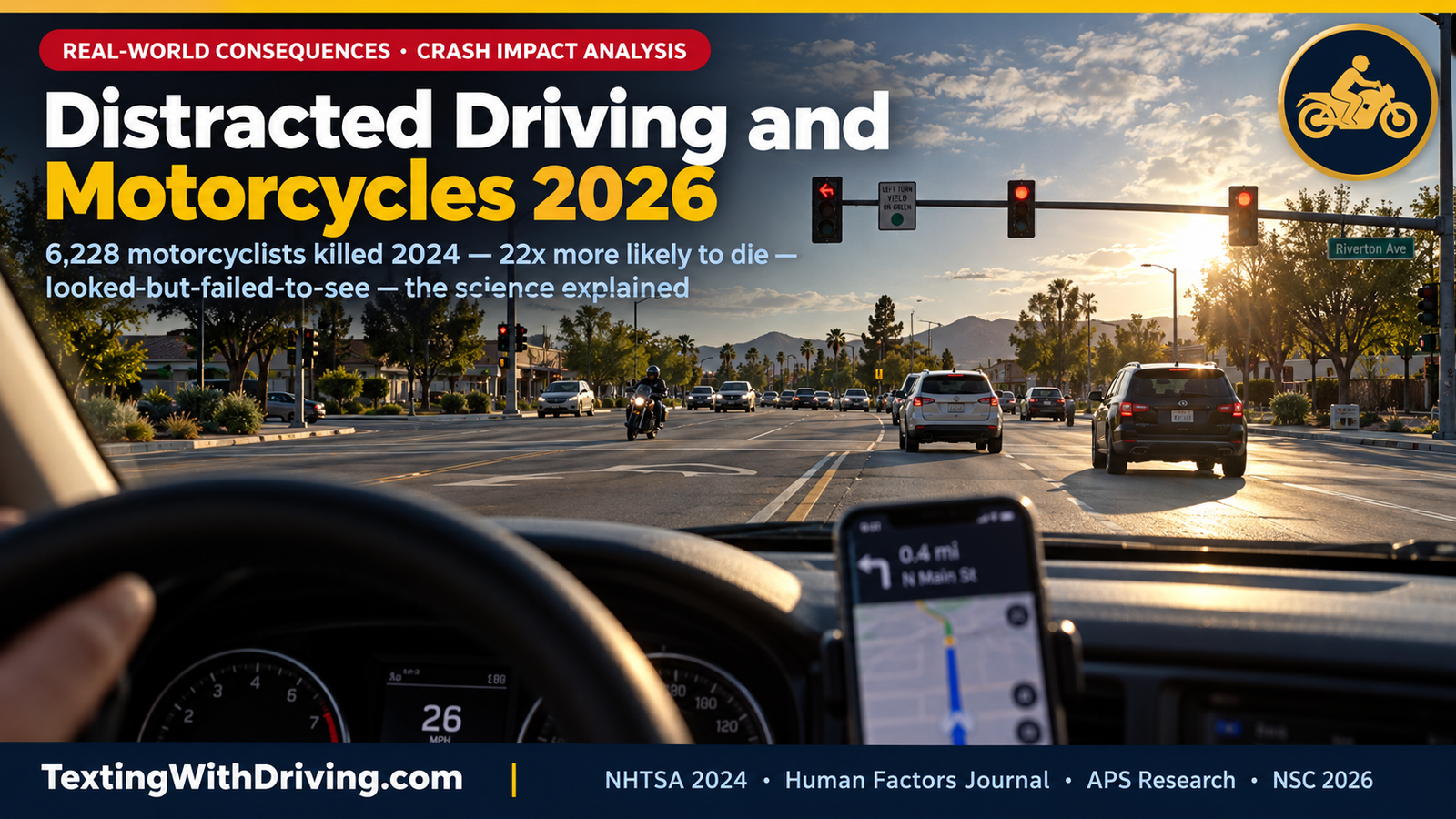
Distracted driving and motorcycles 2026 creates the most consequential human factor mismatch in traffic safety: the vehicle category most vulnerable to not being seen by other drivers is specifically the vehicle category most threatened by the attentional limitation that distracted driving produces.
6,228 motorcyclists were killed in traffic crashes in 2024 — representing 16 percent of all traffic fatalities that year, according to NHTSA’s latest data. Motorcycles account for approximately 3 percent of all registered vehicles. That disproportion — 3 percent of vehicles producing 16 percent of fatalities — defines the motorcycle safety crisis that distracted driving directly amplifies.
Motorcyclists are 22 times more likely to die in a crash than those driving cars. That is not a slight statistical elevation — it is an order-of-magnitude vulnerability that no helmet, no safety gear, and no rider skill can fully compensate for when the primary crash cause is a distracted vehicle driver who did not detect the motorcycle before impact.
The predominating cause of motorcycle accidents is the failure of motorists to detect and recognize motorcycles in traffic. Not speed. Not alcohol. Not rider error in isolation. The detection failure of the other vehicle’s driver — a failure that has a specific name, a specific psychological mechanism, and a specific amplification from distracted driving — is the central cause of motorcycle-vehicle crashes.
This guide covers the complete distracted driving and motorcycles 2026 picture: the NHTSA death data, the looked-but-failed-to-see phenomenon, how inattentional blindness specifically makes motorcycles invisible to distracted drivers, the three crash scenarios where detection failure most often produces fatalities, and what every driver must specifically do to protect motorcycle riders.
The NHTSA Data: Motorcycles’ Disproportionate Death Toll
Distracted driving and motorcycles 2026 begins with the data that establishes the specific scale of the motorcycle vulnerability.
2024: 6,228 motorcyclists killed — representing 16 percent of all traffic fatalities.
2023: 6,335 motorcyclists died in traffic accidents.
The annual motorcycle death toll has been near or above 6,000 for multiple consecutive years — a persistent crisis that has not responded to the same degree of improvement that overall traffic fatality numbers have shown.
The disproportion: 3 percent of registered vehicles. 16 percent of fatalities. If motorcycles were killed at a rate proportional to their vehicle share, approximately 1,100 motorcyclists would die annually — not 6,228. The excess deaths — approximately 5,100 per year — represent the specific vulnerability that motorcycle riders carry relative to car occupants.
The 22-times multiplier: Motorcyclists are 22 times more likely to die in a crash than those driving cars. This per-mile death risk differential reflects the absence of the protective crash structure — seat belts, airbags, crumple zones — that surrounds car occupants, combined with the detection failure problem that makes motorcycle-vehicle crashes disproportionately severe in the first place. A motorcyclist who is struck by a vehicle whose driver failed to detect them has no protective buffer between the impact and their body.
Multi-vehicle crashes: The majority — 55 percent — of fatal motorcycle crashes involve collisions with other motor vehicles. This is the crash category where detection failure by the other vehicle’s driver is the primary mechanism. The solo motorcycle crash — the rider’s own error — accounts for the remaining 45 percent. The 55 percent multi-vehicle category is specifically the target of distracted driving prevention, because it is caused by the other driver.
Looked-But-Failed-to-See: The Most Common Motorcycle Crash Cause
Distracted driving and motorcycles 2026 centers on a specific crash causation category that traffic safety researchers have documented extensively: the looked-but-failed-to-see crash.
Looked-but-failed-to-see (LBFTS) crashes are those where a driver checked for oncoming traffic or looked before changing lanes, but then reported not seeing the motorcycle they crashed into. These are not crashes caused by a driver who was clearly not looking. They are crashes caused by a driver who looked in exactly the right direction, at exactly the right time, and still did not process the motorcycle that was present in their visual field.
LBFTS crashes are particularly troublesome because they can happen in spite of clear driving conditions and a lack of other distractions and hazards. A driver at a clear intersection on a bright afternoon who looks left, looks right, and pulls out into the path of an oncoming motorcycle — with zero alcohol involvement, zero speed violation, and zero mechanical failure — is in a looked-but-failed-to-see crash. The motorcycle was visible. The driver looked. The driver did not see.
Research by human factors and ergonomics researchers Kristen Pammer, Stephanie Sabadas, and Stephanie Lentern of the Australian National University — published in the journal Human Factors — provides the most rigorous available explanation of why this happens. Their study set up a driving simulation where participants viewed an image from a driver’s perspective and answered questions about what they saw.
The result: 65 percent didn’t see the motorcycle, while only 31 percent missed a taxi shown in the same image. The motorcycle was visible. It was present. The taxi was seen twice as often. The difference between a motorcycle and a taxi that produces a 65-versus-31 percent detection failure rate is not size alone — it is the specific psychological mechanism that makes motorcycles systematically harder to detect than larger, more common vehicles.
Inattentional Blindness: The Brain Science Behind LBFTS
Distracted driving and motorcycles 2026 requires understanding inattentional blindness — the psychological phenomenon that research now links directly to looked-but-failed-to-see motorcycle crashes.
Inattentional blindness is a failure to see an object in real life or on a display, not because of visual disability or too-brief exposure to the image, but because the person in question simply does not devote attention to that object. The term “inattentional” is specific: the failure is not in the eyes’ physical ability to detect the object. It is in the brain’s allocation of attentional resources to process what the eyes are seeing.
The brain does not process everything in its visual field equally. It allocates attentional resources based on expectations — what the brain predicts it will encounter. A driver approaching an intersection has a set of visual expectations developed over years of driving: cars, trucks, cyclists, pedestrians in specific locations and sizes. The brain’s attentional resources are allocated toward detecting the objects it expects.
A motorcycle — smaller than a car, with a different visual profile, occupying a fraction of the visual field that a car would occupy at the same distance — is unexpected compared to the larger vehicles that dominate the driver’s attentional expectations. The brain, seeing the motorcycle at the edge of its expected object profile, fails to allocate the attentional resources required to register it as a stop-or-yield signal. The driver looks. The brain processes the car-shaped objects and the expected intersection layout. The motorcycle is seen by the eyes but not processed by the attentional system.
The “Saw but Forgot” error, documented by Chapman (2019) in the Nottingham research, adds a second failure mode: the driver saw the motorcycle and registered it, but failed to retain the information in working memory long enough to respond. The driver pulls out into the motorcycle’s path not because they never processed it but because the working memory representation of the motorcycle was overwritten or decayed before the motor response — slowing, stopping, yielding — was executed.
In vehicle-motorcycle crashes, vehicle drivers fail at the detection level 26.6 percent of the time in visibility-constraint conditions — a rate significantly higher than the detection failure rate in two-vehicle crashes between cars. Motorcycles are specifically harder to detect than cars at the cognitive level, not just the visual level.
How Distracted Driving Amplifies the Detection Failure
Distracted driving and motorcycles 2026 is not just the parallel existence of two risk factors. It is the specific interaction between distracted driving’s attentional limitation and motorcycles’ already-elevated detection failure risk that makes the combination so catastrophically dangerous.
A fully attentive driver approaching a left-turn intersection has the full attentional capacity of their visual processing system available for motorcycle detection. That full attentional capacity still misses the motorcycle 65 percent of the time in controlled research conditions — the baseline LBFTS rate from the Pammer et al. study. The attentive driver who misses the motorcycle at 65 percent rate in a research simulation is the same attentive driver who, in real-world conditions with higher visual complexity, makes the intersection left turn that produces the most common fatal motorcycle crash type.
A distracted driver — holding their phone, managing a navigation query, checking a text message — has reduced their available attentional capacity by the 37 percent brain activity reduction that Carnegie Mellon research documented. The attentional system that was already allocating motorcycle detection poorly is now operating at 63 percent of its baseline capacity. The detection failure rate that was 65 percent for attentive drivers becomes a higher failure rate for the distracted driver — not just by the 37 percent brain activity reduction, but by the specific way that phone distraction depletes exactly the attentional resources that motorcycle detection most requires.
Inattentional blindness, when fueled by distracted driving, makes motorcycle riders — and pedestrians — effectively invisible even when within the driver’s field of vision. That Naval Safety Command July 2025 assessment captures the specific compound effect: inattentional blindness is the baseline mechanism. Distracted driving fuels it to the point where the motorcycle becomes effectively invisible rather than merely harder to detect.
The three LBFTS crash scenarios where this compound effect is most lethal:
Left-turn intersection crash. A driver making a left turn at an intersection fails to detect the motorcycle approaching in the oncoming lane. The motorcycle is traveling straight; the car is turning across its path. This is the single most common fatal motorcycle crash scenario. The distracted driver who looks left before turning — the mandatory safety check — but whose attentional system is depleted by a phone interaction misses the approaching motorcycle that the check was designed to detect.
Lane-change crash. A driver changing lanes fails to detect the motorcycle in the adjacent lane or the blind spot. The mirror check that lane-change safety requires finds the larger vehicles clearly but misses the motorcycle at the visual periphery of the lane change assessment. A distracted driver’s lane-change mirror check is compressed by the ongoing phone interaction — the check happens faster, with less attentional depth, at the moment when motorcycle detection requires maximum attentional allocation.
Intersection pull-out. A driver at a stop sign or driveway looks for a gap in traffic, fails to detect the motorcycle filling that gap, and pulls out. The motorcycle arrives at the intersection in the gap that the driver assessed as clear. The driver’s failure to allocate attention to the motorcycle-sized gap that exists between larger vehicles — which was sufficient to trigger a stop decision even when empty — produces the pull-out crash.
The Motorcycle Rider’s Specific Vulnerability
Distracted driving and motorcycles 2026 is experienced differently from the rider’s perspective than from the data analyst’s perspective. Every motorcycle rider who has survived to accumulate riding experience has experienced the near-miss that demonstrates the detection failure problem directly: the car whose driver looked directly at them and then pulled out anyway. The LBFTS crash that was avoided only because the rider anticipated the car’s movement before the car moved.
Nothing will make you more aware of how distracted drivers are these days than when you’re riding your motorcycle. That observation — widely shared in the rider community — reflects the specific vigilance that motorcyclists develop in response to the detection failure threat. Motorcycle riders cannot control whether a distracted car driver will detect them. They can only control their own position, speed, and anticipation of detection failure before it produces a collision.
The physical consequences of the detection failure crash are asymmetric. A car that pulls out in front of a motorcycle at 30 mph — the intersection pull-out scenario — produces a crash in which the car’s occupants are inside a crash-protective structure with airbags and crumple zones. The motorcycle rider is projected from a vehicle weighing approximately 500 pounds into a collision with a vehicle weighing 3,500 to 5,000 pounds. Helmets are 37 percent effective at preventing fatal injuries to riders — providing meaningful but not complete protection against the physical forces that the crash produces.
What Every Driver Must Do to Protect Motorcycle Riders
Distracted driving and motorcycles 2026 requires specific behavioral changes from every vehicle driver — not just the awareness that motorcycles exist, but the specific attentional practices that counteract the inattentional blindness mechanism.
Phone away before the drive eliminates the attentional depletion that amplifies detection failure. The 37 percent brain activity reduction from phone use specifically reduces the attentional capacity available for motorcycle detection — the most cognitively demanding visual detection task in routine driving. Driving Focus before every drive restores the full attentional capacity that motorcycle detection requires.
Actively expect motorcycles at every intersection approach. The inattentional blindness mechanism is reduced by conscious expectation. A driver who approaches a left-turn intersection saying to themselves “there may be a motorcycle in the oncoming lane” has primed their attentional system to process motorcycle-sized objects in that visual field. Active expectation does not eliminate inattentional blindness — but it measurably reduces the motorcycle detection failure rate compared to passive scanning.
Scan a second time before executing the left turn. The LBFTS crash at a left-turn intersection is specifically produced by a single scan that misses the motorcycle. A second scan — completing the look-left-look-right-look-left-again sequence with a deliberate second check of the oncoming lane before the turn begins — provides the additional attentional pass that catches what the first scan missed.
Check blind spots actively before every lane change. The lane-change LBFTS crash is reduced by a physical head turn that supplements the mirror check — looking over the shoulder to the adjacent lane, not just relying on the mirror that may miss the motorcycle at the visual periphery of the lane change detection range.
Slow down at intersections. Speed is the multiplier that converts a detection failure into a fatality. A motorcycle struck at 25 mph produces survivable crash forces. The same crash at 40 mph produces forces that exceed the protective capacity of any riding gear. Reducing intersection approach speed gives both the detection system more time to register the motorcycle and the vehicle more braking distance to respond when detection occurs late.
For the complete distracted driving brain science that explains why phone use depletes motorcycle detection capacity specifically, our distracted driving brain science 2026 article covers the attentional mechanism. For the national distracted driving statistics that contextualize the motorcycle death toll, our distracted driving statistics 2026 covers the full picture. For the hands-free setup that removes the attentional depletion from every drive, our hands-free while driving complete setup guide covers iPhone, Android, Bluetooth, and CarPlay. And for the Virginia and DMV-specific enforcement context that applies on every road where motorcycles and distracted drivers share the same lane, our Virginia distracted driving law covers Va. Code § 46.2-818.2.
Sources Used in This Article
All links verified working before publication.
NHTSA Traffic Safety Marketing: Motorcycle Safety News Release 2026 — 6,228 motorcyclists killed 2024, 16% all traffic fatalities, speed and alcohol leading contributors, avoid distractions while driving, 2026
Rhode Island Legislature: H8566 Motorcycle Awareness Month May 2026 — Motorcycles 3% registered vehicles 15%+ fatalities, motorcyclists 22 times more likely to die than car occupants, 6,335 motorcyclists died 2023, distracted driving poses one of biggest dangers to motorcycles, enacted May 19 2026
Association for Psychological Science: Motorcycles Are Missed Because Drivers Aren’t Looking for Them — Pammer Sabadas Lentern Australian National University, Human Factors journal, LBFTS most concerning type crash, 65% didn’t see motorcycle 31% missed taxi, inattentional blindness failure to devote attention not visual disability
ENNews: Inattentional Blindness Why Drivers Fail to See Motorcycles — Human Factors “Allocating Attention to Detect Motorcycles: The Role of Inattentional Blindness,” LBFTS despite clear conditions lack hazards, driver looks directly at motorcycle and still pulls into path
DanielRRosen.com / Rosen Law: Inattentional Blindness Motorcycle Accidents — Failure of motorists to detect recognize motorcycles in traffic predominating cause quote HG.org aggregate studies, 65% didn’t see motorcycle 31% missed taxi confirmed, inattentional blindness linked disproportionate motorcycle accidents
Reyes Law: Why Drivers Can’t See Motorcycle Riders — Three crash scenarios: left-turn, lane-change, intersection pull-out; looked but failed to see breach of duty of care, clear line of sight still fails to register rider, inattentional blindness brain filters unexpected objects
Naval Safety Command: Rider Down Report July 2025 — Inattentional blindness fueled by distracted driving makes motorcycle riders effectively invisible even within driver field of vision, July 2025
Overland Expo: Motorcycle Accidents Rise Many Avoidable — 55% fatal motorcycle crashes involve other motor vehicles 2019, distracted drivers nothing makes you more aware, failure to detect and recognize predominating cause HG.org, helmets 37% effective riders 41% passengers
NHTSA: Distracted Driving — 3,208 total distracted driving deaths 2024, 315,167 injuries, national context
TextingWithDriving.com is professionally built and maintained to ensure accurate, accessible safety information reaches every driver who needs it. Website development and ongoing support is handled by Budgetic, a digital agency specializing in purpose-driven WordPress websites.
