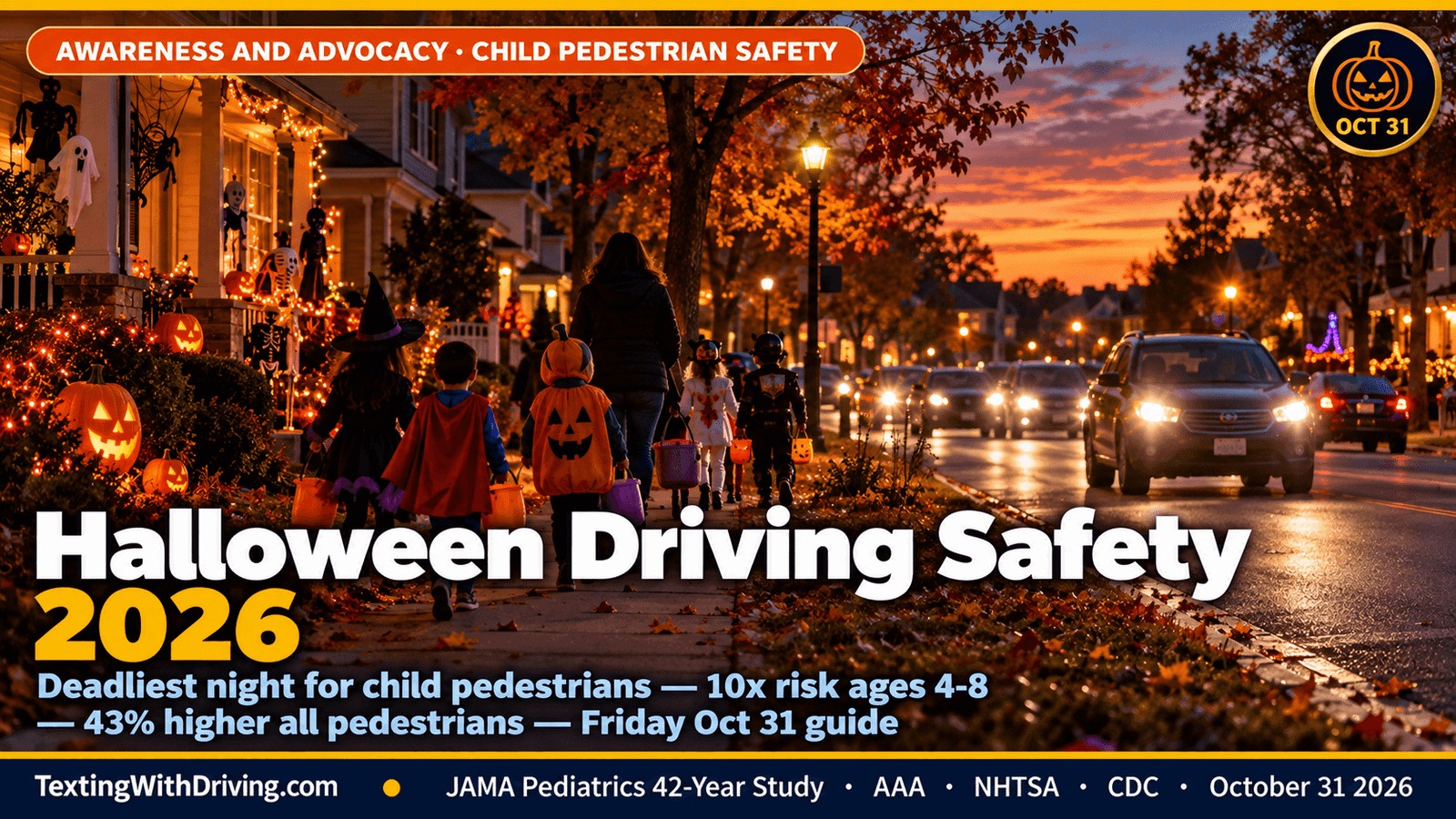
Halloween driving safety comes down to one fact: October 31 is one of the most dangerous evenings of the year for people on foot, and young children are at the greatest risk. A 2019 study in JAMA Pediatrics found that pedestrian deaths were 43% higher on Halloween evening than on comparable evenings, and that children aged 4 to 8 faced about 10 times their usual risk.
Most of those deaths happen in the first few hours after dark, exactly when drivers are heading home, checking messages, and looking at navigation apps. This guide explains what the research shows, why distraction matters so much that night, and the specific habits that keep trick-or-treaters safe.
Key Halloween driving safety facts
- Pedestrian deaths were 43% higher on Halloween evening than on evenings one week before and after (JAMA Pediatrics, 42 years of NHTSA data, 1975 to 2016).
- Children aged 4 to 8 had about 10 times the usual risk of being killed as pedestrians on Halloween (same study).
- Risk peaked around 6 PM (same study).
- The average Halloween produced about 4 more pedestrian deaths than a normal evening (same study).
- An earlier CDC analysis found a fourfold increase in pedestrian deaths among children aged 5 to 14 on Halloween evenings (CDC MMWR, 1997, covering 1975 to 1996).
- In 2024, 639 pedestrians, cyclists and other people outside vehicles were killed in crashes involving a distracted driver (NHTSA).
What the research says about Halloween pedestrian deaths
The most detailed study on the subject comes from researchers John Staples, Candace Yip and Donald Redelmeier, published in JAMA Pediatrics in 2019. They used the federal Fatality Analysis Reporting System to compare pedestrian deaths between 5 PM and midnight on every October 31 from 1975 to 2016 with the same hours one week earlier and one week later.
Over those 42 years, 608 pedestrians died on Halloween evenings, compared with 851 on the 84 comparison evenings. That works out to a 43% higher risk on Halloween, or about four extra deaths each year.
Two other findings stand out:
- The youngest trick-or-treaters face the most danger. Children aged 4 to 8 had roughly 10 times their normal risk.
- The pattern has not gone away. Overall pedestrian deaths fell over the decades as roads and vehicles improved, but the relative jump on Halloween stayed about the same throughout the study period.
The CDC reached a similar conclusion much earlier. Its 1997 report counted 89 pedestrian deaths among children aged 5 to 14 between 4 PM and 10 PM on Halloween from 1975 to 1996, a rate about four times higher than on other evenings.
Why distraction is so dangerous on Halloween night
Halloween changes what is on the road. Children cross in the middle of the block, step out between parked cars, and wear dark costumes or masks that limit their own vision. Many are too young to judge how fast a car is moving.
Those are exactly the conditions where a few seconds of looking at a phone matter most. NHTSA notes that reading or sending a text takes your eyes off the road for about 5 seconds, which at 55 mph is like driving the length of a football field blind. On a neighborhood street at 25 mph, five seconds still covers more than 180 feet, often the length of several houses.
Distraction already takes a real toll on people outside vehicles. NHTSA counted 639 pedestrians, cyclists and other nonoccupants killed in distraction-affected crashes in 2024, about one in five of all distraction deaths that year. On an evening when far more children are walking than usual, the same habits carry more risk.
Timing makes it worse. The JAMA Pediatrics study found risk was highest around 6 PM. In much of the country that is close to sunset at the end of October, when light is fading and many drivers are still on their way home from work.
Halloween driving safety checklist for drivers
These steps take little effort and address the specific risks the research identifies.
- Put your phone on Do Not Disturb before you start the car. Our Do Not Disturb While Driving setup guide shows how to turn it on automatically for iPhone and Android.
- Set your route before you leave. Adjusting navigation while moving is one of the most common reasons drivers look down.
- Drive well below the limit in neighborhoods between 5 PM and 9 PM. Lower speed gives you more time to stop and reduces the force of any impact.
- Expect children to appear from anywhere. Watch driveways, gaps between parked cars, and the middle of blocks, not only crosswalks.
- Turn your headlights on early, even before full dark, so children and parents can see you coming.
- Back out of driveways slowly, and check for small children who may be hard to see in mirrors or cameras.
- Avoid neighborhood streets if you can. If you are not trick-or-treating, a main road or a later departure lowers your exposure.
- Never drive impaired. Halloween parties overlap with trick-or-treat hours, and alcohol and distraction are a dangerous combination.
Advice for parents of teen drivers
Halloween can be a risky night for new drivers too. Teens are more likely to have friends in the car, to be heading to parties, and to be tempted by group chats. NHTSA’s 2024 data shows that drivers aged 15 to 20 were among the age groups with the highest share of distracted drivers in fatal crashes.
If your teen will be driving on Halloween, agree on a few ground rules in advance: phone in the glove box or on Do Not Disturb, no more passengers than your state’s license rules allow, and a planned route that avoids the busiest trick-or-treat streets. Our guide to teen drivers and distracted driving risk has more ideas for that conversation.
Tips to share with families walking on Halloween
Drivers carry the main responsibility, but families can make children easier to see:
- Add reflective tape or a small light to costumes and treat bags.
- Choose face paint over masks that block side vision.
- Carry a flashlight, or have children carry glow sticks.
- Cross at corners and crosswalks, and make eye contact with drivers before stepping out.
- Walk with young children, and agree on a route and a return time for older ones.
- Put your own phone away while crossing streets with children.
Halloween falls on a Sunday in 2027
Halloween moves through the week each year. In 2026 it fell on a Saturday, and in 2027 it falls on a Sunday. The research does not show that any single day of the week is safe, so the same habits apply every year: slow down, put the phone away, and expect children near the road from late afternoon until well after dark.
Many families also trick-or-treat on a different evening when October 31 falls on a school night or a Sunday, so check your town’s announcements and be extra alert on that evening as well.
Frequently asked questions
Is Halloween the most dangerous night for pedestrians?
It is one of the most dangerous. The 2019 JAMA Pediatrics study found pedestrian deaths were 43% higher on Halloween evening than on comparable evenings, and the risk for children aged 4 to 8 was about 10 times higher.
What time is most dangerous for driving on Halloween?
The study found risk was highest around 6 PM. The CDC focused on 4 PM to 10 PM, when most trick-or-treating happens.
How fast should I drive in neighborhoods on Halloween?
Follow posted limits as a maximum and drive slower where children are out. At 25 mph, a car travels more than 36 feet every second, so lower speeds give you far more room to stop.
Is it illegal to use a phone while driving on Halloween?
Texting while driving is banned for all drivers in 49 states and Washington, DC, and 33 states and DC ban handheld phone use entirely, according to the Governors Highway Safety Association. See our hands-free driving laws by state for the rules where you live.
Related reading
Sources
Last reviewed: November 4, 2026
TextingWithDriving.com is professionally built and maintained to ensure accurate, accessible safety information reaches every driver who needs it. Website development and ongoing support is handled by Budgetic, a digital agency specializing in purpose-driven WordPress websites.