

Maryland Distracted Driving and Insurance 2026: Jake’s Law, Rates and the Real Cost

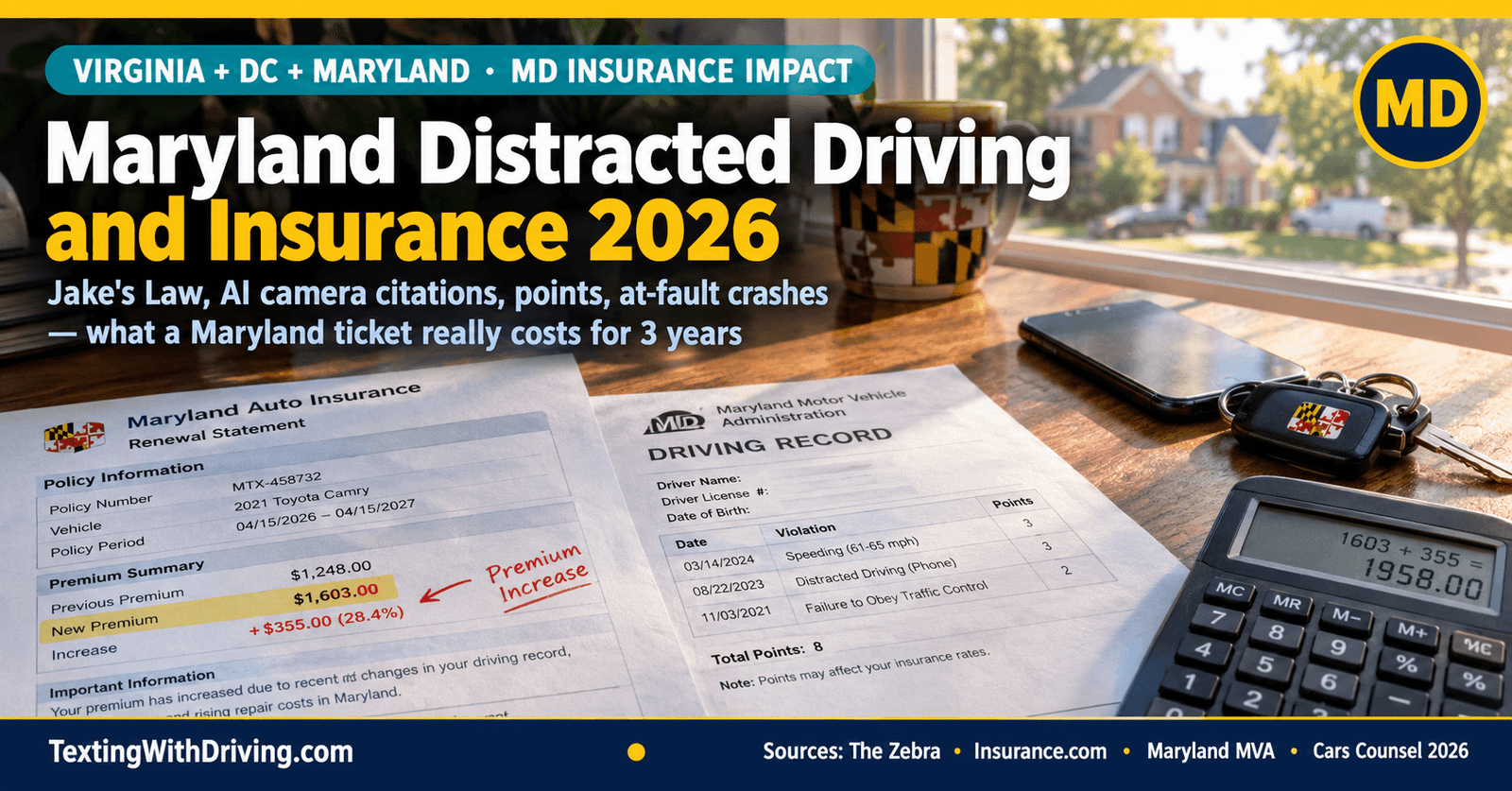
Maryland Distracted Driving and Insurance 2026: Jake’s Law, Rates and the Real Cost
Maryland distracted driving insurance 2026 has one of the most nuanced and misunderstood structures of any state in this series — and the nuance works both for and against Maryland drivers depending on which specific violation they receive.
The seemingly straightforward question — how much does a Maryland distracted driving ticket cost in insurance terms — has a surprisingly complex answer. A first-offense handheld phone violation that costs $83 at the courthouse may cost nothing in insurance because Maryland’s first-offense handheld violation carries zero demerit points. A texting violation that costs $70 at the courthouse carries 1 point and produces a modest insurance impact. An AI camera distracted driving citation — when those citations begin under Maryland’s SB613 pilot — is a civil penalty like a parking ticket that produces no insurance impact at all. But a distracted driving crash that triggers Jake’s Law produces civil lawsuit exposure, at-fault accident insurance designation, and premium consequences that dwarf every other scenario.
This guide covers the complete Maryland distracted driving insurance 2026 picture: how Maryland’s specific points system interacts with insurance rate calculations, what the first-offense handheld zero-point structure means for drivers who have received their first citation, what Jake’s Law means for the at-fault driver’s insurance position, how the AI camera pilot citations work from an insurance perspective, the actual dollar figures for Maryland rate increases, and what Maryland drivers should do to minimize the insurance consequences of a distracted driving citation they have already received.
Maryland’s Points System: The Insurance Foundation
Understanding Maryland distracted driving insurance 2026 begins with Maryland’s specific demerit points structure — which is different from Virginia’s and creates distinctly different insurance outcomes.
Maryland uses a points-based system where moving violations add points to the driving record. The critical thresholds:
3 points in 24 months: The Maryland MVA sends a warning letter.
5 points in 24 months: The driver must complete a Driver Improvement Program.
8 points in 24 months: The driver’s license is suspended.
12 points in 24 months: The driver’s license is revoked.
For Maryland distracted driving insurance 2026, the points assigned per violation type determine the insurance impact:
First handheld device offense (no crash): 0 points. Maryland’s Transportation Code § 21-1124.2 first offense carries a $83 fine and zero demerit points. Insurance companies base their ratings on points in Maryland — so the first handheld offense, while expensive at the courthouse, may not trigger any insurance rate increase because no points are assessed. Insurers who pull the Maryland MVR after a first handheld offense may see the conviction on the record without any associated point assessment, and many carriers treat zero-point convictions differently than point-carrying violations.
Second handheld offense: 1 point. The $140 second-offense fine carries 1 demerit point. This point can trigger modest insurance rate recalculation.
Texting violation (first offense, no crash): 1 point plus $70 fine. Unlike the first handheld offense, a first texting violation under § 21-1124.1 carries 1 point immediately. Insurance companies may see this 1-point texting conviction and rate it as a minor moving violation.
Texting violation contributing to a crash: 3 points plus $110 fine. The crash involvement dramatically changes the points picture — 3 points is the threshold that produces meaningful insurance consequences.
The zero-points structure for first-offense handheld violations is Maryland’s most distinctive insurance characteristic. In Maryland, if you get ticketed for talking or using your handheld phone, it will not impact your insurance rate because it does not carry points. A 1-point ticket for texting and driving could impact your rates, but not very much considering a speeding ticket carries 2 points in Maryland.
This structure creates an interesting compliance dynamic. A Maryland driver who holds their phone for a call — the first handheld offense — faces a $83 courthouse payment and no insurance consequence if it is their first offense. A Maryland driver who texts — even a first offense — faces $70 at the courthouse plus a 1-point record that carries modest insurance implications. The specific behavior (calling vs texting) produces different financial total consequences from the same violation category.
What Maryland Rate Increases Actually Look Like
Maryland distracted driving insurance 2026 produces average rate increases that are lower than the national average in absolute dollar terms — but the Maryland baseline premium context matters.
If you are ticketed for distracted driving, one side effect will be increased car insurance rates. In Maryland, car insurance prices typically increase by $116 annually after a distracted driving conviction. That amounts to a 9 percent increase from the average yearly premium in Maryland, and 33 percent less than the national average cost of car insurance with a distracted driving citation.
The Maryland-specific figures:
Average Maryland distracted driving rate increase: $115 to $116 per year.
Duration: 3 years for Maryland insurers’ standard lookback period.
Total three-year insurance impact: approximately $345 to $348.
Maryland average full coverage baseline: approximately $1,240 to $1,341 per year depending on source.
The $116 annual increase for 3 years ($348 total) is the insurance dimension of a Maryland distracted driving citation that carries demerit points. Combined with the $83 courthouse fine for a second offense or the $70 courthouse fine plus 1 point for a first texting violation, the total real cost over three years runs approximately $418 to $428 — significantly lower than Virginia’s $1,911 average three-year real cost for a comparable violation.
The lower Maryland impact primarily reflects the zero-points first-offense handheld structure. The Virginia first-offense citation carries 3 points and 15-25 percent rate increase regardless of offense history. Maryland’s first-offense handheld violation produces zero points and potentially zero insurance impact, with the insurance consequence appearing only on second offense or for texting violations.
There are significant insurer-to-insurer differences in how Maryland distracted driving convictions are rated. The least expensive car insurance company after being ticketed for distracted driving in Maryland is GEICO, with a typical rate of only $754 per year — 44 percent less than the average distracted driving insurance premium among top insurers.
The $754 GEICO rate versus the state average of approximately $1,341 after a distracted driving ticket represents a $587 annual difference. Shopping the market at renewal — exactly when the citation first appears in the insurer’s MVR pull — can produce savings that represent nearly the entire insurance impact of the citation. A driver who switches to GEICO at renewal after a Maryland distracted driving conviction may experience a net cost lower than staying with their existing insurer at the surcharged rate.
The AI Camera Citation: A Special Insurance Status
Maryland distracted driving insurance 2026 has a specific new dimension from the SB613 AI camera pilot in Montgomery and Prince George’s Counties — and this dimension works entirely in the driver’s favor from an insurance perspective.
As we documented in our Maryland work zone distracted driving 2026 article, the SB613 AI camera pilot citations are civil penalties — not moving violations. The citations would not add points to the driving record and would be treated like parking violations.
The parking violation treatment has direct insurance implications: Maryland insurance companies rate moving violations that carry demerit points. A civil penalty citation that carries no demerit points — treated like a parking ticket — does not appear in the MVR assessment that insurance companies use to calculate premiums. An AI camera distracted driving citation in Montgomery County’s pilot program, if treated as a civil penalty without points, would not affect the driver’s insurance rates regardless of how many were issued.
This is a notable distinction from the officer-issued distracted driving citation. An officer-issued second handheld violation carries 1 point and triggers insurance recalculation. An AI camera citation for the same behavior carries zero points and triggers no insurance recalculation.
The AI camera citation’s civil penalty structure is specifically designed to address privacy concerns — it is addressed to the vehicle owner rather than requiring driver identification from facial recognition. The trade-off is that it functions like a parking ticket: it generates revenue for enforcement, but it does not carry the DMV consequences of a moving violation. For Maryland drivers in Montgomery and Prince George’s Counties, this means the AI camera pilot’s financial consequence is limited to the $40 citation fine — with no insurance multiplier effect.
Jake’s Law: Where Insurance Consequences Get Catastrophic
Maryland distracted driving insurance 2026 reaches its most severe financial dimension when a distracted driving crash triggers Jake’s Law — and the at-fault driver’s insurance position changes from a modest citation surcharge to catastrophic liability exposure.
As we documented in our Maryland distracted driving law 2026 article, Jake’s Law creates criminal penalties of up to $5,000 fine and three years in prison for distracted drivers who cause serious injury or death. But the civil liability dimension — which operates simultaneously with the criminal consequences — is where the insurance impact becomes transformative.
In the civil lawsuit context, negligence per se is sometimes argued to show that because a criminal law was broken, such as texting and driving, it shows that the driver was negligent and liable for the accident. A Jake’s Law criminal conviction — establishing that the driver violated Maryland’s distracted driving law and caused serious injury — creates powerful civil negligence evidence that the injured party’s attorney will present to the jury.
Maryland’s contributory negligence doctrine creates the most dramatic civil liability consequence of any state in this series: Maryland follows the doctrine of contributory negligence, which means that if you were also found to have any degree of negligence, you will not recover any damages in a car accident lawsuit.
For the at-fault distracted driver in Maryland, contributory negligence is a double-edged consideration. On one hand, a plaintiff who had any contributory fault — even 1 percent — cannot recover from the defendant. This sometimes benefits distracted drivers if the injured party made any contributing error. On the other hand, if the plaintiff is completely fault-free — as pedestrians in crosswalks, cyclists in bike lanes, and stopped vehicles struck from behind typically are — the Maryland distracted driver faces 100 percent liability for all damages without any contributory fault reduction.
A Jake’s Law-triggering crash with a completely fault-free plaintiff produces:
Criminal consequences: Up to $5,000 fine and three years in prison.
Civil damages: Full medical expenses, lost wages, future lost earning capacity, pain and suffering, and potentially punitive damages if the distracted driving constituted gross negligence.
Insurance consequence: At-fault accident designation on the driving record. Maryland treats at-fault accidents as a separate and more severe rating factor than moving violations. The at-fault accident designation typically produces rate increases of 40 to 60 percent for three to five years — far larger than the $116/year standard distracted driving citation surcharge.
The insurance company also faces the liability exposure up to the policy limits. For a serious injury claim — spinal cord injury, traumatic brain injury, or multiple injuries — the $300,000 combined single limit that many Maryland drivers carry in liability coverage may be exhausted by a single Jake’s Law crash. The driver is personally liable for damages that exceed the policy limits.
The Safe Driver Discount: The Hidden Cost Many Drivers Miss
Maryland distracted driving insurance 2026 has a specific hidden cost that The Zebra and Insured Better both identify: the loss of the safe driver discount.
On average, car insurance rates in Maryland go up about $115 a year following a distracted driving violation. Plus, if you have been enjoying a safe driver discount, you can probably kiss that good-bye.
Maryland insurers commonly offer safe driver discounts of 5 to 15 percent for drivers with clean records over multi-year periods. A driver who has maintained a clean record and receives a 10 percent safe driver discount — on Maryland’s approximately $1,341 average premium — is saving approximately $134 per year. When a distracted driving conviction removes the discount simultaneously with adding the rate surcharge, the actual premium change is not just the $116 surcharge — it is the $116 surcharge plus the $134 lost discount, for a combined premium impact of approximately $250 per year.
Over three years, the combined safe driver discount loss and rate surcharge produces approximately $750 in additional insurance costs — roughly double what the rate surcharge alone would suggest.
This makes the shopping-at-renewal strategy even more valuable. A driver who shops the Maryland market at renewal after a distracted driving conviction may find that a new insurer — without the prior policy’s established discount structure — offers a rate lower than the penalized old insurer rate, even accounting for the driving record conviction.
The MVA Points Accumulation Risk: When Multiple Violations Stack
Maryland distracted driving insurance 2026 becomes significantly more serious when the distracted driving citation is not the driver’s only recent violation.
A first-offense handheld violation carries 0 points. But a driver who also has a speeding ticket from six months ago (2 points) and a texting violation from eighteen months ago (1 point) adds the handheld violation to a record that already carries 3 points. While the handheld conviction itself adds 0 points, the existing 3 points on the record may already be elevating the insurance rate — and the cumulative violation pattern may trigger higher-tier insurance rating even without the additional points.
Maryland’s MVA warns drivers with letters at the 3-point threshold, requires driver improvement programs at 5 points, and suspends licenses at 8 points within a 24-month period. A driver with 3 existing points who then receives a texting conviction (1 point) is at 4 points — within one more point of the Driver Improvement Program threshold that carries its own consequences and signals.
Insurance companies review the full MVR picture at renewal — not just the most recent citation. A pattern of multiple violations over three years triggers higher-tier rating that can significantly exceed the individual citation’s isolated insurance impact.
Telematics and Usage-Based Insurance: Maryland’s Reduction Opportunity
Maryland distracted driving insurance 2026 recovery has a specific tool that Maryland’s major insurers offer: usage-based insurance programs that monitor actual driving behavior and reward safe driving with premium discounts.
Progressive Snapshot, State Farm Drive Safe and Save, Allstate Drivewise, and GEICO DriveEasy all operate in Maryland. These programs install telematics monitoring through a plug-in device or smartphone app that measures hard braking, acceleration, nighttime driving, and phone use while driving.
For a Maryland driver who has received a distracted driving citation and wants to recover their insurance rate faster than the three-year lookback window allows, enrolling in a telematics program is the most direct available action. Documented safe driving behavior through telematics — including documented phone-free driving — can produce premium discounts of 10 to 30 percent that partially offset the distracted driving citation surcharge.
As we documented in our best apps to stop texting while driving 2026 article, apps like DriveWell Go produce the same behavioral data that telematics insurance programs use. A Maryland driver who installs DriveWell Go simultaneously with enrolling in their insurer’s telematics program is creating documented safe driving evidence on both tracks — behavioral improvement for the traffic safety purpose and insurance rate evidence for the premium recovery purpose.
The Montgomery and Prince George’s County Context
Maryland distracted driving insurance 2026 has a specific geographic dimension for drivers in Montgomery County and Prince George’s County — the two counties where both the AI camera pilot and the highest distracted driving crash concentration intersect.
As we documented in our Maryland distracted driving statistics 2026 article, approximately 85 percent of Maryland’s distracted driving collisions cluster in the Baltimore and DC metro areas — with Montgomery and Prince George’s Counties as primary concentration zones. The insurance market in these counties reflects this crash density: Maryland drivers in the DC metro suburbs typically pay higher base premiums than rural Maryland drivers, meaning the percentage surcharge from a distracted driving citation produces a larger absolute dollar increase.
The AI camera pilot in these two counties creates a monitoring environment unlike anything previously deployed in Maryland for distracted driving — 2,500 violations detected per day from nine cameras in testing before any fines began. Drivers in Montgomery and Prince George’s Counties who are accustomed to the standard officer-based enforcement environment should understand that the camera pilot fundamentally changes the detection landscape. The behavior that previously required an officer’s physical observation to generate a citation can now be captured automatically at monitored intersections.
The citation from the camera — civil penalty, no points, no insurance impact — differs from the officer-issued citation. But drivers who receive camera citations and who continue the behavior are also at increased risk of officer-based citation during the same period, since the pilot program is accompanied by traditional enforcement campaigns. An officer-based citation for the same behavior that the camera captured produces the point-carrying violation that does affect insurance.
What Every Maryland Driver Should Do
Maryland distracted driving insurance 2026 creates a specific set of actions that minimize both the citation risk and the insurance consequence:
Understand the first-offense handheld zero-point structure. A first handheld offense at $83 carries no points and potentially no insurance impact. This does not make the behavior safe or acceptable — it means the financial deterrent of the first citation is primarily the courthouse fine, making behavioral change more important than fine fear. But knowing the actual insurance consequence is essential for accurate compliance motivation.
Treat texting violations differently. A first texting violation carries 1 point — even on a first offense. The texting-versus-calling distinction in Maryland’s points system means that texting while driving has a worse insurance consequence than holding the phone for a call (first offense). Both are illegal. Both are dangerous. But they are not insurance-equivalent under Maryland’s specific points structure.
Recognize that AI camera citations don’t affect rates. When the SB613 pilot begins issuing citations in Montgomery and Prince George’s Counties, those civil penalty citations will not affect insurance. They are $40 fines — pay them and move on without the insurance multiplier concern. But do not conclude that camera-captured violations are insurance-safe overall — an officer who observes the same behavior during the same period issues a point-carrying violation with insurance consequences.
Take Jake’s Law seriously as an insurance issue, not just a criminal one. The at-fault accident designation from a Jake’s Law crash produces insurance consequences that exceed the citation surcharge by an order of magnitude. A 40-60 percent at-fault accident surcharge for three to five years, combined with the potential exhaustion of liability limits in serious injury claims, transforms the Maryland distracted driving insurance 2026 calculation from a modest $348 three-year impact into a potentially catastrophic financial exposure.
Shop the market at renewal. GEICO’s $754 average rate for Maryland distracted driving convictions versus the state average of approximately $1,341 represents a $587 annual savings available to drivers who compare options. The renewal date is the moment of action — before signing the next renewal period at the surcharged rate, obtain quotes from at least three Maryland insurers.
For the complete Maryland law provisions that produce these insurance consequences, our Maryland distracted driving law 2026 covers Maryland Transportation Code § 21-1124 and Jake’s Law in full. For the Maryland crash statistics showing where the insurance risk concentrates geographically, our Maryland distracted driving statistics 2026 covers the complete data picture. For the Virginia comparison showing how Maryland’s insurance impact compares to neighboring Virginia’s significantly higher citation consequences, our Virginia distracted driving and insurance 2026 article covers the full Virginia picture. And for the technology setup that makes distraction-free driving automatic and eliminates all citation and insurance risk simultaneously, our hands-free while driving complete setup guide covers iPhone, Android, Bluetooth, and CarPlay.
Sources Used in This Article
All links verified working before publication.
The Zebra: Car Insurance for High-Risk Drivers in Maryland — $116 annual increase 9% distracted driving Maryland, GEICO $754 cheapest 44% below average, speeding $217/year increase, January 2026
Insured Better: Guide to Maryland Distracted Driving Laws — $115/year average rate increase, safe driver discount lost, 120,000 car accidents per year Maryland, Jake’s Law $5,000 fine 3 years prison, December 2025
Insurance.com: Does Distracted Driving Increase Insurance — National average $169/year, 3-5 year duration, Maryland state comparison context, April 2026
Miller and Zois: Will a Distracted Driving Ticket Make Your Insurance Go Up — Maryland handheld first offense zero points no insurance impact, texting 1 point modest increase, insurance companies rate on points not tickets, speeding 2 points comparison
Cars Counsel: Maryland Distracted Driving Laws 2026 — Fine structure $83/$140/$160, Jake’s Law $5,000 injury penalty, 85% collisions Baltimore DC metro areas, May 2026
LegalClarity: Maryland Cell Phone Driving Laws and Penalties — Zero points first handheld offense, 1 point texting first offense, 3 points texting with crash, MVA suspension authority, May 2026
Enjuris: Maryland Distracted Driving Penalties and Compensation — Contributory negligence doctrine Maryland, negligence per se Jake’s Law criminal conviction civil evidence, insurance increase depends on company and driving history, December 2025
Traub Law: How Will a Traffic Ticket Affect Your Car Insurance in Maryland — Insurance companies raise premiums based on liability assessment, speeding up to 24% increase, moving violation impact explanation, June 2025
Insurance.com: Speeding Ticket Calculator Maryland — Maryland average after speeding ticket $2,404, GEICO cheapest $1,472, 20% increase 3 years standard moving violation, January 2026
NHTSA: Distracted Driving — 3,208 deaths 2024, national context
TextingWithDriving.com is professionally built and maintained to ensure accurate, accessible safety information reaches every driver who needs it. Website development and ongoing support is handled by Budgetic, a digital agency specializing in purpose-driven WordPress websites.

About Texting With Driving
TextingWithDriving.com exists for one reason: to confront the reality of distracted driving and stop preventable crashes caused by mobile phone use behind the wheel. Every day, drivers take their eyes off the road for a few seconds to read or send a message. Those few seconds are enough to cause life-altering consequences. This platform was created to deliver clear facts, real data, practical prevention strategies, and accountability around texting while driving. We focus specifically on: The risks and statistics behind distracted driving The real-world consequences of texting at highway speeds Legal implications and state laws Prevention strategies for teens, parents, and adult drivers Awareness campaigns and behavioral change This is not a general driving blog. It is a focused awareness initiative built around one critical issue: phone distraction behind the wheel. Our content is direct, research-driven, and practical. We prioritize accuracy over opinion and education over sensationalism. The goal is simple — reduce distracted driving incidents by increasing awareness and responsibility. If one article causes one driver to put their phone down, the mission is working. For inquiries or partnerships, contact: privacy@textingwithdriving.com
View all posts by Texting With Driving