

Wisconsin Distracted Driving Law 2026: Texting Ban, No Hands-Free Law and What Every Driver Must Know

Wisconsin Distracted Driving Law 2026: Texting Ban, No Hands-Free Law and What Every Driver Must Know
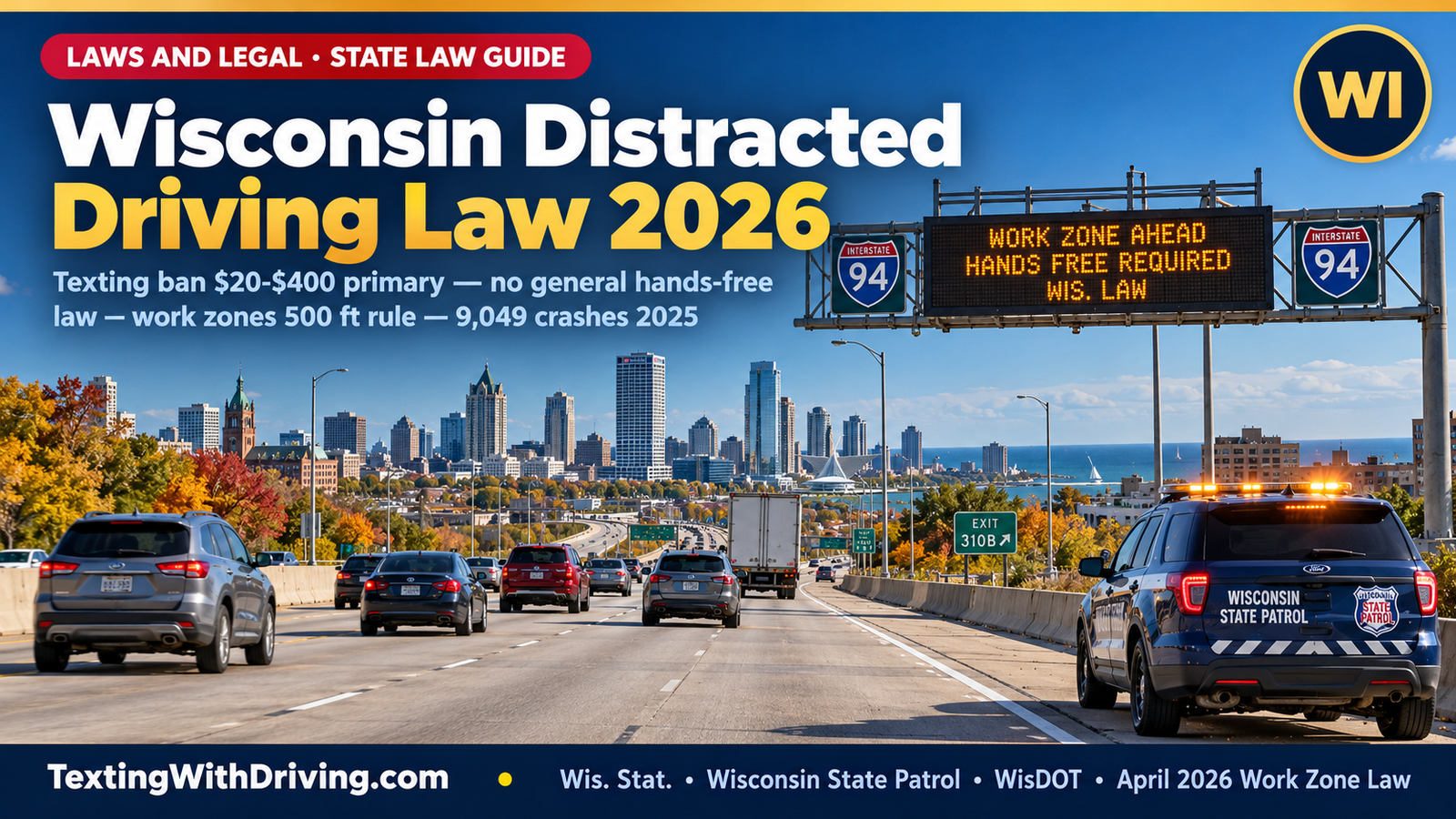
Wisconsin distracted driving law 2026 places the Badger State in a specific and shrinking category: states with a texting ban but no comprehensive hands-free law for adult drivers. Wisconsin banned text messaging while driving in 2010 — primary enforcement, $20 to $400 fine — but has not enacted the comprehensive all-roads handheld ban that now covers 33-plus states.
What Wisconsin does have, as of its April 2026 enforcement announcement, is a specific and actively enforced handheld phone prohibition within 500 feet of work zones, utility work areas, and emergency response areas. Wisconsin State Patrol Superintendent Tim Carnahan’s April 2026 statement — your cell phone isn’t worth someone’s life — accompanied the announcement of over 10,000 work zone citations and warnings issued by Wisconsin State Patrol in 2025.
Wisconsin’s 2025 preliminary crash data: 9,048 distracted driving crashes, 31 fatalities, and 3,660 injuries. In the past five years, work zone crashes alone have produced 47 deaths and 3,638 injuries in Wisconsin — with over 2,000 work zone crashes occurring every year.
Wisconsin is surrounded by states with varying distracted driving frameworks. Iowa enacted a comprehensive hands-free law in July 2025. Illinois has a comprehensive handheld ban. Minnesota enacted a hands-free law in 2019. Michigan has a comprehensive handheld ban. The states sharing Wisconsin’s border now include more comprehensive-law jurisdictions than texting-only peers — creating the border-crossing compliance context that this guide addresses.
This guide covers the complete Wisconsin distracted driving law 2026 picture: the texting ban and its enforcement challenges, the work zone 500-foot handheld rule, the fine structure, the probationary driver complete ban, the 2025 crash data, and what every Wisconsin driver must know.
Wisconsin’s Texting Ban: Primary But Limited
Wisconsin distracted driving law 2026 begins with the Wisconsin Statute texting ban — enacted in 2010, making Wisconsin the 30th state to prohibit text messaging while driving.
What the texting ban covers:
For the most part, Wisconsin law bans text messaging and emailing while driving. The prohibition covers composing, reading, or sending a text or email while operating a vehicle in motion.
What it does NOT cover for adult drivers:
Holding a phone for a voice call — legal on regular Wisconsin roads for adult drivers.
Using a navigation app while holding the phone — legal on regular Wisconsin roads.
Browsing social media without texting — legal on regular Wisconsin roads.
Primary enforcement: Wisconsin’s texting ban is a primary offense — Wisconsin State Patrol and local law enforcement have stop authority for observed texting. Primary enforcement has been in place since the 2010 enactment.
Fine structure:
Distracted driving / inattentive driving / texting violations: $20 to $400 fine range, plus 4 demerit points.
With average court costs, total out-of-pocket per citation: approximately $190.
The 4-demerit-point assessment for a Wisconsin distracted driving citation is significant — it is a substantial points hit on the Wisconsin driving record that affects insurance rates regardless of where within the $20 to $400 fine range the court sets the penalty.
The enforcement challenge: Texting while driving can be hard to prove in Wisconsin, but police are seeking new ways to recognize it. Wisconsin DOT Director of Transportation Safety Dave Pabst’s acknowledgment captures the same enforcement problem that drove Maine, Iowa, and dozens of other states to upgrade from texting bans to comprehensive handheld prohibitions. A Wisconsin officer who observes a driver holding their phone cannot stop them unless they can prove the driver was texting rather than dialing, navigating, or otherwise using the device legally.
Wisconsin’s van enforcement tactic: The Wisconsin DOT awarded a grant to the Dane County Sheriff’s Department to work on Madison’s Beltline Highway using a specific enforcement method — two officers drive in a van looking for drivers who are texting. Since the van sits higher than most cars, it’s easier to observe if someone’s breaking the law. Officers also find it easier to spot texting and driving at night because the phone’s screen glows in the car. This elevated-position enforcement approach is a practical workaround for the limited observation angle that standard patrol vehicles provide.
The Work Zone and Emergency Area 500-Foot Rule
Wisconsin distracted driving law 2026 has a specific and broader prohibition that applies in a defined geographic context: handheld cell phone use is prohibited while passing through and within 500 feet of work zones, utility work areas, and emergency response areas — except to report an emergency.
This rule — highlighted by Wisconsin State Patrol in their April 2026 Law of the Month announcement — establishes that the general texting-ban limitation (which requires proof of texting specifically) does not apply in work zones and emergency areas. Within 500 feet of a work zone, the prohibition extends to all handheld cell phone use — the same comprehensive standard that hands-free laws impose generally, but applied specifically to the high-risk zone context.
The 500-foot rule means:
Any Wisconsin driver approaching a work zone — whether on I-94 through Milwaukee, I-90 through Madison, US-51, or any state highway with active road construction — must put the phone down before entering the 500-foot zone. If the phone is in their hand within 500 feet of a work zone where workers are present, they are violating Wisconsin law regardless of whether they are texting or calling.
The emergency response area provision covers the same 500-foot zone around emergency response scenes — accidents being worked, vehicles on the shoulder with emergency lights, police stops on the roadside. A driver holding their phone while passing a police traffic stop on I-94 is within the 500-foot rule’s coverage.
The scale of the work zone crash problem that this rule addresses is documented in Wisconsin State Patrol’s 2025 data: over 2,000 work zone crashes per year, 47 deaths and 3,638 injuries in the past five years. The work zone distracted driving crash is specifically the crash where a worker on the roadside pays for the driver’s phone use with their life or health. Tim Carnahan’s your cell phone isn’t worth someone’s life is directed at exactly this scenario.
Wisconsin State Patrol issued over 10,000 citations and warnings for traffic law violations in work zones in 2025 — the enforcement scale that makes the 500-foot rule the most actively enforced distracted driving provision in Wisconsin beyond the general texting ban.
Wisconsin’s General Distracted Driving Statute
Wisconsin distracted driving law 2026 also includes a broader distracted driving statute — Wisconsin law bans driving while engaged or occupied with an activity, other than driving the vehicle, that interferes or reasonably appears to interfere with the person’s ability to drive the vehicle safely.
This general statute covers the full range of distracted driving behaviors beyond phone use: eating, adjusting controls, attending to passengers, reading, personal grooming. The same $20 to $400 fine range and 4-demerit-point assessment applies under this statute.
The general statute’s breadth creates enforcement authority for distracted driving behaviors that the texting ban does not cover — and it is this statute that officers can cite when they observe distracted driving without being able to prove phone-specific texting.
Wisconsin’s Supreme Court has ruled that law enforcement officials don’t have to show what specifically distracted a driver who caused a crash — the crash itself and the driver’s distracted behavior are the relevant evidentiary elements, not the specific type of distraction.
Probationary License and Instruction Permit: Complete Ban
Wisconsin distracted driving law 2026 has a complete device prohibition for drivers with a probationary license or instruction permit. These drivers cannot use a phone at all — handheld or hands-free — except to report a true emergency.
This complete ban applies to Wisconsin’s youngest drivers — those in the learner’s permit and graduated licensing stages — regardless of what technology they are using. A teen driver with a probationary license who uses a mounted Bluetooth speakerphone for a call is violating Wisconsin law, even though the same call would be legal for an adult driver with a full license.
Wisconsin DOT explicitly confirms this: hand-held or hands-free cell phone use while driving is against the law in Wisconsin for any driver with a probationary license or instruction permit, except to report an emergency.
Wisconsin’s 2025 Crash Data: The Scale of the Problem
Wisconsin distracted driving law 2026 addresses a documented and significant crash problem — with 2025 preliminary data showing 9,048 distracted driving crashes, 31 fatalities, and 3,660 injuries.
The 9,048 crash figure represents preliminary 2025 data reported by Wisconsin State Patrol in April 2026. For context, Wisconsin logged more than 10,000 distracted driving crashes in a recent state reporting year — a 13 percent jump from 2020 — before the most recent 2025 data showed the figure at 9,048.
The 31 fatalities from distracted driving crashes in 2025 are consistent with prior year patterns. Wisconsin DOT data from prior periods showed distracted driving as a factor in approximately 9,000 crashes with around 31 deaths — the 2025 figure suggests the crash count has not meaningfully declined despite the texting ban’s primary enforcement.
The specific enforcement context: text messaging while driving is responsible for a significant portion of Wisconsin’s distracted driving crashes, but the texting ban’s enforcement challenge — requiring proof of texting rather than any handheld use — limits the law’s deterrence compared to comprehensive hands-free states. Wisconsin DOT Director Pabst’s acknowledgment that texting while driving can be hard to prove in Wisconsin is the specific limitation that the Minnesota border comparison makes vivid — Minnesota enacted a comprehensive hands-free law in 2019 and documented meaningful behavioral improvement.
Comparing Wisconsin to Neighboring States
Wisconsin distracted driving law 2026 sits among neighbors that have moved to comprehensive frameworks:
Minnesota: Comprehensive hands-free law since August 2019. Minnesota’s first-offense fine was $50 before the quadrupling that produced $225 for subsequent violations. Minnesota’s April 2026 enforcement showed 5,426 citations across 296 agencies. The Wisconsin-Minnesota border on I-94 near Hudson is one of the highest-volume Wisconsin border crossings — where drivers transition between Minnesota’s comprehensive handheld ban and Wisconsin’s texting-only standard.
Iowa: Comprehensive hands-free law since July 1, 2025 — documented in our Iowa distracted driving law 2026 article. CMT data showed Iowa’s 13.6 percent behavioral improvement in year one. Wisconsin and Iowa share a border along the Mississippi River in western Wisconsin.
Illinois: Comprehensive hands-free law. Illinois drivers entering Wisconsin on I-90 north from Chicago transition from Illinois’s comprehensive framework to Wisconsin’s texting-only standard.
Michigan: Comprehensive hands-free law — documented in our Michigan distracted driving law 2026 article. Michigan and Wisconsin share a border through the Upper Peninsula and the Lake Michigan coastline.
Indiana: Texting ban, transitional framework. Indiana and Wisconsin share a small border in the far southeast.
Wisconsin’s position as the only Great Lakes state without a comprehensive handheld ban is the specific legislative gap that Wisconsin safety advocates are working to close. The Minnesota and Iowa border examples — two states that have enacted comprehensive laws and documented behavioral improvement — provide the most direct evidence of what Wisconsin’s neighboring drivers have adjusted to.
Milwaukee, Madison and Wisconsin’s Major Highway Network
Wisconsin distracted driving law 2026 applies across Wisconsin’s extensive highway network connecting the state’s major population centers.
Milwaukee metro and I-94: Wisconsin’s largest city at approximately 577,000 residents generates the highest traffic volume in the state. The I-94 corridor through Milwaukee — connecting Chicago to the south and Madison and Minneapolis to the west — is the most heavily traveled and most actively enforced distracted driving corridor in Wisconsin. The Milwaukee metro’s dense interchange network at the I-94/I-43/I-894 junction creates the high-distraction urban driving environment where enforcement is most visible.
Madison and the Beltline (US-12/18): Wisconsin’s capital and university city produces the specific enforcement context documented in the DOT’s Dane County grant — the elevated-position van enforcement on the Beltline Highway targeting texting detection. Madison’s large student population at the University of Wisconsin contributes to the young-adult demographic that is the highest-frequency distracted driving group.
I-90 Wisconsin Dells to Madison corridor: The summer tourism corridor to Wisconsin Dells carries high volumes of out-of-state visitors from Illinois and Minnesota who may be unfamiliar with Wisconsin’s specific texting-ban-only standard on regular roads but may expect a comprehensive handheld ban based on their home states.
I-43 northeast corridor (Green Bay, Sheboygan, Milwaukee): The northeast Wisconsin manufacturing and dairy corridor produces the commercial vehicle traffic concentration where FMCSA’s federal handheld prohibition applies independent of Wisconsin state law.
US-51 north-south: The primary non-interstate north-south corridor through Wausau and Tomahawk into northern Wisconsin is the specific rural highway environment where Wisconsin’s texting enforcement challenge is most acute — low observation angle, low traffic, and the phone-checking impulse of long rural drives combine with limited enforcement presence.
What Every Wisconsin Driver Must Know
Wisconsin distracted driving law 2026 creates specific compliance obligations that every Wisconsin driver needs to understand clearly.
Texting while driving is a $20-$400 primary offense with 4 DMV points. The texting ban applies on every Wisconsin road with primary enforcement authority. The 4-demerit-point assessment is the most significant financial consequence beyond the fine — insurance rate increases that follow 4 demerit points can exceed the $190 average citation cost within a single policy renewal cycle.
Holding your phone for a call is legal on regular Wisconsin roads — but not in work zones or emergency areas. The 500-foot work zone and emergency area rule prohibits all handheld use within that zone. Any driver within 500 feet of an active Wisconsin work zone must go hands-free. The 10,000-plus work zone citations Wisconsin State Patrol issued in 2025 demonstrate that this rule is actively enforced.
If you have a probationary license or instruction permit, no phone use at all. Including hands-free. The complete ban for provisional license holders in Wisconsin is broader than the adult driver standard in every category.
Commercial drivers face FMCSA federal handheld prohibition. Federal regulations apply to commercial drivers on I-94, I-90, I-43, and every other Wisconsin highway — the state’s texting-only framework for regular drivers does not affect the federal overlay for commercial vehicle operators.
The enforcement van is real. The Dane County elevated-position van enforcement on Madison’s Beltline represents a specific and effective enforcement approach that other Wisconsin agencies may adopt. Wisconsin DOT grant programs fund exactly this kind of targeted enforcement detail. A driver texting on the Beltline may be observed by officers in a position that makes the phone screen clearly visible.
The neighboring state comparison is the most compelling hands-free argument. If you cross into Minnesota on I-94 near Hudson, Iowa on US-18, Illinois on I-90, or Michigan through the UP, you immediately enter a jurisdiction where holding your phone for any reason is a primary offense. The hands-free habit you build for those crossings is the same habit that eliminates Wisconsin’s texting-ban risk — and the crash risk — on every Wisconsin road.
For the Iowa comprehensive law that applies immediately when Wisconsin drivers cross the Mississippi River on US-18, our Iowa distracted driving law 2026 covers the complete framework. For the Minnesota hands-free law that applies on I-94 west of Hudson, our Minnesota distracted driving law 2026 covers the complete standard. For the complete 50-state comparison, our distracted driving laws all 50 states 2026 covers every jurisdiction. And for the technology setup that makes Wisconsin compliance automatic in work zones, at traffic lights, and on every Wisconsin road, our hands-free while driving complete setup guide covers iPhone, Android, Bluetooth, and CarPlay.
Sources Used in This Article
All links verified working before publication.
Wisconsin DOT / Wisconsin State Patrol: April Law of the Month Work Zone Emergency Response April 3 2026 — Handheld cell phone prohibited within 500 feet work zones utility work areas emergency response areas, Tim Carnahan your cell phone isn’t worth someone’s life quote, 9,048 distracted driving crashes 2025 preliminary 31 fatalities 3,660 injuries, 10,000+ work zone citations warnings 2025 WSP, 47 deaths 3,638 injuries 5 years work zones, 2,000+ work zone crashes per year, April 2026
Driving Laws: Wisconsin Distracted Driving Texting Cell Phone Laws — General distracted driving statute engaged occupied activity interferes ability drive safely, texting emailing generally prohibited all motorists, hands-free voice-operated devices permitted, commercial drivers hands-free required, work zones hands-free required confirmed, fines $20 to $400
Goldberg Loren: Texting and Driving Appleton WI Laws Fines Crash Statistics — Wisconsin DOT June 2026 confirmation texting ban primary since 2010, probationary license instruction permit complete ban including hands-free except emergency, $20-$400 plus 4 demerit points, average fine court costs approximately $190, AAA 27 seconds cognitive distraction hands-free calls
Coastline Academy: Wisconsin Distracted Driving Laws — Texting illegal all Wisconsin drivers, probationary license instruction permit complete ban except emergency, primary vs secondary enforcement explanation, $20-$400 4 demerit points, emergency vehicle operators exempt
WPR: Minnesota Cracking Down Texting While Driving — Wisconsin average fine court fees approximately $190, Dave Pabst ding email text got to see it dangerous quote, texting hard to prove Wisconsin, Dane County elevated van enforcement Beltline grant, night glow phone screen tip
AutoInformed: Wisconsin Outlaws Texting While Driving 2010 — Wisconsin 30th state, 2010 effective primary enforcement, $20 to $400, law does not make illegal to read texts originally, 20% all crashes involve distraction, NSC urged total ban
NHTSA: Distracted Driving — 3,208 deaths 2024, 315,167 injuries, national context
TextingWithDriving.com is professionally built and maintained to ensure accurate, accessible safety information reaches every driver who needs it. Website development and ongoing support is handled by Budgetic, a digital agency specializing in purpose-driven WordPress websites.
