

Maine Distracted Driving Law 2026: Hands-Free Since 2019, Texting Ban Since 2011 and What Every Driver Must Know

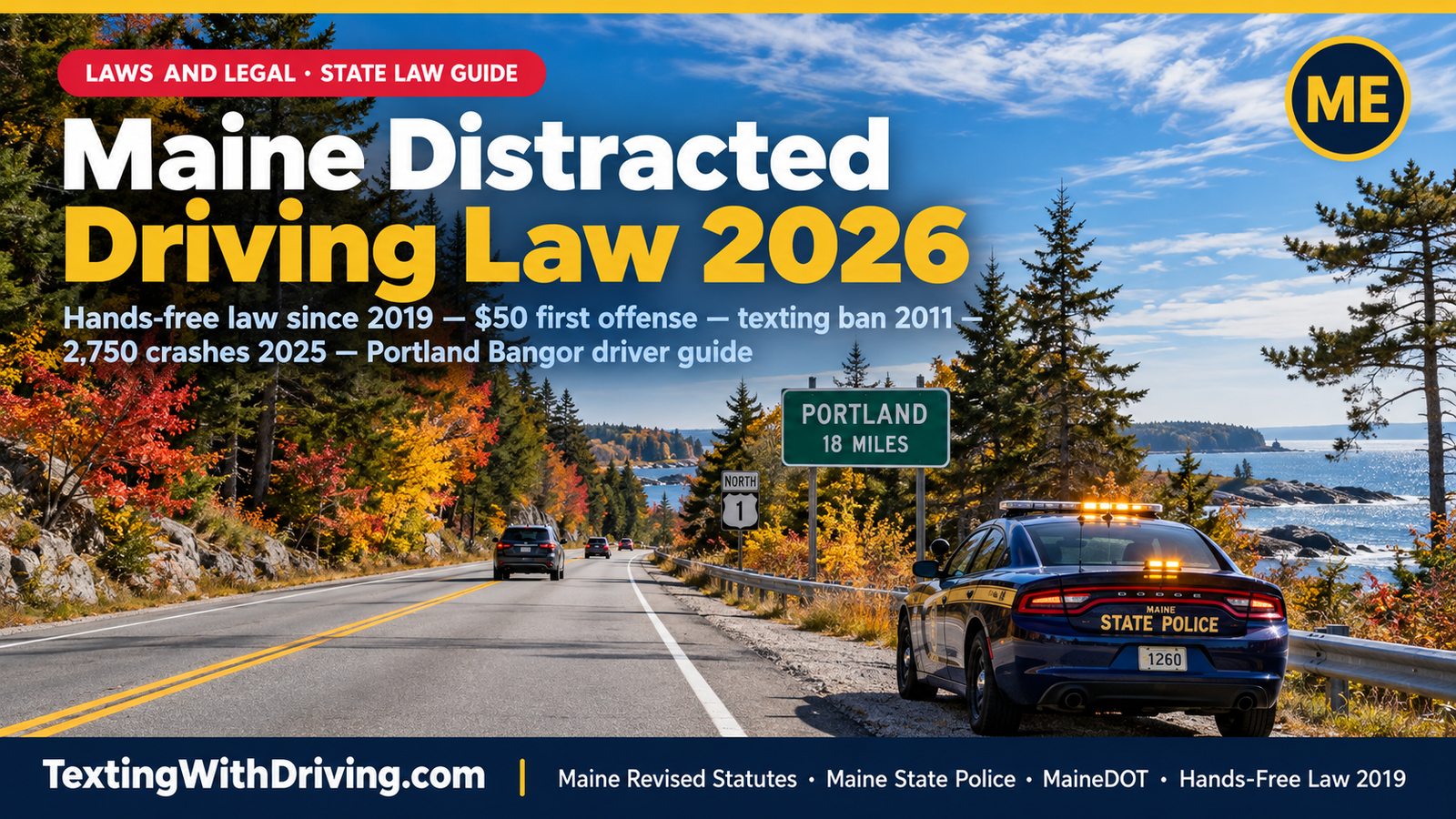
Maine Distracted Driving Law 2026: Hands-Free Since 2019, Texting Ban Since 2011 and What Every Driver Must Know
Maine distracted driving law 2026 gives the Pine Tree State one of the more comprehensive and layered distracted driving legal frameworks in New England — a texting ban enacted in 2011 followed by a comprehensive hands-free law that took effect in September 2019, together creating a dual-enforcement structure where the same distracted driving incident can generate citations under two separate statutes simultaneously.
Maine’s 2019 hands-free law was enacted specifically because the 2011 texting ban had proven nearly impossible to enforce in practice. Law enforcement is having a real challenge with people because it’s hard to determine if the person is dialing their phone or doing something else — the AAA spokesperson’s assessment that drove Maine’s legislative upgrade from a texting-specific ban to a comprehensive handheld prohibition. The 2019 law removed the enforcement ambiguity: if the phone is in the driver’s hand, the driver is in violation — regardless of whether texting, calling, navigating, or browsing.
MaineDOT crash data for 2025 shows 2,750 statewide crashes due to distracted behavior, with 294 of those specifically citing handheld mobile phone as the source of driver distraction. In the year before the hands-free law took effect, Maine State Police issued approximately 1,600 texting citations under the 2011 law. Within the first year of the 2019 hands-free law, Maine State Police issued more than 600 citations under the new statute — a rate that has continued as enforcement and compliance have evolved together.
This guide covers the complete Maine distracted driving law 2026 picture: the two-statute framework, the fine structure under each law, the one-swipe exception for mounted devices, the under-18 complete prohibition, the 2025 crash data, the coastal and interstate enforcement environment, and what every Maine driver and visitor must know.
Maine’s Two-Law Framework: Texting Ban Plus Hands-Free Law
Maine distracted driving law 2026 operates under two distinct statutes that apply simultaneously and can both be cited in the same incident.
Law 1: Maine Hands-Free Law (2019)
Effective September 2019, Maine’s comprehensive hands-free law — “An Act To Prohibit the Use of Handheld Phones and Devices While Driving” — sponsored by Rep. Bill Diamond of Windham and signed by Governor Janet Mills — prohibits any person from operating a motor vehicle on a public way while using, manipulating, talking into, or otherwise interacting with a handheld electronic device or mobile telephone.
The prohibition applies even when the vehicle is temporarily stopped in traffic, at a traffic light, or at a stop sign. A driver checking their phone at a Portland red light is violating the hands-free law as directly as a driver on I-95 at highway speed.
Fine structure:
First offense: $50 traffic infraction
Second or subsequent offense: $250
The mounted-device one-swipe exception: The law allows drivers who are at least 18 years old and not operating with a learner’s permit or intermediate license to use a device in hands-free mode. If the device is mounted where it does not interfere with the driver’s view, the law allows one swipe, tap, or push to activate or deactivate a feature. A mounted phone where the driver taps once to answer a call or activate navigation is within the law’s exception.
Primary enforcement: Maine State Police and local law enforcement can stop a driver solely for observed handheld device use.
Narrow emergency exception: Drivers may hold their phone during emergencies while talking to law enforcement — a specific and narrow exception that does not extend to general emergency calls to 911.
Law 2: Maine Texting-While-Driving Ban (2011)
The separate texting ban — enacted in 2011 — carries a $250 initial fine. If an officer can prove a driver was texting specifically (beyond just holding the phone), the driver is subject to the steeper texting ban fines rather than the hands-free law’s $50 first offense.
The dual-citation possibility: Maine State Police representatives have confirmed that troopers can — and have — cited drivers for both offenses simultaneously, resulting in a combined $184 fine ($50 hands-free + $134 distracted driving law) or higher when the texting ban’s $250 fine applies.
Law 3: Maine Distracted Driving Law (separate statute)
A third statute — the broader distracted driving law — prohibits activity that is not needed to operate the vehicle and that impairs, or is reasonably expected to impair, operation of the vehicle. Violations carry a $134 fine as set by the courts. This statute is broader than the phone-specific laws and covers any distraction-causing behavior, not just electronic device use.
Together, Maine’s three distracted driving statutes create a comprehensive enforcement framework that gives law enforcement multiple citation authorities for the same incident and multiple fine levels depending on what the officer can prove about the specific distraction behavior.
The 2019 Hands-Free Law: How It Changed Maine Enforcement
Maine distracted driving law 2026 was shaped fundamentally by the 2019 transition from texting-ban-only to comprehensive hands-free prohibition.
The pre-2019 enforcement problem was specific: the 2011 texting ban prohibited texting while allowing voice calls, navigation, and other handheld uses. An officer who observed a driver holding their phone could not issue a citation unless they could prove the driver was texting rather than doing something legal — like dialing, using GPS, or making a call. As Maine’s Maine Supreme Court later ruled, law enforcement officials don’t have to show what specifically distracted a driver who caused a crash — but the evidentiary challenge was real for roadside citation without a crash.
The 2019 law resolved the ambiguity completely. The phone in the hand is the violation. The specific use — texting, calling, browsing, navigating — is irrelevant for citation purposes under the hands-free law. This enforcement clarity was the primary driver of the law’s enactment: we had to remove that phone, that electronic device from the hands of people while they are driving — Rep. Diamond’s direct statement of legislative intent.
The compliance response was immediate. South Portland police Sgt. reported: almost immediately people were coming into compliance with the new law. Officers have remarked that drivers in the enforcement area were holding phones less frequently after the law took effect — the behavioral response that comprehensive enforcement authority produces when drivers understand that any handheld use is now citable.
Maine State Police issued more than 600 citations in the law’s first year — compared to approximately 1,600 texting-ban citations the year before. The lower citation count under the new law reflects the compliance effect: the behavioral change produces fewer violations, which produces fewer citations, which is the intended outcome of the legislation.
Maine’s 2025 Crash Data: What MaineDOT Shows
Maine distracted driving law 2026 addresses a documented crash problem on Maine roads that persists despite the legal framework.
The Sanford Police Department’s 2026 report drawing on MaineDOT crash data found 2,750 statewide crashes due to distracted behavior in 2025 — the latest completed calendar year — with 294 of those specifically citing handheld mobile phone as the source of driver distraction.
Prior year data from Maine Department of Transportation public records: 3,154 crashes with distracted driving listed as a factor — approximately 300 more than the 2025 figure, suggesting a modest downward trend. The crash count decline — from 3,154 to 2,750 — represents approximately a 12.7 percent reduction year-over-year, which aligns with the pattern documented in other states where hands-free laws produce gradual behavioral improvement in the years following enactment.
In the past decade, the vast majority of distracted driving crashes in Maine have taken place on dry roads in clear weather conditions — establishing that the Maine distracted driving crash is not primarily a weather or visibility-related event. It is a behavioral event occurring in favorable driving conditions where inattention is the sole cause.
Maine’s 40 percent of all accidents involving distracted driving — cited by Maine State Police before the hands-free law — established the scale of the problem. Even post-law, the 2,750-crash 2025 figure represents a significant ongoing enforcement and behavior-change challenge.
Under-18 Complete Prohibition
Maine distracted driving law 2026 has a specific and stricter standard for younger drivers. Drivers who are under 18, or who are operating with a learner’s permit or intermediate license regardless of age, are subject to a complete ban on device use — including hands-free.
The complete prohibition for this category mirrors standards we documented for West Virginia, Arkansas, and other states with graduated driver licensing frameworks. Maine’s intermediate license category — which typically covers drivers 16 to 18 who have passed the written test but not yet completed the full licensing requirements — falls under the complete ban.
The one-swipe exception for mounted devices that applies to adult drivers over 18 with full licenses does not apply to this category. Learner’s permit and intermediate license holders cannot use any device in any way while operating a motor vehicle.
Maine’s Road Network: Coastal and Interior Enforcement
Maine distracted driving law 2026 applies across a distinctive road network that ranges from the urban I-95/I-295 corridor through Portland and Bangor to the remote US-1 coastal highway and the interior state routes through the Maine woods.
I-95 and I-295 through Portland and Bangor: The primary interstate corridors carry the highest traffic volumes in Maine and the most consistent enforcement presence. The Portland metro area — Maine’s largest city at approximately 68,000 residents — generates the highest traffic density. The I-95/Maine Turnpike through Portland and south to the New Hampshire border is the most heavily patrolled distracted driving enforcement corridor in the state.
US Route 1 coastal: The iconic coastal highway running from Kittery at the New Hampshire border northward through Portland, Rockland, and Ellsworth to Calais at the Canadian border is Maine’s most scenic and most tourist-heavy driving corridor. Summer and fall foliage season bring the highest tourist traffic volumes to US-1, with drivers from Massachusetts, Connecticut, and New York — states with comparable hands-free laws — navigating an unfamiliar road network while managing navigation apps and tourist decisions.
The tourism season distraction context: Maine’s peak tourism season — July through September — produces the highest concentration of out-of-state drivers on US-1 and the coastal routes. October’s fall foliage peak extends the tourist season into the hands-free law enforcement window. Tourists who are simultaneously navigating an unfamiliar Maine coastal road while managing a phone are in exactly the scenario that Maine’s 294 handheld-phone crash citations document.
Rural interior: The remote interior routes — US-201 through Jackman toward Canada, Route 11 through Millinocket, and the extensive state forest road network — present the low-stimulus, long-distance driving context where the phone-checking impulse is highest and enforcement resources are thinnest. Maine’s rural roads are also the specific environment where extended emergency medical services response times — a documented rural EMS challenge across northern New England — make distracted driving crash outcomes more severe than in the southern Maine metro area.
Comparing Maine to New England Neighbors
Maine distracted driving law 2026 is part of a New England regional consensus on comprehensive handheld bans that now covers every New England state.
At the time of Maine’s 2019 enactment, Maine joined New Hampshire, Vermont, Connecticut, and Rhode Island in the comprehensive handheld ban framework — making Massachusetts the only New England state without a handheld ban at that time. Massachusetts has since enacted its own comprehensive law.
The New England regional alignment means that every border crossing in Maine — into and out of New Hampshire at Kittery on US-1 and I-95, and into and out of New Hampshire on the interior routes — involves a transition between two states with comparable comprehensive frameworks. A driver moving from Portsmouth, New Hampshire into Kittery, Maine on the I-95 corridor crosses from New Hampshire’s comprehensive ban into Maine’s comparable framework — the same standard applies on both sides of the Piscataqua River bridge.
The Canadian border dimension: Maine shares a long border with the Canadian provinces of Quebec and New Brunswick, and the Canadian federal framework includes comparable handheld device bans in both provinces. A Canadian driver entering Maine from Canada is transitioning between Quebec’s or New Brunswick’s comprehensive ban and Maine’s comparable framework.
The Fine Increase Proposals: Where the Legislative Debate Stands
Maine distracted driving law 2026 legislative context includes the ongoing debate about whether Maine’s $50 first offense is an adequate deterrent.
Senator Stanley Zeigler’s proposal to increase the initial fine from $50 to $500 and the second violation from $250 to $1,000 represents the stronger-penalty position: the current $50 fine is widely seen as too small to change behavior among drivers who consider it an acceptable cost of phone use. This proposal was not enacted, and as of 2026 the $50 first offense fine remains in place.
Some committee members said it is too early to tell whether the hands-free law and its penalties are working, especially when combined with the separate distracted driving penalties. Some people probably don’t even know it’s a crime to hold a phone while driving in Maine. The combination of relatively low public awareness and a $50 fine that is lower than a parking violation in Portland produces the enforcement challenge that the fine increase proposal was designed to address.
The comparison standard from our Virginia distracted driving law and New Jersey distracted driving law articles: Virginia’s $125 first offense and New Jersey’s $200-$400 first offense both provide stronger financial deterrence than Maine’s $50. Whether Maine’s legislature increases the fine in a future session is the open question that the current enforcement data will eventually answer.
What Every Maine Driver and Visitor Must Know
Maine distracted driving law 2026 creates specific compliance obligations for every driver on Maine roads — resident, tourist, and through-traveler on I-95.
Any handheld electronic device use is a $50 primary offense. The hands-free law applies on every Maine public road — US-1 coastal, I-95, the Maine Turnpike, and every state route. Maine State Police and local law enforcement have primary stop authority. Enforcement operates year-round, with specific grant-funded enforcement details during Distracted Driving Awareness Month in April and high-traffic tourist seasons.
At red lights and stop signs — the law still applies. The hands-free law applies when the vehicle is temporarily stopped in traffic, at a traffic light, or at a stop sign. A driver who picks up their phone at a red light in Portland is violating the law even while stationary.
The mounted device one-swipe exception is narrow. A phone mounted to the dashboard where it does not interfere with the driver’s view — and where the driver uses one tap to answer a call or activate navigation — is within the law’s exception. Multiple taps, typing a destination, or scrolling through contacts is not within the exception.
Both laws can apply to the same incident. A distracted driving incident that triggers both the hands-free law ($50) and the separate distracted driving law ($134) can generate a combined $184 citation. If the officer can prove texting specifically, the $250 texting ban fine applies instead of the $50 hands-free fine.
Under-18 and provisional license holders: complete ban. No hands-free exception. No one-swipe exception. Complete device prohibition for learner’s permit and intermediate license holders.
Tourists: Maine’s law applies from the moment you cross the border. A Massachusetts or Connecticut driver who crosses into Maine at Kittery on I-95 is immediately subject to Maine’s hands-free law. The fact that your home state has a comparable law is not a factor — Maine’s enforcement authority begins at the state line.
For the New Hampshire framework that applies just across the Piscataqua River bridge, our New Hampshire distracted driving law 2026 covers the comparable neighboring standard. For the Vermont framework on the western Maine border, our distracted driving laws all 50 states 2026 covers the complete New England picture. For the FMCSA commercial driver rules that apply on I-95 through Maine, our FMCSA commercial driver distracted driving rules covers the federal overlay. And for the technology setup that makes Maine compliance automatic on US-1, I-95, and every Maine road, our hands-free while driving complete setup guide covers iPhone, Android, Bluetooth, and CarPlay.
Sources Used in This Article
All links verified working before publication.
Sanford Spring Vale News / MaineDOT: Maine Hands-Free Law Sanford Police 2026 — Maine law prohibit operate motor vehicle using manipulating talking into handheld electronic device mobile telephone, stopped traffic light stop sign applies, one swipe tap push mounted device exception, $50 first offense $250 second or subsequent, 2,750 statewide crashes distracted 2025 294 handheld mobile phone citations, NHTSA underreporting caveat, 2026
Press Herald / Central Maine: Maine Hands-Free Law Fine Debate — Zeigler proposal $50 to $500 first $250 to $1,000 second, texting ban $250 initial fine, distracted driving law $134 courts, both cited same incident $184, 3,154 crashes distracted factor year before 300 fewer than prior year, Chipman some people don’t know illegal, Bill Diamond sponsor
News Center Maine: AAA Maine Hands-Free Law Save Lives 2019 — Governor Mills signed, “An Act To Prohibit Use Handheld Phones Devices While Driving,” texting calling Snapchat anything phone in hand illegal, Bluetooth infotainment permitted, current bill nearly impossible enforce police challenge dialing vs texting, AAA Pat Moody eyes road hands wheel quote, Maine joins 38 states
Maine Public: Holding Cell Phone Maine Hefty Fines 2019 — September effective, $250 fine holding phone ear, Bill Diamond we had to remove phone from hands quote, Maine State Police Lt. eyes road hands wheel mind driving deadly combination quote, narrow emergency exception law enforcement
News Center Maine: One Year After Hands-Free Law Effectiveness Unclear — 600+ citations first year MSP, 1,600 texting tickets 2018 comparison, Maine Bureau Highway Safety new distracted driving campaign survey, Diamond not yet exact numbers distracted driving ongoing issue, education accountability understanding enforcement approach
Central Maine: Hands-Free Law First Enforcement — South Portland Sgt. almost immediately coming into compliance quote, Biddeford police four special details December, permits encouraged hands-free calling Bluetooth, Maine in line NH VT CT RI making MA only NE state without handheld ban, 3,160 killed nationally 2017 NHTSA
Maine Public: Legislature Closer Outlawing Hand-Held Devices 2017 — House 85-60 vote hands-free bill, 40% all accidents distracted driving MSP, Rep. McLean distracted driving Maine problem, current law difficult enforce dialing vs GPS, Timberlake older poorer Mainers may not own hands-free devices
Maine.gov DPS: Cell Phone Use While Driving Maine 2025 Survey — 2025 Maine Distracted Driving Survey, September 2019 ban all handheld law change, inaugural survey April 2018, 2021 observations focused law change introduction handheld ban
NHTSA: Distracted Driving — 3,208 deaths 2024, 315,167 injuries, national context
TextingWithDriving.com is professionally built and maintained to ensure accurate, accessible safety information reaches every driver who needs it. Website development and ongoing support is handled by Budgetic, a digital agency specializing in purpose-driven WordPress websites.
