
DC Virginia Maryland Commuter Distracted Driving Laws 2026: Every Border Crossing Explained

DC Virginia Maryland Commuter Distracted Driving Laws 2026: Every Border Crossing Explained
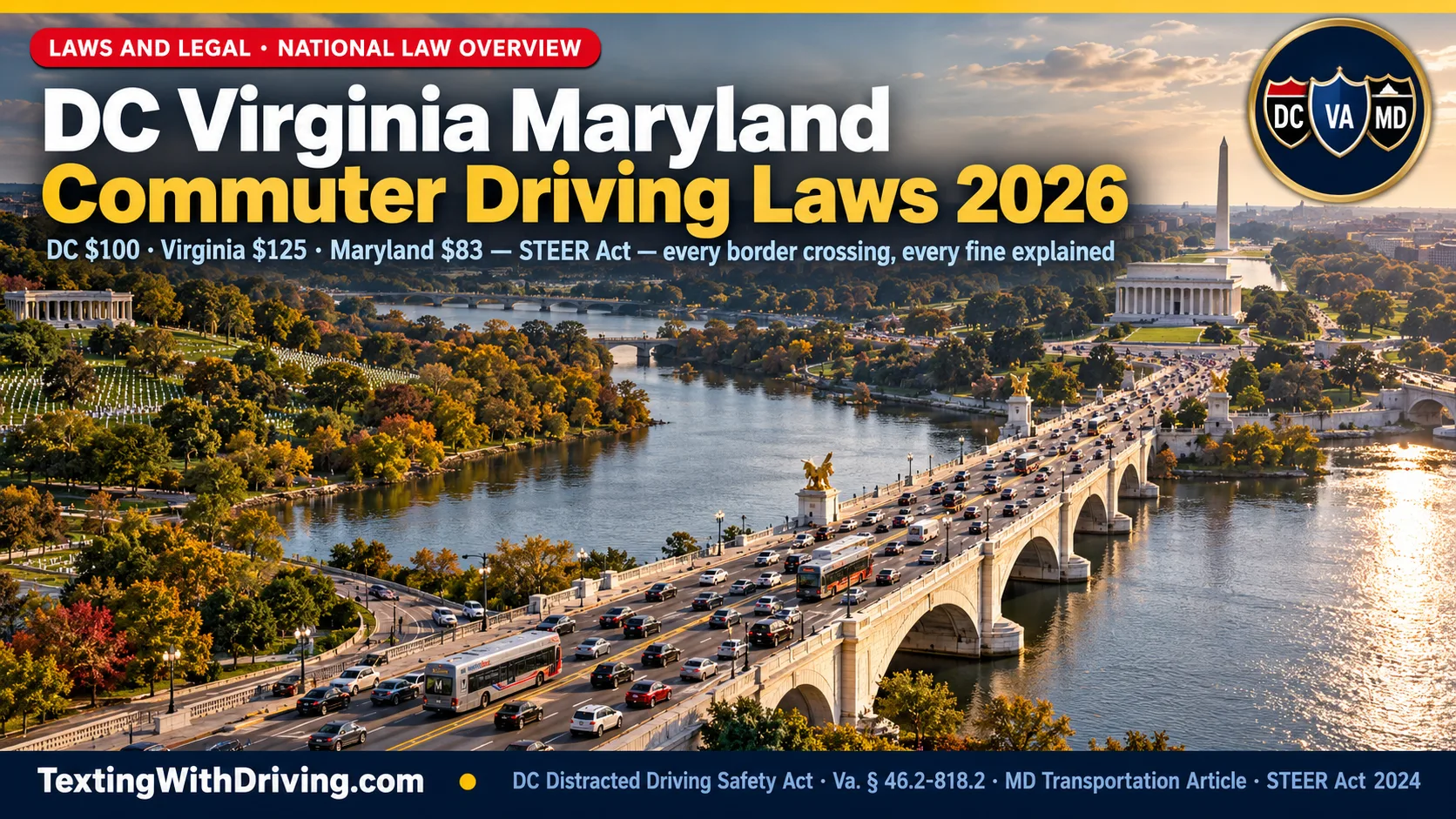
The DC Virginia Maryland commuter distracted driving laws are three separate legal frameworks — enforced by three separate jurisdictions, carrying three different fine amounts, and now linked by the STEER Act’s cross-border enforcement mechanism — that the average DMV commuter crosses between two and four times every day.
The commuter who lives in Loudoun County, commutes to Washington DC via I-66 and exits onto the George Washington Memorial Parkway, then crosses into DC on the Key Bridge for a meeting near Foggy Bottom, then drives south through Southwest DC to the 14th Street Bridge and re-enters Virginia at the Pentagon, and then drives north on I-395 back into DC in the afternoon — has navigated Virginia law, DC law, Virginia law again, DC law again, and Virginia law a third time in a single workday.
Each of those jurisdictional transitions is invisible on the road. There is no sign that reads “You are now subject to a different distracted driving fine.” The Metrobus that just crossed the American Legion Bridge from Maryland into Virginia didn’t stop to inform its passengers that the driver’s legal obligations just changed. The Uber driver navigating from Adams Morgan in DC to Bethesda in Maryland on Wisconsin Avenue NW didn’t receive an alert that the fine structure changed at the Maryland line at Chevy Chase Circle.
This guide explains every aspect of the DC Virginia Maryland commuter distracted driving laws that every DMV commuter should know: the specific law in each jurisdiction, the fine for each jurisdiction, what is and is not permitted in each jurisdiction, the STEER Act’s cross-border enforcement mechanism that means DC fines now follow Maryland and Virginia drivers home, and the specific border crossings where the jurisdictional transition changes the legal framework.
The Three Jurisdictions: Side-by-Side Comparison
DC Virginia Maryland commuter distracted driving laws share a common baseline — all three jurisdictions prohibit handheld device use while driving, all three are primary enforcement laws, and all three have been in effect long enough to be established law rather than new enforcement. But the specific fine amounts, the first-offense procedures, and the secondary consequence structures differ in ways that every DMV commuter needs to understand.
Washington DC:
The DC Distracted Driving Safety Act — enacted in 2004 — makes DC one of the longest-tenured comprehensive handheld driving bans in the United States. DC prohibited handheld phone use while driving more than a decade before most states enacted similar laws, and more than 16 years before Virginia’s 2021 comprehensive ban.
Fine structure: $100 per violation, primary enforcement. First offenders can have the fine suspended by providing proof of acquiring a hands-free device — a provision unique to DC that treats the first offense as an educational opportunity rather than purely a financial penalty. The District issues approximately 6,900 distracted driving tickets per year — a per-capita citation rate in a city of 700,000 that reflects active enforcement across DC’s dense road network.
What is prohibited: any use of a handheld cell phone or electronic device while operating a moving vehicle. Texting, calling, browsing, navigation input — all prohibited while holding the device.
What is permitted: hands-free device use with both hands on the wheel. Voice calls, GPS navigation, and music management through a mounted device or Bluetooth are legal.
Complete ban category: School bus drivers and drivers with learner’s permits are entirely banned from texting and cell phone use while operating a vehicle in motion — regardless of whether they use hands-free accessories. Hands-free is not an option for these categories; the prohibition is complete.
Virginia:
Virginia Code § 46.2-818.2 — the comprehensive handheld ban enacted as part of HB874 in 2020, effective January 1, 2021. Virginia’s law is the youngest of the three DMV jurisdictions’ comprehensive frameworks.
Fine structure: $125 first offense, $250 second and subsequent offenses, primary enforcement.
What is prohibited: holding a personal communications device while operating a moving vehicle. Holding means active possession in the hand — not using a mounted device to make a navigation query with a single touch.
What is permitted: hands-free use, mounted device use with minimal single-touch interaction, voice commands.
Mandatory minimum enhancement: Virginia Code § 46.2-868(C) adds a mandatory $250 minimum fine when reckless driving occurs simultaneously with a § 46.2-818.2 violation — as documented in our Virginia reckless driving and distracted driving 2026 article.
Maryland:
Maryland’s handheld ban — primary enforcement since 2013 — was enacted in stages, with the comprehensive primary enforcement law establishing the framework that Jake’s Law then enhanced for injury crashes.
Fine structure: $83 first offense (base fine), $140 second offense, $160 third and subsequent offense. Primary enforcement.
What is prohibited: using a handheld phone or mobile device while driving.
What is permitted: hands-free use, mounted device use, voice commands.
Jake’s Law enhancement: Maryland’s criminal liability provision for distracted driving injury crashes — documented in our Maryland distracted driving and insurance 2026 article — creates criminal exposure when phone use causes a serious injury crash, independent of the civil fine structure.
The Fine Comparison: What Each Jurisdiction Costs
DC Virginia Maryland commuter distracted driving laws carry three different first-offense fine amounts — and the differences matter for the commuter who crosses multiple jurisdictions daily.
| Jurisdiction | First Offense | Second Offense | Primary Enforcement |
|---|---|---|---|
| Washington DC | $100 (suspendable) | $100 | Yes |
| Virginia | $125 | $250 | Yes |
| Maryland | $83 (base) | $140 | Yes |
Virginia’s $125 is the highest base first-offense fine of the three. Maryland’s $83 is the lowest. DC’s $100 sits between them but has the unique first-offense suspension option that neither Virginia nor Maryland provides.
In Virginia, the fine is $125. In Maryland, it is usually just $83 for the first offense. That quote from Fox5DC’s comparative reporting places DC’s $100 between Virginia’s higher and Maryland’s lower fine — the DMV’s three-tier fine structure.
The practical implication for the commuter who receives a citation on any given day: the jurisdiction they were in when cited determines the fine. A citation received on I-395 in Virginia is $125. The same behavior on the 14th Street Bridge in DC is $100. The same behavior on the Beltway in Maryland is $83. The bridge determines the jurisdiction. The jurisdiction determines the fine.
The STEER Act: How DC Now Follows You Home
DC Virginia Maryland commuter distracted driving laws took on a new cross-border dimension when the DC STEER Act — Strengthening Traffic Enforcement, Education, and Responsibility Act — took effect in October 2024.
The STEER Act’s most significant provision for Maryland and Virginia commuters: if an out-of-state driver accumulates unpaid DC traffic fines, the District can now require payment to renew registration in the driver’s home jurisdiction.
The scale of the unpaid fine problem that prompted the STEER Act is staggering: In Fiscal Year 2022, Maryland and Virginia plates in DC received 757,268 citations totaling $151,250,000 in unpaid fines. In FY2023: 808,933 citations totaling $160,700,000 in unpaid fines. More than $311 million in unpaid fines from Maryland and Virginia drivers in DC over just two years — the fiscal reality that drove DC’s need for a cross-border enforcement mechanism.
The impact of this: some out-of-state drivers aren’t as cautious driving around DC. The behavioral observation from the STEER Act’s advocates captures the specific compliance gap the law addresses: when a Virginia or Maryland driver believes a DC citation is effectively unenforceable because they live in a different jurisdiction, the deterrence value of the citation disappears. The STEER Act restores deterrence by making the unpaid DC fine a registration renewal barrier in Virginia and Maryland.
DC Attorney General Brian Schwalb announced the STEER Act’s first lawsuits in 2024: three Maryland drivers sued for $90,000 across 334 tickets. Schwalb called it the first of several lawsuits under the STEER Act, saying: Starting today, we will aggressively enforce this new law against those wreaking havoc on our streets.
For the DMV commuter who has received DC distracted driving citations and not paid them: the STEER Act means those citations are now a potential barrier to renewing your Virginia or Maryland registration. The $100 DC distracted driving fine that might have seemed ignorable when enforcement felt cross-jurisdictionally toothless is now connected to your vehicle’s registration renewal in your home state.
The Border Crossings: Jurisdiction by Jurisdiction
DC Virginia Maryland commuter distracted driving laws require knowing exactly where each jurisdiction begins. The border crossings that matter for DMV distracted driving enforcement:
Virginia to DC — Northern Crossings:
The Key Bridge (from Georgetown, DC to Rosslyn, Virginia) and the Chain Bridge (from northwest DC to McLean, Virginia) cross the Potomac River from DC into Virginia. The jurisdictional line runs at the Virginia-DC boundary, which follows the high-water mark of the Virginia bank of the Potomac. A driver on the Key Bridge in the DC-side travel lanes is under DC law. A driver who has crossed into the Virginia travel lanes on the Rosslyn approach is under Virginia law.
Virginia to DC — Southern Crossings:
The 14th Street Bridge complex (carrying I-395, the George Washington Memorial Parkway traffic, and the Rochambeau Bridge) crosses from the Arlington/Crystal City area into Southwest DC. The 14th Street Bridge is one of the highest-volume commuter crossings in the region — carrying hundreds of thousands of vehicles daily. The jurisdictional transition from Virginia § 46.2-818.2 ($125) to DC law ($100) occurs mid-bridge.
Virginia to DC — The American Legion Bridge:
The American Legion Bridge on I-495 connects Virginia (Fairfax County/McLean area) to Maryland (Montgomery County/Bethesda area) without passing through DC. A driver on the American Legion Bridge is transitioning between Virginia law ($125) and Maryland law ($83) — not DC law.
Maryland to DC:
Wisconsin Avenue crosses from Bethesda, Maryland into DC at Chevy Chase Circle — the transition from Maryland law ($83) to DC law ($100). Connecticut Avenue crosses similarly at the Maryland-DC line in Chevy Chase. The Eastern Avenue and Eastern Branch corridors provide Maryland-DC crossings in the northeastern quadrant.
The GW Parkway Anomaly:
The George Washington Memorial Parkway runs through both Virginia and DC jurisdictions — and as a federal park road administered by the National Park Service, it is also subject to federal law. A driver on the GW Parkway in the Virginia section is subject to Virginia Code § 46.2-818.2. A driver who enters the DC section of the GW Parkway is under DC law. And a driver cited on the federal road itself may face federal citation authority in addition to state law enforcement — the traffic enforcement jurisdiction on the GW Parkway overlapping between NPS rangers, Virginia State Police, and the Park Police.
The Woodrow Wilson Bridge:
The Wilson Bridge on I-95/I-495 crosses from Alexandria, Virginia to Prince George’s County, Maryland. Maryland law ($83) and Virginia law ($125) apply on their respective sides of the jurisdictional midpoint of the bridge. The Wilson Bridge is one of the most consistently congested crossings in the region — and the stop-and-go I-95/I-495 HOV and general purpose lane management around the bridge’s Virginia and Maryland approaches creates the specific distracted-driving-in-congestion scenario where citation enforcement is most likely.
The STEER Act Citation Flow: What Happens When DC Cites a Virginia Driver
DC Virginia Maryland commuter distracted driving laws cross-border enforcement through the STEER Act creates a specific consequence chain that Virginia and Maryland drivers now face when cited in DC.
A Virginia driver cited in DC for handheld device use under DC’s Distracted Driving Safety Act receives a $100 citation. If the driver pays, the process ends. If the driver does not pay, the DC DMV records the unpaid fine. Under the STEER Act, DC can notify the Virginia DMV of the unpaid fine and require payment as a condition of Virginia registration renewal. The driver who fails to pay a DC $100 distracted driving citation faces the consequence at their next Virginia registration renewal.
The registration renewal connection means the STEER Act’s enforcement is not dependent on the driver being stopped in DC again. The state’s computerized DMV systems, connected through STEER Act protocols, make the unpaid DC citation a registrations-database barrier that the driver encounters in Virginia — in the normal course of maintaining their vehicle’s legal operation.
The same mechanism applies to Maryland drivers: DC can notify Maryland MVA of unpaid fines, requiring payment for registration renewal in Maryland.
This cross-border consequence is the specific enforcement innovation that makes the STEER Act’s impact far larger than the 6,900 annual DC distracted driving citations alone would suggest. Every one of those citations is now a potential registration renewal barrier in Virginia or Maryland — not just a fine that out-of-state drivers could choose to ignore.
The Under-18 Complete Prohibition in All Three Jurisdictions
DC Virginia Maryland commuter distracted driving laws align on one provision that every parent of a teen driver must understand: all three jurisdictions prohibit all device use — including hands-free — for certain under-18 driver categories.
DC: School bus drivers and drivers with learner’s permits cannot use any phone — hands-free or handheld — while operating a vehicle in motion.
Virginia: Drivers under 18 are prohibited from any device use including hands-free under the GDL framework as documented in our Virginia teen distracted driving 2026 article.
Maryland: The complete device ban for drivers under 18 — including hands-free — as documented in our Maryland teen distracted driving 2026 article.
The teen driver who commutes across the Maryland-Virginia line, or the Virginia-DC line, faces the same complete prohibition in all three jurisdictions. There is no jurisdictional refuge where the teen’s hands-free call is legal.
The WTOP Commuter Reality Check: 8 in 10 Crashes Are Distracted
DC Virginia Maryland commuter distracted driving laws exist in the context of a regional crash data reality: AAA notes that 8 out of 10 traffic crashes in DC, Maryland, and Virginia are related to distracted driving. The 80 percent figure — cited in the context of DC’s proposed fine increase discussions — is the regional behavioral backdrop against which the three jurisdictions’ legal frameworks are operating.
DC’s 30 traffic deaths through September 9, 2026 — nearly double 2025’s pace, with DDOT attributing 83 percent to behavioral factors — is the current-year expression of the DMV region’s distracted driving crisis that three separate jurisdictions are each addressing with their own legal tools. DC’s Obvio AI camera pilot detecting 2,500 violations per day in Montgomery County, Virginia’s primary enforcement at $125, and Maryland’s Road Worker Protection Act doubling work zone fines are all responding to the same behavioral reality at different points on the same regional road network.
What Every DMV Commuter Must Know
DC Virginia Maryland commuter distracted driving laws create a specific compliance standard for every commuter who crosses jurisdictional lines daily.
The compliance standard is identical in all three jurisdictions: don’t hold the phone. The fine amounts differ. The institutional enforcement mechanisms differ. The first-offense consequences differ. But the behavioral standard — both hands on the wheel, phone in mount or on seat or in back seat — is the same from Stafford County on I-95 to Montgomery County on I-270, from Reagan National Airport to Union Station.
The STEER Act means DC citations now follow you to your Virginia or Maryland registration renewal. An unpaid DC distracted driving citation is no longer just a $100 fine you could choose to ignore from across the state line. It is a registration renewal barrier in your home jurisdiction. Pay DC citations.
Virginia’s $125 is the highest first-offense fine in the DMV. Maryland’s $83 is the lowest. DC’s $100 is in between with the unique first-offense suspension option. If you are going to be cited anywhere in the DMV for a first offense, Virginia produces the highest immediate financial consequence.
The Wilson Bridge and American Legion Bridge jurisdiction transitions matter. A driver on I-95 crossing the Wilson Bridge who does not know exactly which lane is in which jurisdiction does not need to know — because the compliance standard (no phone in hand) is identical on both sides. But the fine if cited varies by a third between Virginia’s $125 and Maryland’s $83, and a commuter who contests a citation on jurisdictional grounds needs to know precisely where the boundary is.
For the complete Virginia law that applies on the Virginia side of every border crossing, our Virginia distracted driving law covers Va. Code § 46.2-818.2. For Maryland’s specific law framework, our Maryland distracted driving law 2026 covers the complete Maryland structure. For DC’s pedestrian crisis and the behavioral factors driving 30 deaths in 2026, our DC distracted driving and pedestrians 2026 covers the full DC picture. And for the technology setup that makes all three jurisdictions’ compliance automatic on every daily commute, our hands-free while driving complete setup guide covers iPhone, Android, Bluetooth, and CarPlay.
Sources Used in This Article
All links verified working before publication.
Driving Laws: District of Columbia Text Cell Phone Laws — DC illegal all motorists handheld device moving vehicle, $100 fine first offense suspended hands-free device proof, primary enforcement, school bus and learner’s permit complete ban, hands-free accessories permitted, 2026
Price Benowitz: DC Cellphone Driving Laws — $100 fine per offense first offense suspended, primary enforcement officers stop solely for device use, careless driving category if crash results, both hands on wheel hands-free fine, 2026
ICMA: DC Distracted Driving Safety Act 2004 — DC first comprehensive handheld ban 2004, $100 penalty first-time violators suspend fine hands-free device proof, primary enforcement, approximately 6,900 distracted driving tickets per year DC
Fox5DC: New DC Law Aims to Curb Reckless Driving Out-of-State Drivers STEER Act — STEER Act October 2024 components effective, out-of-state drivers pay DC fines to renew registration home jurisdiction, FY2022 757,268 MD and VA citations $151.25M unpaid, FY2023 808,933 citations $160.7M unpaid, registration linkage mechanism, Councilmember Allen quote engineering education enforcement
Fox Baltimore: DC Sues 3 Maryland Drivers STEER Act — AG Schwalb STEER Act first lawsuits three Maryland drivers $90,000 334 tickets, Andre Bowman 135 tickets $36,000+, starting today aggressively enforce quote, October 2024
Fox5DC: DC Considering Raising Fines for Distracted Driving — Virginia fine $125 Maryland $83 first offense DC $100 comparison, DC Bicycle Advisory Council chair Cranor consider banning all phone use, AAA against hands-free ban, Councilmember Cheh
WTOP: DC Tough Distracted Driving Bill — 6,900 DC distracted driving tickets per year, AAA 8 in 10 crashes distracted driving DC Maryland Virginia, third offense automatic license suspension proposed, DC not ban earbuds Maryland Virginia allow one ear
NHTSA: Distracted Driving — 3,208 deaths 2024, national context
TextingWithDriving.com is professionally built and maintained to ensure accurate, accessible safety information reaches every driver who needs it. Website development and ongoing support is handled by Budgetic, a digital agency specializing in purpose-driven WordPress websites.
