

Virginia Distracted Driving Crash Recovery 2026: What Happens to Victims and How Long It Takes

Virginia Distracted Driving Crash Recovery 2026: What Happens to Victims and How Long It Takes
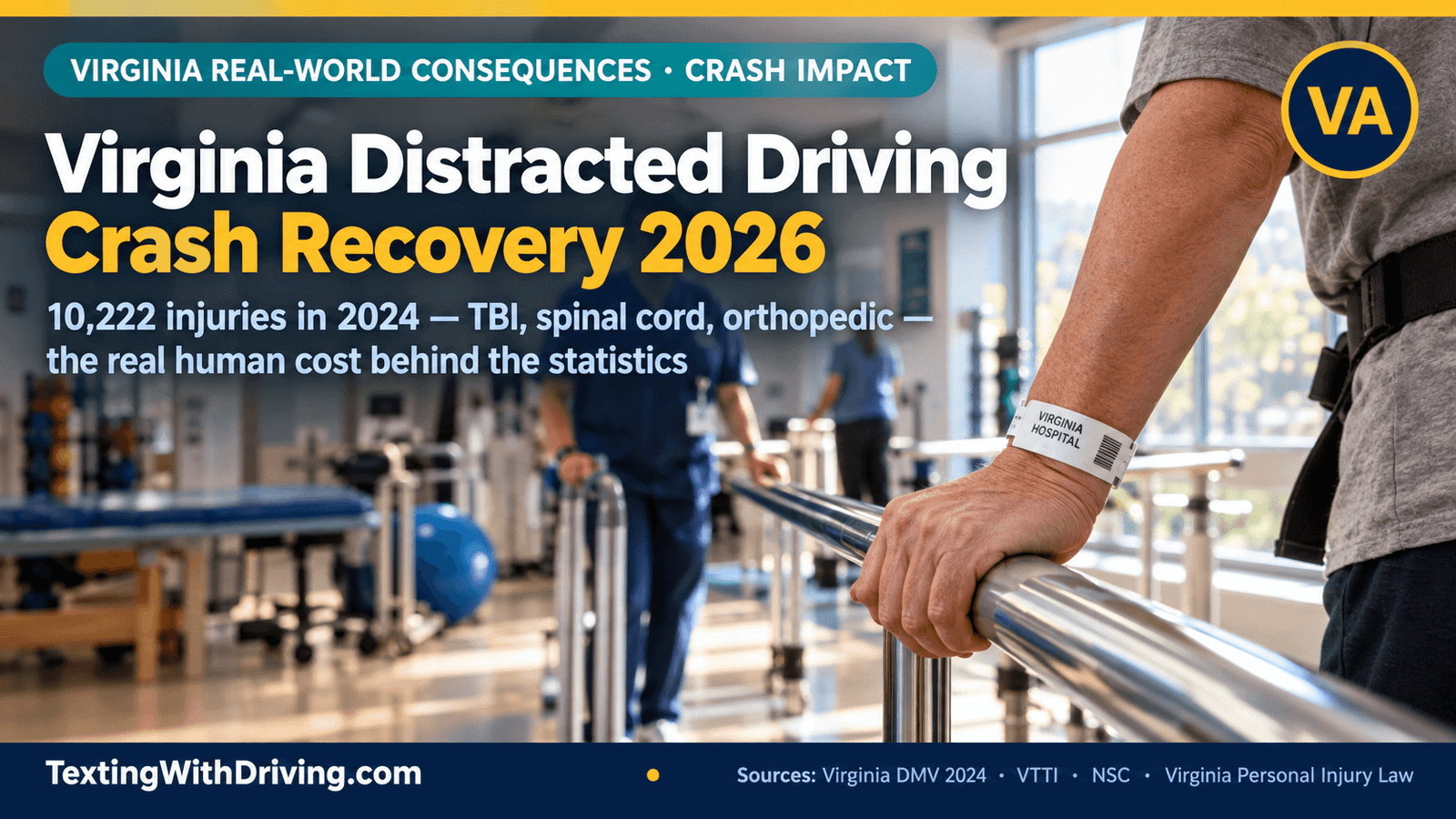
Virginia distracted driving crash recovery 2026 begins with a number that the annual statistics present without context: 10,222 Virginians injured in distracted driving crashes in 2024, according to the Virginia Department of Motor Vehicles. The number appears in the same sentence as 18,688 crashes and 73 fatalities — three statistics that together define Virginia’s distracted driving crisis. But what the statistics do not tell is what happens to those 10,222 people after the crash. Where they go, what their bodies go through, how long recovery takes, what it costs, what they can never get back, and what Virginia law provides for those whose injuries were caused by someone else’s choice to look at their phone.
This guide is about those 10,222 people. It covers the complete Virginia distracted driving crash recovery 2026 picture: the specific injury categories that distracted driving crashes produce, the rehabilitation journey for each major injury type, the realistic recovery timelines that medical literature and Virginia case history establish, the financial dimension of what crashes actually cost victims, and the Virginia legal framework that governs what injured victims can recover from at-fault distracted drivers.
Why Distracted Driving Crashes Produce More Severe Injuries
The first element of Virginia distracted driving crash recovery 2026 that clinicians and attorneys both identify is a pattern specific to distracted driving crash mechanics: they tend to produce more severe injuries than comparable-speed crashes between fully attentive drivers.
A driver who is not paying attention typically does not brake in time or steer away, and hits with far more force than someone who saw the collision coming. That is why the injuries in these crashes tend to be significant. This observation from Virginia crash attorneys reflects the same physics principle that makes rear-end crashes at highway speed so devastating: the full kinetic energy of the striking vehicle is absorbed by the struck vehicle and its occupants without any reduction from pre-impact braking.
Virginia’s 2024 crash data confirms this severity escalation. Even as the total number of distraction-involved crashes went down by 3.6 percent, fatalities rose by 40.6 percent compared to 2023. Fewer crashes, but deadlier ones. This pattern — declining crash frequency but rising fatality rate — suggests that the crashes that are occurring despite primary enforcement are the higher-severity, higher-speed collisions that produce deaths and serious injuries rather than the lower-severity incidents that primary enforcement most effectively deters.
The 10,222 injuries from 18,688 crashes means approximately 55 percent of Virginia’s distracted driving crashes in 2024 produced at least one injury. The injury rate per crash is higher than the comparable figure for non-distracted crashes — reflecting the full-force impact dynamic that the absence of pre-crash braking produces.
Traumatic Brain Injury: The Most Complex Recovery
Virginia distracted driving crash recovery 2026 must begin with traumatic brain injury — the injury category that distracted driving crashes produce with particular frequency through the specific mechanics of sudden deceleration and head contact.
Traumatic brain injuries range from concussion to severe TBI requiring long-term care. TBIs can result in long-term challenges like chronic pain, memory loss, impaired concentration, and mood disorders.
Traumatic brain injuries are among the most complicated and difficult injuries to treat. While advancements in medical technology have certainly improved prognoses and quality of life for brain injuries, there is still so much that is not fully understood about the brain.
The TBI recovery spectrum in distracted driving crashes covers an enormous range of severity and duration:
Mild TBI (concussion). The most frequent TBI category in motor vehicle crashes. Symptoms include headache, nausea, light sensitivity, cognitive fog, and memory difficulty. Most mild TBIs resolve within four to six weeks with cognitive rest and symptom management. Post-concussive syndrome — where concussion symptoms persist beyond the expected resolution window — affects approximately 10 to 15 percent of mild TBI cases, extending recovery to three to six months or longer.
Moderate TBI. Producing a period of unconsciousness and significant cognitive disruption, moderate TBI may require inpatient rehabilitation following acute hospitalization. Recovery extends from several months to a year or more, with some permanent cognitive, behavioral, or physical deficits common in more severe moderate cases.
Severe TBI. The most devastating injury category in high-speed distracted driving crashes — particularly those involving the absence of pre-crash braking that produces full-force impacts. Severe TBI frequently requires immediate neurosurgical intervention, extended ICU care, inpatient rehabilitation at a dedicated brain injury facility, and long-term community support services. Full recovery is rare. Many severe TBI survivors require permanent assistance with activities of daily living, vocational retraining at reduced capacity, or long-term residential care.
TBI symptoms might not be evident right away, but a doctor’s exam and diagnostic tests can reveal a brain injury before symptoms surface. Getting a prompt diagnosis and starting treatment right away increases your chances of recovery. This delayed-symptom reality is critical for Virginia crash victims: a person who walks away from a distracted driving crash feeling shaken but apparently uninjured may be experiencing TBI symptoms within 48 to 72 hours — headache, confusion, sleep disruption, and emotional dysregulation — that require medical documentation for both treatment and legal purposes.
Head and brain injuries are frequently underdocumented and require early neurological evaluation and testimony from people who knew you before. The before-and-after testimony dimension — family members, friends, and colleagues who can describe the specific personality, cognitive, and behavioral changes that TBI produces — is as important to the clinical care picture as the imaging studies, because TBI’s functional impacts often exceed what imaging alone captures.
The Virginia Sentara Norfolk General Hospital Level I Trauma Center — one of the region’s primary severe TBI receiving facilities — handles the most severe distracted driving crash TBI cases from the Hampton Roads region documented in our Virginia Beach distracted driving 2026 and Norfolk Virginia distracted driving 2026 articles. Northern Virginia severe TBI cases are typically stabilized at Inova Fairfax Hospital’s Level I Trauma Center before transfer to specialized rehabilitation facilities.
Spinal Cord Injury: When Recovery Has a Ceiling
Virginia distracted driving crash recovery 2026 reaches its most permanently life-altering dimension with spinal cord injury — the category where recovery often has a defined ceiling that the injury’s level and completeness determine more than the recovery effort or timeline.
Spinal cord injuries include herniated discs and in serious cases paralysis. Damage to the spinal cord leads to chronic pain or even permanent paralysis.
The spinal cord injury spectrum in Virginia distracted driving crashes:
Cervical (neck) injuries. The most common spinal injury location in rear-end crashes — where the head-neck system’s sudden forced extension-flexion (whiplash) can produce cervical disc herniation, cervical fracture, and in the most severe rear-end impacts, cervical spinal cord injury with upper extremity and respiratory involvement. Cervical spinal cord injuries at C3 to C5 can affect breathing function and require mechanical ventilation. Cervical injuries below C6 typically preserve some arm function while causing paralysis or weakness in the lower extremities.
Thoracic and lumbar injuries. More common in higher-energy frontal and side-impact crashes, thoracic and lumbar spinal cord injuries produce paraplegia — lower extremity paralysis and loss of bowel and bladder control — at injury levels above L1. Below L1, lumbar injuries produce variable lower extremity weakness and sensory loss that responds better to rehabilitation than higher thoracic or cervical injuries.
Disc herniation without cord injury. The most common spinal distracted driving crash injury category — producing radiating pain, sensory changes, and weakness that may respond to conservative treatment (physical therapy, epidural steroid injections) or may require surgical intervention (microdiscectomy, fusion). Recovery from disc herniation with nerve involvement ranges from six weeks to twelve months for conservative cases, and extends beyond the surgical recovery period for cases requiring fusion.
Neck and back injuries are objectively common and subjectively contested, and they live or die on the treating physician’s ability to separate a symptomatic injury from an incidental degenerative finding.
This clinical-legal intersection is Virginia-specific and critical: Virginia’s defense bar in personal injury cases routinely argues that a plaintiff’s cervical or lumbar disc findings are pre-existing degenerative conditions that the crash exacerbated but did not create. The physician’s documentation of the specific crash mechanism, the timing of symptom onset relative to the crash, and the absence of pre-crash symptoms is the evidentiary foundation on which the distinction between crash-caused disc injury and pre-existing condition rests.
Orthopedic Injuries: The Most Common, the Most Quantifiable
The highest-volume injury category in Virginia distracted driving crash recovery 2026 is orthopedic — broken bones, fractures, and joint injuries that produce clear imaging evidence, defined treatment protocols, and quantifiable recovery timelines.
Broken bones and fractures including complex injuries requiring surgical repair are among the most common distracted driving crash injuries. Fractures and broken bones often require surgery and lengthy rehabilitation.
The orthopedic injury spectrum in Virginia distracted driving crashes:
Simple fractures. Long bone fractures (femur, tibia, fibula, humerus, radius/ulna) that are well-aligned and stable may be treated with casting or splinting without surgery. Recovery: six to eight weeks immobilization, followed by six to twelve weeks of physical therapy for range-of-motion and strength restoration. Total return to full function: three to six months.
Complex fractures requiring surgical fixation. Comminuted (shattered) fractures, intra-articular fractures involving joint surfaces, and open fractures where bone pierces skin require surgical repair — typically internal fixation with plates, screws, rods, or a combination. Recovery from surgical fixation: six to twelve weeks before weight-bearing or active use, followed by three to six months of intensive physical therapy. Total return to full function in favorable cases: six to twelve months.
Pelvic fractures. Among the most serious orthopedic injuries in high-energy crashes — producing significant blood loss risk, bladder and urologic injuries, and recovery that can extend twelve to eighteen months for severe cases. Complex pelvic ring disruptions may require external fixation, surgical reconstruction, and prolonged limited weight-bearing.
Wrist and hand fractures. The FOOSH (Fall On Outstretched Hand) injury pattern during crash bracing — where the driver or passenger extends their hand against the dashboard or door in the moment of impact — produces wrist and hand fractures that can permanently limit grip strength and fine motor function when involving the dominant hand. A worker whose occupation requires fine motor dexterity — a surgeon, a musician, a dental professional — sustains a career-altering injury from a wrist fracture that another person’s same fracture may not produce.
Orthopedic injuries prove themselves but are undervalued unless permanency and lost earning capacity are documented. This legal principle directly applies to occupational impact documentation: a construction worker whose knee fracture prevents return to the physical demands of the job has a permanent earning capacity reduction that the orthopedic surgeon’s documentation of impairment rating must establish for the personal injury claim to capture its full value.
Soft Tissue Injuries: The Most Contested Recovery
Virginia distracted driving crash recovery 2026 includes the injury category most frequently contested in Virginia personal injury litigation: soft tissue injury — specifically whiplash, muscle strains, and ligament sprains that produce real pain and functional limitation without the clear imaging evidence that fractures and disc herniations provide.
Whiplash — sudden neck movements cause pain and reduced mobility, sometimes lasting for months.
Whiplash’s specific biomechanics in rear-end distracted driving crashes involve the three stages of cervical soft tissue trauma: the initial extension phase where the head is thrown backward relative to the torso, the rebound flexion phase where the head snaps forward, and the restraint phase where the seatbelt and headrest limit extremes of motion. The cervical muscles, ligaments, and joint capsules are stretched beyond their elastic limit during this sequence, producing the tissue disruption that causes acute and sometimes chronic pain.
Recovery from whiplash follows a highly variable timeline. Most whiplash injuries resolve within four to twelve weeks with conservative treatment — physical therapy, chiropractic care, anti-inflammatory medication, and activity modification. Chronic whiplash — where symptoms persist beyond twelve weeks — affects approximately 30 to 50 percent of crash-related whiplash cases. Chronic whiplash can produce symptoms for one to three years or longer, and in a subset of cases, produces permanent cervical sensitization and pain that does not fully resolve.
The soft tissue injury documentation challenge is most acute for the whiplash-only case where the primary evidence of injury is the patient’s self-reported pain. Virginia defense counsel in personal injury cases will argue that whiplash symptoms are exaggerated, pre-existing, or anxiety-related — requiring the treating physician to document objective findings (cervical range of motion limitations, muscle spasm on palpation, positive orthopedic test results) alongside the patient’s subjective symptom report.
The Psychological Dimension: PTSD and Driving Anxiety After Crashes
Virginia distracted driving crash recovery 2026 has a psychological dimension that medical and legal communities increasingly recognize but that the injury statistics do not capture: the post-traumatic stress disorder, driving phobia, and depression that a significant proportion of crash survivors experience.
Psychological injuries are compensable and require actual treatment records. The post-crash psychological response can include: hypervigilance while driving or as a passenger, intrusive memories or flashbacks of the crash, avoidance of the crash location or similar road environments, sleep disruption, and the specific anxiety that return to driving — or the inability to return — produces.
A crash victim whose physical injuries healed within three months but who cannot drive for twelve months because of severe driving anxiety has a psychological injury that extends their functional recovery far beyond the physical recovery timeline. Virginia’s personal injury framework permits compensation for psychological injuries when they are documented through actual treatment records — which means the anxiety or PTSD diagnosis from a treating psychologist or psychiatrist, combined with a treatment record showing therapy attendance and therapeutic response, is necessary to include psychological harm in the personal injury claim.
Pain and suffering, emotional distress, and the inability to do things the victim used to enjoy are non-economic damages that Virginia law specifically permits in personal injury claims. The inability to drive — which in Virginia’s sprawling suburban geography creates profound limitation on employment, childcare, social participation, and every other activity that requires vehicle access — is a specific form of this functional limitation that distracted driving crashes impose on victims regardless of the physical injury category.
The Financial Reality: What Recovery Actually Costs
Virginia distracted driving crash recovery 2026 financial impact is the dimension that most directly connects the injury categories to the $120.32 billion annual economic cost we documented in our economic cost of distracted driving 2026 article.
Medical costs in a Virginia distracted driving crash claim encompass a range of expenses, including emergency room visits, surgeries, hospital stays, medications, physical therapy, and long-term rehabilitation. Lost wages cover income lost due to time away from work during recovery, as well as diminished earning capacity when injuries cause permanent limitations on the ability to work. Transportation costs for medical appointments and home modification expenses — such as wheelchair ramps and bathroom modifications — can also be included when the injuries warrant it.
The specific financial ranges by injury category:
Emergency room and acute care. A serious distracted driving crash requiring emergency transport, trauma center admission, surgery, and a week of inpatient hospitalization produces medical bills in the $50,000 to $150,000 range before any rehabilitation or follow-up care. Traumatic brain injury requiring neurosurgical intervention adds $30,000 to $80,000 in surgical costs. Spinal cord injury requiring surgical stabilization adds $50,000 to $150,000 in neurosurgical costs.
Inpatient rehabilitation. For TBI, spinal cord injury, or complex orthopedic injuries requiring intensive rehabilitation, inpatient rehab facility costs run $1,500 to $3,000 per day. A four-week inpatient TBI rehabilitation stay — the minimum for a moderate TBI — costs $42,000 to $84,000.
Outpatient physical therapy. A twelve-week course of outpatient physical therapy — standard for moderate orthopedic and soft tissue injuries — costs $3,000 to $8,000 depending on session frequency and the specific interventions required.
Lost wages. A Northern Virginia technology worker earning $120,000 annually who is unable to work for six months following a serious distracted driving crash loses $60,000 in income during the recovery period. If permanent cognitive or physical limitations prevent return to the same role, the lost earning capacity calculation extends to the full projected career earnings reduction.
Long-term care. Severe TBI and high-level spinal cord injury requiring long-term residential care or attendant services create lifetime cost projections that can reach $1,000,000 to $5,000,000 or more, depending on the injury level, the victim’s age at injury, and the specific care requirements that the injury produces.
Virginia’s Contributory Negligence Rule: The Critical Legal Context
Virginia distracted driving crash recovery 2026 occurs within a legal framework that is more demanding for injured plaintiffs than most states: Virginia’s pure contributory negligence doctrine.
Virginia follows a strict contributory negligence standard. If the defense establishes any fault on the part of the injured person, recovery can be barred entirely. Insurers in these cases regularly attempt to shift blame, arguing that the other party stopped suddenly, failed to observe traffic conditions, or contributed in some other way.
Virginia is one of only a handful of states that still follows pure contributory negligence rather than the comparative fault standard that most states use. Under comparative fault, a plaintiff who is 20 percent at fault in a crash can still recover 80 percent of their damages. Under Virginia’s contributory negligence doctrine, a plaintiff who is found to be even 1 percent at fault is barred from any recovery.
The contributory negligence doctrine has specific practical implications for Virginia distracted driving crash recovery 2026 victims:
The stopped-suddenly argument. The defense in a rear-end crash case commonly argues that the plaintiff stopped suddenly or abruptly, contributing to the crash. Even though rear-end crashes in Virginia are generally presumed the following driver’s fault, the contributory negligence argument attempts to shift some percentage of fault to the plaintiff to bar recovery entirely.
The failure-to-observe argument. In intersection crashes where a distracted driver ran a red light or failed to yield, the defense may argue that the plaintiff should have observed the approaching vehicle and taken evasive action. If the plaintiff had a last-clear-chance opportunity to avoid the crash that they did not take, contributory negligence becomes a viable defense argument.
The protection response. Virginia Personal injury attorneys handling distracted driving cases must anticipate and counter contributory negligence arguments from the claim’s initial investigation. Evidence that establishes the plaintiff’s full compliance with traffic law — dashcam footage, witness testimony, traffic signal data, and the at-fault driver’s phone records establishing their distraction — is the evidentiary shield against contributory negligence arguments.
The two-year statute of limitations for personal injury claims in Virginia means that injured victims have two years from the date of the crash to file a legal claim. Missing this deadline bars recovery regardless of the severity of the injury or the clarity of the distracted driver’s fault.
Virginia’s Trauma Centers and Rehabilitation Network
Virginia distracted driving crash recovery 2026 occurs within a specific network of Virginia trauma centers and rehabilitation facilities that injured crash victims and their families should know.
Virginia’s Level I Trauma Centers — providing the highest level of trauma care including 24-hour neurosurgical coverage — include Inova Fairfax Hospital (Northern Virginia), VCU Medical Center (Richmond), Sentara Norfolk General Hospital (Hampton Roads), UVA Medical Center (Charlottesville), and Carilion Roanoke Memorial Hospital (Western Virginia). These Level I centers are the receiving facilities for the most severe distracted driving crash injuries — the fatal crashes’ near-misses who survive with TBI, spinal cord injury, and complex polytrauma requiring immediate surgical intervention.
Inpatient rehabilitation following acute trauma care in Virginia is provided through facilities including Inova Mount Vernon Hospital’s Brain Injury Rehabilitation Unit, the VCU Rehabilitation Medicine Inpatient Unit, the Sheltering Arms rehabilitation facility network in Richmond, and UMAR Services’ community-based rehabilitation programs. The specific rehabilitation facility for a Virginia distracted driving crash survivor depends on the injury type, the geographic region, and the insurance coverage that determines which facilities are in-network.
The Virginia Department of Rehabilitative Services provides vocational rehabilitation services for Virginians whose distracted driving crash injuries affect their ability to return to their prior occupation. A construction worker whose traumatic knee injury prevents return to the physical demands of the job, or a long-haul truck driver whose cervical injury creates a medical disqualification from DOT medical certificate requirements, may access vocational rehabilitation assessment, retraining, and job placement services through DRS.
What Crash Victims Should Do Immediately After a Virginia Distracted Driving Crash
Virginia distracted driving crash recovery 2026 includes a specific set of actions in the immediate post-crash period that protect both health and legal rights.
Seek medical evaluation immediately, even if symptoms seem minor. TBI symptoms, internal bleeding, and soft tissue injuries may not be immediately apparent at the crash scene. The delayed-symptom reality documented above — particularly for TBI — means that a person who declines emergency transport at the scene may be experiencing the early phase of a significant injury. Emergency department evaluation creates the initial medical record that documents the crash-to-symptom timeline essential for both treatment and legal purposes.
Document the crash scene. If physically able, photographs of vehicle damage, road conditions, weather, any visible phone or device in the at-fault driver’s vehicle, and the at-fault driver’s demeanor provide evidence that may not be preserved in police photographs. The at-fault driver’s phone positioned face-up on the dashboard, or a phone visible in the hand at the scene, is photographic evidence of distraction that police reports may not capture.
Report to police and obtain the police report. The police report establishes the crash facts — location, parties, vehicle positions, officer observations. In serious injury crashes, requesting that the investigating officer note any observed evidence of distracted driving — phone in hand, phone screen active, driver unable to explain the crash — creates an early record of the distraction evidence.
Consult a Virginia personal injury attorney before speaking to the at-fault driver’s insurance company. The insurance company’s early contact after a serious crash is not a courtesy call. It is an evidence-gathering effort. A Virginia personal injury attorney can manage the insurance contact process in a way that protects the contributory negligence exposure that Virginia’s doctrine creates.
Keep a recovery journal. A daily record of symptoms, pain levels, functional limitations, and activities the victim cannot perform that they previously could establishes the pain and suffering documentation that non-economic damages require. The journal entry written the day after the crash, describing the inability to sleep from pain and the anxiety about driving again, is admissible evidence of the injury’s functional impact that a treating physician’s medical record does not capture.
For the Virginia law that governs what injured crash victims can recover from distracted drivers, our Virginia distracted driving law covers Va. Code § 46.2-818.2 and the civil liability framework. For the Virginia fines and criminal consequences that at-fault distracted drivers face separately from civil liability, our Virginia distracted driving fines 2026 covers the complete penalty structure. For the insurance rate impact that distracted driving citations and at-fault crashes produce for the at-fault driver, our Virginia distracted driving and insurance 2026 covers the full insurance picture. And for the technology setup that eliminates the distracted driving crash risk entirely, our hands-free while driving complete setup guide covers iPhone, Android, Bluetooth, and CarPlay.
Sources Used in This Article
All links verified working before publication.
Virginia Beach Legal Examiner: Virginia’s Distracted Driving Laws and Injury Claims — 18,688 crashes 73 fatalities 10,000+ injuries Virginia 2024, fatalities up 40.6% fewer crashes deadlier ones, distracted driver doesn’t brake hits with more force, Virginia contributory negligence stops suddenly argument, April 2026
Deering Hedrick: Virginia Beach Distracted Driving Accident Lawyers — TBI concussion to severe long-term care, spinal cord herniated discs to paralysis, fractures surgical repair, soft tissue whiplash torn ligaments, compensation categories medical lost wages pain suffering property damage, July 2026
Tronfeld West and Durrett: Virginia Beach Distracted Driving Accident Lawyer — TBI long-term chronic pain memory loss mood disorders, spinal injuries chronic pain paralysis, fractures surgery lengthy rehabilitation, whiplash months duration, immediate medical care medical record importance, two-year statute of limitations Virginia, June 2026
Kalfus and Nachman: Virginia Distracted Driving Accident Lawyers — Sentara Level I Trauma Center Norfolk General, $5.147 million TBI settlement I-64, $10.5 million truck accident, swerving abrupt braking failure to stop distracted driver consequences
Kalfus and Nachman: Virginia Beach Distracted Driving Accident Lawyer — Transportation costs home modifications wheelchair ramps compensable, non-economic damages pain suffering emotional distress reduced quality life, contributory negligence insurer shift blame tactics, April 2026
Dulaney Lauer and Thomas: Virginia Compensation for Traumatic Brain Injuries — TBI delayed symptoms 48-72 hours, prompt diagnosis increases recovery chances, neurological evaluation before symptoms fully surface, contact attorney immediately TBI diagnosis
Shin Law Office: Car Accident Injuries in Virginia Why Your Injury Decides Your Case — TBI frequently underdocumented early neurological evaluation testimony from people who knew you before, neck back injuries physician separate symptomatic from degenerative, orthopedic injuries prove permanency and lost earning capacity, psychological injuries compensable actual treatment records required, contributory negligence converts conduct argument to recovery nothing, August 2026
Virginia Beach Legal Examiner: Can I Recover Compensation for Brain Injury Virginia Car Accident — TBI most complicated difficult to treat every case unique costs unique, attorney help understand doctors reports recovery timeline damages extent, March 2023
NHTSA: Distracted Driving — 3,208 deaths 2024, 315,167 injuries nationally, national context
TextingWithDriving.com is professionally built and maintained to ensure accurate, accessible safety information reaches every driver who needs it. Website development and ongoing support is handled by Budgetic, a digital agency specializing in purpose-driven WordPress websites.

About Texting With Driving
TextingWithDriving.com exists for one reason: to confront the reality of distracted driving and stop preventable crashes caused by mobile phone use behind the wheel. Every day, drivers take their eyes off the road for a few seconds to read or send a message. Those few seconds are enough to cause life-altering consequences. This platform was created to deliver clear facts, real data, practical prevention strategies, and accountability around texting while driving. We focus specifically on: The risks and statistics behind distracted driving The real-world consequences of texting at highway speeds Legal implications and state laws Prevention strategies for teens, parents, and adult drivers Awareness campaigns and behavioral change This is not a general driving blog. It is a focused awareness initiative built around one critical issue: phone distraction behind the wheel. Our content is direct, research-driven, and practical. We prioritize accuracy over opinion and education over sensationalism. The goal is simple — reduce distracted driving incidents by increasing awareness and responsibility. If one article causes one driver to put their phone down, the mission is working. For inquiries or partnerships, contact: privacy@textingwithdriving.com
View all posts by Texting With Driving