

Distracted Driving in Work Zones: Why Construction Zone Fines Are Higher

Distracted Driving in Work Zones: Why Construction Zone Fines Are Higher
There is a person wearing an orange vest standing between you and the crash barrier on that highway construction site. They are 18 inches from the travel lane. They cannot move. Their job requires them to be exactly where they are.
If you drive through that work zone looking at your phone, the collision that results is not abstract. It is specific. It is immediate. And it is why virtually every US state that has any distracted driving or traffic enforcement at all treats violations in active work zones as a categorically more serious offense than violations on open roads.
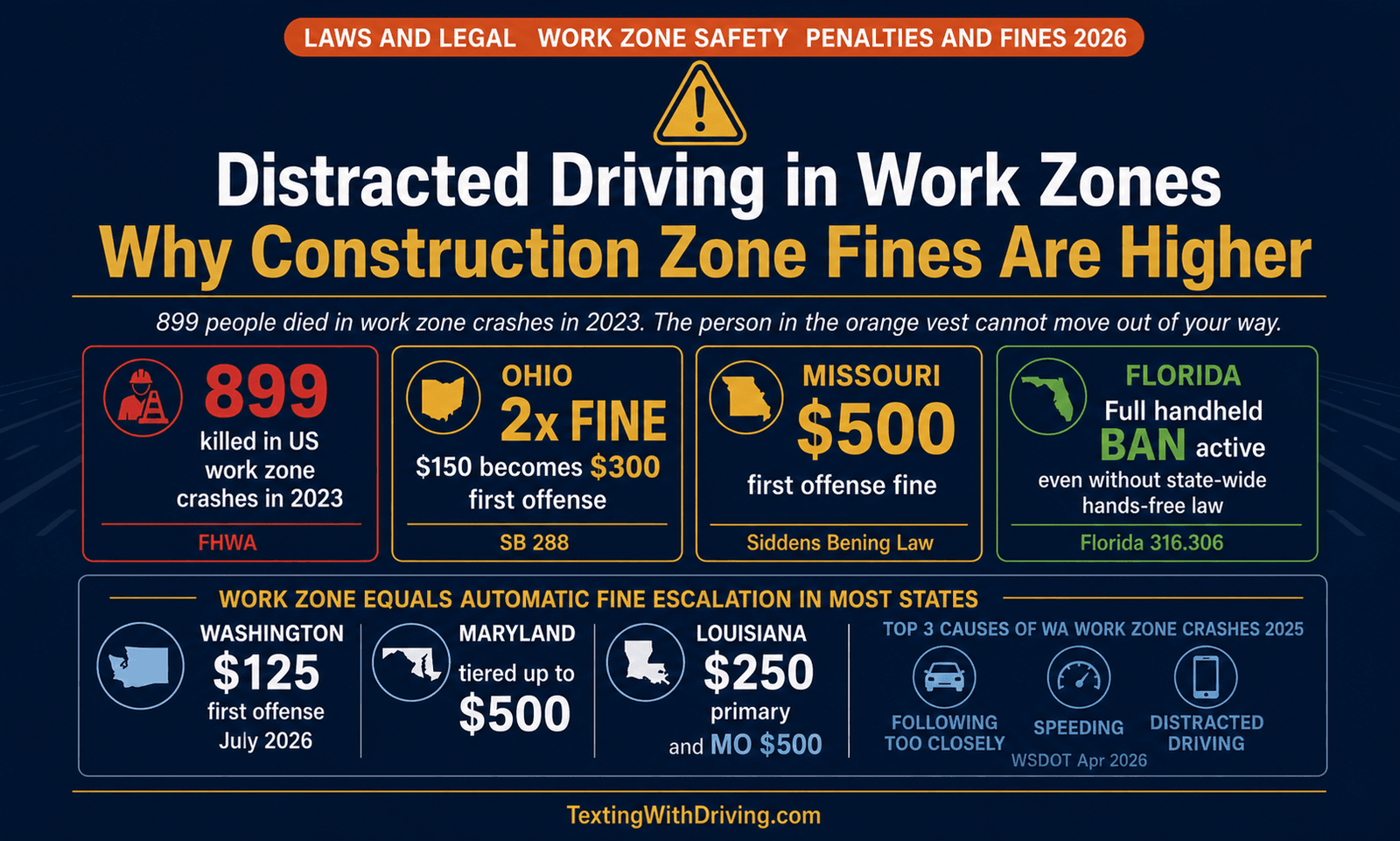
899 people were killed in work zone crashes in the United States in 2023, according to the Federal Highway Administration. Drivers are the ones more likely to be injured or killed in work zone crashes, but highway workers are all too often the victims. Behind each of those 899 deaths is a specific moment when a driver failed to maintain full attention in an environment where the margin for error had been reduced to near zero.
This article covers exactly what the enhanced work zone distraction penalties look like state by state, why they exist, when they apply, how camera enforcement is expanding to catch violations automatically, and what every driver needs to know before entering a construction zone.
Why Work Zones Demand More Attention, Not Less
The intuitive assumption many drivers make about work zones is backward. Because work zone speeds are reduced, drivers often feel that the driving is easier and the margin for inattention is larger. The reality is the opposite.
Work zones concentrate multiple specific hazards that require more active driving attention than normal highway conditions. Lane configurations change, sometimes dramatically, in very short distances. New lane markings appear alongside old ones, creating momentary confusion about which markings are authoritative. Merge points require gap selection in moving traffic. Equipment moves unpredictably across the roadway. Workers and flaggers appear at the edge of the travel lane. And the physical environment, including narrowed lanes, concrete barriers placed close to the travel path, and uneven pavement transitions, reduces the mechanical margin for error even as it demands more cognitive engagement from the driver.
Construction zones are any place on a highway or other roadway where workers are engaged in construction projects. Cell phone use, or failing to yield the right of way, is also a violation of the law in construction zones. NHTSA
A driver who enters a work zone while looking at a phone is combining maximum cognitive load on the secondary task with a driving environment that demands maximum cognitive load on the primary task. The result is a complete collapse of the hazard response capacity that the work zone specifically requires.
In 2025, the top three causes for work zone crashes in Washington were following too closely, speeding, and distracted driving, all of which are preventable. US Department of Transportation
Washington State’s 2025 work zone crash data explicitly identifies distracted driving as one of the three leading causes. This finding is consistent with FHWA analysis across multiple states and years. Distraction, speeding, and following too closely are the behavioral failures that produce the majority of work zone crashes. All three are entirely preventable with the same behavioral decision: put the phone down and slow down before entering the work zone.
The Legal Framework: Why Fines Are Higher in Work Zones
The enhanced penalty structure for violations in work zones reflects a policy judgment that the elevated risk to workers and drivers in these environments warrants a stronger financial deterrent than what applies on open roads.
Most states implement work zone enhanced penalties through one of three mechanisms. The simplest is a flat doubling or tripling of the standard fine. The second is a separate, elevated fine schedule specifically for work zone violations. The third is a categorical upgrade from secondary to primary enforcement within the work zone, allowing officers to stop drivers solely for phone use even in states where that requires another violation on open roads.
Many of these enhanced penalties apply regardless of whether workers are physically present at the moment of the violation. The work zone designation, established by posted signage and regulated lane markings, creates the enhanced fine zone that persists for the length of the designated work area.
State by State: The Enhanced Fine Structure
The work zone enhanced fine structures vary significantly by state. Here is the documented picture across the major states with specific work zone provisions.
Ohio provides one of the clearest examples of work zone fine doubling integrated directly into a comprehensive distracted driving law. Ohio doubles all distracted driving fines when violations occur in marked construction areas. A first offense that normally costs $150 jumps to $300 in work zones. This enhanced penalty structure recognizes the increased risks that distracted drivers create in these areas. Ohio’s first offense course completion option, which allows drivers to complete a distracted driving safety course in lieu of the fine, also remains available for work zone violations, though the point and fine consequences for those who do not complete the course are doubled relative to non-work-zone violations. Shorty Awards
Missouri’s Siddens Bening Hands-Free Law, which we covered in our Missouri hands-free driving law 2026 guide, carries a $500 first offense fine for violations in school zones and active construction zones. The standard first offense on an open Missouri road is $150. The work zone multiplier is more than three times the standard rate, making Missouri’s construction zone fine structure among the most financially significant in the country.
Louisiana’s HB 519, which we covered in our Louisiana hands-free law 2025 guide, carries a $250 fine for work zone violations compared to the standard $100. Louisiana also upgrades its work zone enforcement to primary offense status, meaning officers can stop drivers in construction zones solely for phone use even though the broader Louisiana law operates as secondary enforcement on open roads.
Florida provides the most dramatic example of a work zone provision that goes beyond fine enhancement into categorical prohibition for a state that does not have comprehensive hands-free law generally. Under Florida Statute 316.306, you cannot use any wireless device in a handheld manner while driving through school zones or active work zones. This means no phone calls, no checking texts, and no holding your device at all. An active work zone is defined as an area where construction personnel are present or operating equipment on the roadway or immediately adjacent to it. AT&T
A Florida driver who can legally hold their phone for a call anywhere else on the Florida road network faces a categorical primary offense prohibition the moment they enter an active work zone. The Florida work zone provision creates, in effect, a hands-free zone within the borders of a state that has not otherwise enacted a hands-free law.
Pennsylvania’s Paul Miller’s Law, fully enforced from June 6, 2026 as we covered in our Pennsylvania Paul Miller’s Law Day 1 article, includes enhanced penalties in work zones that add to the already significant base fine structure of the primary enforcement law.
Washington State is expanding its camera enforcement program in work zones with escalating penalties. Beginning July 1, 2026, the first infraction will cost $125. The second and all subsequent infractions remain $248. According to preliminary statistics, the total number of work-zone-related crashes was 1,557 in 2025, a slight decrease from the year before. US Department of Transportation
Minnesota law requires that any fine for speeding in a work zone must be at least $300, and the standard rule of doubling base fines applies to phone use violations in work zones as well, producing significant escalation from the open-road baseline.
California has doubled all fines for violations occurring in construction zones, with no traffic school option available to reduce or eliminate the doubled fine. The California approach ensures that the work zone premium applies to every driver who receives a citation in a designated construction area, without the safety valve of traffic school attendance.
Camera Enforcement: The 2026 Expansion
One of the most significant developments in work zone enforcement in 2025 and 2026 is the expansion of automated camera enforcement specifically within work zone boundaries, extending enforcement coverage beyond what officer presence alone can achieve.
Maryland’s State Highway Administration reminded motorists that changes to state law governing the use of automated speed enforcement in work zones took effect June 1, with additional changes effective January 1, 2025. The new law allows speed cameras to be placed in more work zones across the state. In some larger work zones more than one camera may be deployed. Defensivedriversinstitute
Maryland’s tiered fine system, ranging from $60 for 12 to 15 mph over the limit to $500 for 40 mph or more above the limit, creates a graduated deterrent that the camera system enforces around the clock without requiring officer presence. The expansion of camera placement authority to more work zones means that more of Maryland’s active construction sites now have continuous automated enforcement.
Washington State is explicitly planning expansion of its camera enforcement program. The second year of the program will bring additional cameras, with up to 15 in operation by 2027 and expansion to eastern Washington. US Department of Transportation
The camera enforcement model for work zones parallels the camera enforcement approach we covered for school zones in our school zone distracted driving laws article. Fixed-location cameras provide continuous coverage that cannot be achieved through patrol-based enforcement, creating a deterrent that applies every hour of every day the work zone is active rather than only during the windows when officers are present.
For distracted driving specifically, the camera enforcement trend is moving toward AI-powered phone detection systems that can document screen-illuminated phone use inside vehicles passing through work zones, similar to the systems being piloted by law enforcement departments in Australia and parts of the United States. As we covered in our article on how police enforce distracted driving laws, these AI camera systems represent a qualitative expansion of enforcement capacity that manual policing cannot match.
The Human Cost: Who Dies in Work Zones
The 899 work zone fatalities in 2023 documented by the Federal Highway Administration represent both the drivers who fail to navigate work zones safely and the workers whose lives are directly at risk from those failures.
Speeding is the main cause of accidental deaths in construction zones and drivers are the ones who are more likely to be injured or killed in the accidents that result. However, all too often, highway workers are the victims. NHTSA
Highway workers who die in work zone crashes did not make any unsafe driving decision. They were doing their jobs in a location that their employer required them to occupy. A flagged worker directing traffic at a construction site merge point, a highway maintenance worker repainting lane markings, a utility crew working on roadside infrastructure — all of these workers are present in the travel corridor because their work requires it. None of them can protect themselves from a driver who is looking at their phone rather than at the road.
The moral dimension of work zone distracted driving is similar to the pedestrian dimension we documented in our distracted driving and pedestrian safety article. The worker in the orange vest made no unsafe choice. They have no ability to anticipate or avoid a distracted driver. Their safety depends entirely on every passing driver making the right decision about their phone before entering the work zone.
The human stories behind Maryland’s work zone safety campaign illustrate this specifically. Between 2018 and 2022, there were 7,193 work zone crashes in Maryland, or roughly 1,500 each year. Forty-four people were killed in those crashes and 2,769 were injured. Many of the victims are highway workers, but others are drivers and their passengers. Defensivedriversinstitute
1,500 work zone crashes per year in a single mid-sized state. 44 deaths over five years. 2,769 injuries. These are the human-scale consequences of the distraction and speeding failures that work zone enhanced penalties are designed to deter.
When Work Zone Laws Apply: Active vs. Posted Zones
One practical question that many drivers have about work zone penalties is whether they apply only when workers are physically present or whenever a work zone is designated by signage.
The answer varies by state and by the specific law, but the general pattern is that enhanced penalties apply to the designated work zone area as marked by official signage, not only to moments when workers are physically visible.
The Florida definition provides a clear example. Florida defines an active work zone as an area where construction personnel are present or operating equipment on the roadway or immediately adjacent to it. This definition requires actual worker presence for the enhanced restriction to apply. A Florida work zone with signage in place but no workers present at the moment of the drive may not trigger the Florida-specific work zone prohibition, though the posted signage itself is ambiguous evidence about worker presence.
Most states, however, apply enhanced penalties to the entire designated work zone corridor regardless of whether workers are present at any specific moment. The rationale is that workers move within the zone, visibility is limited, and the road conditions created by the construction, including lane shifts, barriers, and pavement changes, create elevated risk throughout the designated area even during periods when workers are not immediately visible.
The safest practical approach for every driver is to treat work zone signage as activating the enhanced legal framework for the entire designated corridor, from the first work zone warning sign to the end of construction sign. Phone away before the first orange sign. Not retrieved until the end of construction sign has been passed.
The Infrastructure Design Dimension
Beyond the legal and enforcement dimensions of work zone distracted driving, the physical environment of work zones itself is evolving to address the reality that some drivers will not comply with phone restrictions.
Variable message signs can display warnings like “Don’t Text and Drive” or alert drivers to upcoming hazards, refocusing attention. In work zones, clear signage reduces confusion, preventing distracted drivers from missing cues. Barriers, such as traffic barricades and Jersey walls, provide physical separation, protecting workers and other road users if a distracted driver veers off course. The Global Statistics
The combination of dynamic messaging that recaptures driver attention and physical barriers that protect workers when behavioral compliance fails represents the infrastructure engineering response to the distraction problem. The Jersey wall that separates the travel lane from the work area does not prevent the distracted driving event. It mitigates the consequences when the event occurs despite all deterrence efforts.
This layered approach, legislation plus enforcement plus physical protection, reflects the Safe System philosophy we discussed in our distracted driving and pedestrian safety article. Road design should be forgiving of human error. In work zones, this forgiving design takes the specific form of physical separation between workers and vehicles that provides some protection against the crashes that distracted driving produces.
The Practical Checklist for Work Zone Driving
The pre-work-zone behavioral protocol is the same as the pre-drive protocol we cover throughout this site, applied with specific urgency at the approach to work zone signage.
When you see the first orange work zone sign: phone goes in back seat if it is not already there. No navigation interaction. No incoming call acceptance. No checking of any kind until the end of construction sign. GPS audio guidance only, pre-set before the work zone was entered.
This applies regardless of how familiar the work zone is. Familiar work zones are the ones where complacency is highest and where the specific configuration, which may have changed overnight, is most likely to surprise a driver who is not paying full attention.
For the complete technology setup that makes this automatic before every drive, not just before work zones, our Do Not Disturb while driving setup guide covers both iPhone and Android from scratch. For the full national picture of state distracted driving fines including work zone enhanced penalties, our texting while driving fines by state 2026 guide covers every state. And for the broader context of what distracted driving produces in crashes and deaths nationwide, our distracted driving statistics 2026 overview has everything in one place.
The person in the orange vest is counting on your decision about your phone. Make it before the first orange sign.
Sources Used in This Article
All links verified working before publication.
FHWA: Work Zone Safety Statistics — 899 work zone deaths in 2023, national data
WSDOT: Speed Cameras Bring Added Safety to Work Zones — Washington distracted driving third cause, $125 first infraction July 2026, April 16, 2026
Ohio Attorney Mike: Ohio Distracted Driving Laws Accident Compensation Guide 2025 — Ohio doubles fines in work zones, $300 first offense, September 2025
Wiseman Trial Law: Florida Texting While Driving Laws 2025 — Florida Statute 316.306 work zone full handheld ban, January 2026
MDOT SHA: Enhanced Work Zone Safety Laws — Maryland tiered fine system, camera expansion, May 2024
Zero Deaths Maryland: Work Zone Safety — Maryland $80 to $500 tiered fines, 7,193 crashes 2018-2022
LegalMatch: Speeding in Construction Zone Laws — FHWA 899 deaths, Minnesota $300 minimum, cell phone work zone prohibition
Traffic Safety Store: Distracted Driving 2025 Tech and Laws — Variable message signs, Jersey walls, infrastructure response, August 2025
Work Zone Safety Information Clearinghouse: Laws and Standards — State law library
GHSA: Distracted Driving State Laws — National state law comparison context
TextingWithDriving.com is professionally built and maintained to ensure accurate, accessible safety information reaches every driver who needs it. Website development and ongoing support is handled by Budgetic, a digital agency specializing in purpose-driven WordPress websites.

About Texting With Driving
TextingWithDriving.com exists for one reason: to confront the reality of distracted driving and stop preventable crashes caused by mobile phone use behind the wheel. Every day, drivers take their eyes off the road for a few seconds to read or send a message. Those few seconds are enough to cause life-altering consequences. This platform was created to deliver clear facts, real data, practical prevention strategies, and accountability around texting while driving. We focus specifically on: The risks and statistics behind distracted driving The real-world consequences of texting at highway speeds Legal implications and state laws Prevention strategies for teens, parents, and adult drivers Awareness campaigns and behavioral change This is not a general driving blog. It is a focused awareness initiative built around one critical issue: phone distraction behind the wheel. Our content is direct, research-driven, and practical. We prioritize accuracy over opinion and education over sensationalism. The goal is simple — reduce distracted driving incidents by increasing awareness and responsibility. If one article causes one driver to put their phone down, the mission is working. For inquiries or partnerships, contact: privacy@textingwithdriving.com
View all posts by Texting With Driving