

Distracted Driving and Mental Health 2026: The Anxiety, Stress and FOMO Connection

Distracted Driving and Mental Health: The Anxiety, Stress and FOMO Connection
Every piece of content about distracted driving eventually arrives at the same recommendation: put your phone away before you drive. The advice is correct. The problem is that for a significant proportion of drivers, the difficulty of following that advice is not ignorance about danger. It is something more complex happening in their relationship with their phone.
The research has been accumulating for years across behavioral psychology, road safety science, and mental health literature, and it is now substantial enough to state clearly: for many drivers, phone use while driving is not simply a habit or a momentary lapse of judgment. It is a behavioral expression of underlying psychological states — anxiety, FOMO, stress, and in some cases compulsive patterns — that willpower alone is demonstrably inadequate to address.
Understanding this connection does not excuse the behavior or reduce its danger. A crash caused by a driver who could not resist checking their phone because of anxiety is no less catastrophic than a crash caused by simple inattention. But understanding the mental health dimension of distracted driving changes how prevention should be designed, how drivers should think about their own behavior, and what interventions actually work for the population of drivers for whom phone-free driving is genuinely psychologically difficult rather than simply inconvenient.
FOMO: The Behavioral Driver That 85 Studies Confirm
Fear of missing out, commonly abbreviated as FOMO, is defined as the apprehension of missing out on socially rewarding experiences that others may be having. It is closely related to social anxiety, generates compulsive social media checking behavior, and has been studied extensively in the context of problematic smartphone use.
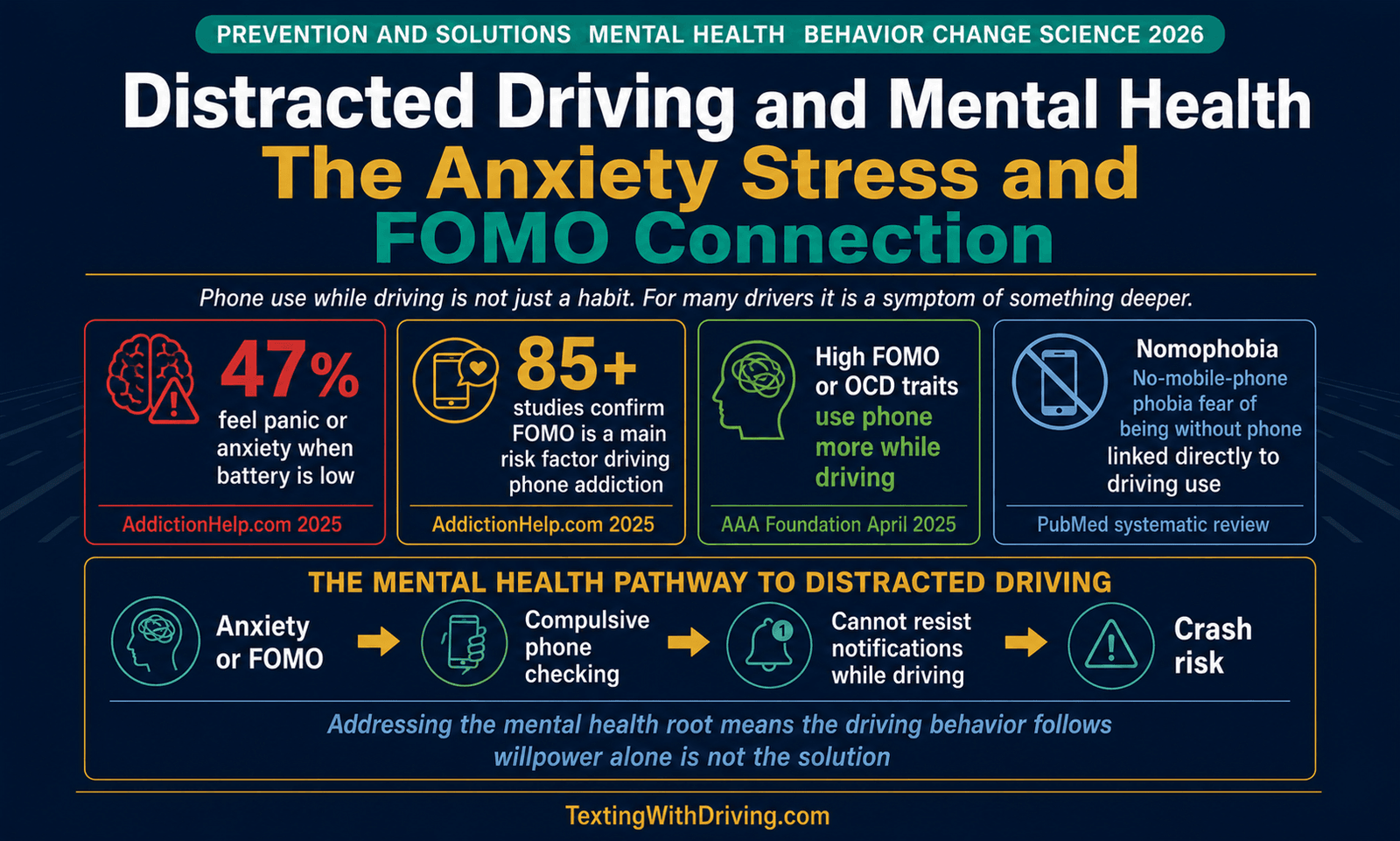
More than 85 studies were compiled into a single report, which concluded that FOMO is closely related to excessive phone use and a main risk factor in driving phone addiction rates. NHTSA
85 studies. A main risk factor. Not a contributing factor or a correlate. A main risk factor for the phone addiction that produces distracted driving. The volume and consistency of the FOMO research in this context makes it one of the most robustly supported findings in the behavioral psychology of smartphone use.
FOMO, the fear of missing out, is related to missing potential social interactions by not engaging with a phone. Those with higher levels of FOMO or obsessive-compulsive disorder have been shown to use their smartphone more frequently while driving. NHTSA
Higher levels of FOMO produce more frequent smartphone use while driving. This is not a self-reported association from a single survey. It is a finding replicated across multiple research designs using objective phone interaction data, driving simulator studies, and naturalistic driving research.
The mechanism is direct: FOMO creates a persistent background anxiety about social connection, social information, and social standing that a smartphone notification can temporarily relieve. When a notification arrives while driving, the FOMO-affected driver experiences not just a neutral alertness cue but an anxiety-relevant signal: something has happened in the social environment they need to know about. The pull toward checking is not willpower competing with temptation. It is an anxiety-reduction mechanism activating against a competing safety concern.
The PLOS One research on problematic smartphone use and driving behavior confirms this: FOMO is closely related to problematic smartphone use, which McGinnis established as a common social influencing factor on young people’s mental health. Smartphone use while driving, FOMO, and problematic smartphone use are significantly correlated, particularly under conditions of high social reward salience. NHTSA
Nomophobia: The Fear of Being Without Your Phone
Alongside FOMO, a related psychological phenomenon has emerged in the clinical and behavioral literature that has specific relevance to distracted driving: nomophobia, derived from “no-mobile-phone phobia,” which describes an irrational fear of being separated from one’s phone.
Emerging road safety research has started to explore new constructs such as Fear of Missing Out (FOMO) and no-mobile-phone-phobia (Nomophobia) to identify determinants of phone use among road users. Nomophobia, FOMO, mobile phone involvement, cell phone overuse, mobile phone dependency, possession attachment to phone, and compulsive mobile phone checking are all covered under the umbrella of maladaptive mobile phone use, which is identified as a possible determinant of risky phone use behavior on the road. NHTSA
Nomophobia manifests as significant distress when a person is separated from their phone, when the phone battery is low, when they are in an area with poor signal, or when they are in a situation where phone use is restricted. The driving context is precisely such a situation: the phone is present but use is restricted by law, safety norms, and good judgment.
47 percent of respondents said they feel panic or anxiety when their phone gets a low battery. NHTSA
Nearly half of drivers feel panic or anxiety about a low battery. The panic about battery level is not primarily about practical concerns like missing an important call. It is an anxiety response to the perceived threat of disconnection that nomophobia creates. A driver who feels genuine anxiety about their phone battery is a driver who is experiencing the phone’s presence as psychologically significant in a way that goes well beyond its utility as a communication tool.
For this driver, putting the phone in the back seat before driving is not a simple behavioral choice. It is a step that requires managing a low-level anxiety about separation that operates continuously in the background of their driving experience. This is why the environmental restructuring approach, which we covered in our 10 proven ways to stop texting while driving guide, works better than willpower for this population. Removing the phone from reach addresses the anxiety-related pull before it activates, rather than asking the driver to resist it in real time.
Work Stress and Responsive Availability Pressure
Beyond FOMO and nomophobia, workplace stress and professional communication expectations create a distinct mental health pathway to distracted driving that is particularly relevant for adult drivers in demanding professional roles.
The expectation of responsive availability — the implied or explicit professional requirement to be reachable and responsive to communications at all times — creates a specific anxiety about non-response that is separate from social FOMO. A professional who receives a message from a client, a manager, or a colleague while driving experiences not just the social pull to connect but a professional anxiety about the consequences of delayed response.
This is the dimension that makes the employer policy component of distracted driving prevention so important. When the professional communication expectation is managed at the organizational level, through explicit policies about driving response times and expectations, the individual driver is released from the professional anxiety that drives the impulse to check messages during driving. The organizational norm does the work that willpower cannot do alone.
As we documented in our employee distracted driving policy guide, the employer who creates an explicit policy that no response is expected from employees while driving is not just reducing liability. They are addressing the underlying professional anxiety that makes their employees’ hands reach for their phones.
The specific auto-reply strategy we covered in our 10 proven ways to stop texting while driving article works through the same mechanism at the individual level. When an auto-reply communicates to every sender that the driver is operating a vehicle and will respond when they arrive, the professional anxiety about non-response is managed by the technology rather than requiring the driver to tolerate the anxiety without any communicative response.
Emotional Dysregulation and Impulsive Phone Use
Beyond the specific constructs of FOMO and nomophobia, the broader category of emotional dysregulation contributes to distracted driving in ways that the mental health literature is beginning to document more systematically.
Phone addiction mediates the relationship between certain personality traits and use of smartphones while driving. Additionally, maladaptive mobile phone use has been identified to directly affect the frequency of mobile phone use while riding a motorcycle and can also be associated with drivers’ dangerous phone use. NHTSA
The mediation pathway — personality traits leading to phone addiction which leads to driving phone use — is important because it identifies where intervention is most effective. Interventions that target the driving phone use behavior directly compete with the personality and addiction dynamics that motivate it. Interventions that address the underlying phone relationship reduce the driving behavior as a downstream consequence.
Emotional dysregulation, which describes the difficulty of managing emotional states within a normal range, is associated with higher rates of impulsive smartphone use. A driver who is experiencing elevated stress, conflict-related distress, or emotional overwhelm before getting in the car is more likely to reach for their phone during the drive as a soothing behavior — seeking the dopamine-mediated comfort of social connection or the distraction of scrolling — than a driver who is emotionally regulated.
The pre-drive emotional state is therefore a meaningful predictor of in-drive phone use risk. As we covered in our article on the psychology of phone addiction and distracted driving, the dopamine response cycle that makes phone notifications compelling is particularly powerful when emotional resources are depleted. A driver who is stressed, upset, or overwhelmed has reduced prefrontal cortex capacity for impulse regulation, making the pull toward phone use harder to resist than it would be under neutral emotional conditions.
The Research Findings on What Works for This Population
The AAA Foundation’s April 2025 research report on increasing the use of smartphone-limiting technology specifically addresses the population of drivers for whom phone use while driving is connected to psychological states rather than simple habit.
Those who believed phone use would harm others or who reported higher levels of regret post-use were less likely to engage their smartphones while driving. Phone addiction mediates the relationship between certain personality traits and use of smartphones while driving. NHTSA
Two findings emerge from the AAA research that have direct implications for mental health-aware prevention. First, the belief that phone use would harm others, which is an empathy-based awareness of external consequences, reduces distracted driving among this population more effectively than awareness of personal risk. This is consistent with the broader research on prosocial motivation in behavior change: other-directed consequences activate different motivational systems than self-directed consequences and are more effective for impulsive behavior patterns.
Second, regret after phone use during driving reduces subsequent phone use. This creates a specific behavioral strategy: deliberately reflecting on and articulating regret following a phone use event while driving activates the emotional learning system that can build the aversion response that pure willpower cannot sustain. The reflection is not self-punishment but a deliberate use of emotional memory to strengthen the behavioral commitment.
The specific environmental tools that work across all populations, phone in back seat, driving mode active, Bluetooth for calls, GPS pre-set, work even better for high-FOMO and nomophobic drivers because they remove the anxiety trigger before it activates. A phone in the back seat with all notifications silenced does not generate the anxiety that a visible, accessible phone with notifications arriving creates. The environmental intervention does not require the driver to tolerate anxiety-relevant stimuli. It prevents those stimuli from arising.
The Digital Wellness Connection: Addressing the Root
This article belongs in a mental health context as much as a road safety context because the root cause it describes — anxiety, FOMO, nomophobia, stress-driven phone seeking — is not primarily a driving problem. It is a phone relationship problem that expresses itself dangerously during driving.
Drivers who recognize any of these patterns in themselves — the anxiety about low battery, the compulsive notification checking, the difficulty leaving the phone face-down without checking, the professional anxiety about response times — are experiencing something that has received substantial clinical and research attention outside the road safety literature.
Digital wellness approaches, including structured screen time limits, notification discipline, intentional phone-free periods during other activities, and for more severe patterns, support from mental health professionals who work with behavioral addictions, can address the underlying phone relationship in ways that improve both the driver’s wellbeing generally and their driving behavior specifically.
The driving mode strategy that we cover in our Do Not Disturb while driving setup guide is, from this perspective, not just a road safety tool. It is a daily digital wellness practice: a structured period in which the phone’s anxiety-generating notifications are deliberately silenced, the response anxiety is managed by auto-reply, and the driver has a protected environment in which full attention to a single task — driving — is required and supported.
For drivers who find this framing useful: every drive is a potential digital wellness practice. The phone-free drive is not just a safety choice. It is a daily exercise in attention management, anxiety tolerance, and the experience of being present without the constant pull of the digital social environment.
The Prevention Implication: Going Deeper Than Awareness
The mental health connection in distracted driving research changes what prevention should look like for a significant subset of the driving population.
Standard awareness-based prevention assumes that the driver does not know the behavior is dangerous, or knows but has not properly internalized the danger, and that providing more compelling danger information will produce behavior change. For the FOMO-affected driver, the nomophobic driver, and the stress-driven phone seeker, this assumption is incorrect. These drivers often know exactly what they are doing is dangerous and reach for the phone anyway, because the anxiety-reduction value of the phone interaction competes more powerfully with the abstract danger of a crash than awareness arguments can overcome.
Prevention for this population requires addressing the anxiety, not just the knowledge. This means tools that reduce the anxiety before it motivates phone use: auto-reply messages that manage the social obligation anxiety; driving modes that remove the notification stimulus entirely; explicit professional policies that eliminate the responsive availability pressure; and for drivers who recognize more significant patterns, connection to the digital wellness and behavioral health resources that can address the underlying phone relationship.
The research is clear that higher levels of regret and other-concern reduce driving phone use even in high-FOMO populations. The most effective framing for a distracted driver who recognizes the mental health dimension of their phone use might be: every person in the other vehicles shares the road with me. My anxiety is mine. The risk belongs to all of them.
For the complete behavioral framework that addresses the pre-drive setup, our 10 proven ways to stop texting while driving guide covers the environmental restructuring and technology approaches that work regardless of the psychological dimension. For the national death toll context, our distracted driving statistics 2026 overview has everything in one place. And for the underlying neuroscience of why the dopamine notification cycle is so powerful, our article on the psychology of phone addiction and distracted driving covers the full biological mechanism.
If you are personally struggling with anxiety, stress, or patterns of compulsive phone use that go beyond driving, speaking with a mental health professional who works with behavioral patterns and digital wellness is a meaningful step. This content is informational and is not a substitute for professional support.
Sources Used in This Article
All links verified working before publication.
AAA Foundation for Traffic Safety: Increasing the Use of Smartphone-Limiting Technology to Combat Distracted Driving — FOMO and OCD traits drive more frequent smartphone use while driving, DND usage data, April 2025
AddictionHelp.com: Phone Addiction Statistics Usage Effects and Key Trends 2025 — 85+ studies confirm FOMO as main risk factor, 47% low battery anxiety, October 2025
PubMed: Is Distraction on the Road Associated with Maladaptive Mobile Phone Use? Systematic Review — MMPU systematic review, nomophobia, FOMO framework
ScienceDirect: Is Distraction on the Road Associated with Maladaptive Mobile Phone Use? — Phone addiction mediates personality-driving phone use relationship
PMC: Fear of Missing Out Predicts Distraction by Social Reward Signals on Smartphones in Difficult Driving Situations — FOMO modulates attentional capture by smartphone signals, Frontiers in Psychology
PLOS One: Surfing in the Streets — Problematic Smartphone Use FOMO and Antisocial Personality Traits Linked to Driving Behavior — FOMO and SUWD correlation, 2023
PMC: Determining How Individuals Manage Their Driving Anxiety — 40 million Americans with anxiety, driving phobia prevalence
IIHS: Distracted Driving Research — Over one fifth of drivers engage in smartphone-based distraction on most trips
NHTSA: Distracted Driving — 3,208 deaths 2024, national statistics
TextingWithDriving.com is professionally built and maintained to ensure accurate, accessible safety information reaches every driver who needs it. Website development and ongoing support is handled by Budgetic, a digital agency specializing in purpose-driven WordPress websites.

About Texting With Driving
TextingWithDriving.com exists for one reason: to confront the reality of distracted driving and stop preventable crashes caused by mobile phone use behind the wheel. Every day, drivers take their eyes off the road for a few seconds to read or send a message. Those few seconds are enough to cause life-altering consequences. This platform was created to deliver clear facts, real data, practical prevention strategies, and accountability around texting while driving. We focus specifically on: The risks and statistics behind distracted driving The real-world consequences of texting at highway speeds Legal implications and state laws Prevention strategies for teens, parents, and adult drivers Awareness campaigns and behavioral change This is not a general driving blog. It is a focused awareness initiative built around one critical issue: phone distraction behind the wheel. Our content is direct, research-driven, and practical. We prioritize accuracy over opinion and education over sensationalism. The goal is simple — reduce distracted driving incidents by increasing awareness and responsibility. If one article causes one driver to put their phone down, the mission is working. For inquiries or partnerships, contact: privacy@textingwithdriving.com
View all posts by Texting With Driving