

How Self-Driving Cars Will Change Distracted Driving: What the Research Shows

How Self-Driving Cars Will Change Distracted Driving: What the Research Shows
The promise of self-driving cars has been explicit for years: once the car does the driving, the distraction problem disappears. Drivers can check their phones, watch videos, sleep, read, work, do anything they want, because the vehicle handles the road.
That promise is partially real and almost entirely premature. And for the tens of millions of drivers who currently use Level 2 partial automation systems like Tesla’s Autopilot, General Motors’ Super Cruise, or Ford’s BlueCruise, a specific and well-documented danger exists that most users do not know about.
The research does not show that partial automation reduces distracted driving. It shows the opposite. And understanding why this paradox exists is essential for anyone who drives a modern vehicle with advanced driver assistance features in 2026.
The SAE Automation Level Framework: Where We Actually Are
The public conversation about self-driving cars consistently conflates very different levels of automation capability, which makes both the opportunity and the danger of current technology difficult to assess accurately.
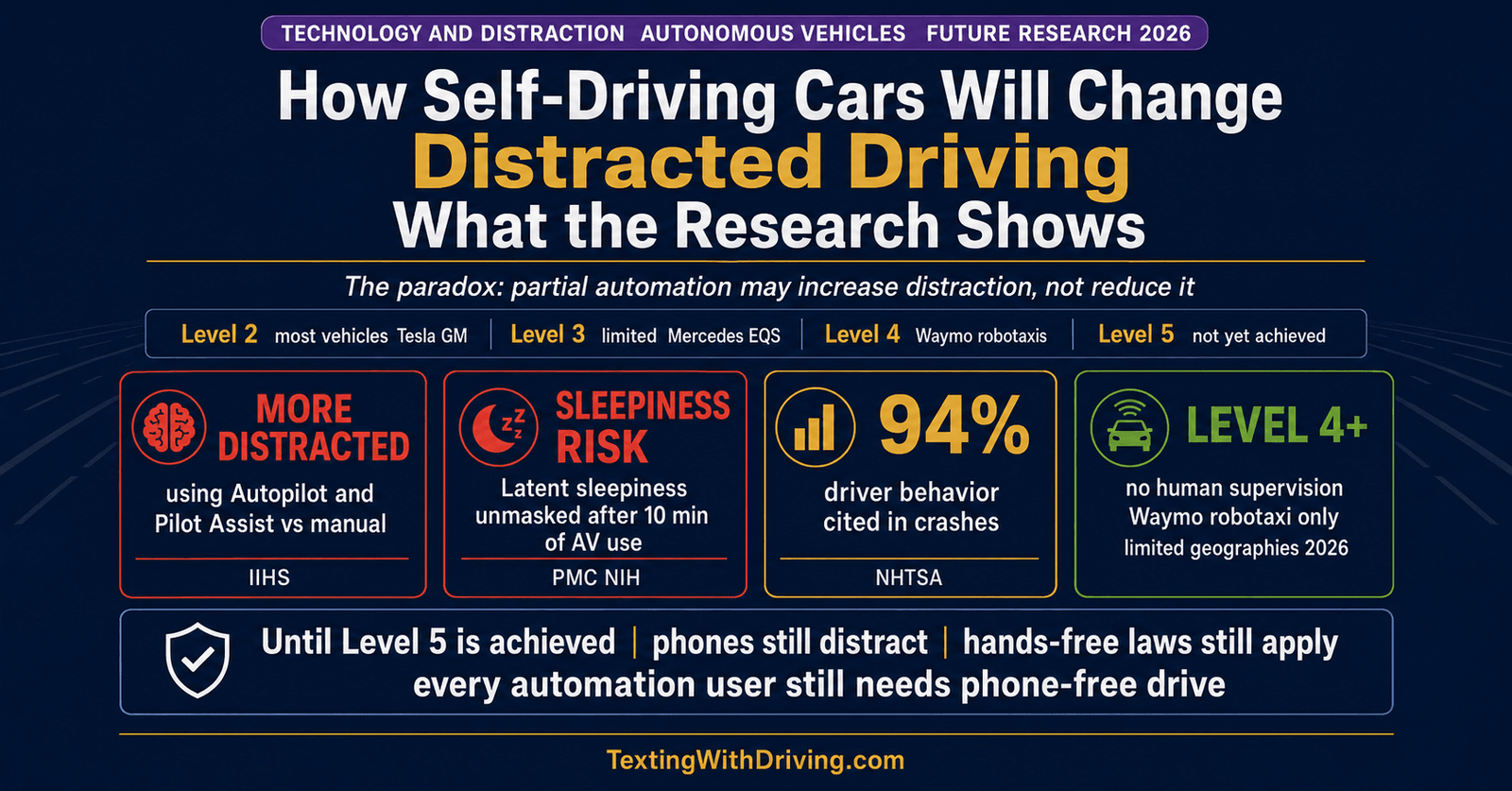
SAE International defines six automation levels, from Level 0, which is no automation, to Level 5, which is full automation requiring no human involvement in any driving scenario. In 2026, the automotive landscape looks like this:
The closest we have today is Level 2+ and Level 3 autonomy, where cars can drive themselves under certain conditions but still require human intervention. No company has yet achieved Level 5, where a car can drive itself in any situation without human oversight, meaning no steering wheel, no pedals, just a fully automated experience. NHTSA
Tesla vehicles currently operate at Level 2 automation, which requires continuous driver supervision and does not constitute full self-driving capability. Tesla’s Full Self-Driving (Supervised) system provides semi-autonomous navigation on nearly all roads, self-parking, and the ability to summon the car from a parking space, but the driver is required to remain attentive and ready to take control at any moment. NHTSA
Level 2 automation, which handles steering and speed within defined parameters while requiring continuous human supervision and readiness to intervene, is the technology in millions of vehicles on American roads right now. Level 3, where the vehicle can handle all driving tasks under specific conditions and the driver does not need to monitor continuously but must be available to take control when requested, exists in very limited form in a small number of vehicle models and geographic deployments. Level 4, where the vehicle handles all tasks without human intervention within a defined operational domain, exists only in Waymo’s robotaxi service in limited cities. Level 5 does not yet exist in any commercial deployment.
The practical implication for every current driver is that if you are operating a personally owned vehicle in 2026, including a Tesla with Full Self-Driving activated, you are operating a Level 2 system that requires your constant attentive supervision. The legal and safety obligation to maintain awareness and readiness to take control has not been transferred to the vehicle. It remains entirely with you.
The Paradox: Why Partial Automation May Increase Distraction
Here is the finding that should be at the center of every conversation about autonomous vehicles and distracted driving.
Recent studies from the Insurance Institute for Highway Safety suggest that drivers using advanced automation features like Tesla’s Autopilot and Volvo’s Pilot Assist are becoming more distracted, not less. This goes against the common expectation that these features would help reduce accidents and increase road safety. Instead, they may be contributing to an increased risk of crashes, as drivers become too reliant on the technology to handle key tasks. Facebook
More distracted, not less. The IIHS finding is counterintuitive but has a clear mechanistic explanation that the cognitive science of driving fully supports.
When a driver activates Autopilot and the vehicle begins maintaining lane position and following distance automatically, the cognitive resources that were dedicated to those tasks are no longer required. They are freed up. But freed cognitive resources in a brain with a phone notification waiting in the cupholder or a social media feed loaded on the mounted device are not neutrally available. They are immediately available for secondary task engagement.
The driver who activates Autopilot on an empty highway and picks up their phone is not making an irrational decision. They are responding logically to the immediate experience of reduced driving demand. The automation is handling the steering. The speed is stable. Nothing seems to require attention. Why not check the message?
The answer is what the IIHS research documents: the automation is not actually handling the driving responsibility. It is handling the mechanics while the human retains the responsibility to monitor for situations that exceed the automation’s capability, intervene when required, and maintain the situational awareness needed to take immediate control at any moment. Picking up the phone does not remove that responsibility. It removes the capacity to fulfill it.
Many Tesla drivers learn how to give the steering wheel just enough nudges to avoid escalating attention warnings without actually paying full attention. Instead of focusing on the road, they might check their phones, eat, or perform other tasks. Over time, as drivers become more familiar with these systems, their tendency to engage in distracting activities increases. Facebook
Drivers actively defeating the attentiveness monitoring systems by providing minimal steering inputs that satisfy the sensor without demonstrating actual engagement. This is not a fringe behavior. It is documented as a pattern that develops with familiarity. The longer a driver uses Autopilot, the more comfortable they become with the system, and the more likely they are to disengage their own attention while the system’s safety monitoring is technically satisfied.
The Sleep Paradox: Automation and Latent Fatigue
Beyond the phone distraction finding, the research on automated vehicles reveals a second concerning paradox involving fatigue.
Driving conditions that do not require frequent use of vehicle controls, but do require constant vigilance for hazards, may paradoxically reduce driver alertness, even after only 10 minutes on the road. Such conditions may even put drivers to sleep. Prolonged periods of automated driving may become outright boring for some drivers left on standby. AT&T
Our findings suggest that the introduction of partial self-driving capabilities in vehicles has the potential to paradoxically increase accident risk through the unmasking of latent sleepiness relative to manually controlled driving. Tennessee Traffic Safety Resource Service
The sleepiness paradox is the physiological companion to the distraction paradox. A driver who is mildly fatigued can maintain adequate alertness through the physical and cognitive engagement of manual driving: steering inputs, speed adjustments, continuous environmental scanning. These actions serve as their own alertness mechanism. Activate Autopilot, remove those engagement demands, and the driver’s underlying fatigue is unmasked. Drowsiness that manual driving was suppressing through active engagement is no longer suppressed.
Ten minutes. That is how quickly the fatigue unmasking effect was measurable in research conditions. A driver who activates Autopilot for a ten-minute highway stretch may be significantly less alert at the end of that stretch than at the beginning, even if they felt alert when the automation was activated.
This paradox has appeared in the real-world crash data involving automated vehicles.
In cases involving semi- and fully autonomous vehicles, the operators either did not react in time to a safety-critical event or were distracted at the time of the crash. In the case of a fatal crash involving a vehicle operating in semi-autonomous mode, the National Transportation Safety Board reported that the driver’s pattern of use of the system indicated an over-reliance on the automation and a lack of understanding of the system limitations. Kargo
Over-reliance on automation. Lack of understanding of system limitations. These are not fringe failure modes. They are the documented cognitive errors that the partial automation paradox produces systematically in drivers who use the technology as if it provides more capability than it actually does.
The Complacency Research: What Happens With Extended Use
The pattern of growing complacency with extended automation use is one of the most consistent findings across multiple research programs examining Level 2 system users.
Empirical studies involving Tesla Autopilot users have shown that prolonged exposure to reliably performing Level 2 automation often results in passenger-like viewing behaviours, including extreme cases such as drivers sleeping at the wheel. These behaviours illustrate the risks associated with overreliance on automation, leading to reduced attention and increased distraction. NHTSA
Passenger-like viewing behaviors. The driver behind the wheel of a Level 2 automated vehicle begins to behave, over time, like a passenger in someone else’s vehicle. The expectation of having to intervene recedes because the system performs reliably in normal conditions. Each successful automated drive without a required intervention reinforces the subjective sense that the system can handle it alone. The driver’s monitoring attention degrades as this reinforced expectation grows.
Research indicates that Tesla Autopilot users might misuse automation, becoming complacent and engaging in hazardous behaviors such as hands-free and mind-off driving, intentionally manipulating the steering wheel to feign attentiveness, and sleeping while the system is engaged. NHTSA
The specific behaviors documented in Tesla user research, steering wheel manipulation to avoid attentiveness warnings, sleeping, and mind-off driving, are not the behaviors of uninformed users. They are the behaviors of experienced users who have developed an accurate model of what the automation monitoring systems require to remain satisfied, and who use that knowledge to exploit the gap between technical attentiveness compliance and actual cognitive engagement.
The IIHS response to this documented failure mode is a ratings system for partial automation safeguards. The new IIHS ratings aim to encourage safeguards that can help reduce intentional misuse and prolonged attention lapses as well as to discourage certain design characteristics that increase risk in other ways. These results are worrying, considering how quickly vehicles with these partial automation systems are hitting our roadways. NHTSA
The Legal Framework: Hands-Free Laws and Level 2 Vehicles
The expansion of hands-free driving laws that we have documented throughout this series, covering now 33 states plus DC with primary enforcement, applies to Level 2 automated vehicle drivers with the same force as to any other driver.
A Tesla driver operating Full Self-Driving in Pennsylvania is subject to Paul Miller’s Law, which as we covered in our Pennsylvania Paul Miller’s Law enforcement article took effect June 6, 2026. Holding a phone while FSD is active is a primary offense, citable without any other violation.
A driver operating Super Cruise in Ohio is subject to Senate Bill 288, which we covered in our Ohio distracted driving law results 2026 article. The automation is handling the lateral and longitudinal control of the vehicle. The driver is still legally operating a motor vehicle on a public road and is still subject to the same phone-in-hand prohibition that applies to any other driver.
This is the legal reality that many drivers using partial automation systems do not fully understand. Activation of Autopilot, FSD, Super Cruise, or any other Level 2 system does not create a legal window for phone use. The driver remains legally responsible for the vehicle and legally subject to all distracted driving prohibitions.
What Level 4 and Level 5 Would Actually Change
The genuine long-term promise of autonomous vehicle technology for the distracted driving problem is real, but it requires a level of autonomy that does not currently exist in personal vehicles.
Level 4 automation, where the vehicle handles all driving tasks within a specific operational domain without requiring human supervision, does fundamentally change the distraction equation. A Waymo robotaxi passenger is genuinely free to use their phone because the vehicle’s autonomy system is responsible for all driving decisions within its operational domain. There is no human driver supervision requirement.
Human error is cited as a contributing factor in the vast majority of highway accidents, according to long-standing research including studies cited by NHTSA, with driver-related behavior contributing to over 94 percent of accidents. If Level 4 autonomy were available in personal vehicles at scale, the category of human-error-caused crashes would be fundamentally reduced because human driving decisions would no longer be the primary determinant of vehicle behavior.
Level 5 autonomy, which would handle all driving scenarios without any geographic or condition limitations, represents the endpoint where the distracted driving problem from the vehicle operator’s perspective is eliminated entirely. The concept of a driver being distracted is meaningless when there is no driver making operational decisions.
But as of June 2026, neither Level 4 nor Level 5 autonomy exists in personally owned vehicles. Waymo’s Level 4 service operates in limited cities and is not a personal vehicle ownership proposition. Level 5 remains without any commercial deployment.
The timeline to widespread Level 4 or 5 deployment in personal vehicles remains genuinely uncertain despite years of optimistic projections. The technical, regulatory, liability, and infrastructure challenges are all real and all unresolved. What is certain is that the current decade will be characterized by expanding Level 2 deployment in personal vehicles, with all of the complacency and distraction risks that research documents for that automation level.
The University of Washington Finding: In-Vehicle Touchscreens
Beyond phone distraction and automation complacency, a parallel technology research thread is equally important for the distracted driving future.
In 2025, research from the University of Washington and the Toyota Research Institute used vehicle simulators to show that driving accuracy and cognitive function declined as drivers used built-in touchscreens. The AAA Foundation for Traffic Safety found that Tesla, Volvo, and GMC infotainment systems distracted drivers for the longest durations in testing, with some tasks requiring up to 40 seconds of eyes-off-road interaction.
As we covered in our article on whether voice-to-text is safe while driving, the in-vehicle technology that manufacturers have positioned as a safe alternative to phone handling produces its own significant distraction load. The modern vehicle dashboard, with its large touchscreen interface managing navigation, climate, media, phone, and vehicle settings, creates a new category of distraction that is not external to the vehicle but is built into it.
The regulatory response to this dimension of the technology distraction problem is developing. NHTSA has published guidelines for in-vehicle electronic device interaction, and the IIHS infotainment system ratings create market incentives for manufacturers to design systems that minimize driver interaction time. But as long as primary vehicle controls are managed through touchscreen interfaces, the attention demand of in-vehicle technology remains a distraction risk that partial automation does nothing to address.
What This Means for Every Driver in 2026
The honest summary of where autonomous vehicles stand in relation to the distracted driving problem in 2026 is this: the technology that could eliminate the problem does not yet exist in personal vehicles, and the technology that does exist in personal vehicles may be making the problem worse.
For drivers who use Level 2 automation systems, the research points to several specific behavioral standards.
Understand that Level 2 is not self-driving. Autopilot and Full Self-Driving are driver assistance tools that require your continuous supervisory attention. Activating them does not transfer driving responsibility to the vehicle. It distributes some mechanical tasks to the system while you retain full legal and ethical responsibility for the vehicle’s operation.
Apply the same phone-free standards to automated driving that apply to manual driving. The IIHS research documents that automation activation is associated with more phone use, not less. The legal frameworks in 33 states plus DC establish clearly that automation activation does not create a legal window for phone handling.
Recognize the fatigue unmasking risk. If you are mildly tired when you activate automation, you may be more impaired ten minutes later than you were at activation. The automation handles the steering but it does not handle your alertness.
And for the future: the technology trajectory toward genuinely capable autonomous vehicles is real. Level 4 and eventually Level 5 autonomy will change the fundamental distracted driving equation when they arrive in personal vehicles at scale. That transition is measured in years or decades, not months. Until it happens, every driver of every vehicle, automated or not, retains the same phone-free driving obligation.
For the complete behavioral and technology solutions that apply to every driver regardless of automation level, our guide to the best apps to block texting while driving covers every option. For the national distraction statistics that all of this technology context surrounds, our distracted driving statistics 2026 overview has the full picture. And for the foundational neuroscience of why distraction is dangerous regardless of what the vehicle is doing, our article on how distracted driving affects your brain covers the complete mechanism.
Sources Used in This Article
All links verified working before publication.
EndDD.org: Are Self-Driving Features Really Making Us Safer on the Road — IIHS more distracted finding, steering wheel nudge behavior, August 2025
IIHS: First Partial Driving Automation Safeguard Ratings — Safeguard ratings, complacency risks
ScienceDirect: Meaningful Human Control of Partially Automated Driving Systems — Passenger-like viewing behaviours, sleeping at wheel, May 2025
PMC: Supervision of a Self-Driving Vehicle Unmasks Latent Sleepiness — 10-minute fatigue unmasking finding
Verisk: Self-Driving Cars No Cure for Distracted Driving — NTSB fatal crash analysis, complacency documentation
Phys.org: Automated Vehicles May Encourage a New Breed of Distracted Drivers — Driving conditions reduce alertness within 10 minutes
Wikipedia: Tesla Autopilot — Level 2 designation, FSD Supervised current status, April 2026
ArXiv: Why Do Drivers and Automation Disengage the Automation — FSD Beta user behavior research
Europcar: Self Driving Cars State of Play in 2025 — University of Michigan 6% AV traffic optimization, 94% human error, June 2025
PatentPC: Level 5 Autonomy How Close Are We — Current industry state, Waymo Level 4 deployment
NHTSA: Distracted Driving — National statistics context
TextingWithDriving.com is professionally built and maintained to ensure accurate, accessible safety information reaches every driver who needs it. Website development and ongoing support is handled by Budgetic, a digital agency specializing in purpose-driven WordPress websites.

About Texting With Driving
TextingWithDriving.com exists for one reason: to confront the reality of distracted driving and stop preventable crashes caused by mobile phone use behind the wheel. Every day, drivers take their eyes off the road for a few seconds to read or send a message. Those few seconds are enough to cause life-altering consequences. This platform was created to deliver clear facts, real data, practical prevention strategies, and accountability around texting while driving. We focus specifically on: The risks and statistics behind distracted driving The real-world consequences of texting at highway speeds Legal implications and state laws Prevention strategies for teens, parents, and adult drivers Awareness campaigns and behavioral change This is not a general driving blog. It is a focused awareness initiative built around one critical issue: phone distraction behind the wheel. Our content is direct, research-driven, and practical. We prioritize accuracy over opinion and education over sensationalism. The goal is simple — reduce distracted driving incidents by increasing awareness and responsibility. If one article causes one driver to put their phone down, the mission is working. For inquiries or partnerships, contact: privacy@textingwithdriving.com
View all posts by Texting With Driving