

Commercial Driver Distracted Driving Rules: FMCSA Regulations Explained

Commercial Driver Distracted Driving Rules: FMCSA Regulations Explained
Most distracted driving content addresses personal vehicle drivers. The legal framework, the consequences, the behavioral research all center on the private car owner choosing to pick up their phone.
Commercial drivers operate under an entirely different framework. Federal rules from the Federal Motor Carrier Safety Administration, rather than state traffic laws, govern phone use for truck drivers, bus drivers, and commercial motor vehicle operators. Those federal rules are stricter than almost every state law, apply in all 50 states simultaneously regardless of which state the driver is passing through, and carry consequences that extend well beyond a traffic fine into career-threatening CDL disqualification territory.
If you drive a commercial motor vehicle, manage a fleet of commercial drivers, or are responsible for transportation safety compliance at any organization, this article covers the federal framework completely. If you share a road with commercial drivers, understanding these rules helps explain the accountability structure governing the vehicles most likely to produce catastrophic outcomes when distraction causes a crash.
The Federal Authority: Why FMCSA Rules Supersede State Law
The FMCSA, which operates under the US Department of Transportation, has authority over drivers of commercial motor vehicles operating in interstate commerce. This authority is federal, not state, which means FMCSA regulations apply uniformly across every state in the country regardless of what individual state laws say.
Under 49 CFR 392.82, commercial motor vehicle drivers are prohibited from using a handheld mobile telephone while operating a CMV. This is a federal rule, not a state traffic law, and it applies to every commercial driver in the country, regardless of which state they are driving in. Occupational Safety and Health Administration
This is the most important structural feature of the FMCSA framework for commercial drivers to understand. A truck driver passing through Texas, which as of June 2026 still lacks a comprehensive statewide hands-free law for personal vehicle drivers, is not operating under Texas’s more permissive personal vehicle standard. They are operating under 49 CFR 392.82, which prohibits all handheld phone use for commercial motor vehicle drivers in every state.
The federal rule predates most state hands-free laws by years. FMCSA finalized its handheld phone ban for commercial motor vehicle drivers in January 2012, more than a decade before the current wave of state hands-free legislation. Commercial drivers have been subject to a comprehensive federal handheld ban since 2012.
What the FMCSA Rule Prohibits: The Exact Scope
The FMCSA rule restricts the use of all hand-held mobile devices by drivers of commercial motor vehicles. This rulemaking restricts a CMV driver from holding a mobile device to make a call, or dialing by pressing more than a single button. CMV drivers who use a mobile phone while driving can only use a hands-free phone located in close proximity. NHTSA
The specific prohibition covers: reaching for a mobile phone, holding a mobile phone in any position, dialing by pressing more than a single button, texting, reading messages, and any other interaction that requires physical handling of the device. The only permitted phone use while driving is through a hands-free system that does not require holding the device and requires no more than a single button press to initiate or receive a call.
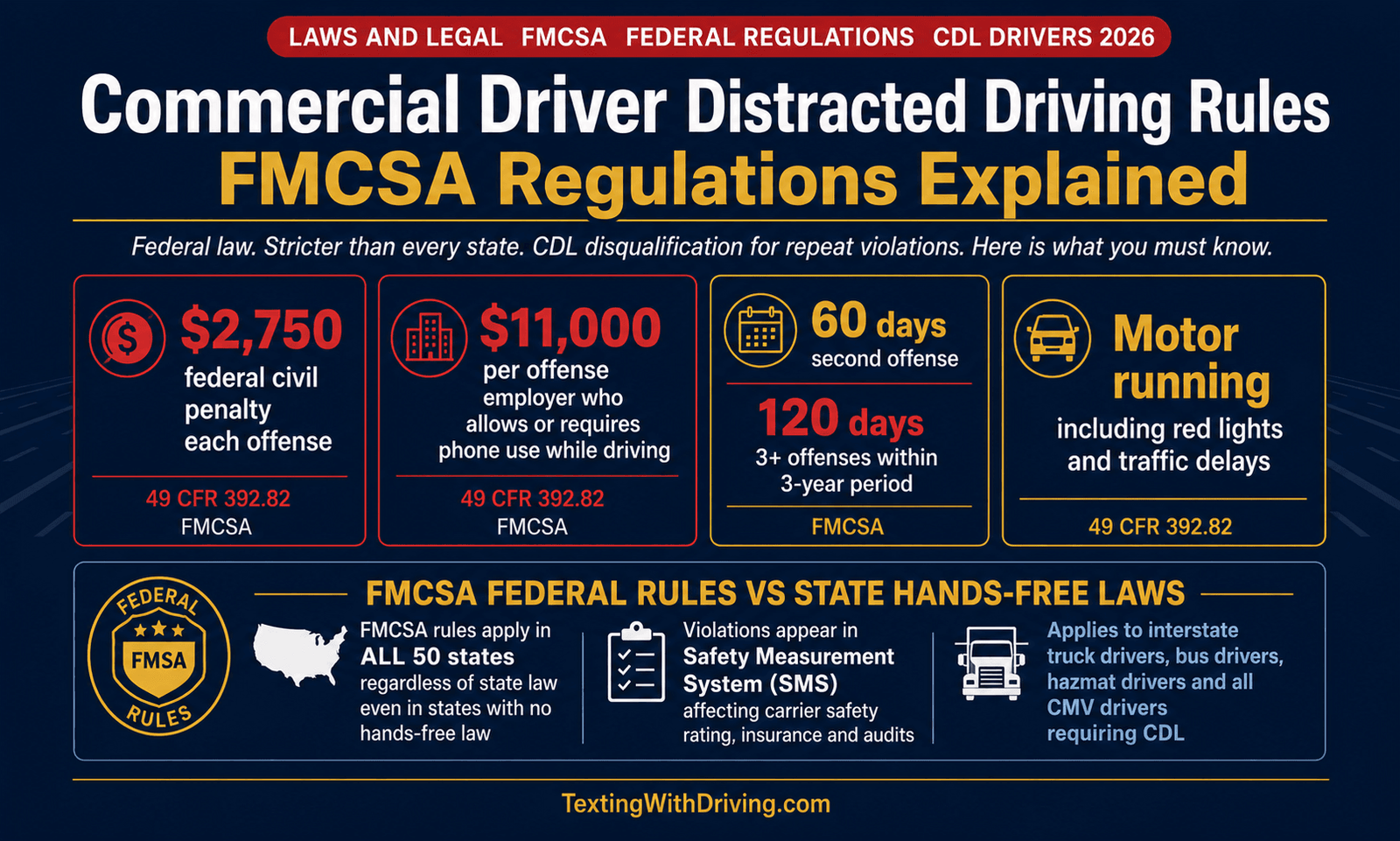
Driving is defined as operating a CMV, with the motor running, including while temporarily stationary because of traffic, a traffic control device, or other momentary delay. Occupational Safety and Health Administration
This definition eliminates the red light loophole that some personal vehicle drivers attempt to rely on. A commercial driver whose motor is running is operating the vehicle under the FMCSA definition, regardless of whether the vehicle is moving. Being stopped at a red light, caught in a traffic backup, or waiting at a railroad crossing all constitute operating a CMV under 49 CFR 392.82. The phone must not be in the driver’s hand during any of these situations.
The FMCSA’s handheld phone rule is broader than most state distracted driving laws. Occupational Safety and Health Administration
This breadth is intentional. Commercial vehicles, because of their size, weight, and the consequences of crashes involving them, warrant stricter behavioral standards than personal passenger vehicles. A fully loaded 18-wheeler weighing 80,000 pounds traveling at highway speed represents a kinetic energy level that makes distraction-caused crashes categorically more lethal than comparable events in passenger cars.
The Texting Prohibition: A Separate Parallel Rule
In addition to the handheld phone ban under 49 CFR 392.82, FMCSA also enacted a separate texting prohibition under 49 CFR 392.80, which applies even to hands-free device use.
The FMCSA and the Pipeline and Hazardous Materials Safety Administration have published rules specifically prohibiting interstate truck and bus drivers and drivers who transport placardable quantities of hazardous materials from texting or using hand-held mobile phones while operating their vehicles. NHTSA
The texting ban covers composing, reading, or sending text messages, instant messages, email, and other text-based electronic communications while operating a CMV. Unlike the handheld phone ban, which has an exception for hands-free devices, the texting ban applies regardless of the technology used to send or receive the message. A driver using voice-to-text through a hands-free system to compose and send a text message is violating the texting ban even if they never physically touch their phone.
This dual prohibition, the handheld ban and the texting ban operating simultaneously, creates a comprehensive restriction on phone interaction during commercial driving that goes beyond what most state hands-free laws require even for personal vehicle drivers.
The Fine Structure: What a Violation Actually Costs
The financial consequences of an FMCSA violation are substantially higher than typical state traffic fines for distracted driving.
Penalties for texting or using a hand-held mobile phone can reach $2,750, as adjusted for inflation, for drivers and $11,000, as adjusted for inflation, for employers who allow or require drivers to text or use a hand-held mobile phone while driving. NHTSA
$2,750 per offense for the individual driver. $11,000 per offense for the carrier or employer who allowed or required the phone use. These are federal civil penalties, not state traffic fines, and they are assessed per violation event. A driver who is cited twice in the same year faces potential exposure of $5,500 in federal penalties alone, before any state traffic fines for the same events are added.
The employer fine structure deserves specific attention because it creates liability for transportation companies whose management practices implicitly or explicitly encourage or allow phone use during driving. A dispatcher who calls a driver repeatedly while the driver is in transit, creating the expectation that the driver will answer while moving, is creating a policy environment that could expose the carrier to the $11,000 per violation penalty. A company whose fleet management software sends navigation updates that require driver interaction while moving is in a comparable position.
Violations also appear in the FMCSA’s Safety Measurement System, which affects the carrier’s safety rating, insurance premiums, and audit risk. Occupational Safety and Health Administration
The Safety Measurement System consequence extends the financial impact far beyond the immediate fine. A carrier whose SMS score deteriorates due to accumulated driver violations faces increased regulatory scrutiny, more frequent compliance audits, higher insurance premiums, and in extreme cases, the operational restrictions or out-of-service orders that can threaten a carrier’s ability to operate entirely.
CDL Disqualification: The Career Consequence
For commercial drivers specifically, the most serious non-criminal consequence of handheld phone violations is CDL disqualification, which removes the driver’s legal authority to operate a commercial motor vehicle.
Second and third offenses result in driver disqualifications for 60 and 120 days, respectively. States will suspend a driver’s Commercial Driver’s License after two or more serious traffic violations. NHTSA
A 60-day CDL disqualification for a second offense means 60 days during which the driver cannot legally operate a commercial motor vehicle. For a professional truck driver or bus operator whose livelihood depends on CDL status, a 60-day disqualification represents 60 days of lost income. For a driver on a third offense facing 120 days of disqualification, the career implications are severe.
The disqualification applies across states. A Texas-based driver whose CDL is disqualified by FMCSA cannot legally operate a CMV in any state during the disqualification period. The federal authority means state boundaries provide no refuge from the consequences of accumulated violations.
Multiple violations of State laws prohibiting use of a mobile phone while driving a CMV is a serious traffic violation that could result in fines, probation, disqualification by a State of drivers required to have a CDL, and potential jail time. NHTSA
The inclusion of potential jail time in the consequences framework reflects the criminal escalation pathway that applies when distracted commercial driving produces serious injury or death. While the base administrative violations produce fines and CDL disqualification, a commercial driver whose phone use causes a fatal crash faces potential criminal charges including vehicular homicide or criminally negligent homicide under applicable state laws, with sentences that can include years of incarceration.
Who Is Covered: Defining Commercial Motor Vehicles and CDL Drivers
Understanding who is subject to FMCSA distracted driving rules requires understanding how commercial motor vehicles are defined, because the category extends beyond what most people think of as a commercial vehicle.
The FMCSA rules apply to drivers of commercial motor vehicles, which include vehicles with a gross vehicle weight rating of 26,001 pounds or more, vehicles designed to transport 16 or more passengers including the driver, and vehicles transporting placardable quantities of hazardous materials regardless of size. Additionally, any vehicle requiring a CDL to operate is subject to the rules even if it does not meet the weight threshold.
This definition covers not only the large 18-wheelers that most people visualize when thinking of commercial trucks, but also smaller delivery vehicles above the weight threshold, passenger buses and coach vehicles, school buses, hazardous material transport vehicles, and a range of specialized equipment.
For professional drivers whose vehicles approach or exceed these thresholds, the FMCSA rules apply regardless of whether they consider themselves a commercial driver in the conventional sense. A driver operating a large moving truck, a delivery vehicle above the weight threshold, or a passenger van configured for 16 or more passengers should verify whether FMCSA rules apply to their specific vehicle and route.
GPS Navigation: The Grey Area Clarified
One practical question that commercial drivers frequently raise is whether GPS navigation apps constitute a violation under the FMCSA rules. The answer depends on how the navigation is accessed and managed.
Using a GPS application can be a violation if it requires the driver to hold the device or interact with the screen while driving. Navigation apps that are mounted and operate without requiring hand-held use or multi-button interaction are generally compliant. Occupational Safety and Health Administration
A phone mounted in a dashboard holder, displaying GPS navigation, and providing audio turn directions without requiring any screen touch while driving is generally compliant with FMCSA rules. The navigation is operating in a passive mode that provides audio guidance without creating a handheld device interaction event.
A driver who reaches for their mounted phone to zoom in on the map, type a new destination, or tap through navigation options while moving is creating a handheld interaction that violates the rule even though the phone is mounted. The violation is the reaching and holding, not the navigation itself.
The practical standard for compliance is: GPS destination set before the vehicle moves, navigation mounted and providing audio guidance, and no touchscreen interaction with the device during movement. Any adjustment that requires touching the screen must be made while fully stopped off the roadway in a legally parked position.
The same standard that applies to personal vehicle drivers under state hands-free laws applies to commercial drivers under the FMCSA rules, but with higher financial and career consequences for non-compliance.
Carrier Responsibility: What Fleet Managers Must Do
The $11,000 carrier fine for allowing or requiring driver phone use creates specific organizational compliance obligations that fleet managers and transportation company owners must address.
Motor carriers are prohibited from requiring or allowing drivers of CMVs to use hand-held mobile telephones where their use is not allowed. Companies should make every effort to ensure their drivers know the law and should consider having a company policy on the use and nonuse of mobile devices. The FMCSA rule states that employers who allow or require drivers to use a hand-held communications device while driving face liability. Make sure anyone that operates one of your commercial vehicles is aware you do not condone the use of such devices in violation of FMCSA regulations. Get Clue
The carrier liability framework requires affirmative steps beyond simply not requiring phone use. A carrier that has no documented phone use policy, no driver training on the FMCSA rules, and no enforcement mechanism for violations has created an organizational environment where FMCSA inspectors could find implicit allowance of the prohibited behavior.
Best practice fleet compliance requires a written policy specifically prohibiting handheld phone use and texting while driving, driver acknowledgment signatures confirming receipt and understanding of the policy, documented training on the FMCSA rules and their specific requirements, telematics monitoring that captures phone handling events and creates accountability for violations, and consistent enforcement with documented consequences for policy violations.
The organizational framework we covered for all employers in our employee distracted driving policy guide applies with greater urgency and greater regulatory specificity in the commercial fleet context, because the federal regulatory consequences add a compliance dimension that purely voluntary employer policies do not carry.
How FMCSA Rules Interact With State Laws
In states that have enacted comprehensive hands-free laws, commercial drivers are subject to both the FMCSA federal requirements and the state law requirements simultaneously. Where the two frameworks overlap, the stricter standard applies.
In states without comprehensive hands-free laws, including Texas, Florida for general driving, Montana, and others, commercial drivers remain subject to the full FMCSA federal handheld ban regardless of what the state law says. The absence of a comparable state law for personal vehicle drivers does not create any exemption or relaxation of the federal commercial driver standard.
This means that a commercial driver and a personal vehicle driver can be side by side on the same Texas highway in the same traffic, and the commercial driver is subject to a comprehensive federal handheld ban with $2,750 fine exposure while the personal vehicle driver is operating under Texas’s more limited texting-only ban. The federal-state distinction produces materially different legal standards for different drivers on the same road.
For the complete national picture of which states have hands-free laws and how they compare, our hands-free driving laws by state 2026 guide covers all 50 states. For the specific fines that state laws impose in addition to the FMCSA penalties that commercial drivers face on top of state consequences, our texting while driving fines by state 2026 article covers the full national fine structure.
The Distraction Data Specific to Commercial Vehicles
The research on commercial driver distraction confirms why the FMCSA rules impose such strict standards. The consequences of distraction events involving large commercial vehicles are categorically more severe than equivalent events involving passenger cars.
FMCSA research shows that using a hand-held cell phone while driving requires a commercial driver to take several risky steps beyond what is required for using a hands-free mobile phone, including searching and reaching for the phone. The reaching motion that begins a handheld call requires the driver to take their eyes off the road and divert manual control of the vehicle simultaneously, creating a compound distraction event at the precise moment when commercial vehicle weight and speed make hazard response most critical.
A commercial truck traveling at 65 miles per hour with a full load of 80,000 pounds requires significantly longer stopping distances than a passenger car at the same speed. The same five-second phone glance that covers a football field blind at 55 mph in a passenger car covers an equivalent blind distance in an 80,000-pound truck that cannot stop in anything approaching the same distance. The physics of commercial vehicle stopping make every second of distraction more consequential than in a lighter vehicle.
For the broader context of what distracted driving produces in crash outcomes and why commercial driver distraction carries disproportionate risk, our distracted driving accident statistics article covers the complete national crash data. For the employer liability dimension that applies to commercial carriers whose drivers cause crashes while distracted, our article on whether you can be sued for texting while driving covers the civil liability framework that complements the FMCSA regulatory structure.
Sources Used in This Article
All links verified working before publication.
FMCSA: Mobile Phone Restrictions — Official 49 CFR 392.82 rule text
FMCSA: Final Rule Banning Hand-Held Cell Phone Use by Commercial Drivers — Official FMCSA announcement of the 2012 final rule
Aguiar Injury Lawyers: Federal Cell Phone Rules for Commercial Truck Drivers — 49 CFR 392.82 practical application and GPS guidance, February 2026
American Family Insurance: Commercial Driver Cell Phone Laws — Definition of driving, carrier prohibitions, penalty structure
CSA FMCSA: Electronic Devices and Mobile Phones 392.80 to 392.82 — Second and third offense disqualification schedule
CNS Insures: How Serious Can Cell Phone or Handheld Device Tickets Be in Trucking — CDL career consequences and SMS impact, June 2025
Lexology: FMCSA Policy on Distracted Truckers — Legal analysis of FMCSA enforcement framework
GHSA: Distracted Driving State Laws — State law context for federal preemption analysis
NHTSA: Distracted Driving — National distracted driving statistics
TextingWithDriving.com is professionally built and maintained to ensure accurate, accessible safety information reaches every driver who needs it. Website development and ongoing support is handled by Budgetic, a digital agency specializing in purpose-driven WordPress websites.

About Texting With Driving
TextingWithDriving.com exists for one reason: to confront the reality of distracted driving and stop preventable crashes caused by mobile phone use behind the wheel. Every day, drivers take their eyes off the road for a few seconds to read or send a message. Those few seconds are enough to cause life-altering consequences. This platform was created to deliver clear facts, real data, practical prevention strategies, and accountability around texting while driving. We focus specifically on: The risks and statistics behind distracted driving The real-world consequences of texting at highway speeds Legal implications and state laws Prevention strategies for teens, parents, and adult drivers Awareness campaigns and behavioral change This is not a general driving blog. It is a focused awareness initiative built around one critical issue: phone distraction behind the wheel. Our content is direct, research-driven, and practical. We prioritize accuracy over opinion and education over sensationalism. The goal is simple — reduce distracted driving incidents by increasing awareness and responsibility. If one article causes one driver to put their phone down, the mission is working. For inquiries or partnerships, contact: privacy@textingwithdriving.com
View all posts by Texting With Driving