Distracted driving statistics for 2025 come in two parts. NHTSA’s early estimate shows overall traffic deaths fell sharply in 2025, to about 36,640. But the detailed breakdown of how many of those deaths involved a distracted driver has not been published yet. NHTSA usually releases each year’s distraction figures about 15 months after the year ends, so the 2025 numbers are expected in 2027.
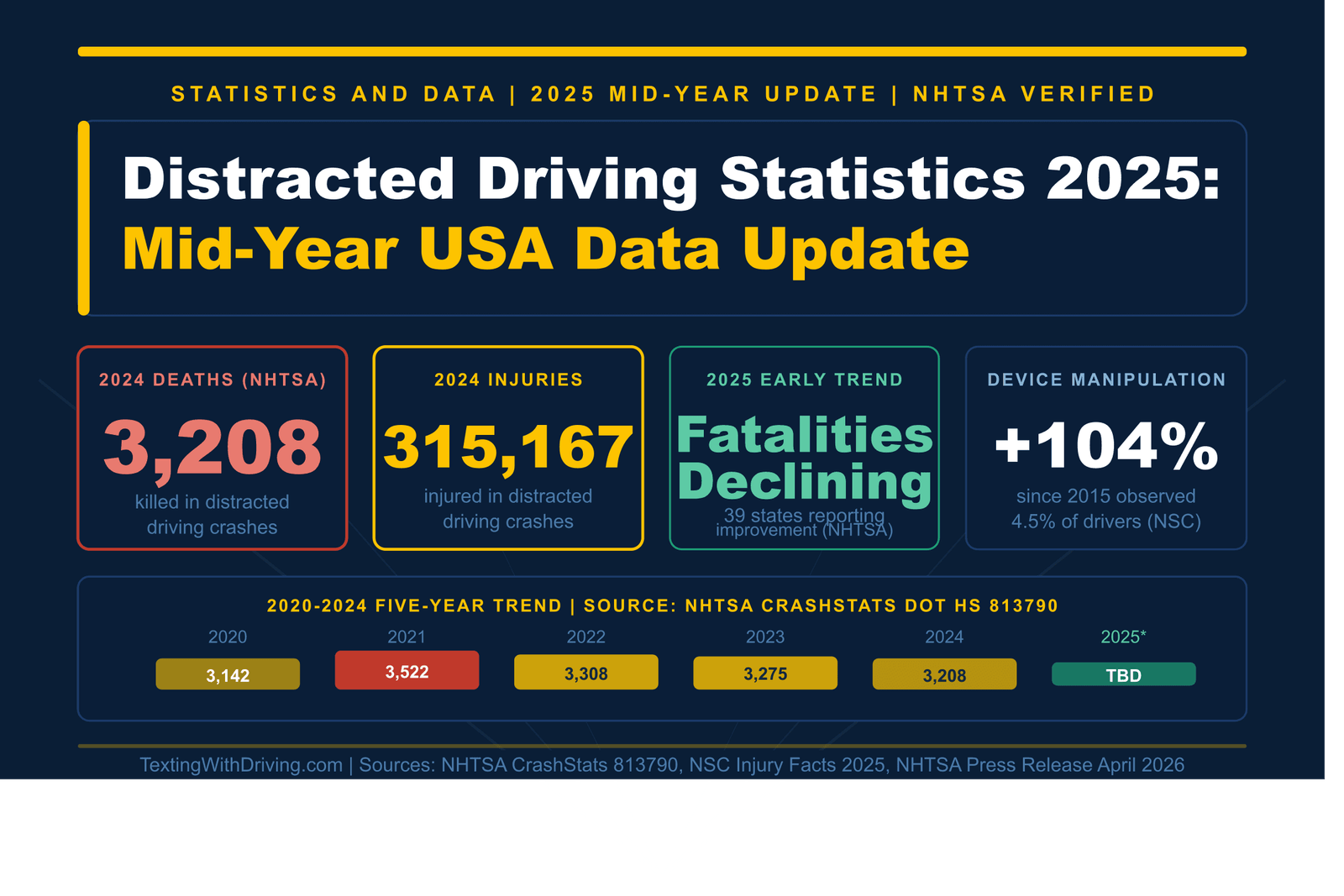
Until then, the most recent complete distraction data is for 2024: 3,208 people killed in crashes involving a distracted driver. This page brings together what is known about 2025 and the latest confirmed figures.
Key distracted driving statistics for 2025
An estimated 36,640 people died in US traffic crashes in 2025, down about 6.7% from 39,254 in 2024 (NHTSA early estimate, April 2026).
The 2025 fatality rate fell to an estimated 1.10 deaths per 100 million vehicle miles, the second lowest on record.
The most recent distraction data (2024): 3,208 deaths and an estimated 315,167 injuries in distraction-affected crashes (NHTSA).
Cambridge Mobile Telematics reported that phone distraction among drivers fell 8.6% in 2024, the second straight yearly decline.
At least three more states began enforcing hands-free laws for all drivers in 2025 or 2026: Iowa, South Carolina and Pennsylvania.
2025: overall traffic deaths fell
NHTSA’s early estimate for 2025, published in April 2026, projects that 36,640 people died in motor vehicle crashes, a drop of about 6.7% from 2024. If that holds, it would be the fifth largest yearly percentage drop in the history of NHTSA’s Fatality Analysis Reporting System (FARS), and it would bring deaths back to pre-pandemic levels.
Year
Traffic deaths
Change from prior year
2021
43,230
+10.8%
2022
42,721
-1.2%
2023
41,025
-4.0%
2024
39,254
-4.3%
2025 (estimate)
36,640
-6.7%
The fatality rate also improved, from 1.26 deaths per 100 million vehicle miles in 2023 to 1.19 in 2024 and an estimated 1.10 in 2025.
Sources: NHTSA DOT HS 813 800 and 813 791.
Other findings from the early estimate:
The fourth quarter of 2025 was the 15th straight quarter with fewer deaths than a year earlier.
Americans drove about 29.8 billion more miles in 2025 than in 2024, an increase of about 0.9%, while deaths fell.
All 10 NHTSA regions are projected to show declines, along with 39 states, Washington, DC and Puerto Rico.
These are projections. NHTSA says the counts will be revised when final 2024 and annual 2025 FARS files are released in early 2027.
The most recent distraction data (2024)
The latest year with detailed distraction figures is 2024, from NHTSA’s research note published in April 2026:
Measure (2024)
Figure
People killed in distraction-affected crashes
3,208 (8% of all traffic deaths)
People injured
315,167 (estimated)
Fatal crashes involving distraction
2,955
Deaths in crashes where a driver was using a phone
437
Pedestrians, cyclists and others outside vehicles killed
639
Deaths in distraction-affected crashes have edged down since a 2021 peak of 3,521: 3,316 in 2022, 3,283 in 2023 and 3,208 in 2024. NHTSA also notes that distraction is likely underreported, because drivers rarely admit phone use and investigators often cannot confirm it after a crash.
Crash reports are one measure. Observed behavior is another.
Phone handling is falling. Cambridge Mobile Telematics (CMT), which measures phone use through driving apps, reported in April 2025 that distracted driving, meaning drivers texting, using apps and handling their phones, dropped 8.6% in 2024, the second straight year of improvement. CMT estimated the drop helped prevent about 105,000 crashes and 480 deaths.
Many drivers still use phones. Citing NHTSA’s survey of driver electronic device use in 2024, GHSA reports that at any daylight moment more than 537,000 US drivers were visibly manipulating a phone.
Several states expanded or began enforcing phone laws in 2025:
Colorado: a handheld ban for all drivers took effect January 1, 2025.
Iowa: a hands-free law took effect in July 2025 with a warning period; fines of $100 began January 1, 2026.
South Carolina: a hands-free law took effect September 1, 2025, with citations from March 1, 2026, according to GHSA.
Oklahoma: since November 1, 2025, all drivers are barred from holding a phone in active school and work zones.
Pennsylvania: Paul Miller’s Law took effect in 2025 with a one-year warning period; citations began June 5, 2026.
GHSA counted 33 states plus DC with a handheld ban for all drivers as of its June 2025 review. Check every state in our hands-free driving laws by state guide.
What the numbers mean for drivers
Fewer people are dying on US roads, and phone handling appears to be declining. But thousands of people still die each year in crashes involving distraction, and NHTSA notes that reading or sending a text takes your eyes off the road for about 5 seconds. At 55 mph, that is the length of a football field.
NHTSA’s early estimate is 36,640, down about 6.7% from 39,254 in 2024. The final count will be published in 2027.
How many people died from distracted driving in 2025?
NHTSA has not yet published 2025 distraction figures. The most recent data shows 3,208 deaths in distraction-affected crashes in 2024.
Is distracted driving getting better?
There are signs of progress. Distraction deaths have fallen each year since 2021, and CMT measured an 8.6% drop in phone distraction in 2024. NHTSA cautions that distraction is likely underreported.
When will 2025 distracted driving data be released?
NHTSA released 2024 distraction data in April 2026, so 2025 figures are likely in the first half of 2027.
What was the traffic fatality rate in 2025?
An estimated 1.10 deaths per 100 million vehicle miles traveled, the second lowest on record after 1.08 in 2014.
TextingWithDriving.com is professionally built and maintained to ensure accurate, accessible safety information reaches every driver who needs it. Website development and ongoing support is handled by Budgetic, a digital agency specializing in purpose-driven WordPress websites.
The TextingWithDriving.com Editorial Team researches and writes every article on this site. We cover distracted driving laws in all 50 states and Washington, DC, national crash data, teen driver safety, workplace policy, and practical ways to keep phones out of drivers' hands. Every statistic and legal reference links to its original source, such as NHTSA, FMCSA, IIHS, state statutes, and state transportation departments. If you spot an error or an outdated figure, contact us and we will check it and correct it.
Our October 2026 resource roundup: updated state law guides, fall and holiday safety, teen driver advice, insurance and legal guides, and free phone tools.
October 2026 distracted driving news: Connecticut's new work zone law, the 2026 phone bills that died, rising violations and the latest NHTSA estimate.
Maine bans handheld phone use while driving, even at lights. Fines are $50 then $250, and texting starts at $250 with license suspensions for repeat offenders.
West Virginia bans holding a phone, texting, video and games while driving. Fines run up to $100, $200 and $350 plus 3 points, with tougher penalties for crashes.