

Nebraska Distracted Driving Law 2026: Secondary Enforcement, No Hands-Free Law and What Every Driver Must Know

Nebraska Distracted Driving Law 2026: Secondary Enforcement, No Hands-Free Law and What Every Driver Must Know
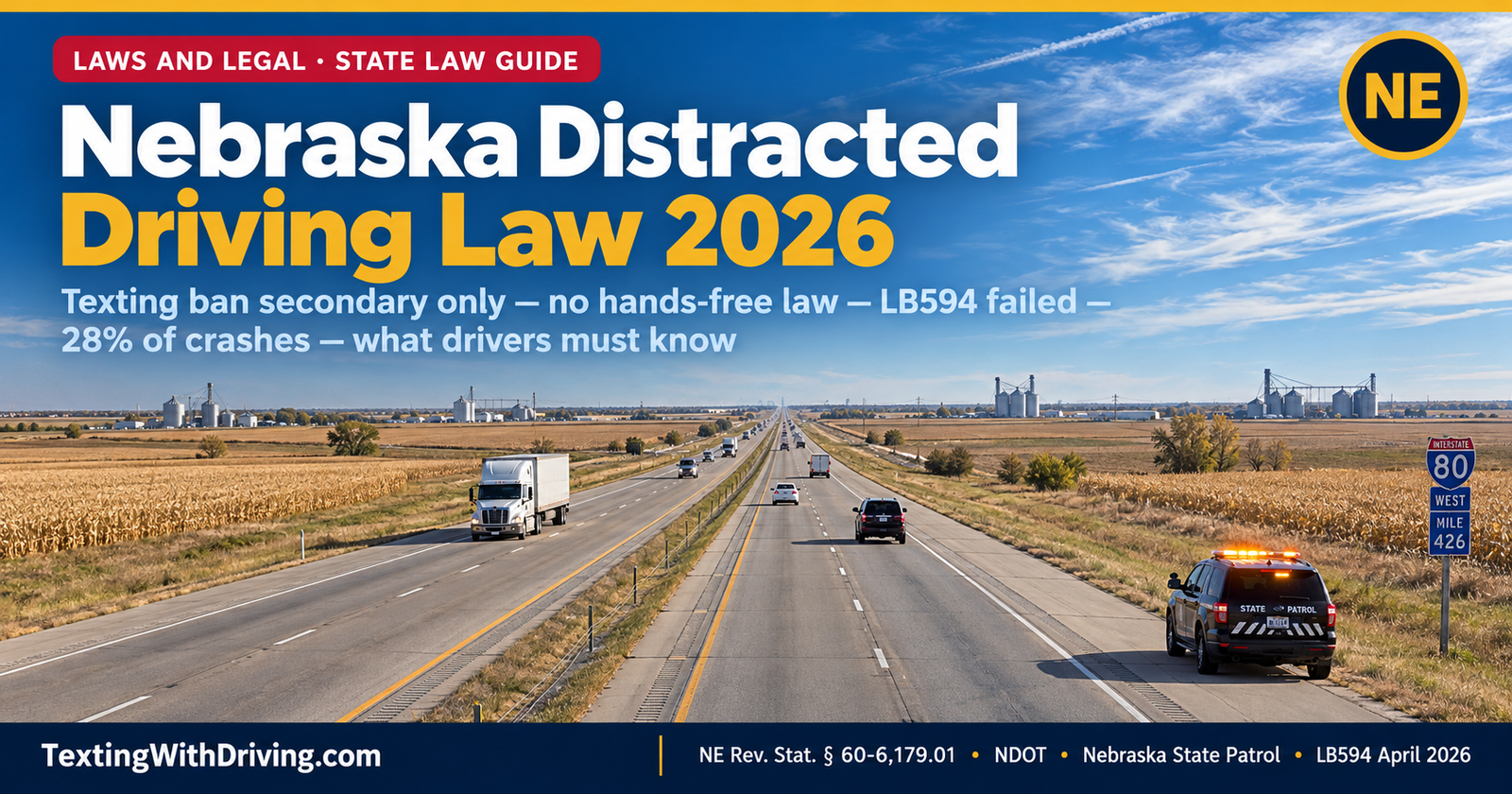
Nebraska distracted driving law 2026 places the state in a small and shrinking group of states with the weakest distracted driving enforcement framework in the country: texting while driving is a secondary offense only, there is no comprehensive hands-free law, and the most recent legislative attempt to change both — LB594 — was indefinitely postponed on April 17, 2026.
Nebraska is one of only four remaining states where texting while driving is not a primary offense. That means a Nebraska State Patrol trooper who observes a driver on I-80 west of Lincoln clearly composing a text message cannot stop that driver for the texting alone. The trooper needs another violation — a lane departure, a speed infraction, a turn signal omission — before the texting can be addressed.
Meanwhile, 28 percent of crashes in Nebraska are attributed to distracted driving. 251 people died on Nebraska roads in 2024 — the highest rate in 17 years. From 2014 to 2023, 114 people died in distraction-related crashes in Nebraska and nearly 13,000 were injured. And Nebraska drivers use their phones while driving more than the national average, according to the Nebraska Department of Transportation’s own testimony before the Legislature.
Across the border in Iowa, where a comprehensive hands-free law took effect July 1, 2025, Cambridge Mobile Telematics documented a 13.6 percent reduction in screen-tapping behavior in the law’s first year. Nebraska has no comparable data to cite because Nebraska has no comparable law.
This guide covers the complete Nebraska distracted driving law 2026 picture: what the current law actually prohibits, why secondary enforcement matters, the fine structure, the LB594 failure and what it means for 2027, the Iowa border comparison, and what every Nebraska driver must know.
What Nebraska’s Current Law Actually Says
Nebraska distracted driving law 2026 is codified in Nebraska Revised Statutes Section 60-6,179.01 — the state’s principal distracted driving statute.
What it prohibits: Using a handheld wireless communication device to read a written communication, manually type a written communication, or send a written communication while operating a motor vehicle which is in motion.
What it does NOT prohibit:
Talking on a handheld phone while driving. Talking on the phone is not against the law in Nebraska for adult drivers. A driver on I-80 through Omaha making a voice call while holding their phone is not violating any Nebraska statute.
Using navigation apps while holding the phone. Map and GPS interactions while holding the device are not prohibited.
Social media browsing without text entry. Scrolling a social media feed without typing a message occupies a legal gray area that the text-specific prohibition does not clearly capture.
Secondary enforcement: Nebraska’s distracted driving law is a secondary law, meaning an officer can only issue a ticket if the driver is pulled over for some other violation. The driver who is observed texting but is otherwise driving lawfully — maintaining speed, holding their lane, using signals — cannot be stopped.
Fines: $200 to $500 if caught texting and driving in Nebraska, plus three points on the driving record. The fine range is among the higher of any texting-ban state — but the secondary enforcement status means the fine is rarely imposed without a concurrent violation triggering the stop.
Enforcement reality: In 2020, Nebraska State Patrol issued only 112 tickets for texting while driving across the entire state. Secondary offense status sends the message to officers and drivers that distracted driving is not a priority — the assessment of Safe Driving Nebraska’s Eric Koeppe that has been confirmed repeatedly in legislative testimony.
Exceptions: First responders and emergency situations are exempt. Commercial drivers are subject to federal FMCSA regulations that are stricter than Nebraska state law — as documented in our FMCSA commercial driver distracted driving rules article.
The Numbers Behind Nebraska’s Enforcement Gap
Nebraska distracted driving law 2026 gap is documented in data that Nebraska’s own officials have presented to the Legislature:
251 deaths in 2024 — the highest rate on Nebraska roads in 17 years, according to NDOT Director Vicki Kramer.
28 percent of crashes attributed to distracted driving — Kramer’s direct testimony before the Legislature.
2,243 crashes since 2021 involving cell phones — data cited by the Grand Island Police Department in the April 2026 enforcement campaign.
40,000-plus crashes since 2010 caused by distracted drivers in Nebraska, producing 14,018 injuries and 119 fatalities.
114 deaths and nearly 13,000 injuries from distraction crashes 2014-2023 — cited in LB594 legislative testimony.
Distracted driving crashes increased by 31.7 percent since 2010 in Nebraska, even as the law has remained unchanged.
Nebraska drivers use phones while driving more than the national average — NDOT Director Kramer’s characterization in LB594 testimony. The absence of primary enforcement creates the behavioral incentive that produces above-average phone use: Nebraska drivers have learned that they can hold their phone without meaningful enforcement risk unless they simultaneously commit another violation.
LB594: The Failed Hands-Free Bill
Nebraska distracted driving law 2026 was supposed to change this year. LB594 — introduced by Lincoln Senator Jason Prokop on January 22, 2025 — proposed to:
Prohibit all handheld wireless communication device use while operating a motor vehicle in motion (not just text messaging).
Make the prohibition a primary offense — giving law enforcement stop authority solely for observed handheld device use.
Require hands-free or voice-activated technology for any phone interaction while driving.
The bill carried extensive official support. Nebraska State Patrol Col. Bryan Waugh said any opportunity we can get legislatively that will help us on the enforcement piece, but more importantly, the education piece to go hands-free and take that step to avoid additional distraction while you’re behind the wheel — we know that in states like Ohio and Colorado, they’ve seen about a 19 percent decrease in distracted driving when they pass a hands-free law.
NDOT Director Kramer testified directly: the department believes that higher phone usage while driving is influenced by the fact that Nebraska is one of five states without a hands-free driving law or primary enforcement of texting and driving. In the more than two dozen states that have implemented hands-free laws, instances of distracted driving have decreased by 6 percent.
A 2019 poll found that 89 percent of Nebraskans supported a law that allowed law enforcement to stop a driver and ticket them solely for texting.
Despite this support — from NDOT, from the Nebraska State Patrol, from law enforcement agencies statewide, and from the public — LB594 was indefinitely postponed on April 17, 2026. The bill died in committee without a floor vote, continuing Nebraska’s years-long pattern of considered and rejected hands-free legislation.
The opposition that prevailed: the ACLU of Nebraska and the Nebraska Criminal Defense Attorneys Association testified against the bill on the grounds that primary enforcement would allow law enforcement to stop anyone at any time — a civil liberties objection that has repeatedly blocked primary enforcement legislation in Nebraska.
The Iowa Border Comparison: What Nebraska Is Missing
Nebraska distracted driving law 2026 stands in direct contrast to Iowa’s experience next door. Iowa’s comprehensive hands-free law took effect July 1, 2025 — prohibiting all handheld device use while driving with primary enforcement.
Cambridge Mobile Telematics documented Iowa’s year-one results: a 13.6 percent reduction in screen-tapping behavior and 140,700 fewer phone-motion events in a single month. Iowa’s behavioral change is happening on the same roads, with the same demographics, in the same geographic region as Nebraska — demonstrating what a comprehensive law produces that Nebraska’s secondary texting-ban-only framework does not.
Nebraska officials explicitly cited Iowa’s law as the model they sought to replicate through LB594. The NDOT Director’s June 2025 statement — that Nebraska would like to see laws passed to keep drivers’ hands off their phones and on the wheel, similar to what Iowa just enacted — established the Nebraska-Iowa policy comparison that LB594’s April 2026 failure left unresolved.
Nebraska and Iowa share hundreds of miles of border. Nebraska and Iowa share the I-29 corridor, the Council Bluffs-Omaha metro area, and the Missouri River crossings where drivers transition between the two states’ legal frameworks multiple times in a single day. A driver who crosses from Council Bluffs, Iowa into Omaha, Nebraska goes from a comprehensive primary enforcement handheld ban ($100-$200 fine) to a secondary-enforcement texting-only ban ($200-$500 fine that requires another violation to trigger). The legal framework changes at the bridge.
The April 2026 Enforcement Campaign: What It Produced
Nebraska distracted driving law 2026 was the backdrop for Nebraska’s participation in the April 2026 National Distracted Driving Awareness Month enforcement campaign.
The Nebraska State Patrol, Grand Island Police Department, and other agencies conducted the Put the Phone Away or Pay crackdown from April 9-13, 2026. Results reported:
The Grand Island Police Department conducted 298 traffic stops, with 122 citations and 176 warnings issued. The Grand Island enforcement involved both distracted driving citations (for violations caught alongside other stops) and warnings for observed behaviors that the secondary enforcement standard did not allow to be cited as standalone violations.
The Nebraska State Patrol arrested 20 impaired drivers during the concurrent special enforcement effort.
The April 2026 campaign results illustrate both the enforcement effort and its limitations. 298 traffic stops producing 122 citations in Grand Island — a city of approximately 53,000 — represents active enforcement. But every one of those distracted driving citations required a primary violation to trigger the stop. The secondary enforcement standard means that the April 2026 campaign was working against its own legal framework: enforcing distracted driving by catching it as a secondary violation while the primary behavior — driving while holding a phone — was not independently citable.
Nebraska’s Key Highways and the Distraction Risk
Nebraska distracted driving law 2026 applies on a road network where the enforcement gap creates specific dangers:
Interstate 80: The primary east-west corridor through Nebraska — running from the Iowa border at Council Bluffs through Omaha, Lincoln, Grand Island, North Platte, and to the Wyoming border at Cheyenne — is one of the straightest, flattest, lowest-stimulus highway corridors in the country. Long straight I-80 through central Nebraska produces exactly the low-stimulus driving environment where the phone-checking impulse is highest and the distracted driving behavior is most sustained. A driver on I-80 west of Grand Island who picks up their phone for navigation is likely to hold it for several minutes — with no legal consequence as long as they are not simultaneously texting.
Interstate 29: The Missouri River corridor running north-south through the Council Bluffs-Omaha metro area is the Nebraska-Iowa border highway where drivers cross between Iowa’s comprehensive law and Nebraska’s secondary framework multiple times on a short commute.
US-77 and US-275: The primary Omaha-Lincoln connector routes carry the highest commuter traffic volumes between Nebraska’s two largest cities — the specific phone-heavy commuter behavior that primary enforcement specifically targets.
US-30: The original Lincoln Highway running through Nebraska’s smaller communities is the rural highway environment where enforcement resources are thinnest and the secondary enforcement limitation is most constraining.
What Every Nebraska Driver Must Know
Nebraska distracted driving law 2026 creates a specific compliance picture for every driver on Nebraska roads.
Texting while driving is illegal — even though enforcement is limited. Secondary enforcement does not mean legal. A Nebraska driver who is involved in a crash while texting is subject to the $200-$500 fine plus three DMV points — regardless of whether a primary stop could have been made. And in a crash scenario, law enforcement can obtain a warrant for the driver’s phone records to document device use at the time of impact.
Talking on the phone while holding it is legal under Nebraska state law. This is the clearest gap in Nebraska’s framework compared to 33-plus states with comprehensive hands-free laws. Nebraska drivers who make voice calls while holding their phone are not violating state law. But they are creating the cognitive and visual distraction that the behavioral research shows is as dangerous as texting — and they are operating in the LexisNexis environment where violations across all categories are tracked by insurers regardless of the citation’s primary or secondary status.
Commercial drivers face federal FMCSA handheld prohibition. Regardless of Nebraska state law, commercial drivers on I-80 and every other Nebraska road are prohibited from handheld device use under federal FMCSA regulations with a maximum $2,750 fine.
LB594’s failure does not mean the issue is resolved. Nebraska’s hands-free legislation has been introduced and rejected in multiple legislative sessions. The 2027 Nebraska Legislature session — for which bill pre-filing begins in November 2026 — is the next opportunity. Nebraska’s continuing position as one of four remaining states without primary texting enforcement makes the legislative pressure for change persistent.
Hands-free is the safest standard regardless of the law. The Iowa comparison is the most compelling argument for Nebraska drivers to adopt hands-free voluntarily: Iowa’s law produced a 13.6 percent behavioral improvement in year one not because Iowa’s drivers are more safety-conscious but because the law changed the behavioral environment. Nebraska drivers can achieve the same safety outcome without waiting for the law by adopting the hands-free standard that 89 percent of Nebraskans already say they support requiring.
For the Iowa hands-free law that produces the year-one comparison data Nebraska’s officials cite, our Iowa distracted driving law 2026 covers the complete Iowa framework. For the national 50-state comparison that places Nebraska in the full legislative landscape, our distracted driving laws all 50 states 2026 covers every state. For the FMCSA commercial driver rules that apply on I-80 regardless of Nebraska state law, our FMCSA commercial driver distracted driving rules covers the federal framework. And for the technology setup that makes hands-free automatic in Nebraska regardless of what the law requires, our hands-free while driving complete setup guide covers iPhone, Android, Bluetooth, and CarPlay.
Sources Used in This Article
All links verified working before publication.
KSNB / WOWT / KTIV / 1011Now: Nebraska Officials Seek Hands-Free Law Similar Iowa’s — NDOT Director Vicki Kramer 251 deaths highest rate 17 years quote, 28% crashes distracted driving quote, Col. Bryan Waugh hands-free education quote, Ohio Colorado 19% decrease hands-free law quote, Nebraska use phones more national average, June 2025
KSNB: Put the Phone Away or Pay Nebraska April 2026 — April 9-13 2026 enforcement, Grand Island PD 298 traffic stops 122 citations 176 warnings, NSP 20 impaired drivers, 2,243 crashes since 2021 cell phones Nebraska, national 3,275 deaths 2023, April 2026
Nebraska Legislature: LB594 Status — Indefinitely postponed April 17 2026, introduced January 22 2025, Transportation and Telecommunications Committee, Sen. Jason Prokop, Sanders and Raybould added, carryover bill 2026
Nebraska Legislature: LB594 Bill Text — Amend § 60-6,179.01, prohibit physically hold support any part body handheld wireless device operating motor vehicle in motion, exceptions first responders emergency, primary offense
Nebraska Legislature Update: Primary Enforcement Texting Considered LB594 Hearing — Feb 24 2025 hearing, Prokop primary offense handheld use, NDOT Kramer five states without hands-free primary enforcement quote, 114 died 2014-2023 13,000 injured, Meisinger ACEC support, Eickholt ACLU NCDAA opposition stop anyone any time quote, hands-free 6% decrease 2+ dozen states
WOWT: Stopping Texting and Driving Tough Task Law Enforcement Nebraska — Secondary offense can’t pull over texting alone, talking phone not against law Nebraska, fines $200-$500 plus 3 points, NSP can seize phone warrant crash, AAA Nebraska Brian Ortner texting most dangerous thing quote, one of only three states secondary, 2023
Enjuris: Nebraska Distracted Driving Laws — § 60-6,179.01 principal law, 40,000+ crashes 14,018 injuries 119 fatalities since 2010, 12% all traffic crashes, 31.7% increase since 2010, secondary law, fines relatively minor, hands-free not prohibited
Nebraska Examiner: New Senator Tries Again Primary Offense — 2020 record 19 fatalities 3,924 crashes distracted driving NDOT HSO, secondary offense like seat belt, 89% Nebraskans support primary enforcement 2019 poll, Eric Koeppe Safe Driving Nebraska secondary sends message not priority quote, 34 states ban handheld use
NDOT Highway Safety Conference March 2026 — LB594 discussed annual conference Feb 19-20 2025 Kearney, teen traffic fatalities 81% no seat belt 2023, Nebraska ranks 49th 50 states seat belts, LB600 Move Over Law, LB594 hands-free bill proposed
NHTSA: Distracted Driving — 3,208 deaths 2024, 315,167 injuries, national context
TextingWithDriving.com is professionally built and maintained to ensure accurate, accessible safety information reaches every driver who needs it. Website development and ongoing support is handled by Budgetic, a digital agency specializing in purpose-driven WordPress websites.
