

What Is Distracted Driving? The Complete Definition and Types Explained

What Is Distracted Driving? The Complete Definition and Types Explained
You have probably heard the phrase hundreds of times. But what does distracted driving actually mean in legal, scientific, and practical terms? What activities count? What does not count? And why does the specific definition matter for how we understand the danger?
This article gives you the complete answer. The official NHTSA definition, the three distinct categories of distraction, the full list of behaviors that qualify, why some distractions are far more dangerous than others, and where texting fits into the picture when all of this is laid out clearly.
If you are new to this site, this is the right place to start. If you have been following the full series, this article fills in the foundational vocabulary that every other article assumes.
The Official NHTSA Definition
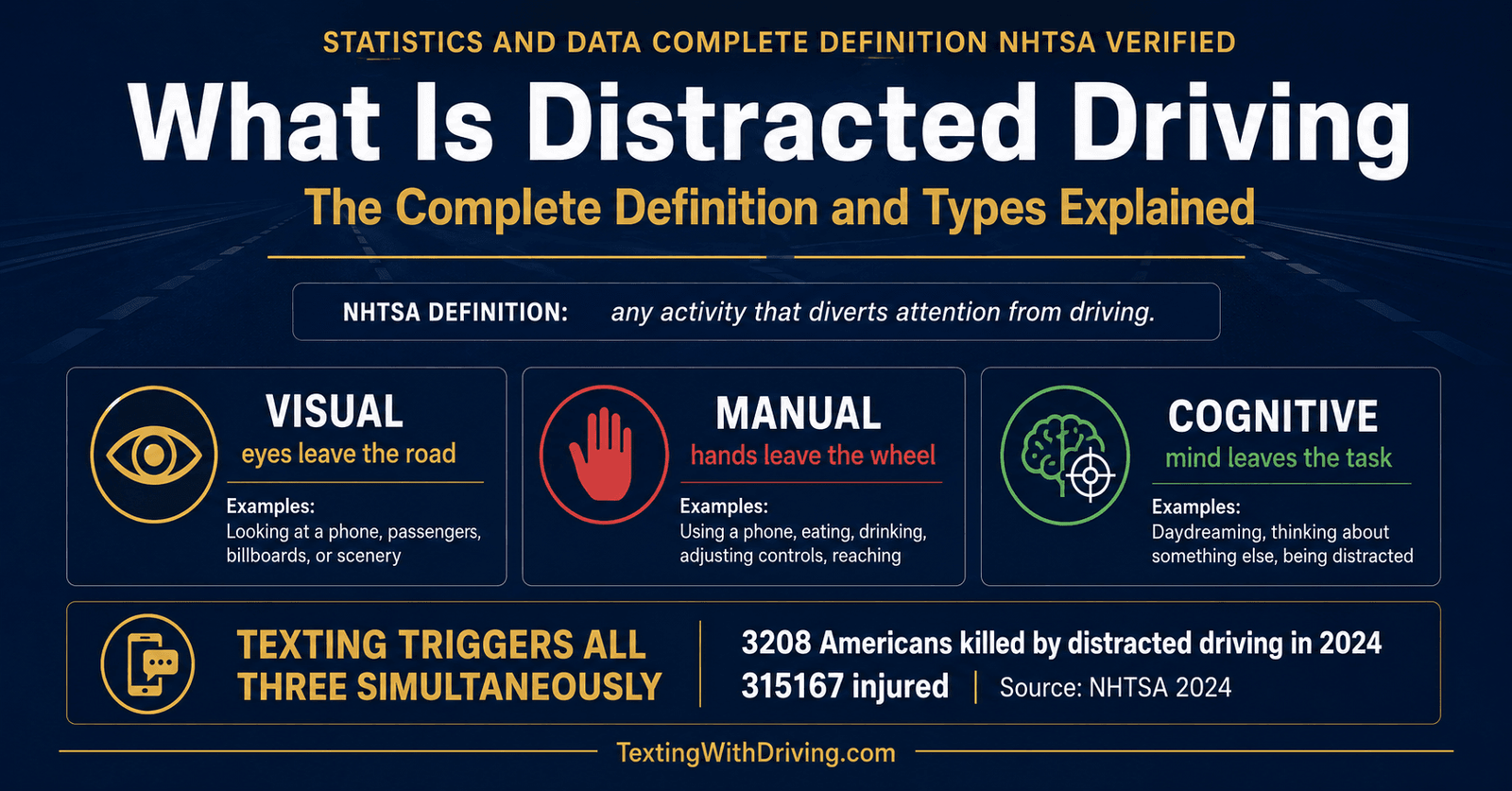
Distracted driving is any activity that diverts attention from driving, including talking or texting on your phone, eating and drinking, talking to people in your vehicle, fiddling with the stereo, entertainment or navigation system, or anything that takes your attention away from the task of safe driving. Michigan Auto Law
That definition from NHTSA is deliberately broad. It does not restrict the concept to phone use. It covers any activity. The breadth is intentional because distraction is not a single behavior. It is a category of behaviors that all share one characteristic: they take some form of driver attention away from the primary task of operating a vehicle safely.
Distracted driving is the act of driving while engaged in other activities that take your attention away from the road, according to NSC Injury Facts. Distractions endanger the driver, passengers, and bystanders. Zutobi
The NSC definition adds an important element: distracted driving endangers not just the driver and their passengers but everyone else on or near the road. Pedestrians, cyclists, motorcyclists, and other drivers who made no choice related to the distracted driver’s phone or sandwich are equally exposed to the consequences of that driver’s divided attention.
Why the Definition Matters Beyond Semantics
You might wonder why the precise definition matters. Why not just say texting while driving is dangerous and leave it at that?
The definition matters for three practical reasons.
First, it determines what behaviors are covered by distracted driving laws. States that define distracted driving narrowly as texting only leave dozens of other distracting behaviors completely unaddressed legally. States with broader definitions, covering all handheld device use or all electronic interactions, cover a larger proportion of the actual distraction problem. Understanding the definition helps you understand what your state’s law actually prohibits and what it does not.
Second, it determines what qualifies as negligence in a civil lawsuit. When a crash victim’s attorney argues that the at-fault driver was negligent because of distracted driving, the legal definition of what counts as distracted determines whether the specific behavior in question qualifies. A driver eating a burger when they rear-ended someone is engaging in distracted driving under NHTSA’s definition, but whether that specific distraction constitutes negligence depends on how courts in that jurisdiction have applied the standard.
Third, it shapes how research is conducted and how statistics are interpreted. When NHTSA reports that 3,208 people were killed in distraction-affected crashes in 2024, that figure reflects whatever police officers identified as distraction at crash scenes using the federal definition. A narrower definition would produce a lower reported number. A broader definition, or one with better enforcement tools, would produce a higher number.
The Three Types of Distraction
NHTSA, the AAA Foundation for Traffic Safety, and virtually every major road safety research organization classify driver distraction into three distinct categories. Understanding these categories is the foundation for understanding why different distractions carry different levels of danger.
We covered these three types in depth in our dedicated article on the three types of distraction and why texting is the perfect storm. Here is the foundational overview.
Type 1: Visual Distraction
Visual distraction occurs when drivers take their eyes off the road. This can include looking at a cell phone screen, looking at passengers or objects inside the vehicle, or glancing at something outside the vehicle. Federal Motor Carrier Safety Administration
Visual distraction is the most intuitive of the three types. If your eyes are not on the road, you cannot see what is happening on the road. The danger is direct and physical: during a visual distraction event, you receive zero visual information about hazards, traffic changes, pedestrians, or road conditions in the forward driving environment.
The research on how long visual distractions impair driving is precise. A glance away from the road lasting more than two seconds doubles crash risk, according to AAA Foundation research. At 55 miles per hour, two seconds covers approximately 161 feet of road. At five seconds, which is the average duration of a text-related glance according to NHTSA, a driver covers the full length of an American football field with no visual input from the road at all.
Common visual distractions include: reading or sending text messages, looking at a phone screen for any reason, checking a navigation device that is not properly mounted, looking at passengers, reading physical materials, and watching events outside the vehicle.
Type 2: Manual Distraction
Manual distraction occurs when drivers remove one or both hands from the steering wheel. Common examples include reaching for a dropped item, eating and drinking, grooming, and holding a cell phone to use it. Federal Motor Carrier Safety Administration
Manual distraction affects driving through a different mechanism than visual distraction. When your hands are off the wheel, your ability to make emergency steering inputs is reduced or eliminated. A vehicle traveling at highway speed requires constant micro-adjustments to maintain lane position. These adjustments happen largely automatically for experienced drivers, but they require physical contact with the wheel. Remove the hands and the vehicle begins to drift without active correction.
More critically, emergency evasive maneuvers, swerving to avoid a stopped vehicle, correcting a sudden skid, navigating around road debris, all require both hands on the wheel with immediate response capability. A single-handed or no-handed driving posture reduces the speed and precision of any emergency response.
Common manual distractions include: holding a phone in any position, eating or drinking, reaching for objects in the vehicle, adjusting interior controls that require removing a hand from the wheel, and grooming activities.
Type 3: Cognitive Distraction
Cognitive distraction occurs when drivers take their mind off the driving task. This is the most difficult type to observe from outside the vehicle, as the driver may appear to be paying attention with eyes on the road and hands on the wheel, but their mental focus is elsewhere. Federal Motor Carrier Safety Administration
Cognitive distraction is the least visible and arguably the most consequential of the three types for a specific reason: a driver experiencing only cognitive distraction may appear completely attentive to an outside observer. Eyes forward. Hands on wheel. Vehicle tracking normally. But internally, the brain’s hazard detection and response systems are operating on reduced capacity because cognitive resources are being shared with an unrelated mental task.
The AAA Foundation research we covered in our article on whether voice-to-text is safe while driving found that voice-to-text systems produce the highest levels of cognitive distraction of any in-vehicle technology tested, scoring higher on the cognitive distraction scale than handheld phone calls, hands-free phone calls, or passenger conversations. A driver using Siri to compose a message appears completely safe to every passing observer. Their brain is operating in a significantly impaired state.
Cognitive distraction also has a documented residual effect. AAA Foundation research established that cognitive distraction persists for up to 27 seconds after the distracting task ends. A driver who finishes a voice command and puts their phone down is still cognitively impaired for nearly half a minute into subsequent driving.
Common cognitive distractions include: phone conversations whether handheld or hands-free, emotional stress or upset, intense conversations with passengers, daydreaming, voice-to-text composition, and mentally managing complex non-driving situations.
Why Texting Is the Most Dangerous Form of Distracted Driving
Every road safety researcher and every major safety organization that has studied this question reaches the same conclusion. Of all the distractions a driver can experience, texting while driving is the most dangerous because it is the only common behavior that simultaneously triggers all three distraction types.
Sending or reading a text takes your eyes off the road for 5 seconds. At 55 mph, that is like driving the length of an entire football field with your eyes closed. Texting is especially dangerous because it combines visual, manual and cognitive distraction. Governor’s Traffic Safety Committee
When you reach for your phone and begin reading or composing a text message, three things happen at the same time. Your eyes move to the phone screen, creating visual distraction. Your hand holds and operates the device, creating manual distraction. And your brain engages with the content of the message, creating cognitive distraction. All three simultaneously. For the entire duration of the glance.
This triple-threat combination is why the Virginia Tech Transportation Institute found that text messaging while driving made the risk of a crash or near-crash 23.2 times higher than non-distracted driving. For context, a handheld phone call, which triggers primarily cognitive and manual distraction but returns eyes to the road, produces a crash risk multiplier of about 2.5. Texting is nearly ten times more dangerous than a handheld phone call by this measure, because it adds the visual component on top of everything else.
The Full List of Behaviors That Qualify as Distracted Driving
Because distracted driving covers any activity that diverts attention, the list of qualifying behaviors is longer than most drivers assume. Here is a comprehensive breakdown organized by how common each behavior is.
Phone-related behaviors produce the highest crash risk because they typically combine multiple distraction types. Reading or sending text messages, making or receiving handheld calls, scrolling through social media, watching videos, taking photos or video, using navigation apps by touch, and composing voice-to-text messages all qualify. Hands-free phone calls also qualify as a form of distracted driving, specifically cognitive distraction, even though they are legal in most states.
Eating and drinking is one of the most common non-phone distractions. Eating while driving is one of the most dangerous things a person can do behind the wheel, but most people do not think twice about it. It can lead to a crash just as easily as texting, because it combines manual distraction with potential visual distraction and sometimes cognitive distraction depending on what is being consumed and how. Unwrapping food, managing a drink with a loose lid, or handling anything that requires repeated attention creates a distraction profile that is underestimated by most drivers. Zutobi
Grooming activities create significant manual and visual distraction. Applying makeup, shaving, brushing hair, or checking appearance in the mirror while driving are behaviors that studies have found in a measurable percentage of crash-involved drivers.
Passenger interactions can create cognitive distraction, particularly emotionally charged conversations. Research distinguishes between calm passenger conversations, which create manageable cognitive load and have the adaptive benefit of an additional observer who can warn the driver of hazards, and high-emotion arguments or complex discussions that consume cognitive resources in a way that impairs hazard response.
Interior vehicle adjustments create brief but real distraction events. Adjusting the radio, climate controls, navigation system, or seat position requires visual and manual attention away from the road. Modern touchscreen infotainment systems are particularly problematic because they replace physical controls that could be operated by feel with screens that require visual confirmation of each interaction.
Daydreaming and mind wandering is the most common form of cognitive distraction and is responsible for a larger share of crash involvement than most people assume. Daydreaming while driving, also known as mind wandering, is the most common driver distraction according to an Erie Insurance study. In a poll of more than 2,000 adults, Erie Insurance found that among distracted drivers involved in fatal crashes, more than 60 percent were mind wandering. This is more than three times the percentage attributed to cell phones. Zutobi
That last finding is one of the most surprising in distracted driving research. Mind wandering, not phone use, accounts for the largest single category of distraction-involved fatal crashes in that analysis. This does not minimize the phone problem, which is uniquely dangerous because of the triple-distraction combination. But it does clarify that distracted driving is a broader problem than phone use alone, and that driving with full conscious attention to the road is the actual safety standard rather than simply having the phone in the back seat.
What Does Not Qualify as Distracted Driving
Understanding what the definition covers is also clarified by understanding what it does not cover, because some common assumptions are incorrect.
Hands-free phone calls are still distracted driving from a scientific standpoint, even though they are legal in most states. The cognitive distraction from a phone conversation is real and measurable regardless of whether the phone is held or mounted. The law draws the line at handheld use because that is where the broadest combination of distraction types occurs. But the science does not treat hands-free as distraction-free, which is why the AAA Foundation has titled its research series on this topic “Hands-Free Is Not Risk-Free.”
Listening to music through a car stereo is generally not classified as distracted driving. It creates a very low level of cognitive engagement with a task, around 1.2 on the AAA Foundation distraction scale of 1 to 5, that does not meaningfully impair driving performance in most circumstances. The distinction between passive listening, which creates low cognitive load, and active management of a playlist or audio system, which creates higher cognitive and manual load, matters.
Brief mirror checks, over-the-shoulder lane-change checks, and scanning the road environment are not distracted driving. These are attentive driving behaviors that are part of the safe driving task, not diversions from it.
Distracted Driving in the Law: How the Definition Is Applied
The legal definition of distracted driving varies by state and is not always coextensive with the scientific definition. Most state laws are narrower than the NHTSA scientific framework.
State distracted driving laws generally regulate specific behaviors rather than adopting the full NHTSA definition. Most states specifically ban texting while driving, and a growing number ban all handheld device use while driving. Very few states have laws that address cognitive distraction from hands-free calls, eating, or daydreaming directly, because these behaviors are significantly harder to observe and enforce. Geotab
The practical implication is that many behaviors that qualify as distracted driving under the scientific definition are not illegal in most states. Eating while driving is legal everywhere. Hands-free phone calls are legal in all 50 states. Intense passenger conversations are legal everywhere. The law addresses the most dangerous and most observable behaviors. Science defines distraction more broadly than law enforces it.
This gap between the scientific definition and the legal definition is one reason why personal behavioral standards should exceed legal minimums. Complying with the law in your state by not holding your phone does not necessarily mean you are driving without distraction in the full scientific sense of the term.
For the complete legal picture of what each state specifically prohibits, our hands-free driving laws by state 2026 guide covers all 50 states with current enforcement types and fine structures. For the specific fines attached to legal violations, our texting while driving fines by state 2026 guide covers first and repeat offense costs across every state.
The Death Toll: What the Definition Produces in Practice
In 2024, 3,208 people were killed and an estimated 315,167 people were injured in police-reported motor vehicle traffic crashes involving distracted drivers according to the National Center for Statistics and Analysis. Michigan Auto Law
Those are the consequences that flow from the NHTSA definition in practice: 3,208 deaths and 315,167 injuries in a single year from crashes where some form of distraction was identified in police reports. As NHTSA and independent researchers consistently note, this is a minimum figure because distraction is significantly underreported at crash scenes due to the difficulty of establishing it without admission or direct evidence.
The true scope of distraction-affected crashes, when all forms of the behavior including cognitive distraction are properly captured, is estimated at 29 percent of all crashes according to NHTSA’s own naturalistic observation research. That proportion of 2024’s total 5.9 million police-reported crashes would represent roughly 1.7 million distraction-affected crashes, far beyond what the official count captures.
For the detailed breakdown of these numbers including year-over-year trends, age group analysis, and economic costs, see our distracted driving statistics 2026 overview and the distracted driving statistics 2025 mid-year update. For the specific danger created by the most common distraction, our article on the real danger of texting while driving covers the five-second football field data in full detail.
The Bottom Line
Distracted driving is not a synonym for texting while driving. It is a broader category that covers any activity diverting attention from the driving task. It includes phone use, eating, grooming, daydreaming, and dozens of other behaviors that most drivers engage in regularly without thinking of them as dangerous.
The reason texting while driving receives the most legal and public attention is not because it is the only form of distracted driving. It is because it is the most measurably dangerous form, combining all three distraction types simultaneously and producing the highest documented crash risk multiplier of any common driver behavior.
Understanding the full definition makes you a better-informed driver, a better-informed voter on road safety legislation, and a more effective advocate for the behavioral changes that actually reduce the death toll.
Sources Used in This Article
All links verified working before publication.
NHTSA: Distracted Driving — Official definition and 2024 fatality data
NHTSA CrashStats: Distracted Driving in 2024 — DOT HS 813 790, detailed crash breakdown
NSC Injury Facts: Distracted Driving — National Safety Council definition and data
NHTSA: Countermeasures That Work — Distracted Driving — Three-category distraction framework
AAA Foundation: Measuring Cognitive Distraction in the Automobile — Distraction scale with category examples
FCC: The Dangers of Texting While Driving — Federal definition and football field statistic
Florida Highway Safety: Types of Distracted Driving — State-level definition breakdown
AutoInsurance.com: What Is Distracted Driving — Daydreaming as leading distraction factor, Erie Insurance study
EndDD.org: Research and Statistics — Virginia Tech Transportation Institute crash risk multipliers
TextingWithDriving.com is professionally built and maintained to ensure accurate, accessible safety information reaches every driver who needs it. Website development and ongoing support is handled by Budgetic, a digital agency specializing in purpose-driven WordPress websites.

About Texting With Driving
TextingWithDriving.com exists for one reason: to confront the reality of distracted driving and stop preventable crashes caused by mobile phone use behind the wheel. Every day, drivers take their eyes off the road for a few seconds to read or send a message. Those few seconds are enough to cause life-altering consequences. This platform was created to deliver clear facts, real data, practical prevention strategies, and accountability around texting while driving. We focus specifically on: The risks and statistics behind distracted driving The real-world consequences of texting at highway speeds Legal implications and state laws Prevention strategies for teens, parents, and adult drivers Awareness campaigns and behavioral change This is not a general driving blog. It is a focused awareness initiative built around one critical issue: phone distraction behind the wheel. Our content is direct, research-driven, and practical. We prioritize accuracy over opinion and education over sensationalism. The goal is simple — reduce distracted driving incidents by increasing awareness and responsibility. If one article causes one driver to put their phone down, the mission is working. For inquiries or partnerships, contact: privacy@textingwithdriving.com
View all posts by Texting With Driving