

Month in Review: October 2026 Distracted Driving News

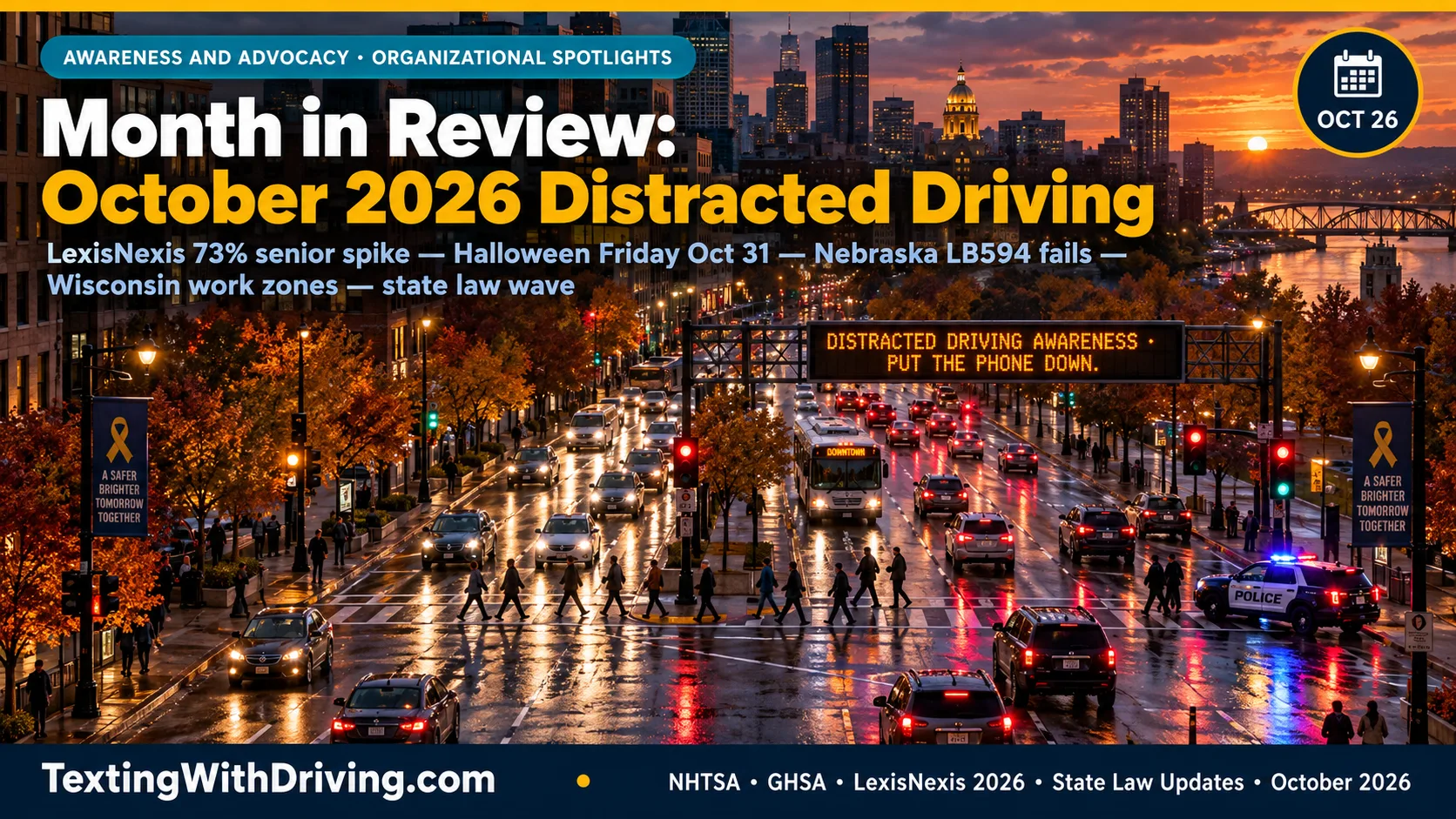
Month in Review: October 2026 Distracted Driving News
Distracted driving news October 2026 arrived in waves: a behavioral data story that redefined the demographic profile of the distracted driver, a legislative failure that left Nebraska as one of the last states without primary enforcement, a school and work zone law entering its first anniversary in Oklahoma, and the convergence of Halloween Friday and approaching DST that makes October’s final days the year’s most urgent pedestrian safety moment.
This month’s national series — 15 state and national articles alongside the 15-article Virginia DMV series — completed coverage of 7 additional states, documented the national insurance rate impact of the behavioral violation surge, examined the motorcycle detection failure mechanism, and published updated rankings for the technology tools that prevent distracted driving. Here is the complete distracted driving news October 2026 picture from every angle.
The Month’s Defining Data Story: LexisNexis 73% Senior Spike
Distracted driving news October 2026’s most important behavioral finding came from the 2026 LexisNexis U.S. Auto Insurance Trends Report, released May 19 but reaching its full public impact in October’s awareness campaigns: distracted driving violations among drivers aged 66 and older increased 73 percent since 2022 — the steepest increase of any age group and a finding that fundamentally disrupts the conventional wisdom that distracted driving is primarily a young driver problem.
The data’s interpretive key: miles driven increased only 2 percent in the same period. The violation surge is behavioral — driver behavior changed, not driving frequency. Drivers over 66 are using smartphones while driving at dramatically accelerating rates, driven by the rapid smartphone adoption that the COVID-19 isolation period accelerated in the 65-plus demographic.
The compound context from the 2025 LexisNexis data: drivers 66 to 90 showed an 80.3 percent year-over-year increase in a prior measurement period. The 73 percent since-2022 figure represents a sustained structural shift, not a temporary anomaly.
As documented in our distracted driving senior drivers 2026 article, the brain science amplifies the finding: the Transportation Research Part F 2026 study found older adults (mean age 69.5) showed significantly longer braking times than younger adults (p=0.046), and cognitive distraction specifically reduces their compensatory driving strategies. The combination of accelerating smartphone adoption and age-amplified distraction vulnerability is producing the 73 percent violation surge’s crash consequences in the bodily injury cost data — bodily injury rose from less than 20 percent to more than 26 percent of all auto insurance claim dollars between 2022 and 2025.
The family conversation implication: the October LexisNexis finding is the data anchor for every family with an older parent who drives. The 73 percent violation increase in the 66-plus demographic is the population-level signal that the individual family conversation about hands-free setup and phone habits is urgently needed.
The Month’s Legislative Story: Nebraska LB594 Indefinitely Postponed
Distracted driving news October 2026’s most consequential legislative event occurred on April 17, 2026 — but its full documentation arrived in October’s state law coverage. Nebraska’s LB594 — the comprehensive hands-free bill that would have prohibited all handheld device use and made it a primary offense — was indefinitely postponed, leaving Nebraska as one of only four remaining states where texting while driving is not a primary offense.
The Nebraska data context makes the failure particularly striking: 251 people died on Nebraska roads in 2024, the highest rate in 17 years. 28 percent of crashes are attributed to distracted driving. Nebraska drivers use phones while driving more than the national average. NDOT Director Vicki Kramer and Nebraska State Patrol Col. Bryan Waugh both testified in support of LB594. An 89 percent public support figure from a 2019 poll documented overwhelming voter demand for primary enforcement.
The ACLU of Nebraska and Nebraska Criminal Defense Attorneys Association opposition — that primary enforcement would allow officers to stop anyone at any time — prevailed over the safety evidence for the second consecutive legislative session cycle. Nebraska’s 2027 Legislative session, with pre-filing beginning in November 2026, is the next opportunity.
Across the Missouri River, Iowa’s year-one results from the comprehensive hands-free law that took effect July 1, 2025 — 13.6 percent reduction in screen-tapping behavior and 140,700 fewer phone-motion events in a single month — provide the behavioral comparison that Nebraska’s 2027 legislative advocates will cite. The same highway network. The same demographics. The same phone-use culture. Different law. Different outcomes.
The Month’s Safety Milestone: Oklahoma HB2263 at One Year
Distracted driving news October 2026 milestone for Oklahoma: HB2263 — the school and work zone hands-free law authored by Rep. Nicole Miller — is completing its first year of active enforcement on November 1, 2026, having taken effect November 1, 2025.
HB2263 prohibits handheld phone use within active school zones and construction work zones — the first legislative expansion of Oklahoma’s distracted driving framework beyond the 2015 texting-ban-only standard. The law’s first year covered one full school year’s worth of school zone enforcement, establishing the behavioral baseline that subsequent years will measure against.
Oklahoma’s ODOT crash data for 2017-2021 documented 250 fatalities and 8,000 injuries from distracted driving — the evidence base that drove HB2263’s passage by the House 59-24. The one-year mark is the specific evaluation point where Oklahoma’s enforcement data should begin reflecting the school zone compliance improvement that comparable zone-specific laws have produced in other states.
The named-law context remains present: Oklahoma’s texting ban is the Trooper Nicholas Dees and Keith Burch Act of 2015, named for two Oklahoma Highway Patrol troopers struck by a distracted driver on I-40 in Seminole County. Every Oklahoma driver who passes through an active school zone this November — the month the Dees-Burch Act celebrated its 11th year and HB2263 its first — is driving under the accumulated legal framework that two troopers’ injuries and death produced.
October’s State Law Wave: Seven States Documented
Distracted driving news October 2026 national series documented seven states in depth this month — the largest single-month state law coverage in the project’s history:
West Virginia (§ 17C-14-15 Electronically Distracted Driving Act): $100 first offense, $200 second, $350 third misdemeanor — and the unique provision that a violation causing death is prosecuted under WV’s DUI statute § 17C-5-1. The most consequential penalty structure in the Appalachian corridor.
Alaska (texting ban only): $500 first offense primary enforcement — one of the highest single-offense fines of any non-comprehensive state. But NO comprehensive hands-free ban at state level; only Sitka’s local ordinance goes further. Alaska’s remote road context — 200,000 moose, extended EMS response times, avalanche zones — makes the law gap more consequential than in any comparable texting-ban-only state.
Arkansas (tiered framework): Primary enforcement texting ban; hands-free required ages 18-21 everywhere; handheld ban in school and work zones; one of only two states (with New Jersey) with a specific drowsy driving statute defining fatigue as more than 24 consecutive hours without sleep. Arkansas FADD CEO Michelle Paden notes the state is in the top 10 nationally for distracted driving.
Oklahoma (HB2263 + Dees-Burch Act): The full picture documented as HB2263 reaches one year — school and work zone handheld ban since November 1, 2025, building on the 2015 primary texting ban.
Nebraska (LB594 failure): Secondary enforcement only. No primary stop authority for texting. No hands-free ban. 251 deaths in 2024. LB594 indefinitely postponed April 17, 2026.
Maine (comprehensive since 2019): $50 first offense, $250 subsequent. Texting ban since 2011, comprehensive hands-free since September 2019. 2,750 distracted crashes in 2025. CDOT-comparable awareness gap — many drivers unaware of the law’s full scope.
Wisconsin (work zone 500-foot rule): Texting ban since 2010. No general hands-free ban. But within 500 feet of work zones and emergency response areas — comprehensive handheld ban. Wisconsin State Patrol issued over 10,000 work zone citations in 2025. 9,048 distracted crashes in 2025, 31 fatalities.
Together with the October Virginia DMV series documenting West Virginia as a Virginia border state, October 2026 added seven state law profiles to the comprehensive 50-state coverage that TextingWithDriving.com is completing through 2026.
The Month’s Consequence Story: Insurance and the $21M Verdict
Distracted driving news October 2026 consequence coverage addressed both the individual and corporate financial realities of distracted driving.
The national insurance rate guide documented the three-data-source convergence: Insurance.com’s 30 percent average rate increase and $576 average annual dollar increase, Zebra’s $226 average annual rate hike, and the LexisNexis macro context showing bodily injury costs rose from less than 20 to more than 26 percent of all auto insurance claim dollars between 2022 and 2025. At the 2026 national average full coverage premium of $2,637, a distracted driving citation costs the average driver approximately $2,058 to $2,373 in three-year surcharge costs — before the citation fine itself.
The employer liability guide documented the corporate exposure: the $21 million Florida verdict that sent shockwaves through fleet industries, the $5 million to $22 million vicarious liability range across documented cases, and Fisher Phillips LLP’s 2026 guidance that OSHA considers distracted driving a recognized workplace hazard that every employer with driving employees must address through written policy, signed acknowledgements, MVR checks, training, and fleet camera monitoring.
The Month’s Science Story: Motorcycles and Inattentional Blindness
Distracted driving news October 2026 science contribution is the motorcycle inattentional blindness documentation — the specific mechanism by which distracted driving amplifies motorcycle crash risk beyond the already-severe baseline.
6,228 motorcyclists were killed in traffic crashes in 2024 — 16 percent of all traffic fatalities from 3 percent of registered vehicles. Motorcyclists are 22 times more likely to die than car occupants. The predominating cause of motorcycle-vehicle crashes is the failure of motorists to detect and recognize motorcycles in traffic.
The Australian National University research (Pammer, Sabadas, Lentern — Human Factors journal) documented the specific mechanism: 65 percent of study participants didn’t see the motorcycle in a driving simulation image while only 31 percent missed a taxi in the same image. The brain’s attentional allocation underweights motorcycle-sized objects relative to car-sized objects — producing the looked-but-failed-to-see crash even under attentive driving conditions.
Distracted driving amplifies this baseline detection failure by the 37 percent brain activity reduction that Carnegie Mellon’s research documented for phone use. The Naval Safety Command’s July 2025 assessment named it directly: inattentional blindness fueled by distracted driving makes motorcycle riders effectively invisible even when within the driver’s field of vision. October’s motorcycle article provided the complete mechanistic explanation that makes the three-specific-action guidance — scan parked-car gaps, look twice at intersections before left turns, phone away before driving — directly connected to the documented death toll.
The Month’s Halloween Convergence: Friday October 31
Distracted driving news October 2026’s most time-sensitive safety story is the one happening right now: Halloween 2026 is Friday, October 31 — the deadliest day for child pedestrians on the worst possible day of the week.
The JAMA Pediatrics 42-year study: 43 percent higher pedestrian fatality risk on Halloween. Children aged 4-8: 10-fold increase. Average 4 additional deaths per Halloween. Deadliest hour: 6 PM.
Friday Halloween: 23 percent more pedestrian deaths than regular Fridays. The Friday commute volume, the post-work alcohol presence, and the Friday social coordination phone traffic all peak at exactly the 6 PM trick-or-treating hour.
AAA data: 49 children under 17 killed on Halloween 2007-2021 — nearly double the next deadliest day.
The October 31 driver action: Driving Focus before leaving for any drive after 4 PM. Speed reduced to 15-20 mph on every residential street. Active scanning of every parked-car gap. The phone-free, speed-reduced standard on Halloween night 2026 is the specific behavioral implementation of everything the research shows about the 10-fold child pedestrian death risk.
Looking Ahead: November 2026 Preview
Distracted driving news October 2026 closes with November’s preview — a month that brings two high-stakes safety events in its first two weeks.
November 2: Daylight Saving Time ends at 2 AM. The Carnegie Mellon/IIHS finding: 11-fold increase in 6 PM pedestrian death risk after the transition. 37 more US pedestrian deaths at 6 PM in November vs October. IIHS calculation: year-round daylight saving would save 200 lives annually. Virginia’s 75 percent of pedestrian deaths occurring at night, concentrated in the October-December DST-adjusted window, establishes the regional urgency.
The first two weeks after DST — November 2-16 — are the highest-risk pedestrian period of the year as drivers and pedestrians both fail to adapt their behavior to the abrupt one-hour darkening. Driving Focus and 10 mph below residential speed limits during the evening commute are the specific behavioral responses the research supports.
November 2027 pre-filing: Nebraska’s 2027 legislative session pre-filing window opens in November 2026. The LB594 failure data — 251 deaths in 2024, LB594 indefinitely postponed — gives advocacy organizations and legislative champions the specific evidence base for the next attempt at primary enforcement.
Thanksgiving week: The highest travel volume week of the year arrives in the last week of November — combined with the DST-adjusted darkness, the peak deer rut, and the holiday emotional distractions that produce the specific November crash concentration that Operation CARE has historically targeted.
The complete October 2026 state and national article index is available in the October 2026 Distracted Driving Resource Roundup.
Sources Used in This Article
All links verified working before publication.
LexisNexis Risk Solutions: 2026 U.S. Auto Insurance Trends Report May 19 2026 — 73% increase 66+ violations, 57% all ages since 2022, 2% miles driven, bodily injury 20% to 26% all claims dollars
JAMA Pediatrics: Pedestrian Fatalities Associated With Halloween — 43% higher fatality risk Halloween, 10-fold children 4-8, 4 additional deaths average, 6 PM deadliest
Wisconsin DOT / Wisconsin State Patrol: April Law of the Month April 3 2026 — 9,048 crashes 31 fatalities 3,660 injuries 2025, 10,000+ work zone citations, 500 feet handheld ban
Nebraska Legislature: LB594 Status Indefinitely Postponed April 17 2026 — Indefinitely postponed April 17, Sen. Prokop sponsor
Oklahoma House: New Law Requires Drivers Go Hands-Free October 27 2025 — HB2263 effective November 1 2025, school work zones, one year milestone November 2026
Insurance.com: How Much Will Car Insurance Go Up After Ticket — Distracted driving ticket 30% increase $576 average annual dollar increase
Fisher Phillips LLP 2026: OSHA Employers Distracted Driving — OSHA recognized hazard, $60 billion annually, cameras monitoring enforcement, Fisher Phillips 2026
TT News: $21M Verdict Fleet Distracted Driving — $21 million verdict beverage manufacturer, $5M-$22M range, 200,000 employee injuries annually
Association for Psychological Science: Motorcycles Missed Drivers Not Looking — 65% missed motorcycle 31% missed taxi, LBFTS inattentional blindness Pammer Sabadas Lentern
NHTSA: Distracted Driving — 3,208 deaths 2024, 315,167 injuries, national context
TextingWithDriving.com is professionally built and maintained to ensure accurate, accessible safety information reaches every driver who needs it. Website development and ongoing support is handled by Budgetic, a digital agency specializing in purpose-driven WordPress websites.
