

The Three Types of Distraction: Why Texting While Driving Is the Perfect Storm

The Three Types of Distraction: Why Texting While Driving Is the Perfect Storm
Most people know that texting while driving is dangerous. Far fewer understand exactly why it is more dangerous than every other common driving distraction combined.
The answer comes down to three categories of distraction that road safety researchers have identified, and how texting uniquely activates all three at the same moment. Understanding this framework changes how you think about every interaction with your phone while in a moving vehicle — and why so many other activities that feel equivalent are actually far less dangerous.
The NHTSA Framework: Three Categories of Driver Distraction
The National Highway Traffic Safety Administration and the AAA Foundation for Traffic Safety both use the same foundational classification system for driver distraction. Every activity that diverts driver attention falls into one or more of three categories.
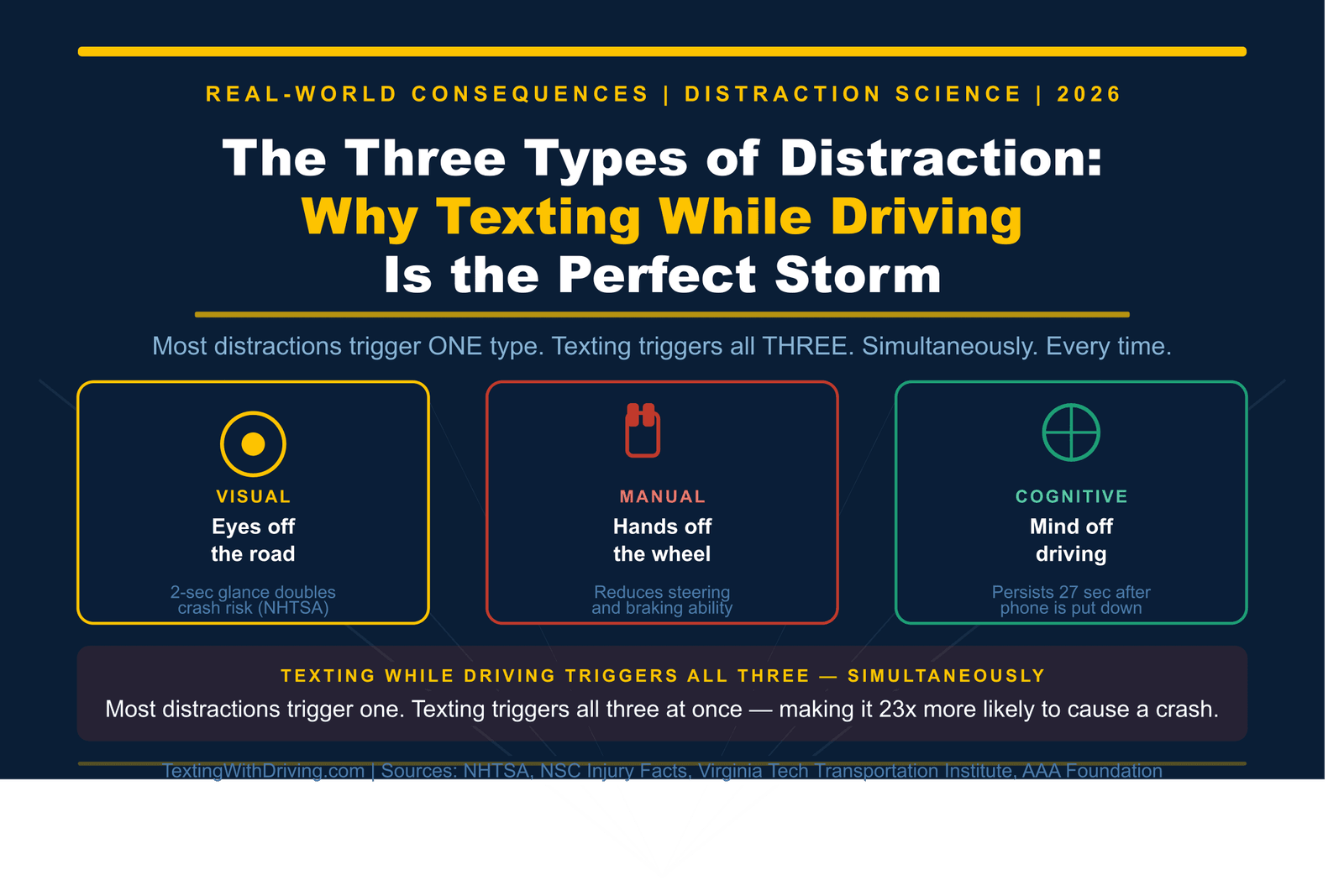
Some activities may take a driver’s eyes off the road as a visual distraction, the driver’s mind off the task of driving as a cognitive distraction, or the driver’s hands off the wheel as a manual distraction, with some behaviors including texting combining all three categories of distraction. Michigan Auto Law
Distraction is anything that diverts the driver’s attention from the primary tasks of navigating the vehicle and responding to critical events. To put it another way, a distraction is anything that takes your eyes off the road as a visual distraction, your mind off the road as a cognitive distraction, or your hands off the wheel as a manual distraction. So when you think about tasks that can be a driving distraction, you can see that they often fit into more than one category: eating is visual and manual, whereas using a navigation system is all three. Zutobi
Each category impairs driving in a distinct way. Understanding the specific mechanism of each one helps explain why some combinations are catastrophically more dangerous than the sum of their individual parts.
Category One: Visual Distraction
Visual distraction is the most intuitive of the three categories and the easiest for most people to understand. It is simply looking at something other than the road.
Visual distraction covers tasks that require the driver to look away from the roadway to visually obtain information. Mattiacci Law
The danger of visual distraction is direct and physical. When your eyes are not on the road, you are receiving zero visual input from the driving environment. Hazards that appear during a visual distraction period cannot be perceived, processed, or responded to until visual attention returns to the road.
The AAA Foundation for Traffic Safety explained that visual distractions such as glances away from the forward roadway lasting more than two seconds increased the risk of a crash or near-crash to over two times that of normal driving. Sentryroad
Two seconds. That is the threshold at which a glance away from the road doubles crash risk. At 55 miles per hour, two seconds covers approximately 161 feet of road. The vehicle has traveled more than half the length of an American football field with no visual input from the driver.
At five seconds, which is the average duration of a text-related glance according to NHTSA research, the vehicle covers over 400 feet at highway speed. That is the football field statistic that has become the most cited figure in distracted driving awareness, and it is based on this specific visual distraction mechanism.
Every second of visual distraction is a second of completely blind driving. This is not a metaphor. It is a physical description of what is happening.
Examples of primarily visual distraction beyond phone use include: looking at a passenger, reading a billboard, checking a navigation screen, watching roadside activity, and looking at objects in the vehicle.
Category Two: Manual Distraction
Manual distraction covers any activity that removes one or both hands from the steering wheel.
Manual distraction covers tasks that require the driver to take a hand off the steering wheel and manipulate a device. Mattiacci Law
The danger of manual distraction is equally direct. A steering wheel that is not being held cannot respond to the split-second micro-corrections that safe lane tracking requires, the emergency braking maneuvers that hazard avoidance demands, or the evasive steering that close-call situations sometimes require.
Modern vehicle stability and lane-keeping systems have improved the margin of error for brief one-handed driving on straight roads. But no technology fully compensates for the combination of a removed hand and an unexpected hazard that requires immediate steering input. The hand that is not on the wheel is the hand that cannot correct a skid, avoid a swerving vehicle, or navigate around road debris that appears without warning.
Examples of primarily manual distraction include: eating and drinking, reaching for objects in the vehicle, adjusting climate controls or the radio, grooming, and holding a phone to the ear.
Category Three: Cognitive Distraction
Cognitive distraction is the least visible, least understood, and according to the World Health Organization, arguably the most impactful of the three categories.
Cognitive distraction covers the mental workload associated with a task that involves thinking about something other than driving. Mattiacci Law
What makes cognitive distraction particularly insidious is that it is invisible. A driver experiencing cognitive distraction may have their eyes on the road and both hands on the wheel. From the outside, they appear to be driving attentively. Inside their brain, however, cognitive resources that are needed for hazard detection, peripheral awareness, and rapid decision-making are being consumed by an unrelated mental task.
Cognitive distracted driving is described by the AAA Foundation as cognitive or mental distractions that take the driver’s mind off the task at hand which is safe driving. Worrying about a job interview or dwelling on an argument are examples. This can be just as dangerous as other types of distracted driving, especially because the driver can appear focused even when their attention is elsewhere. Sentryroad
The World Health Organization concluded in its review of mobile phone driving research that using mobile phones can cause drivers to take their eyes off the road, their hands off the steering wheel, and their minds off the road and the surrounding situation. It is this type of distraction, known as cognitive distraction, which appears to have the biggest impact on driving behaviour. Geotab
One of the most striking research findings about cognitive distraction comes from the AAA Foundation’s work on the residual effect. As we covered in detail in our article on the real danger of texting while driving, AAA research found that cognitive distraction persists for up to 27 seconds after the distracting task ends. A driver who finishes a voice-to-text message and puts their phone down is not fully cognitively engaged with driving for approximately half a minute afterward.
This means that a driver who checked their phone for five seconds at a red light, then put it down when the light turned green, is still cognitively impaired 27 seconds into the next stretch of driving. At 35 miles per hour in city traffic, 27 seconds covers more than half a mile of road in a reduced-attention state.
Examples of primarily cognitive distraction include: phone conversations both handheld and hands-free, emotional stress, daydreaming, passenger conversations in high-emotion contexts, and voice-to-text composition.
Why Texting Is the Perfect Storm: All Three at Once
Now the critical question: why is texting uniquely dangerous compared to the dozens of other activities that qualify as distracting?
The answer is that texting simultaneously activates all three distraction categories at the same moment, at the same intensity, for the same duration.
Each type of distraction is risky on its own, but activities that cause all three types to occur are especially dangerous. Examples include sending or reading texts, talking on a hand-held cell phone, putting on makeup, and unwrapping and eating a sandwich or candy bar. NAHB
When a driver reaches for their phone to read or send a text message, this is what happens in real time:
Their eyes leave the forward roadway and move to the phone screen. Visual distraction is active from the moment the eyes leave the road. No visual information about road conditions, traffic movement, pedestrians, or hazards is being received.
Their hand leaves the wheel to hold and operate the phone. Manual distraction is active simultaneously. The vehicle’s ability to respond to emergency steering inputs is reduced. On highways at speed, even a slight drift toward a lane boundary during this period may not be corrected in time.
Their mind engages with the content of the message. Cognitive distraction activates on top of the visual and manual impairment. The brain’s hazard-processing resources shift from monitoring the road environment to reading, comprehending, and composing text. Even when the eyes return to the road during a pause in typing, the cognitive load of the message composition continues.
All three. At the same time. For an average of five seconds per text exchange, with residual cognitive impairment lasting up to 27 seconds after the phone goes down.
Text messaging made the risk of crash or near-crash event 23.2 times as high as non-distracted driving, according to a study from the Virginia Tech Transportation Institute. Sentryroad
23.2 times more likely to crash. Not 23.2 percent more likely. 23.2 times. For comparison, the Virginia Tech Transportation Institute found that dialing a handheld cell phone while driving made drivers 12 times more likely to crash. And a handheld phone call, which primarily triggers manual and cognitive distraction but returns the eyes to the road, is already one of the most dangerous common driving behaviors in regular use. Texting is nearly twice as dangerous as that.
How Other Common Distractions Compare
Understanding the three-category framework helps explain why certain activities feel safe and are genuinely less dangerous, and why others that feel safe are not.
Talking to a passenger: Primarily cognitive with low manual impact. Passengers share the road environment and naturally reduce conversation intensity when driving conditions become complex. Studies consistently show passenger conversations are among the safer secondary activities while driving, partly because the passenger provides environmental feedback that adjusts the cognitive load in real time.
Hands-free phone calls: Primarily cognitive with no significant visual or manual component. However, as the WHO conclusion above notes, cognitive distraction from phone calls is significant and does not disappear when the phone is hands-free. The phone caller, unlike a passenger, has no access to the road environment and cannot reduce conversational demand at critical moments.
Eating while driving: Visual and manual. Lower cognitive component than phone interactions. Risk varies significantly by food type. A driver eating a French fry encounters brief manual distraction. A driver unwrapping a burger encounters prolonged visual and manual distraction.
GPS navigation: Can trigger all three depending on how it is used. A properly mounted GPS providing voice directions is primarily cognitive at a low level. A driver who holds the phone to look at the map while navigating encounters all three simultaneously, approaching the danger level of texting.
Voice-to-text: Primarily cognitive, and according to AAA Foundation research, produces the highest level of cognitive distraction among all tested secondary tasks, higher than handheld phone calls, because composing a message verbally requires significantly more active cognitive processing than simply speaking in a conversation.
When sending or receiving a text message with a hand-held phone, the total time that a driver’s eyes are focused off the road is 23 seconds on average, meaning while traveling at 55 mph, a driver’s eyes are off the road for more than a third of a mile for every text message sent or received. Federal Motor Carrier Safety Administration
A third of a mile with eyes off the road for a single text message exchange. That is the cumulative visual distraction measurement when reading time, composition time, and sending time are combined into a complete exchange. A conversation involving multiple back-and-forth messages multiplies this exponentially.
The Red Light Fallacy: Why Stopping Does Not Make It Safe
One of the most common justifications drivers use for phone use while driving is the red light. “I only check my phone when I’m stopped.” The three-distraction framework explains precisely why this does not solve the problem.
Visual and manual distraction are active from the moment the phone is picked up, regardless of vehicle speed. The vehicle may be stopped, but the driver’s eyes and hands have left the driving environment.
Cognitive distraction does not stop when the light turns green. Research has established the 27-second residual effect. A driver who is engaged with a message while stopped at a red light and puts the phone down when the light changes is cognitively impaired well into the next block or mile of driving. Their hazard detection and response capability are degraded during the period that follows the light change, precisely when the driver needs to be most attentive to merging traffic, pedestrians crossing, and vehicles accelerating around them.
Additionally, in most US states with hands-free laws, being stopped at a red light does not constitute being lawfully parked. The phone use at a red light is a violation of the law in most states with comprehensive handheld bans, as we covered in detail in both our Pennsylvania distracted driving law 2026 and Louisiana hands-free law 2025 guides. For a complete state-by-state picture, see our hands-free driving laws by state 2026 overview.
What This Framework Means for Prevention
Understanding the three categories of distraction directly informs which prevention strategies actually work.
Strategies that address visual distraction alone, such as mounting a phone where it is visible without looking away, reduce visual distraction but do not address manual or cognitive impairment.
Strategies that address manual distraction alone, such as using speakerphone, reduce one component but leave visual and cognitive distraction active.
The only approach that addresses all three simultaneously is removing access to the phone before the drive begins. A phone in the back seat cannot create visual distraction because there is nothing to look at. It cannot create manual distraction because it is out of reach. And when paired with a Do Not Disturb feature that prevents incoming notifications, it substantially reduces cognitive distraction by eliminating the anticipation of incoming messages.
This is why every behavioral and technology-based prevention strategy that the research supports is a pre-drive intervention rather than an in-drive one. The decision to prevent all three categories of distraction must be made before the drive starts, because once the drive begins, the phone is already capable of triggering the triple-threat response at any moment.
For the specific technology tools that make this automatic, see our guide to the best apps to block texting while driving and our step-by-step Do Not Disturb while driving setup guide. For the full national death toll that results from this triple distraction, see our distracted driving statistics 2026 overview. And for the specific data on which age groups are most affected by all three distraction types, our article on why teen drivers are the most at-risk group for distracted driving covers the generational picture in detail.
The Framework in One Sentence
Every distraction impairs some aspect of driving. Texting while driving impairs every aspect of driving. At the same time. Every time.
That is the perfect storm. And it explains, more clearly than any statistic alone, why the difference between reaching for your phone and not reaching for it is not a matter of degree. It is a matter of completely different risk categories.
Sources Used in This Article
All links verified working before publication.
NHTSA: Distraction Research Human Factors — Official NHTSA three-category distraction framework
NHTSA: Countermeasures That Work — Distracted Driving Chapter — Three-category definition with texting as triple threat
NSC Injury Facts: Distracted Driving Data Details — NHTSA distraction category definitions, May 2025
Michigan Auto Law: 3 Types of Distracted Driving Visual Cognitive and Manual — AAA Foundation and Virginia Tech Institute research summary, April 2025
Call Sam: Three Types of Distracted Driving — Three-category explanation with crash risk data
Expert Market: The Three Types of Distracted Driving and How to Avoid Them — Fleet management application of three-category framework
Federal Register: NHTSA Driver Distraction Guidelines for Portable and Aftermarket Devices — 23-second average text glance duration data
AAA Foundation: Measuring Cognitive Distraction in the Automobile — 27-second residual cognitive distraction research
NHTSA: Risky Driving — Distracted Driving — National data and framework
GHSA: Distracted Driving State Laws — Legislative context
TextingWithDriving.com is professionally built and maintained to ensure accurate, accessible safety information reaches every driver who needs it. Website development and ongoing support is handled by Budgetic, a digital agency specializing in purpose-driven WordPress websites.

About Texting With Driving
TextingWithDriving.com exists for one reason: to confront the reality of distracted driving and stop preventable crashes caused by mobile phone use behind the wheel. Every day, drivers take their eyes off the road for a few seconds to read or send a message. Those few seconds are enough to cause life-altering consequences. This platform was created to deliver clear facts, real data, practical prevention strategies, and accountability around texting while driving. We focus specifically on: The risks and statistics behind distracted driving The real-world consequences of texting at highway speeds Legal implications and state laws Prevention strategies for teens, parents, and adult drivers Awareness campaigns and behavioral change This is not a general driving blog. It is a focused awareness initiative built around one critical issue: phone distraction behind the wheel. Our content is direct, research-driven, and practical. We prioritize accuracy over opinion and education over sensationalism. The goal is simple — reduce distracted driving incidents by increasing awareness and responsibility. If one article causes one driver to put their phone down, the mission is working. For inquiries or partnerships, contact: privacy@textingwithdriving.com
View all posts by Texting With Driving
