

Alaska Distracted Driving Law 2026: Remote Roads, Long Highways and What Drivers Must Know

Alaska Distracted Driving Law 2026: Remote Roads, Long Highways and What Drivers Must Know
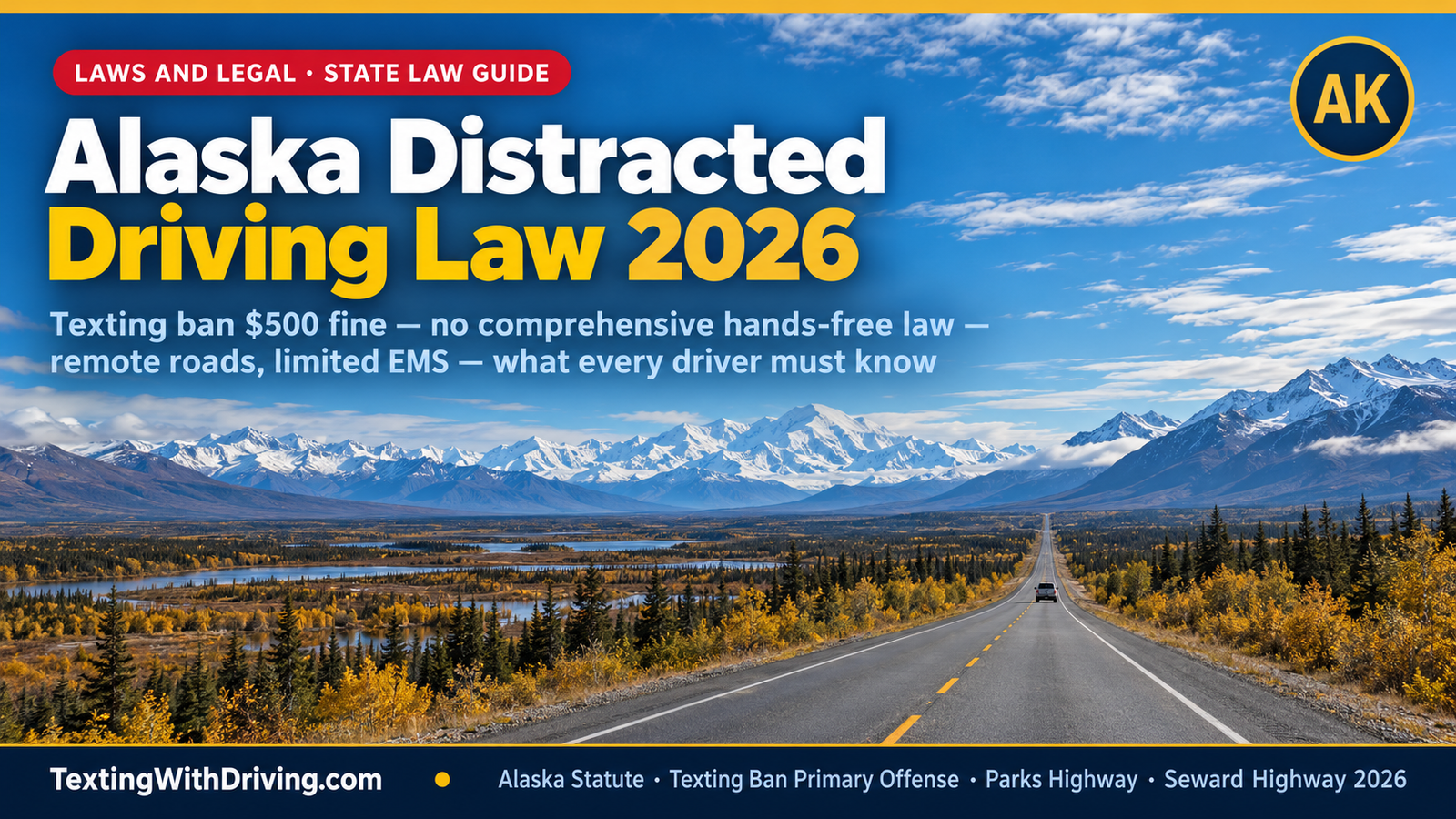
Alaska distracted driving law 2026 presents a specific and consequential gap in the United States’ progressive movement toward comprehensive hands-free driving laws: Alaska prohibits texting while driving with a $500 first-offense fine and primary enforcement authority, but Alaska does not have a comprehensive statewide hands-free ban that prohibits handheld phone calls and other handheld device use for adult drivers.
Alaska banned texting while driving in 2008 — one of the earlier states to do so, before Virginia, before many neighboring western states, and well before the national consensus around comprehensive prohibition. But Alaska has not taken the comprehensive step that 33-plus states have now taken — prohibiting all handheld device use, not just text messaging.
This legal gap creates a specific enforcement paradox in Alaska that is unlike any other state: a driver on the Parks Highway north of Anchorage who is composing a text message is committing a primary offense with a $500 fine and 2 DMV points. The same driver making a voice call while holding their phone is not violating state law — unless a local ordinance applies. And the driver looking up their next restaurant on a navigation app while holding their phone is also not violating state law.
The gap matters because Alaska’s geographic reality makes distracted driving more consequential than in almost any other state in the country. Alaska’s highways are remote, emergency medical services response times are extended, and the specific road conditions — moose crossings, black ice, avalanche zones, narrow mountain roads — require the maximum attentional capacity that phone use depletes.
This guide covers the complete Alaska distracted driving law 2026 picture: what the texting ban specifically prohibits, why the absence of a hands-free ban is a safety gap, the specific Alaska geography that makes distracted driving more dangerous, the local ordinances that go further than state law, and what every Alaska driver and visitor must know.
What Alaska’s Law Prohibits and Permits
Alaska distracted driving law 2026 begins with the texting ban — Alaska Statute governing electronic device use while driving, enacted 2008:
Prohibited: Texting while driving — composing, reading, or sending a text message, email, or any written communication while operating a motor vehicle in motion.
Fine: Up to $500 for a first offense — the highest texting-ban-only first offense fine of any state that has not enacted a comprehensive hands-free law. Alaska’s $500 first offense exceeds Virginia’s $125 hands-free law fine and is the fifth-highest first-offense distracted driving fine in the country.
Enforcement: Primary offense — an officer can stop a driver solely for observed texting. No concurrent violation is required.
DMV points: 2 demerit points added to the driving record.
What is NOT prohibited at the state level:
Holding and making a voice call while driving — legal under Alaska state law for adult drivers.
Using navigation apps while holding the phone — legal under Alaska state law for adult drivers.
Browsing the internet while holding the phone — arguably covered under some interpretations of Alaska’s texting ban but not clearly prohibited as handheld device use for non-text functions.
Exceptions to the texting ban:
Emergency communications — calling 911 or emergency services is permitted.
Hands-free texting — voice-to-text or Bluetooth text composition is not prohibited by Alaska law.
Commercial drivers: Alaska’s anti-texting ban historically has included exemptions for commercial drivers and allows for flip phones — an exception that the federal FMCSA rules governing commercial driver distracted driving supersede with stricter federal standards.
The commercial driver federal overlay: As documented in our FMCSA commercial driver distracted driving rules article, FMCSA regulations prohibit commercial drivers from holding and using a mobile phone with a maximum fine of $2,750 — regardless of what state law allows. Alaska commercial drivers are subject to the federal prohibition even though Alaska state law provides commercial driver exemptions.
The Law Gap: Why Alaska’s Texting-Only Ban Is Insufficient
Alaska distracted driving law 2026 has a specific inadequacy that the national behavioral research makes clear: the brain science of distracted driving does not distinguish between texting and phone calls in terms of cognitive impairment.
As documented in our distracted driving brain science 2026 article, Carnegie Mellon University’s research found that phone conversations — whether on a held phone or a hands-free device — reduce driving-related brain activity by 37 percent. The impairment is not in the physical act of holding the phone. It is in the cognitive demands of the phone conversation itself.
But the cognitive impairment from phone calls aside, the handheld use distinction still matters for the visual and manual components of distraction:
A driver who is looking at their phone for navigation purposes is creating visual distraction — eyes off the road — that the texting ban does not address.
A driver who is scrolling through a music playlist while holding their phone is creating manual distraction — hand off the wheel — that the texting ban does not address.
A driver who is looking at a map application on their phone while holding it at arm’s length is creating all three types of distraction (manual, visual, cognitive) simultaneously — and none of it is prohibited by Alaska’s texting ban as long as no text message is being sent or received.
The states that have enacted comprehensive hands-free laws — 33-plus as of GHSA’s June 2026 update — recognized this gap and closed it. Alaska’s texting-only ban is the same limitation that produced the behavioral data showing 26.5 percent increases in distraction events in Minnesota (another texting-only state) compared to Iowa’s 13.6 percent reduction after Iowa’s comprehensive hands-free law took effect, as documented in our Iowa distracted driving law 2026 article.
The enforcement challenge that Sitka Police Chief Sheldon Schmitt identified — that texting while driving is generally an add-on after an accident happened — reflects the fundamental limitation of texting bans: proving that a driver was texting rather than dialing, searching, or navigating requires the officer to identify the specific type of phone interaction, not just the fact of phone holding.
Alaska’s Geographic Reality: Why the Gap Matters More Here
Alaska distracted driving law 2026 gap is more consequential in Alaska than in most other states because Alaska’s road conditions make attentional availability more critically important than anywhere else in the country.
Extended emergency medical services response times. Alaska’s road network is sparse — approximately 14,000 miles of roads for a state covering 663,268 square miles. Large portions of Alaska are accessible only by small aircraft or boat, not road. In the road-connected portions of Alaska, emergency medical services response times in rural areas can be 30 to 60 minutes or longer — compared to 8-10 minutes in suburban settings. A distracted driver who causes a crash on the Parks Highway near Denali, 90 miles from Anchorage, is in a situation where the extended EMS response time means that the injury outcome from the crash is significantly worse than the same crash in an urban setting.
Moose crossings. Alaska has an estimated 200,000 moose — the highest moose population of any US state — and moose-vehicle collisions are among the most dangerous wildlife-vehicle crashes in North America. A moose standing in the road is harder to detect than a deer due to moose’s dark coloring, tall profile, and tendency to stand in the road rather than cross it quickly. A distracted driver who fails to detect a moose in their path at highway speed faces a collision with an animal weighing 800 to 1,200 pounds whose body mass is at windshield height — producing catastrophically severe crash injuries. The attentional vigilance that moose-vehicle crash avoidance requires is the same attentional capacity that phone use depletes.
Ice and snow conditions. Alaska’s road conditions for a substantial portion of the year — black ice, packed snow, frost heaves, and the specific traction limitations of northern highway driving — require active speed management, increased following distance, and the continuous road surface assessment that attentive driving provides. A distracted driver who fails to detect an icy patch developing on the Parks Highway in October or the Seward Highway in November has zero reaction time for the traction change that requires an immediate, specific driving response.
Avalanche zones. The Seward Highway between Anchorage and Seward passes through documented avalanche zones where debris can fall without warning. The Glenn Highway through the Matanuska-Susitna Valley passes through mountain corridors with similar hazards. A distracted driver in an avalanche zone is the specific worst case for the failure-to-detect-hazard mechanism.
Narrow two-lane roads with no shoulder. Many Alaska state highways are narrow two-lane roads with minimal or no paved shoulder — the Kenai Peninsula roads, the Richardson Highway portions, and countless state and borough roads outside the Anchorage bowl. Lane departure from distracted driving on these roads places the vehicle immediately in oncoming traffic or off the paved surface into gravel, brush, or ditch. The road geometry makes distracted driving’s lane-departure consequence immediate rather than recoverable.
Anchorage’s Specific Context
Alaska distracted driving law 2026 in Anchorage — home to approximately 300,000 of Alaska’s 730,000 residents — creates the urban distracted driving environment that exists alongside the state’s remote road challenges.
Anchorage’s road network includes the Glenn Highway connecting downtown Anchorage to the Matanuska-Susitna Borough to the north, the Seward Highway running south toward the Kenai Peninsula, the New Seward Highway connecting to South Anchorage and Girdwood, and the urban arterial network of Northern Lights Boulevard, Tudor Road, and the Dimond district’s commercial corridors.
Anchorage’s urban driving environment — with its signalized intersections, commercial strip development, and the specific mixed-use pedestrian environment of downtown Anchorage and Midtown — produces the same phone-in-hand crash patterns as any continental US urban arterial. The difference is that Anchorage’s signalized intersections are surrounded by a road network that transitions immediately to highway speeds and wilderness proximity — the Seward Highway between Anchorage and Potter Marsh passes through an urban wildlife corridor where both moose and beluga whales are visible from the road.
The Anchorage Traffic Talks program documented in the Alaska Highway Safety Annual Report 2025 represents the state’s community-level enforcement and education approach to distracted driving in the state’s primary urban center.
Sitka and Local Ordinances: Going Further Than State Law
Alaska distracted driving law 2026 has a specific local ordinance dimension: the City of Sitka enacted its own distracted driving ordinance in April 2016 that goes significantly further than Alaska state law.
The Sitka Assembly passed a law that would fine those using their phone while driving — banning texting, talking, watching videos, and using GPS while driving. Exceptions are made for hands-free use. The Sitka ordinance covers the full handheld device use prohibition that Alaska state law does not address — the same comprehensive standard that 33-plus states have now enacted statewide.
Sitka’s ordinance creates a specific compliance context: a driver in Sitka who is making a voice call while holding their phone is violating Sitka’s local ordinance even though they are not violating Alaska state law. The same driver who leaves Sitka and drives on state or federal roads becomes subject only to the texting-ban state standard.
The Sitka Police Chief’s enforcement observation — that the ordinance fine is $25 and enforcement relies primarily on warning citations — reflects the challenge of local ordinance enforcement in a small community where social relationships create the informal deterrent pressure that citation-based enforcement supplements.
What Fairbanks and Interior Alaska Drivers Face
Alaska distracted driving law 2026 on the Parks Highway — the 362-mile corridor connecting Anchorage to Fairbanks through Wasilla, Talkeetna, and Denali — creates the specific long-distance distracted driving context that Alaska’s geography uniquely produces.
The Parks Highway north of Wasilla transitions quickly from the Matanuska-Susitna urban fringe into the boreal forest and wetland corridor where moose crossings are frequent, wildlife observation is compelling, and the specific phone-checking impulse of long-distance highway driving reaches its peak. A driver north of Willow on the Parks Highway who looks at their phone to check the time is checking their phone on a road where a moose standing in the travel lane 300 feet ahead is a realistic hazard.
Fairbanks itself — Alaska’s second-largest city — has its own urban distracted driving context on Airport Way, College Road, and the Johansen Expressway. The Fairbanks North Star Borough’s road network transitions rapidly from urban arterials to the rural Alaska Highway connecting Fairbanks to Delta Junction and the Canadian border.
The Road to Comprehensive Law: Legislative History
Alaska distracted driving law 2026 has a legislative history of bills introduced but not enacted to create a comprehensive hands-free ban. The Alaska Legislature has considered comprehensive hands-free legislation in multiple sessions — including HB 257 from the 26th Legislature that proposed banning all phone use while driving — but Alaska has not enacted a comprehensive law.
The arguments against comprehensive legislation that have prevailed in the Alaska Legislature reflect several Alaska-specific concerns: the vast rural areas where cellular coverage is nonexistent anyway, the commercial and industrial workforce that uses mobile communications for safety and operational coordination, and the philosophical preference for less regulatory intervention that characterizes Alaska’s political culture in multiple policy domains.
The evidence from states that have enacted comprehensive laws — Iowa’s 13.6 percent screen-tapping reduction, South Carolina’s 13,814 six-month citations, Ohio’s 18,000 fewer crashes over two years — is the data context that future Alaska legislative sessions will need to address. When behavioral change data from multiple states consistently shows that comprehensive hands-free laws reduce distracted driving behavior in ways that texting bans alone do not achieve, the legislative argument for Alaska’s texting-only standard becomes increasingly difficult to sustain.
What Every Alaska Driver Must Know
Alaska distracted driving law 2026 creates specific compliance obligations for every driver on Alaska’s roads — resident, visitor, and through-traveler on the Alaska Highway.
Texting while driving is a $500 primary offense. Alaska’s texting ban is primary enforcement — an officer who observes a driver texting can stop them without any concurrent violation. The $500 first offense is among the highest texting ban fines in the United States.
Handheld calling is not prohibited by state law — but is still dangerous. The absence of a comprehensive hands-free ban does not mean that holding your phone while driving in Alaska is safe. The cognitive impairment, the moose-detection demand, the ice-management requirement, and the extended EMS response times all make Alaska’s roads the specific environment where hands-free compliance is most important even when not legally required.
If you are in Sitka, the local ordinance prohibits all handheld use. Sitka’s local ordinance goes beyond state law and prohibits handheld calling, GPS use, and video use while driving — with a $25 fine. Drivers in Sitka must comply with the local ordinance’s comprehensive standard.
Commercial drivers are subject to FMCSA’s $2,750 maximum fine. Alaska state law’s commercial driver exemptions do not override federal FMCSA regulations. Commercial drivers on Alaska’s highways operate under the federal handheld device prohibition regardless of what Alaska state law provides.
The remote road context makes hands-free the only sensible standard. Every driver on the Parks Highway, the Seward Highway, the Glenn Highway, or any other Alaska road outside Anchorage’s urban core is operating in an environment where moose crossings, icy roads, avalanche zones, and extended EMS response times make the attentional cost of phone use more immediately lethal than in any comparable continental US driving environment. Use hands-free. Not because Alaska’s law requires it. Because Alaska’s roads demand it.
For the complete national law comparison showing Alaska within the 50-state framework, our distracted driving laws all 50 states 2026 covers every jurisdiction. For the Iowa behavioral change data that demonstrates what comprehensive hands-free laws achieve compared to texting-only bans, our Iowa distracted driving law 2026 article covers the year-one results. For the FMCSA commercial driver rules that supersede Alaska’s commercial driver exemptions, our FMCSA commercial driver distracted driving rules article covers the federal framework. And for the technology setup that makes Alaska compliance and safety automatic on every Alaska highway regardless of the legal standard, our hands-free while driving complete setup guide covers iPhone, Android, Bluetooth, and CarPlay.
Sources Used in This Article
All links verified working before publication.
GHSA: Distracted Driving State Laws June 2026 — Alaska listed separately from comprehensive hands-free states, all but six states primary enforcement, June 2026 update
GetJerry: Texting and Driving in Alaska — Alaska texting ban $500 fine primary offense 2 demerit points, hands-free texting not prohibited, no special ban for teenage drivers, enforcement challenge, Alaska one of 48 states banning texting while driving
Juneau Empire: Sitka Assembly Approves Ban on Texting While Driving — Sitka Assembly April 2016 local ordinance banning texting talking videos GPS while driving, hands-free exception, $25 fines, police chief enforcement add-on after accident, state law only prohibits texting
Alaska Public Media: Sitka Drivers Told Hands Off Your Cell Phone — Alaska banned texting 2008, Sitka ordinance broader than state law, Police Chief Schmitt texting add-on after accident quote, commercial driver exemptions Alaska state law, hands-free Bluetooth not prohibited state law
Alaska Legislature HB 257: Distracted Driving Legislation History — Alaska District 25 Anchorage bill proposing comprehensive phone ban, maximum fine $300, current law prohibits certain use, study cell phone as dangerous as drunk driving
WV Code § 17C-14-15 for comparison context — Neighboring state comparison
NHTSA: Distracted Driving — 3,208 deaths 2024, national context
TextingWithDriving.com is professionally built and maintained to ensure accurate, accessible safety information reaches every driver who needs it. Website development and ongoing support is handled by Budgetic, a digital agency specializing in purpose-driven WordPress websites.
