

High School Programs That Are Actually Reducing Teen Distracted Driving

High School Programs That Are Actually Reducing Teen Distracted Driving
The statistics on teen distracted driving are alarming and we have covered them in detail across this site. Distraction is involved in 58 percent of teen crashes. Teen drivers aged 16 to 24 have the highest rates of handheld phone manipulation while driving of any age group. Motor vehicle crashes remain the leading cause of death for American teenagers.
But here is what is equally true and far less often discussed: the numbers are improving. Nationally, distracted driving dropped 8.6 percent in 2024, the second consecutive year of improvement according to Cambridge Mobile Telematics data. States with comprehensive hands-free laws saw even steeper reductions. And at the school and community level, a set of programs are producing measurable results that the research literature is starting to document with real evidence.
This article covers the high school programs that are actually working, what the research says makes them effective, and how parents and educators can connect with them.
Why School-Based Programs Are a Critical Piece of the Puzzle
Before looking at specific programs, it is worth understanding why school-based intervention is necessary alongside legislation and parental influence rather than instead of it.
Three core themes emerged from a comprehensive integrative review of teen distracted driving research published in Frontiers in Public Health: hazard awareness, hazard mitigation, and attention maintenance are the primary skills needed to prevent distracted driving; engaging a parent or adult as a partner in the intervention process from classroom to car contributed to the effectiveness of the intervention; and leveraging technology in training enhanced the effectiveness of the intervention. Geotab
School-based programs address the hazard awareness and hazard mitigation components in a structured, peer-influenced environment that neither legislation nor family conversation alone can replicate. A law tells a teen driver what is illegal. A parent conversation tells a teen driver what is expected. A well-designed school program shows a teen driver, viscerally and memorably, what the consequences look like and gives them practiced skills for managing risk.
The research consistently shows that programs combining all three elements produce the strongest outcomes. The programs profiled below have all adopted this integrated approach in different ways.
1. B.R.A.K.E.S.: The Program With the Most Rigorous Evidence
B.R.A.K.E.S., which stands for Be Responsible and Keep Everyone Safe, is a non-profit teen driving education program that operates across the United States, providing hands-on advanced driver training to teens and their parents at no cost.
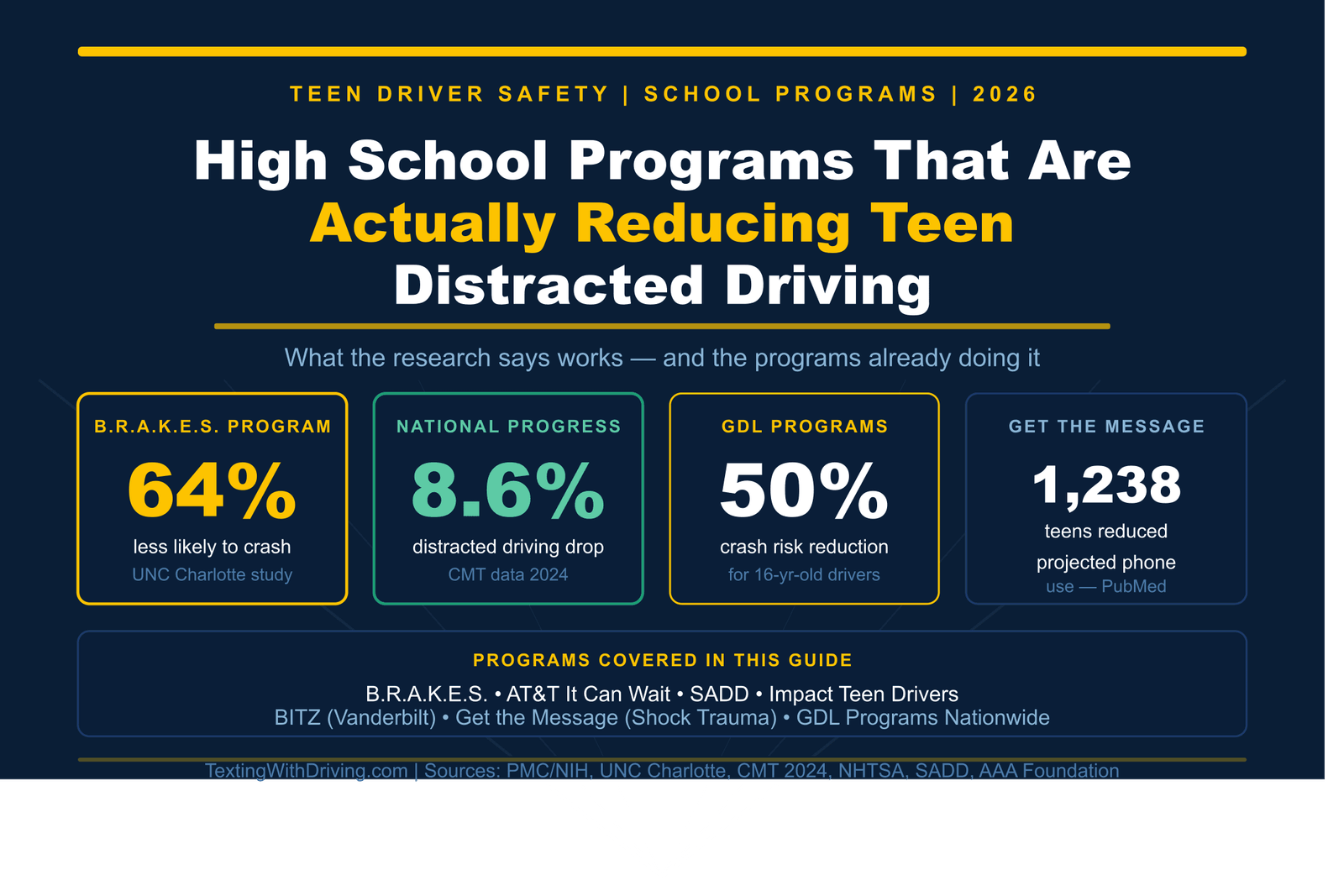
Unlike standard driver’s education, B.R.A.K.E.S. offers a curriculum focused on high-risk scenarios young drivers are likely to face. Teens and their parents receive instruction in collision avoidance, emergency braking, drop-off recovery, distracted driving awareness, and vehicle control on slick or icy surfaces. Most importantly, according to an independent study conducted by researchers at the University of North Carolina at Charlotte, B.R.A.K.E.S. graduates are 64 percent less likely to be involved in a crash within their first three years of driving. SearchAtlas
A 64 percent reduction in crash likelihood over the first three years of driving is the most significant evidence-based outcome measure of any program reviewed in this article. It comes from an independent study, not the program’s own self-reporting.
What makes B.R.A.K.E.S. different from classroom-only programs is the physical practice component. Teens actually practice emergency braking, learn vehicle dynamics at the edge of control, and experience what it feels like to respond to a sudden hazard. These are skill-building experiences that no presentation, video, or lecture can replicate. And they include a specific distracted driving awareness module that connects the physical experience of handling a vehicle in an emergency to the cognitive reality of what five seconds of phone distraction does to crash response capability.
The program is offered at no cost to teen drivers and their parents. More information and event listings are available at brakesProgram.org.
2. Be In The Zone (BITZ): Hospital-School Collaboration in Tennessee
Be In The Zone, known as BITZ, is a peer-to-peer teen driver safety program run through Monroe Carell Jr. Children’s Hospital at Vanderbilt University in Nashville, Tennessee.
Be In The Zone is geared toward high schools in the region and aims to reduce the growing problem of teen driver crashes. The program encourages peer-to-peer education on safe driving initiatives with an emphasis on distracted driving. These students are determined to make an impact through various awareness campaigns and hands-on learning at their schools to help change behavior among young drivers and make a difference in their communities. According to Tennessee Department of Safety and Homeland Security data from 2023, drivers ages 16 to 24 have the highest percentage of driving-distracted crash rates, and motor vehicle crashes remain the leading preventable cause of death for teens aged 15 to 19. Nine schools signed up to participate in the 2025 program, which receives funding from a Nissan Neighbors grant. Cmtelematics
The hospital-school collaboration model is one of the features that makes BITZ distinctive. A trauma center staff member joins with high school students to deliver presentations that show the real consequences of distracted driving crashes, not hypothetically but through the direct testimony of medical professionals who treat those crash victims. The emotional impact of hearing from someone who works in the emergency department responding to teen distracted driving crashes is qualitatively different from watching a statistics presentation.
A BITZ participant and current emergency medicine physician described the impact of the program: when they saw the true consequences and the realness of what happens, it changed everything. BITZ was impactful even then. The program employs peer education as its delivery mechanism, training high school students to become advocates at their own schools rather than having adults deliver the message. Cmtelematics
The peer-delivery component is deliberate and research-backed. Teen drivers are more receptive to safety messaging when it comes from other teens who share their social context than when it comes from adults who are perceived as having an authority agenda.
3. Impact Teen Drivers: Engage, Educate, Empower
Impact Teen Drivers is a California-based nonprofit that brings evidence-based programming into high schools nationwide with an explicit focus on distracted and reckless driving.
Impact Teen Drivers’ programs are high-energy and interactive and share real stories that connect with teens, empowering them with evidence-based strategies to keep themselves and others safe. The organization delivers statistics and facts about reckless and distracted driving in a creative and effective manner. Through an engage, educate, and empower approach, the program encourages teens to take the lead in peer-to-peer messaging in their schools and communities. The evidence-based teen programs include What Do You Consider Lethal? at 60 minutes and Are We Living in a Dream World? Federal Motor Carrier Safety Administration
The What Do You Consider Lethal program title is itself a research-informed choice. It challenges the assumption that most teens hold: that they are already aware of which driving behaviors are dangerous. The program reveals that teens consistently underestimate the danger of specific distracted behaviors that feel ordinary and low-risk in the moment.
Impact Teen Drivers makes its school program resources, including pledge campaigns and peer leadership materials, available through their website at impactteendrivers.org. Schools can request programs directly through the site.
4. SADD: Students Against Destructive Decisions
SADD, which began as Students Against Drunk Driving in 1981 and has since broadened to Students Against Destructive Decisions, operates peer chapters in thousands of high schools across the country and has been a consistent presence in teen distracted driving prevention.
Liberty Mutual and SADD research found that teens felt pressure to stay connected or always on contributed to their need to engage with cell phones even while driving. 48 percent of teens reported texting more when alone in their car, 55 percent reported texting while driving to update parents, 37 percent reported texting to coordinate or confirm event details with friends, and 34 percent reported taking their eye off the road when receiving an app notification. LuccaAM
SADD’s contribution to distracted driving prevention is not just programmatic but research-driven. The Liberty Mutual and SADD data quoted above is among the most frequently cited research on the specific social dynamics that drive teen phone use while driving. Understanding that 55 percent of teens who text while driving are doing it to update their parents is the kind of finding that changes how parents frame the conversation and how school programs address the behavior.
SADD’s peer chapter model means that the prevention message is delivered by students to students, and sustained throughout the school year rather than through a single assembly. The social norm influence operates continuously within the peer environment rather than as a one-time event. Chapter information and resources are available at sadd.org.
5. AT&T It Can Wait: The Pledge Model at National Scale
AT&T’s It Can Wait campaign is the largest corporate-backed distracted driving awareness initiative in the country, and its school-facing component has reached millions of students since the campaign’s launch in 2013.
The pledge model at the center of It Can Wait asks students to publicly commit to never driving distracted. The research basis for pledge campaigns in behavior change is mixed, with pledges producing stronger outcomes when they are social and visible rather than private. AT&T’s implementation incorporates classroom discussions, documentary-style video testimonials from crash survivors and victims’ families, and school challenge programs where institutions compete for recognition based on pledge participation rates.
The It Can Wait campaign from AT&T invites people to take the pledge to never drive distracted and to join the movement to help make an impact. Resources are available to help raise awareness and put an end to distracted driving in the community. Governor’s Traffic Safety Committee
The school toolkit includes classroom presentations, discussion guides, and social media sharing tools that extend the reach of an assembly beyond a single session. For schools that want to run their own campaign, resources are available through AT&T’s corporate social responsibility page at about.att.com/csr/itcanwait.
The effectiveness of pledge campaigns alone is debated in the research literature. The strongest evidence suggests that pledge programs produce better outcomes when paired with specific behavioral skill-building, such as the pre-drive phone placement habit, rather than relying on the pledge commitment alone to change in-the-moment behavior.
6. Get the Message: Hospital-Based Trauma Education
The Get the Message program, based at the R Adams Cowley Shock Trauma Center in Maryland, represents one of the most rigorously documented school-based distracted driving interventions in published research.
Get the Message: A Teenage Distracted Driving Program was established at the R Adams Cowley Shock Trauma Center to identify, define, and measure the factors that contribute to distracted driving in teens. A convenience sample of 1,238 teenagers in the study represented all 50 states, the District of Columbia, Puerto Rico, Canada, and 21 other countries. The program employs a slide presentation, hospital tour, video, and survivor testimony to influence teen driving behaviors and increase knowledge. Based on postsurvey results, the reduction in projected phone use while driving in this teen population indicates the effectiveness of this hospital-based teen distracted driving program. Insurify
What makes Get the Message particularly notable is its publication in a peer-reviewed medical journal, giving it a level of research rigor that most school programs do not achieve. The reduction in projected phone use post-program was measurable and documented across a sample of over 1,200 teens from across the country.
The hospital tour component, where participants see the trauma unit where distracted driving crash victims are treated, consistently appears in research as one of the most impactful elements of hospital-based programs. It converts statistical information into visceral reality in a way that no classroom presentation can fully replicate.
7. Graduated Driver Licensing: The Systemic Solution
No discussion of high school programs reducing teen distracted driving is complete without addressing Graduated Driver Licensing, which is not a school program but is the policy framework that schools operate within and that produces the strongest documented outcomes of any single intervention.
Graduated Driver Licensing systems, adopted in all 50 states and DC, gradually phase in full driving privileges. Studies show these programs reduce crash risk by up to 50 percent by limiting exposure to high-risk situations until drivers gain more experience. SearchAtlas
GDL programs restrict teen drivers from the highest-risk driving situations during the period of greatest vulnerability: nighttime driving, multiple teen passengers, highway driving without supervision. These restrictions are not a substitute for distracted driving education, but they reduce the number of high-risk driving events during which a phone distraction is most likely to be catastrophic.
Newly licensed teens are more likely to speed when driving their own vehicle compared with the family car, highlighting a potential benefit of delaying giving teens their first personal vehicle. Parents are essential to reducing risks by modeling safe driving, setting firm limits on distractions and passengers, enforcing seat belt use, and establishing curfews. A parent-teen driving agreement before handing over the keys is a very valuable tool for setting proper expectations. SearchAtlas
Schools that integrate GDL rules into their curriculum, helping teens understand what restrictions exist and why, produce students who are better equipped to navigate the graduated licensing period safely.
What the Research Says About What Makes Programs Work
The integrative review of teen distracted driving interventions found that while study designs were heterogeneous, three themes consistently emerged across effective programs: hazard awareness training, hazard mitigation skill building, and attention maintenance practice are the core necessary competencies. Programs that engaged a parent or adult as a partner, rather than targeting the teen alone, were consistently more effective. And programs that leveraged technology in training, such as driving simulators, telematics feedback, or in-vehicle monitoring, enhanced outcomes compared to classroom-only approaches. Geotab
Research reveals that 7 in 10 teens admit to using or taking long glances at their phones while driving, often for about 20 percent of their total drive time. Entertainment including music and social media accounts for 65 percent of teen phone use while driving. Texting comes in at 40 percent, and navigation or map use at 30 percent. Perhaps most ironic, 55 percent of teens who text while driving say they are doing it to update their parents. AgencyAnalytics
That last finding — that more than half of teen phone use while driving is to update their parents — is one of the most actionable pieces of information any school program can incorporate. Teaching teens to set up auto-reply messaging through iPhone Driving Focus or Android driving mode specifically for the drive-home-to-update-parents scenario addresses the exact behavioral trigger that is driving the majority of their phone use.
The setup guide for these features is in our dedicated article on how to set up Do Not Disturb While Driving on iPhone and Android. It is the kind of specific, practical tool that complements school awareness programs by giving teens something concrete to do in the moment of temptation.
The National Progress Number: Reason for Cautious Optimism
According to Cambridge Mobile Telematics, distracted driving dropped 8.6 percent in 2024, the second consecutive year of improvement. States that implemented hands-free laws in 2023, including Ohio, Alabama, Michigan, and Missouri, saw an average 11.8 percent decrease in distracted driving since their laws began. Michigan leads with an 18.7 percent reduction since its law took effect. The reduction is attributed to increased enrollment in usage-based insurance programs, expanded hands-free laws, greater public awareness, and school and community programs. Tech Trendz
8.6 percent nationally. 11.8 percent average in states with new hands-free laws. 18.7 percent in Michigan specifically. These are not transformative numbers, but they represent genuine, measurable movement in the right direction. Programs, laws, technology, and parent conversations are working together to produce an outcome that none of them could produce alone.
For schools and administrators looking to bring structured distracted driving prevention into their curriculum, the programs in this article represent the most evidence-supported options available in 2026. All of them have mechanisms for school partnerships, most offer free resources, and several actively recruit school chapters or student ambassadors.
For parents who want to reinforce school-based programming at home with the specific conversations and pre-drive habits that research supports, our parent’s guide to talking to your teen about phone use while driving covers exactly what to say and how to say it.
For the full context of why teen distracted driving is such a persistent and serious problem, our article on why teen drivers are the most at-risk group for distracted driving covers all of the underlying statistics and risk factors. And for the national death toll data that makes these programs necessary, the distracted driving statistics 2026 overview has the complete picture.
Sources Used in This Article
All links verified working before publication.
PMC: An Integrative Review on Teen Distracted Driving for Model Program Development — Frontiers in Public Health, 2019, reviewed for current relevance
PubMed: Get the Message — A Teen Distracted Driving Program — R Adams Cowley Shock Trauma Center, peer-reviewed
Vanderbilt Health News: Be In The Zone Program Shows Students Distracted Driving Can Take Many Forms — October 2025
KESQ: How Parents Programs and Automakers Are Working Together to Keep Teen Drivers Safe — B.R.A.K.E.S. UNC Charlotte study, October 2025
Impact Teen Drivers: High School Programs — Program details and school resources
SADD: Students Against Destructive Decisions — Chapter information and resources
AT&T It Can Wait: Campaign and School Resources — Pledge and school toolkit
Liberty Mutual and SADD: The Risk of Distracted Driving — Teen behavior survey data
Personal Injury San Diego: Teen Driving Safety Guide 2026 — Cambridge Mobile Telematics 8.6 percent drop data, January 2026
Kidslox: Teen Distracted Driving Protection — 7 in 10 teens phone use while driving data, December 2025
Safe Teen Driving Resources — National program directory including DriveitHOME and NOYS
NHTSA: Teen Driving Resources for Parents — Federal guidance
AAA Foundation: Distracted Driving Among Newly Licensed Teen Drivers — 58 percent distraction in crashes finding
GHSA: Distracted Driving State Laws — Legislative context
TextingWithDriving.com is professionally built and maintained to ensure accurate, accessible safety information reaches every driver who needs it. Website development and ongoing support is handled by Budgetic, a digital agency specializing in purpose-driven WordPress websites.

About Texting With Driving
TextingWithDriving.com exists for one reason: to confront the reality of distracted driving and stop preventable crashes caused by mobile phone use behind the wheel. Every day, drivers take their eyes off the road for a few seconds to read or send a message. Those few seconds are enough to cause life-altering consequences. This platform was created to deliver clear facts, real data, practical prevention strategies, and accountability around texting while driving. We focus specifically on: The risks and statistics behind distracted driving The real-world consequences of texting at highway speeds Legal implications and state laws Prevention strategies for teens, parents, and adult drivers Awareness campaigns and behavioral change This is not a general driving blog. It is a focused awareness initiative built around one critical issue: phone distraction behind the wheel. Our content is direct, research-driven, and practical. We prioritize accuracy over opinion and education over sensationalism. The goal is simple — reduce distracted driving incidents by increasing awareness and responsibility. If one article causes one driver to put their phone down, the mission is working. For inquiries or partnerships, contact: privacy@textingwithdriving.com
View all posts by Texting With Driving