

The Textalyzer: The Device That Could Prove You Were Texting When You Crashed

The Textalyzer: The Device That Could Prove You Were Texting When You Crashed
When a drunk driver causes a crash, law enforcement has a tool that can establish impairment at the scene in minutes. The breathalyzer has been a cornerstone of drunk driving enforcement for decades. It is fast, objective, and legally defensible. And it changed the entire accountability landscape around impaired driving.
Distracted driving has no equivalent. An officer who arrives at a crash scene today has almost no practical way to determine whether a driver was texting before impact. They can ask the driver. They can ask witnesses. They can request phone records, which takes weeks and requires a subpoena. But in the immediate aftermath of a crash, the question of whether a phone was in use at the moment of impact largely goes unanswered unless someone admits it.
That is the problem the Textalyzer was designed to solve.
What the Textalyzer Is
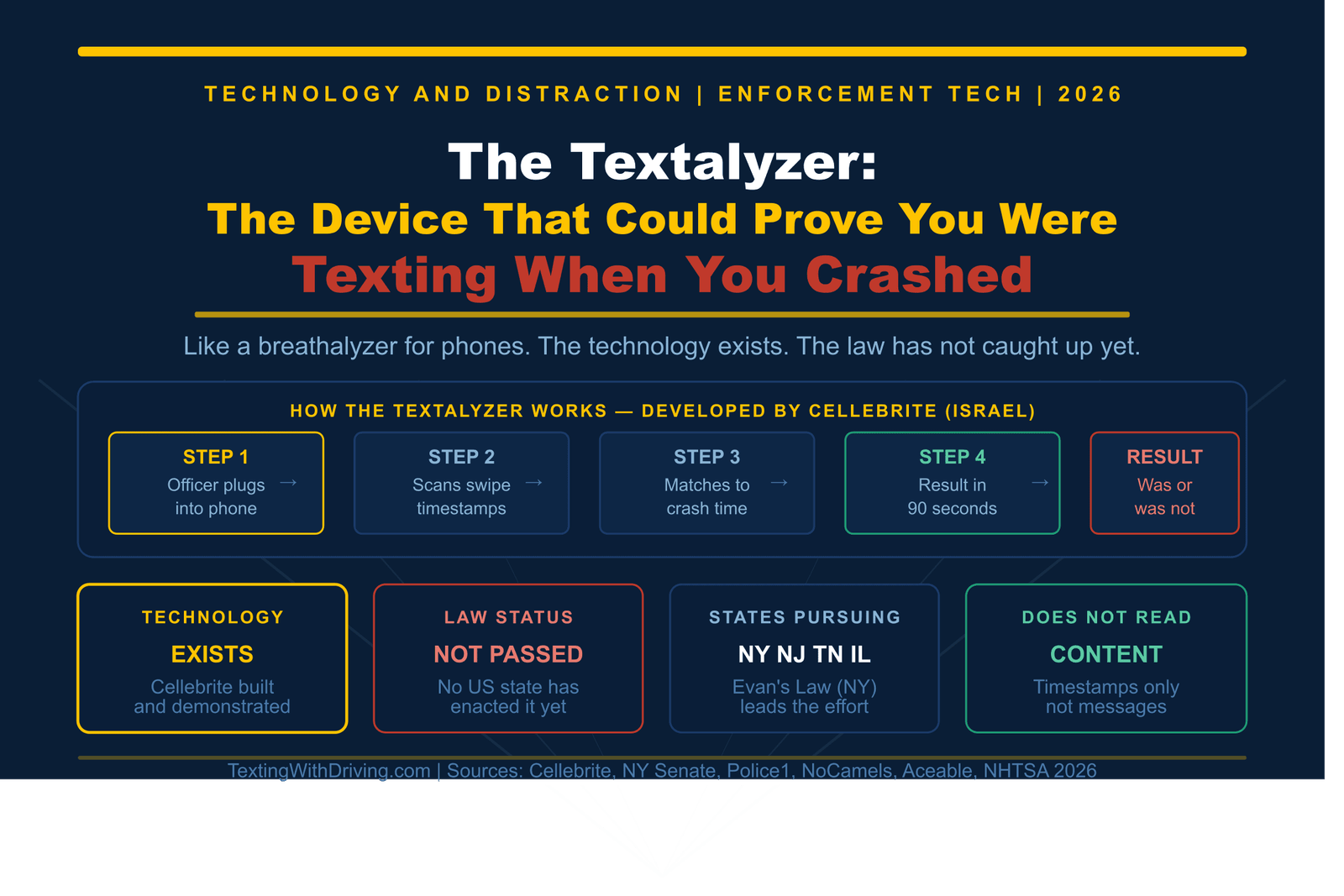
The Textalyzer is a roadside device developed by Cellebrite, an Israeli digital intelligence company that is already widely used by law enforcement agencies in the United States for mobile forensics work. The device connects to a driver’s smartphone at a crash scene and, within approximately 90 seconds, produces a report showing whether the phone’s screen was active, whether swipe or tap interactions occurred, and when those interactions took place.
The Textalyzer reveals to law enforcement time-stamps of the driver’s swiping or typing on his mobile device, without storing or retrieving personal content. The Textalyzer does not reveal the content or application used by the driver, only the timestamp of when the driver was swiping or typing. The Textalyzer technology can also distinguish between legal hands-free use of the mobile device through Bluetooth technology. Insurify
That last capability is significant. The device is not simply detecting whether a phone was on or whether it received a notification. It is detecting active manual interaction with the screen: taps, swipes, and typing. And it can distinguish between a driver who was physically touching their screen and one who was using the phone through a Bluetooth system, the latter of which is legal in most states.
The analogy to the breathalyzer is deliberate. A breathalyzer does not tell a police officer what the driver was drinking, who bought it for them, or what conversations they had while drinking. It provides one specific piece of information: blood alcohol concentration at the time of the test. The Textalyzer works on the same principle of targeted measurement that answers one specific question: was this phone being physically operated at the time of the crash.
The Story Behind the Technology: Evan Lieberman
Like so many distracted driving initiatives, the Textalyzer legislative push began with a specific loss.
The legislation will be referred to as Evan’s Law, named after Evan Lieberman, a 19-year-old who was killed in a car crash in 2011. He had died after an accident due to distracted driving. His father and the tech company Cellebrite have teamed up to present the textalyzer system to New York lawmakers. Governor’s Traffic Safety Committee
Ben Lieberman, Evan’s father, became one of the most persistent advocates for Textalyzer legislation in the years following his son’s death. His central grievance was not simply that his son died. It was that after the crash, there was no reliable way to establish whether phone use had been a factor, even though Lieberman believed it was.
The Textalyzer, named after the blood alcohol breath testing tool the breathalyzer, is manufactured by Cellebrite in Israel. It analyzes the mobile device to determine its recent usage. SearchAtlas
Ben Lieberman’s partnership with Cellebrite produced a proof of concept that was demonstrated before New York state lawmakers multiple times beginning in 2016. The demonstration showed officers connecting the device to a phone and receiving a timestamp report in under two minutes. For lawmakers who had seen the breathalyzer’s impact on drunk driving accountability, the parallel was compelling.
How the Technology Works in Detail
The technical operation of the Textalyzer is worth understanding in some detail, partly because the privacy debate around it depends heavily on what the device does and does not access.
The textalyzer technology could be brought to market within six to nine months of a distracted driver law passing, Cellebrite CEO James Grady told lawmakers. While ensuring privacy, a textalyzer device would give officers the ability to determine within 90 seconds if a smartphone’s applications had been used, but without revealing or reporting on any of the material content. Mattiacci Law
The device plugs into the phone’s charging port or connects via a proprietary interface. Its software queries the phone’s activity log, which records the timestamps of screen interactions at the operating system level. This log is separate from the content of messages, calls, photos, or app data. The Textalyzer reads only the interaction log, produces a timestamp report, and does not store or transmit any content from the device.
New York legislators considering the bill stated that it would determine cell phone usage without an inquiry into the content. The legislation also specifies that the field test would allow officers to make a time-stamped report on which apps the driver had open and if the driver was using devices hands-free or hands-on around the time of the accident. Federal Motor Carrier Safety Administration
The hands-free versus hands-on distinction is what gives the Textalyzer its legal and evidentiary value specifically. Under hands-free laws, legal use of a phone through a mounted system or Bluetooth does not generate the same type of manual interaction timestamps as typing or swiping on a held screen. The Textalyzer can theoretically separate legal hands-free activity from illegal manual engagement, which is the specific distinction that matters in distracted driving enforcement.
Where the Law Stands in 2026: No State Has Passed It Yet
Here is the honest status report as of mid-2026: the Textalyzer technology exists and has been demonstrated. No US state has passed legislation authorizing its use.
Lawmakers in several US states are considering legislation to allow law enforcement officers to connect a textalyzer to a mobile phone to instantly learn if the driver was texting prior to a crash. States including New Jersey and Tennessee are studying the textalyzer with an eye toward legislation. The legislation is similar in scope to laws that require drivers to submit to a breathalyzer. Not handing over your mobile device could be grounds for citation or another punitive action. Baderlaw
New York has been the leading state in this legislative push, with multiple versions of Evan’s Law introduced in both the Assembly and Senate over several legislative sessions.
State Senator Shelley Mayer and Assemblymember Amy Paulin are sponsors of legislation which establishes a pilot program for the Textalyzer to be used by law enforcement in Westchester County to detect illegal swiping or typing on mobile devices in the event of a motor vehicle crash. Senator Mayer stated that distracted driving due to cell phone use is an epidemic in New York State and that the Textalyzer is a respectful and efficient way to fix the broken system and achieve the right balance between public safety and privacy. Federal Motor Carrier Safety Administration
A pilot program in Westchester County would have been a more limited test than a statewide law, but even that proposal has not advanced to enactment as of mid-2026. The same pattern has played out in New Jersey, Tennessee, and Illinois, where proposals have been introduced and discussed without reaching passage.
Under the proposed New York law, motorists who refuse to surrender their phones to police after the accident could face up to a $500 fine, immediate license suspension, and a one-year license revocation. Zutobi
The implied consent framework, where refusal to submit to the test carries its own penalties as refusing a breathalyzer does in most states, is the legal model that Evan’s Law advocates have proposed. The structure mirrors drunk driving law deliberately: consent to testing is a condition of driving on public roads, and refusal triggers administrative consequences regardless of guilt.
The Privacy Debate: Why the Law Has Not Passed
The primary obstacle to Textalyzer legislation is not opposition to the goal of catching distracted drivers. It is concern about Fourth Amendment implications and the scope of what law enforcement access to a phone, even a limited one, creates.
Some opponents to this software cite privacy and civil rights concerns in using this technology. SearchAtlas
The Fourth Amendment protects Americans against unreasonable searches and seizures. A breathalyzer test is constitutionally permissible under implied consent law because it measures one physical attribute, blood alcohol content, that exists transiently and can only be captured in the moment. Courts have upheld breathalyzer requirements on these grounds for decades.
A phone search, even a limited one, raises different questions. The Fourth Amendment case Riley v. California, decided by the Supreme Court in 2014, established that police generally need a warrant to search a cell phone’s content, even after a lawful arrest. The Textalyzer’s advocates argue that the device does not access content, only interaction timestamps, and therefore does not constitute a search of the phone’s content. Critics counter that the activity log of which apps were active and when interactions occurred is itself a form of content that may reveal private information beyond simply whether the driver was swiping.
There is also the practical enforcement question of accuracy. If a passenger was using their phone in the front seat, the officer cannot determine whose interaction created the timestamps being measured. If the phone was dropped during a crash and interacted with the screen accidentally, those interactions would appear in the log. These ambiguities would create evidentiary challenges in any prosecution relying on Textalyzer results.
Road safety experts including the NHTSA point out that police are able to determine the role of distracted driving using other tools including cell phone records, eyewitness accounts, and even data from the vehicles involved in an incident, among other investigative techniques. SearchAtlas
NHTSA’s position is that existing investigative tools, including subpoenaed phone records, witness statements, and increasingly sophisticated vehicle data systems, can establish phone use in crashes through existing legal frameworks. The Textalyzer’s advocates counter that those tools require weeks to months and are often unavailable in the immediate post-crash window when establishing facts quickly matters most.
What Already Exists: Current Evidence Methods Without the Textalyzer
Understanding what law enforcement can already do to establish phone use helps put the Textalyzer debate in context.
As we covered in our article on whether you can be sued for texting while driving, attorneys in civil cases can subpoena carrier records showing the exact timestamp of every text sent or received. These records are available to investigators and attorneys and have been the primary evidence tool in distracted driving civil cases for years. The limitation is time: obtaining a subpoena and receiving records from a carrier takes weeks, not 90 seconds at the scene.
In criminal cases, law enforcement can obtain a warrant to access phone data after the fact. The Riley v. California ruling requires this warrant, but it does not prohibit phone data from being used as evidence when properly obtained. The evidence exists. It is the speed and immediacy of access that the Textalyzer would change.
Increasingly sophisticated vehicle event data recorders, colloquially known as black boxes, record vehicle speed, braking patterns, steering inputs, and in some vehicles, phone connectivity status. This data can establish that the driver’s phone was actively connected and transmitting at the time of a crash. As vehicle technology has advanced, this evidence has become more detailed and more widely available.
The Textalyzer would add immediate at-scene evidence to the toolkit of post-crash investigation tools that already exist. Its primary value is not replacing those tools but providing something they currently cannot: a result within the same timeframe as a breathalyzer test, before evidence degrades, witnesses disperse, or facts are disputed.
Why This Technology Matters for Distracted Driving Accountability
Currently, law enforcement has no practical means of determining whether distracted driving due to mobile device use contributed to a motor vehicle crash. Michigan Auto Law
That single sentence captures the accountability gap that the Textalyzer is designed to close. Every year, thousands of Americans die in crashes where phone use may have been a contributing factor and where that factor goes undocumented because no tool exists to establish it at the scene.
The behavioral research we covered in our article on the psychology of phone addiction and distracted driving consistently shows that perceived risk of being caught matters more than awareness of danger in changing driver behavior. Drunk driving accountability improved dramatically not when the public became more aware of its dangers, but when detection became reliable, swift, and certain.
If the Textalyzer achieved legislation in any state, the deterrent effect would extend beyond the individual crash scene. Drivers who know that a device can detect phone use at the scene of any crash, in the same way they know a breathalyzer can detect alcohol, would carry a different risk calculation about texting while driving than drivers who know that unless a witness saw them, the evidence question is unanswerable at the scene.
That deterrent effect is precisely what the Textalyzer’s legislative advocates have been arguing since Evan Lieberman’s father first brought the technology to lawmakers’ attention years ago.
What Comes Next in 2026 and Beyond
As of mid-2026, the legislative path for the Textalyzer remains blocked primarily by privacy and Fourth Amendment concerns that the courts have not yet definitively resolved in this specific context.
The most likely path forward involves one of two developments. A state legislature could pass a sufficiently narrow version of Evan’s Law with strong privacy protections, such as requiring a warrant for Textalyzer use or limiting its application to crashes with injuries, and that law could survive an inevitable constitutional challenge. If the law is upheld, other states would likely follow, as has happened with every major distracted driving legislation trend from texting bans to handheld bans.
Alternatively, the Supreme Court could address the specific constitutional question of whether accessing a phone’s interaction timestamps without accessing content constitutes a Fourth Amendment search. A ruling clarifying this distinction would either open the door to Textalyzer legislation or definitively close it.
What is clear from the research on distracted driving accountability is that the current situation is not working at the scale required. As of 2026, 30 states plus DC enforce hands-free cell phone laws for driving restrictions. The most recent additions include Iowa, South Carolina, Louisiana, and Pennsylvania in 2025. Legislative progress on phone restrictions is real. But the enforcement gap, the inability to establish phone use at a crash scene without weeks of investigation, remains one of the most significant structural weaknesses in distracted driving law. NAHB
Whether the Textalyzer specifically is the solution, or whether some combination of existing investigative tools, vehicle data systems, and carrier cooperation can close the gap without it, the accountability problem it was designed to address is real, documented, and growing.
For the complete picture of how civil and criminal liability currently works for distracted driving crashes under existing law, see our article on whether you can be sued for texting while driving. For the full national death toll that makes this enforcement gap so consequential, our distracted driving statistics 2026 overview covers everything in one place. And for what the law currently requires in every state regardless of enforcement technology, the hands-free driving laws by state 2026 guide covers all 50 states.
Sources Used in This Article
All links verified working before publication.
NY Senate: Senator Mayer and Distracted Driving Prevention Advocates Host Textalyzer Round Table — New York State Senate official press release
Police1: Textalyzer NY Distracted Driving Law Advances — Law enforcement publication coverage
NoCamels: Cellebrite Driving Texting Law Enforcement US — Cellebrite technology detail
Price Benowitz: Pending Distracted Driving Legislation Textalyzer — Legislative detail including penalty for refusal
National Law Review: Textalyzer May Become New Tool in Detecting Distracted Driver Accidents — Privacy analysis and how it works
Ontario Trucking Association: The Textalyzer Next Distracted Driving Police Tool — Multi-state legislative overview
Aceable: Distracted Driving Laws by State — Textalyzer privacy debate summary
GHSA: Distracted Driving State Laws — National legislative landscape October 2025
Road Law Guide: Distracted Driving Laws 2026 — Current state law status February 2026
NHTSA: Distracted Driving — National data and existing enforcement tools
TextingWithDriving.com is professionally built and maintained to ensure accurate, accessible safety information reaches every driver who needs it. Website development and ongoing support is handled by Budgetic, a digital agency specializing in purpose-driven WordPress websites.

About Texting With Driving
TextingWithDriving.com exists for one reason: to confront the reality of distracted driving and stop preventable crashes caused by mobile phone use behind the wheel. Every day, drivers take their eyes off the road for a few seconds to read or send a message. Those few seconds are enough to cause life-altering consequences. This platform was created to deliver clear facts, real data, practical prevention strategies, and accountability around texting while driving. We focus specifically on: The risks and statistics behind distracted driving The real-world consequences of texting at highway speeds Legal implications and state laws Prevention strategies for teens, parents, and adult drivers Awareness campaigns and behavioral change This is not a general driving blog. It is a focused awareness initiative built around one critical issue: phone distraction behind the wheel. Our content is direct, research-driven, and practical. We prioritize accuracy over opinion and education over sensationalism. The goal is simple — reduce distracted driving incidents by increasing awareness and responsibility. If one article causes one driver to put their phone down, the mission is working. For inquiries or partnerships, contact: privacy@textingwithdriving.com
View all posts by Texting With Driving