

Motorcycle and Distracted Driving: Why Riders Face a Higher Risk From Other Drivers

Motorcycle and Distracted Driving: Why Riders Face a Higher Risk From Other Drivers
The motorcycle rider has been riding for twenty years. They wear full protective gear. They follow every traffic law. They ride within the speed limit and give every intersection their full attention.
And then a driver three lanes over looks at their phone for five seconds.
The specific vulnerability of motorcyclists to distracted driving is unlike the vulnerability of any other road user category. Pedestrians are at risk because they are unprotected in a collision. Cyclists are at risk because of their smaller profile. But motorcyclists face a unique combination of factors that makes a distracted driver’s inattention event categorically more dangerous for them than for almost anyone else on the road.
They cannot be seen easily. When they are seen and a collision happens, they have no protective cage. And when an emergency response is required of them to avoid a distracted driver’s error, their vehicle is less stable under sudden braking and swerving than any passenger car.
This article covers what the crash data shows about motorcyclists and distracted driving, why the vulnerability profile is what it is, and what riders can do to manage a risk that originates entirely from other drivers’ choices.
The Numbers: Motorcycle Fatalities in Context
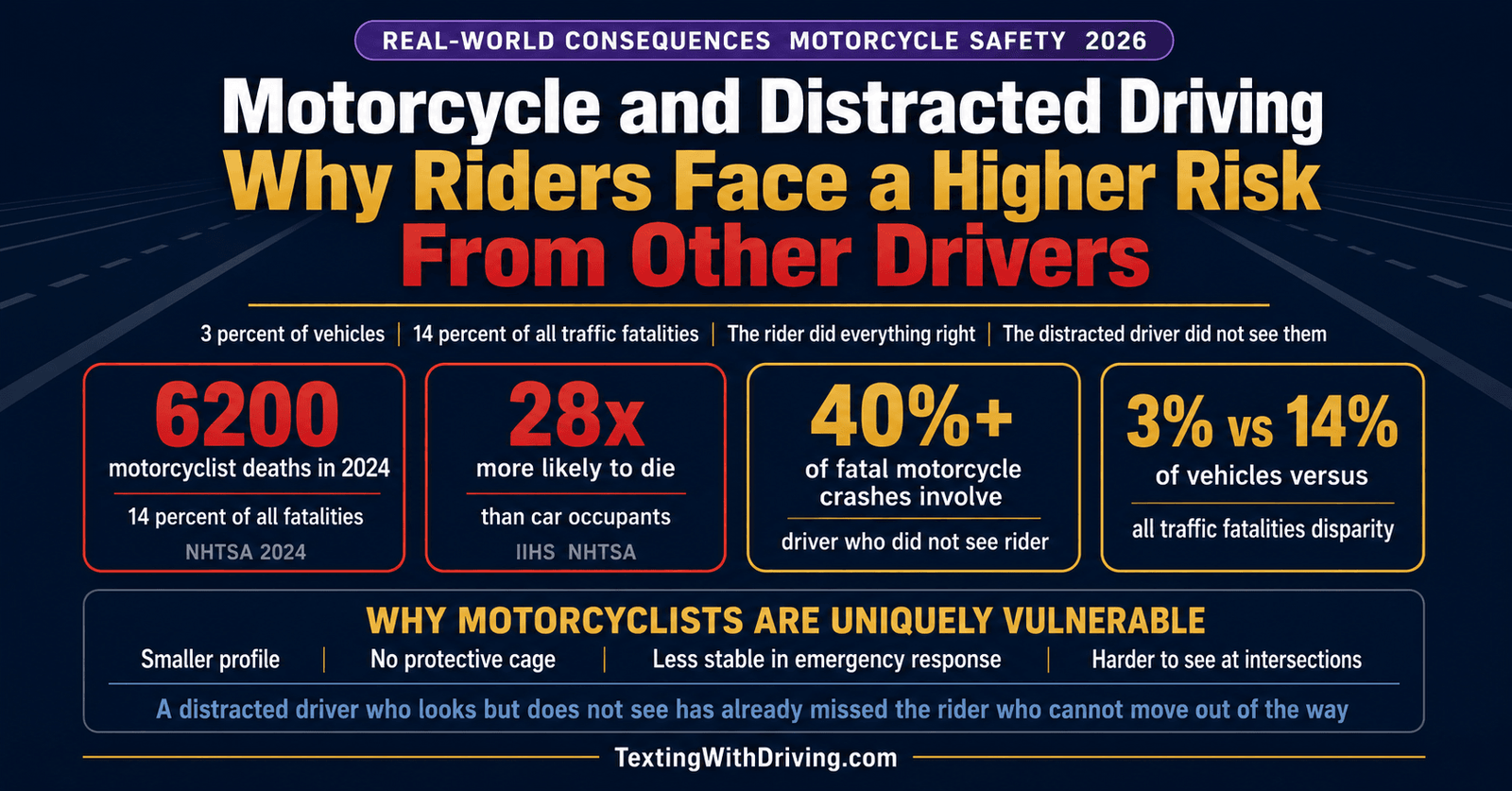
According to NHTSA, approximately 6,200 motorcycle fatalities occurred in the United States in 2024, a slight decrease from the record high of around 6,500 in 2022. While motorcycles make up only 3 percent of registered vehicles, they account for roughly 14 percent of all traffic fatalities annually. This means riders are significantly more likely to be killed or seriously injured in crashes compared to passenger vehicle occupants. Kargo
3 percent of vehicles. 14 percent of all traffic fatalities. That ratio describes a level of disproportionate crash mortality that no other vehicle category in American road use comes close to matching.
Motorcycle riders are 28 times more likely to die in a fatal crash compared to individuals in passenger cars, and they are also four times more likely to sustain an injury in an accident. NHTSA
28 times more likely to die. The source of that multiplier is not reckless riding behavior alone, though that is a factor in a portion of motorcycle deaths. It is the fundamental physics of motorcycle crashes. When a motorcycle is involved in a collision with a passenger vehicle, the rider has no protective structure between their body and the point of impact. No crumple zone. No airbag. No steel cage. The human body absorbs the collision directly, and the outcomes reflect that physical reality.
The 6,200 deaths in 2024 represent a slight improvement from the pandemic-period peak, but they remain near historic highs driven by increased motorcycle ownership, distracted driving among motorists, and the growing size of passenger vehicles that motorcyclists must share roads with.
The Distracted Driver Connection: The Most Significant External Factor
Driver inattention is one of the most common contributing factors behind fatal motorcycle accidents, with over 40 percent of fatal crashes involving another driver who did not see the motorcyclist. Kargo
Over 40 percent of fatal motorcycle crashes involve a driver who did not see the rider. Not a driver who made a wrong tactical decision after seeing the rider. A driver who failed to perceive the rider’s presence at all.
This is the distracted driving connection at its most direct. A driver who is looking at their phone for five seconds at 55 miles per hour covers a full football field without any visual input from the road environment. If a motorcycle is within that visual field during those five seconds, the rider is effectively invisible to the driver. Not obscured. Not blocked. Simply not processed as a hazard requiring response because the driver’s visual processing system is suppressed by the competing cognitive demand of the phone interaction.
As we documented in our article on how distracted driving affects your brain, this visual processing suppression is not a metaphor. It is a measurable neurological event documented in fMRI and EEG research. Brain activity associated with visual processing is actively suppressed when drivers are cognitively distracted, even when eyes remain nominally pointed at the road. A driver who looks directly at a motorcycle during a cognitive distraction event may not register the motorcycle as a hazard at all.
Distracted driving can cause motorcycle accidents in many ways, as a person can hit a nearby motorcyclist if they take their eyes off the road or their minds off driving for any reason. Anyone on or near a road is at risk, but the risk of injury or death for motorcyclists in a traffic crash is substantially higher. Motorcycles make up just three percent of all vehicles, yet riders account for 14 percent of all crash fatalities. Tennessee Traffic Safety Resource Service
Why Motorcyclists Are Specifically Vulnerable
Understanding the specific physical and perceptual reasons why motorcyclists are more vulnerable to distracted driver events than other road users explains why the distraction problem is not symmetric. A distracted driver who fails to perceive a pedestrian creates one level of danger. The same distraction event with a motorcycle in the field of view creates a different risk profile.
The visibility problem. Motorcycles have a significantly smaller visual profile than passenger cars. From the front or rear, a motorcycle presents a narrow silhouette that is easily lost in the visual clutter of a roadway environment, particularly at intersections where multiple visual stimuli compete for a driver’s attention. A distracted driver who is returning their gaze to the road after a phone interaction is scanning for large objects moving in expected patterns. A motorcycle, narrow and sometimes traveling at a different speed than surrounding traffic, may not register in that rapid environmental scan.
The visibility problem is compounded by the size of modern passenger vehicles. As we noted in our article on distracted driving and pedestrian safety, SUVs and pickup trucks account for more than half of new vehicle sales in the United States. The hood height of a large SUV creates a sight line problem at intersections that makes a motorcycle approaching from a cross street even harder for the SUV driver to detect during even a brief period of inattention.
The protective cage absence. When a distracted driver fails to perceive a passenger car and a collision occurs, both vehicles have crumple zones, airbags, and structural cages designed to absorb collision energy and protect occupants. When a distracted driver fails to perceive a motorcycle and a collision occurs, the rider has none of these protections. The rider’s body is the absorption mechanism for all collision energy that their gear cannot dissipate.
According to IIHS, motorcyclists face an increased risk of injury or death for several reasons: the impact of any crash hits them directly, with no protection from a car frame encasing them. Motorcycles do not have the stability or maneuverability of cars when they must brake or swerve quickly to avoid obstacles. Tennessee Traffic Safety Resource Service
The emergency response limitation. When a distracted driver suddenly perceives a motorcycle in their path and makes an emergency maneuver, the motorcycle rider must simultaneously respond. But a motorcycle’s emergency response capability is inherently more limited than a passenger car’s in specific scenarios. Sudden hard braking on a motorcycle, particularly in a curve or on an uneven road surface, creates instability that hard braking in a four-wheeled vehicle does not. A rider who must swerve suddenly to avoid a car that has moved into their lane is managing both the swerve itself and the vehicle’s reduced stability during that swerve simultaneously.
The chain of events that a distracted driver’s inattention creates for a motorcyclist is therefore more severe than for most other road users. The driver’s visual processing failure may not be recognized until the distance is too close for the rider to avoid the collision entirely, and the response options available to the rider to minimize the collision’s severity are more limited than those available to a driver of a four-wheeled vehicle in the same scenario.
Intersection Crashes: The Most Common Lethal Scenario
The collision scenario that most frequently produces motorcycle fatalities from other-driver inattention is the intersection left-turn crash.
A motorcycle traveling through an intersection on a green light. A vehicle approaching from the opposite direction waiting to make a left turn. The turning vehicle driver looks for oncoming traffic, fails to perceive the motorcycle, and begins the turn. The motorcycle is directly in the turning vehicle’s path.
This crash type, sometimes called a SMIDSY crash after the common driver statement “Sorry Mate, I Didn’t See You,” is the most common fatal motorcycle crash type involving another vehicle in US data. And it is precisely the crash type that distracted driving makes more likely, because it requires the turning driver to perceive a relatively narrow approaching object (the motorcycle) at the precise moment when their attention is most fragmented, particularly if they have just looked away from their phone and are re-orienting to the intersection environment.
The principal arterials that we identified in our article on distracted driving on highways versus city streets as the most dangerous road type for distracted driving crashes are also the road type where the left-turn motorcycle crash scenario is most common. Multiple lanes of traffic, high intersection density, and a large proportion of turning movements at signalized intersections create the conditions for this collision type at maximum frequency.
The Right-of-Way Violation Pattern
Beyond left-turn crashes, the broader pattern of right-of-way violations by passenger vehicle drivers is a significant source of motorcycle crash risk from distracted drivers.
A driver who is distracted approaching a stop sign may roll through it without fully stopping, failing to perceive a motorcycle that has the right of way on the intersecting road. A driver who is looking at their phone before merging onto a highway may not check the lane they are merging into, where a motorcycle traveling at highway speed is present. A driver who drifts across a lane boundary because of cognitive distraction may move into the lane where a motorcycle is traveling in the adjacent lane.
Each of these scenarios involves a driver error that produces a motorcycle crash in which the rider made no unsafe choice. The rider was operating correctly, in the correct lane, at the correct speed, following all applicable laws. The crash occurs entirely because another driver’s attention was elsewhere.
This is the dimension of motorcycle safety that makes distracted driving uniquely personal for the riding community. The risk is not primarily about their own riding behavior. It is about the behavior of every other driver they share the road with on every ride.
What Riders Can Do to Manage a Risk They Did Not Create
While the risk from distracted drivers originates with those drivers’ choices and not with riders’ behavior, experienced riders and motorcycle safety organizations have developed defensive riding strategies that reduce exposure to the crash scenarios distracted drivers create.
Ride as if invisible. The foundational principle of defensive motorcycle riding is to operate under the assumption that other drivers cannot see you. This means not relying on having been seen before acting on traffic rights. Approach every intersection expecting that turning vehicles may not have perceived you. Position in the lane to maximize your visibility from all directions. Cover the brake before approaching any intersection or merge point where a right-of-way violation could create a crash scenario.
Use high-visibility gear and lighting. Upgrade to LED headlights and taillights, wear reflective gear, and reduce speed. Visibility is the key factor in preventing nighttime fatalities. High-visibility riding gear, auxiliary lights, and modulating headlights all increase the probability that a momentarily inattentive driver will register the motorcycle in their environment even during a brief inattention event. Gear cannot guarantee being seen, but it shifts the probability toward being perceived. Kargo
Position for escape routes. In urban arterial traffic, experienced riders position within their lane to maintain escape route options in all directions. Lane position on the left or right of the lane rather than the center provides space to maneuver if a vehicle begins to drift or turn unexpectedly. Following distance on highway sections provides the response time buffer that the rider cannot create for themselves if they are riding too close to the vehicle ahead.
Recognize the high-risk moments. The left-turn crash scenario at intersections, the merge right-of-way scenario on highway on-ramps, and the multi-lane lane-change scenario on arterials are the three highest-risk interaction types with potentially distracted passenger vehicle drivers. Reducing speed and increasing attention at every instance of these scenarios, regardless of traffic conditions that appear safe, addresses the specific scenarios where driver inattention most often produces motorcycle crashes.
Understand the legal landscape. As we have documented throughout this series, 33 states plus DC now have primary enforcement hands-free laws that prohibit any driver from holding a phone while operating a vehicle. A driver who collides with a motorcycle while holding their phone in any of these states has committed a primary traffic offense that is directly documentable as a contributing factor in the crash. For the complete state-by-state legal picture, our hands-free driving laws by state 2026 guide covers all 50 states.
The Advocacy Dimension: Why Motorcycle Riders Are Natural Distracted Driving Advocates
The motorcycle riding community has a specific and powerful reason to advocate for stronger distracted driving enforcement that goes beyond general road safety advocacy. Every primary enforcement hands-free law that passes in a state where riders live reduces the probability of every ride ending with a SMIDSY crash.
The relationship is direct: primary enforcement hands-free laws produce measurable reductions in distracted driving. Ohio documented 15,400 fewer total crashes in year one of its law. Michigan showed 18.7 percent reduction in phone distraction. The behavioral change that laws produce is the same behavioral change that makes every intersection a motorcycle passes through slightly less likely to include a distracted driver who does not perceive the approaching rider.
Motorcycle safety organizations including the Motorcycle Safety Foundation, AMA (American Motorcyclist Association), and state rider advocacy groups have increasingly aligned their advocacy with distracted driving legislative efforts precisely because the statistical connection between reduced driver distraction and reduced motorcycle fatalities is direct and well-documented.
For riders in states that still lack comprehensive hands-free laws, including Texas, Florida, Montana, and others we covered in our hands-free driving laws by state 2026 guide, the advocacy equation is particularly urgent. The same drivers sharing the road with them can legally hold their phones while driving in those states, and the data from states that have changed their laws shows clearly what the alternative produces.
The Right Answer Is Not Just for Riders
The fundamental solution to the motorcycle distraction problem is not riding with more visibility gear, though that helps. It is not defensive riding techniques, though those help too. It is the behavioral change in passenger vehicle drivers that prevents the inattention event from occurring in the first place.
The driver who puts their phone in the back seat before every drive, who activates their driving mode before the engine starts, who never picks up their device at a red light is a driver who will not generate the SMIDSY scenario. They will see the motorcycle at the intersection because their visual processing system is not suppressed by a competing cognitive demand. They will not drift into the motorcycle’s lane because their attention is on the driving environment. They will not roll through the stop sign because they are actually watching the road.
That driver — phone in back seat, driving mode active, full attention on the road — is the only driver that every motorcycle rider on every road can afford to share the road with.
For the national data context that frames all of this, our distracted driving statistics 2026 overview covers the full crash landscape. For the neurological explanation of why distracted drivers literally do not see motorcycles they are looking at, our article on how distracted driving affects your brain covers the visual processing suppression mechanism in detail. And for the behavioral and technology tools that make phone-free driving automatic, our Do Not Disturb while driving setup guide covers both iPhone and Android from scratch.
Sources Used in This Article
All links verified working before publication.
EagleLights: How Many Motorcycle Deaths Per Year 2025 US Statistics — 6,200 deaths 2024, 3% vehicles 14% fatalities, driver inattention 40%+, October 2025
Oshan and Associates: Motorcycle Accident Statistics 2024 — 28 times more likely to die, 14% all traffic fatalities, 17% occupant fatalities
Ben Crump Law: How Does Distracted Driving Cause Motorcycle Accidents — IIHS risk factors, protective cage absence, emergency response limitation
NHTSA CrashStats: Distracted Driving in 2024 — DOT HS 813 790, motorcyclists included in occupant fatality category
NHTSA: Distracted Driving — 3,208 total distracted driving deaths 2024
NSC Injury Facts: Distracted Driving — 2024 distracted driving data context
IIHS: Motorcycles Research Area — Crash type analysis and vulnerability factors
Motorcycle Safety Foundation: Risk Awareness — Defensive riding strategies
GHSA: Distracted Driving State Laws — Legislative context for rider advocacy
TextingWithDriving.com is professionally built and maintained to ensure accurate, accessible safety information reaches every driver who needs it. Website development and ongoing support is handled by Budgetic, a digital agency specializing in purpose-driven WordPress websites.

About Texting With Driving
TextingWithDriving.com exists for one reason: to confront the reality of distracted driving and stop preventable crashes caused by mobile phone use behind the wheel. Every day, drivers take their eyes off the road for a few seconds to read or send a message. Those few seconds are enough to cause life-altering consequences. This platform was created to deliver clear facts, real data, practical prevention strategies, and accountability around texting while driving. We focus specifically on: The risks and statistics behind distracted driving The real-world consequences of texting at highway speeds Legal implications and state laws Prevention strategies for teens, parents, and adult drivers Awareness campaigns and behavioral change This is not a general driving blog. It is a focused awareness initiative built around one critical issue: phone distraction behind the wheel. Our content is direct, research-driven, and practical. We prioritize accuracy over opinion and education over sensationalism. The goal is simple — reduce distracted driving incidents by increasing awareness and responsibility. If one article causes one driver to put their phone down, the mission is working. For inquiries or partnerships, contact: privacy@textingwithdriving.com
View all posts by Texting With Driving